
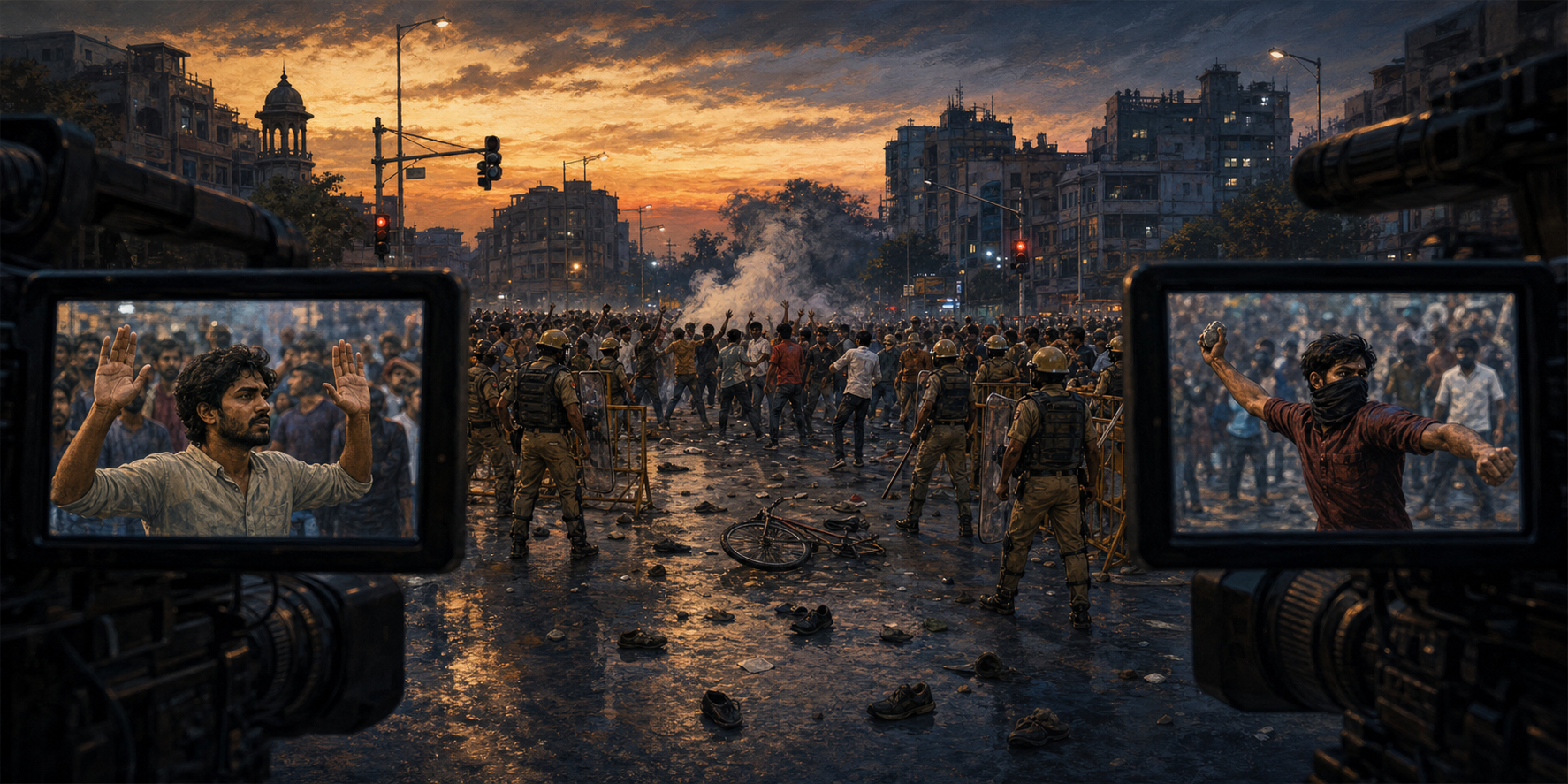
You see a short video of a confrontation. One headline calls it a peaceful march met with police force; another calls it mob violence that compelled a police response. If you share either version immediately, you may be outsourcing your judgement to its verbs.
You do not need to become a forensic investigator before discussing public disorder. You do need a repeatable way to separate verified conduct, disputed chronology, legal status and editorial framing. That discipline is especially important when you suspect Hindu victims, police personnel or inconvenient facts are being pushed out of view.
Build the factual and legal timeline before choosing a side
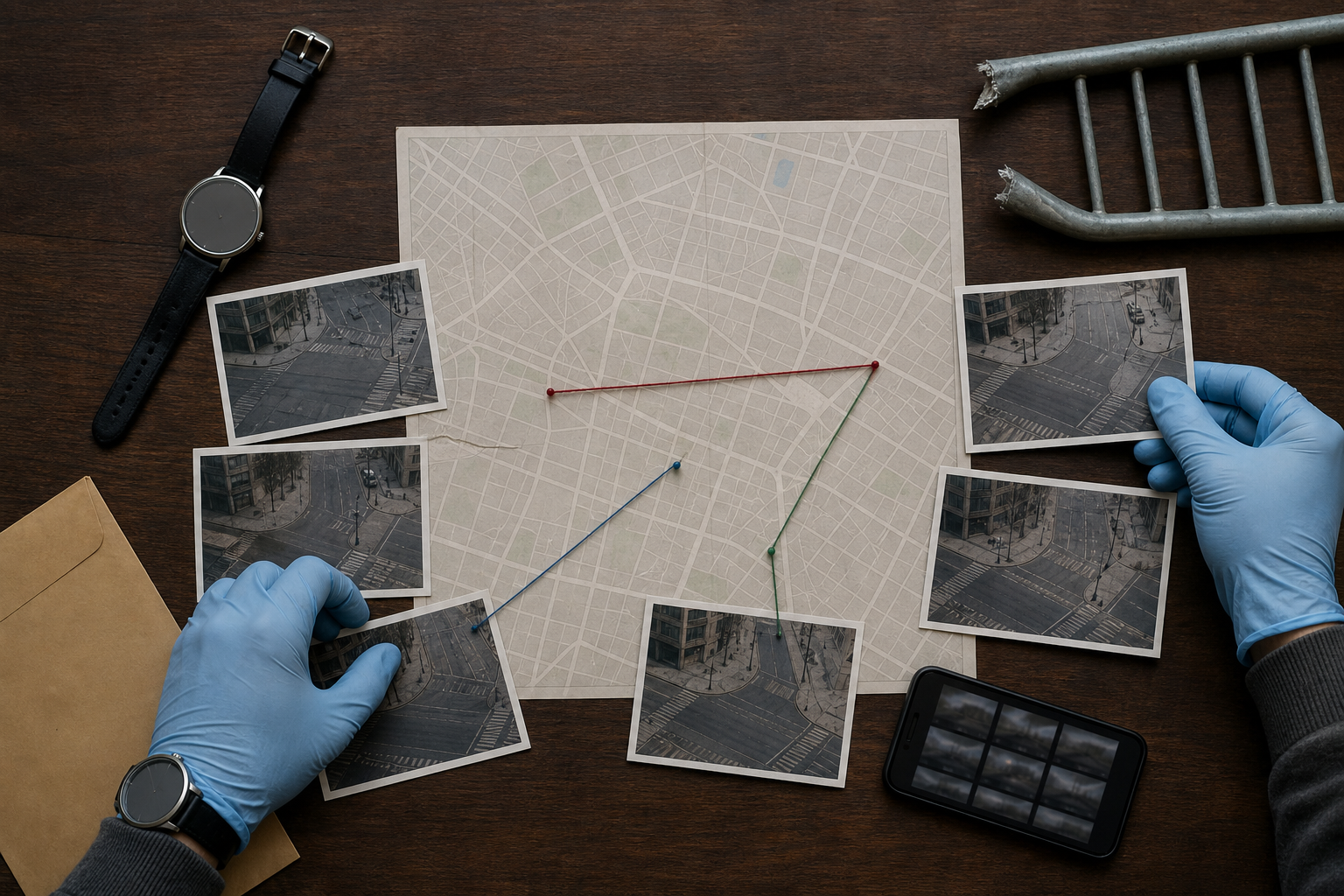
Political reporting often compresses several different kinds of claims into one narrative. Separate them before you decide what happened:
- Visible conduct: A recording appears to show a person throwing an object, striking someone or damaging a vehicle. It does not automatically identify the person, establish the location or reveal what happened outside the clip.
- An allegation: A witness, political organisation, police agency or participant says something happened. An allegation can be important without yet being proven.
- An accusation or charge: Authorities formally associate a person with an offence. This is more specific than a rumour, but it is not a conviction.
- A judicial finding: A court reaches a decision after a legal process. Report the level and status of that decision accurately; do not imply that possible appellate questions have already been resolved.
A July 2026 Delhi court decision illustrates why these distinctions matter. Additional Sessions Judge Praveen Singh convicted former Aam Aadmi Party councillor Tahir Hussain and four others in the murder of Intelligence Bureau employee Ankit Sharma. Hussain was convicted of murder, kidnapping, rioting with deadly weapons, unlawful assembly and promoting enmity between groups. Once that verdict existed, continuing to describe him only as an accused would conceal a material change in legal status.
The reverse rule matters too. A report published before a verdict was right to distinguish accusation from conviction. A later conviction does not retroactively permit anyone to state that guilt had already been judicially established years earlier. To evaluate old coverage fairly, compare its wording with what was known on its publication date. Then check whether subsequent coverage clearly recorded the verdict.
Use a two-date audit whenever a case develops over years. Write down the publication date and the date of the event, charge, judgement or other development being described. If those dates are blurred, the framing may be borrowing certainty from the future or withholding certainty that has since become available.
Keep individual guilt separate from collective identity. A conviction can establish the responsibility of named defendants within the scope of that case. It does not establish the guilt of a religion, neighbourhood, political movement or every person present during a disturbance. Refusing collective guilt is not softness; it is factual precision.
Read every loaded verb as an unproved evidence label
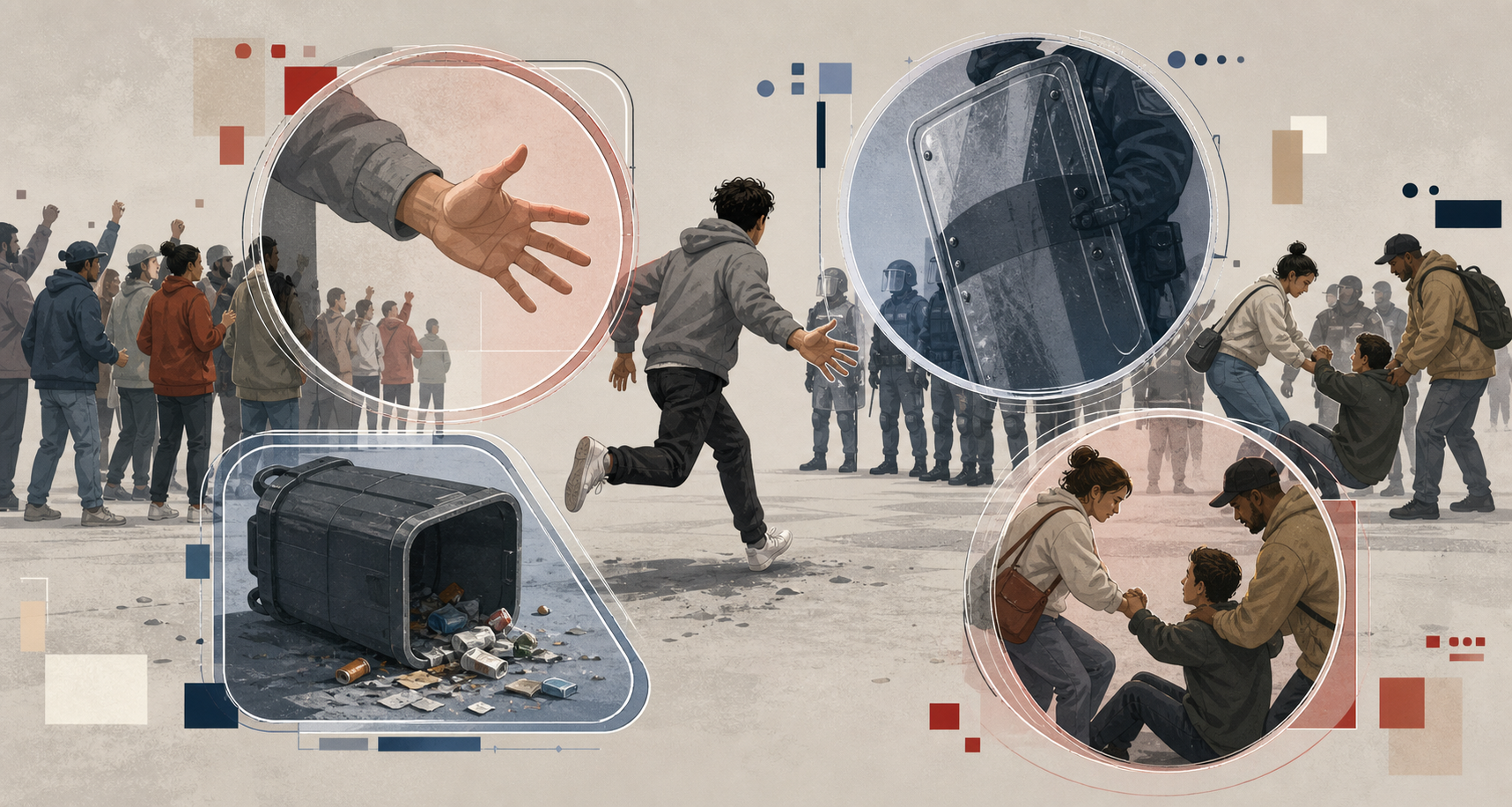
A headline can mislead without making a plainly false statement. It can select a broad noun, hide the actor, shrink the relevant time window or use a verb that quietly supplies motive and causation.
- Protest identifies a public purpose. It does not tell you whether every participant remained peaceful throughout the event.
- Riot may describe serious collective disorder, but a report should still identify the conduct and actors supporting that label.
- Clashes can imply reciprocal violence. It is inadequate when the available evidence identifies a clear initiator, and it is too definite when the sequence remains unknown.
- Violence erupted removes human agency. Ask who is alleged to have done what, to whom, where and at what point.
- Police action hides the form of force. Ask whether it means a warning, a barrier, detention, a baton charge or something else.
- Police were forced to respond presents necessity and proportionality as settled conclusions. Evidence of crowd violence may justify some intervention without validating every police tactic.
- Peaceful requires a scope. Does it describe the organisers’ stated intention, most participants, an early period, a particular location or the entire event?
Try the actor-verb-object test. Rewrite the central claim without adjectives: who did what to whom? Replace “disorder broke out” with the most specific supported action, such as “people identified as protesters threw stones at police” or “police struck demonstrators after the barrier was breached.” If the available account does not support that precision, write “it is not yet clear” rather than filling the gap with your preferred politics.
Then perform an identity swap. Would you accept the same headline if the alleged attacker and victim belonged to the opposite political or religious camp? Would you call a march peaceful after visible stone-throwing if its cause offended you? Would you call every participant a rioter if you supported the police? A standard that changes with identity is advocacy disguised as verification.
Passive voice is not proof of bias. Repeated asymmetry is more revealing. Notice who receives active verbs, who merely “dies” or “is injured,” whose claims are treated as facts, and whose actions appear only as responses to someone else’s conduct.
Reconstruct the sequence before judging protesters or police
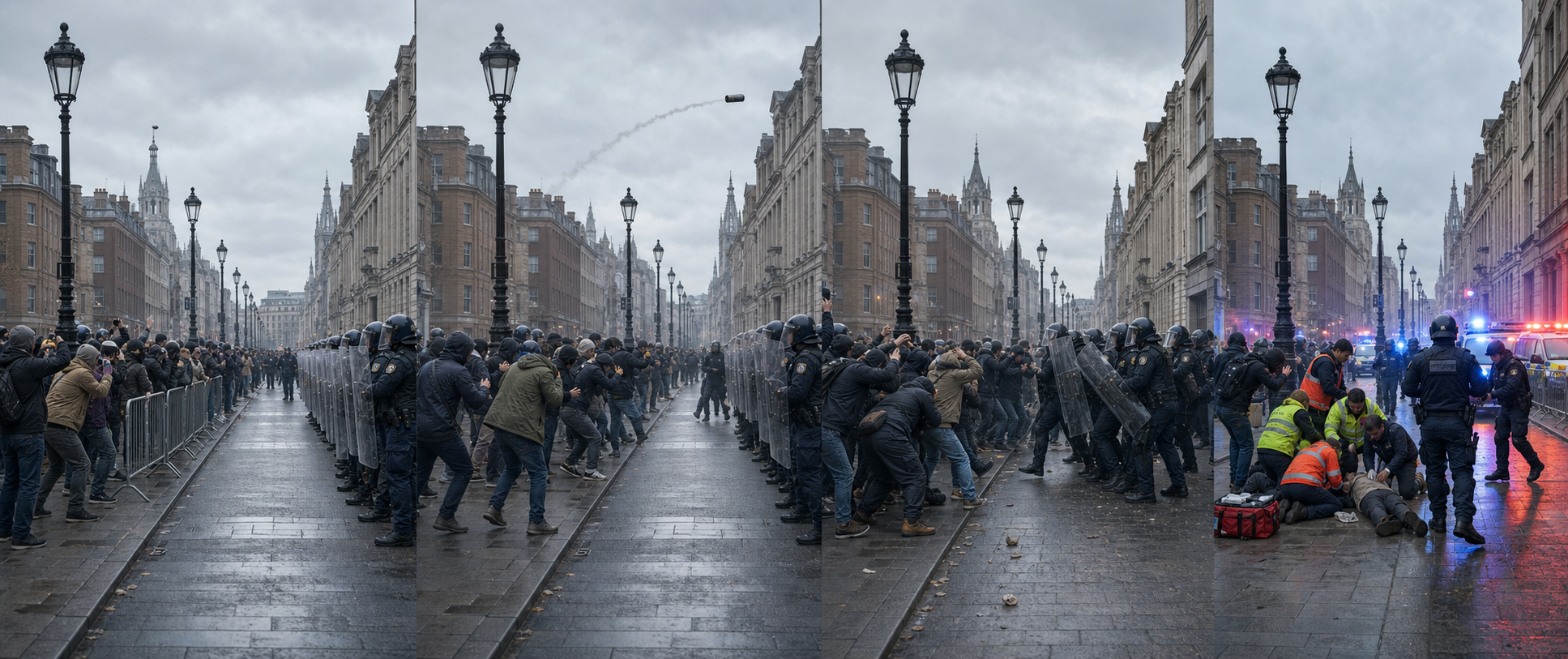
A clip from the middle of a confrontation can prove that a visible act occurred within the clip. By itself, it may not prove who initiated the confrontation, what warning preceded it, whether the recording is complete or whether the filmed people represent the larger gathering.
During a July 2026 demonstration, stone-throwing, vehicle damage and injuries to more than 50 police personnel were alleged, with circulating photographs and videos offered in support. Those allegations cannot honestly coexist with an unqualified claim that nothing violent happened. They also do not, without a complete and authenticated chronology, establish the conduct of every marcher, the first unlawful act or the proportionality of every subsequent police response.
Build the event in seven rows on paper or in your notes:
- Purpose and route: What was the gathering intended to do, and where was it supposed to go?
- Initial conditions: Was the crowd moving normally, blocked, dispersed or already in confrontation?
- First verified unlawful act: What is the earliest conduct you can support without relying on a label?
- Warnings and opportunities to comply: What instructions, if any, were given, and can their timing be established?
- Conduct by participants: Separate stone-throwing, assault or property damage from lawful presence. Do not turn “some” into “all.”
- Police response: Identify the tactic, timing, apparent target and visible effect rather than calling it simply “action.”
- Aftermath: Record injuries, deaths, damage, arrests, charges and later judicial findings as distinct developments.
Apply basic checks to every image or clip before treating it as decisive. Look for the earliest available upload rather than a repost with a partisan caption. Confirm whether the landmarks, weather, clothing and sequence are consistent with the claimed place and time. Check for cuts immediately before the key act. Distinguish what is visible from what the caption asks you to infer. If identity, timing or location remains uncertain, carry that uncertainty into your conclusion.
Do not confuse two separate questions: whether police intervention had a legitimate trigger, and whether the particular intervention was proportionate. Evidence supporting the first does not automatically settle the second. Likewise, evidence of excessive or mistaken police conduct does not erase violence committed by participants.
Count every victim without flattening responsibility
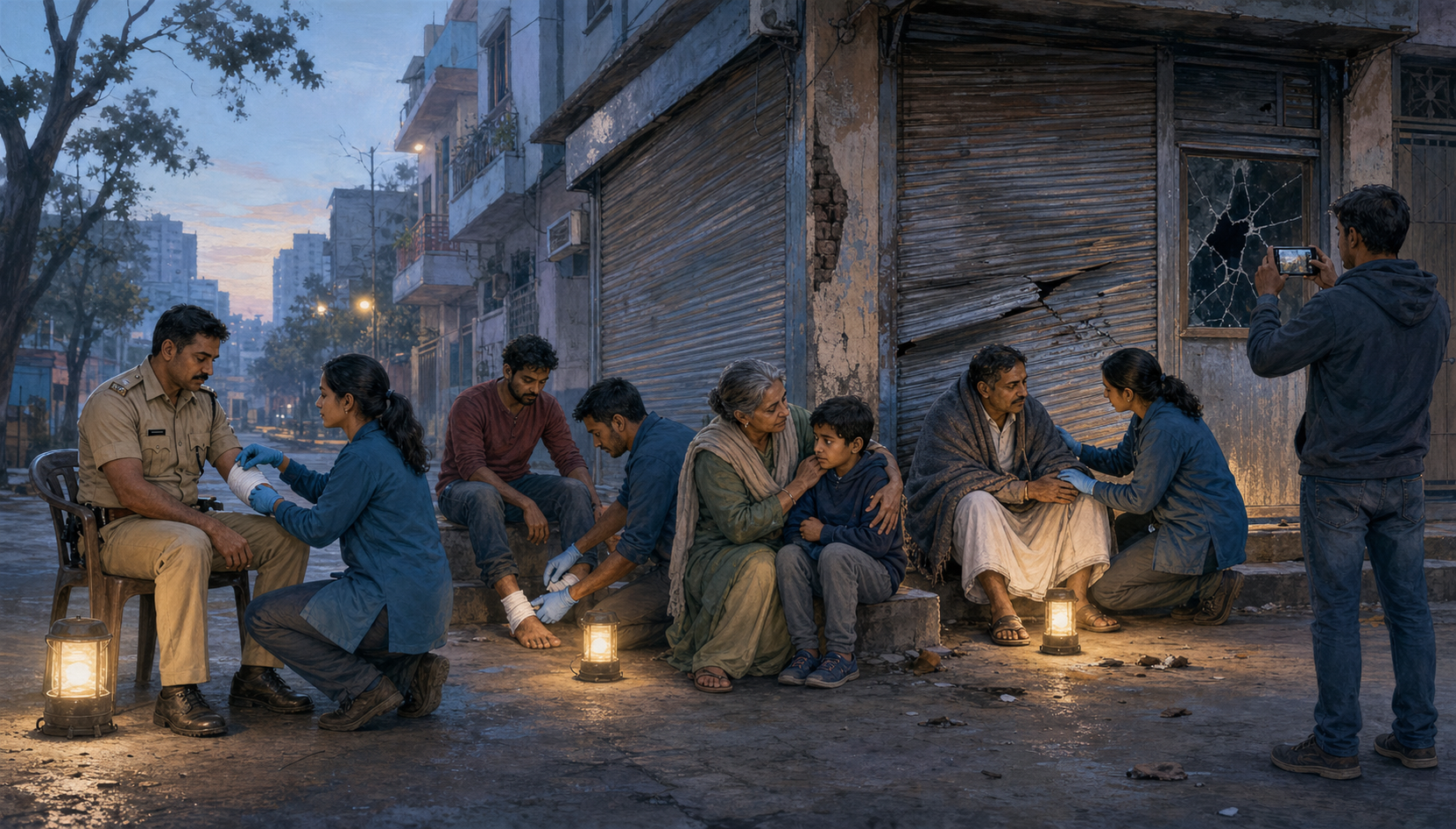
Framing becomes morally serious when it determines whose suffering receives a name, a chronology and concrete detail. Ankit Sharma’s body was recovered from the Chand Bagh drain on 26 February 2020, and the post-mortem recorded 51 ante-mortem injuries caused by sharp-edged weapons and blunt force. Reducing such a death to a generic riot fatality would hide evidence that conveys the nature and severity of the crime.
Specificity should serve truth, not spectacle. A victim’s name, role, relevant injuries and place in the chronology can prevent erasure. Graphic details that add nothing to the reader’s understanding can turn a human being into emotional ammunition. Ask what a detail proves before repeating it.
Audit victim treatment with the same questions across groups:
- Are murdered or injured civilians named where their identities are established?
- Are injured police personnel counted, or treated as an expected and therefore unimportant part of disorder?
- Are peaceful participants distinguished from people shown committing violence?
- Are bystanders, residents and property owners visible in the account?
- Is one side granted personal histories while the other appears only as a faceless category?
- Is religious or political identity included because it explains the event, or because it intensifies anger?
Equal moral attention does not require equal factual blame. If evidence shows that one person attacked and another was attacked, describing them symmetrically would be false. The discipline is to recognise every injury while assigning responsibility only where the evidence supports it.
This is where a Dharmic standard is more demanding than partisan balance. Satya requires you to resist useful falsehoods even when they benefit your side. Ahimsa requires you to notice harm to a civilian, protester, police officer or bystander without first asking whether the victim advances your narrative. Jain anekantavada adds another useful caution: a viewpoint may contain part of the truth without containing the whole event. That is not an excuse for vague “both sides” language. Partial perspectives must still be tested against conduct, chronology and evidence.
A pro-Hindu reading should therefore be exacting, not merely oppositional. If Hindu suffering is minimised, identify the omitted victim, fact or legal development. If a claim favourable to Hindus outruns the evidence, narrow it. Credibility grows when the same rule survives an identity swap.
Key takeaways: use this seven-question frame audit
- What happened without the adjectives? Write one actor-verb-object sentence using only supported conduct.
- What was the legal status on that date? Distinguish suspicion, allegation, charge, conviction and later appellate status.
- Whose agency is visible? Replace “violence erupted” and “action was taken” with named actors where the evidence permits.
- Is the chronology complete? Look for the first verified unlawful act, warnings, crowd conduct, police tactics and aftermath.
- What can each item of evidence actually prove? Separate what a clip visibly records from claims about motive, identity, representativeness and preceding events.
- Would the language survive an identity swap? Apply the same standard to allies, opponents, police, protesters and religious communities.
- What remains unknown? State the missing fact and identify what would change your conclusion instead of treating uncertainty as permission to speculate.
Before sharing a volatile claim, make three small corrections if they are needed: change “all protesters” to “some people identified as protesters,” change “proved by video” to “visible in this clip,” and update “accused” to “convicted” when a court has actually delivered that finding. These corrections preserve both urgency and accuracy.
The next time a headline asks you to choose instantly between a peaceful protest and a violent mob, pause at the noun. Rebuild the legal status, verbs, sequence and victims. Share the conclusion only after it survives that audit. In a charged public sphere, disciplined truth is not passivity; it is part of dharma.
References
- Hindu Post – 2020 Delhi Riots Accused Tahir Hussain Convicted: How Bharat’s ‘Liberal’ Media Whitewashed His Crimes For Six Years
- Hindu Post – CJP protest stone-pelting, police injuries and competing claims that the demonstration was peaceful