

You may own the Bhagavatam, listen to classes, and still feel unsure what to do when you sit down to study. Opening at random gives you no dependable place to resume. Moving from one recording to another can leave you with memorable moments but no grasp of the text as a whole.
The remedy is not to consume more. Give every sitting a clear purpose: meet a definite passage, understand it in context, preserve an honest question, and carry something from it into your conduct. That turns Bhagavatam study and Krishna-katha from occasional inspiration into a sustainable part of sadhana.
Choose a study lane before you choose a lecture

The Bhagavata Purana and Srimad Bhagavatam are names for the same sacred text. Bhagavatam study and Krishna-katha overlap, but they are not interchangeable. Knowing which one you are doing prevents a common problem: collecting devotional impressions without developing continuity.
- Sequential reading follows the text from a known starting point. It helps you see how teachings, characters, prayers, conflicts, and narrative consequences fit together.
- Passage-based class studies a limited section with a teacher. A class devoted to Bhagavatam 4.27.1-12, for example, demonstrates how tightly the scope can be defined.
- Krishna-katha centers hearing and speaking about Krishna, his qualities, activities, devotees, and the path of bhakti. It may follow a passage, an episode, or a devotional theme rather than a continuous reading schedule.
If you are beginning, make sequential reading your spine. Let classes and thematic Krishna-katha deepen that reading. Choose an edition accepted within the Vaishnava lineage you are following, keep the same edition nearby, and mark the exact place where you stop. If two translations differ, record the difference instead of silently combining them.
Reverse the usual order of online consumption. Do not begin with whichever recording a platform places before you. Choose the passage or question first, then select the class that serves it. The passage becomes your curriculum; the speaker helps you enter it.
Use a repeatable loop for every sitting
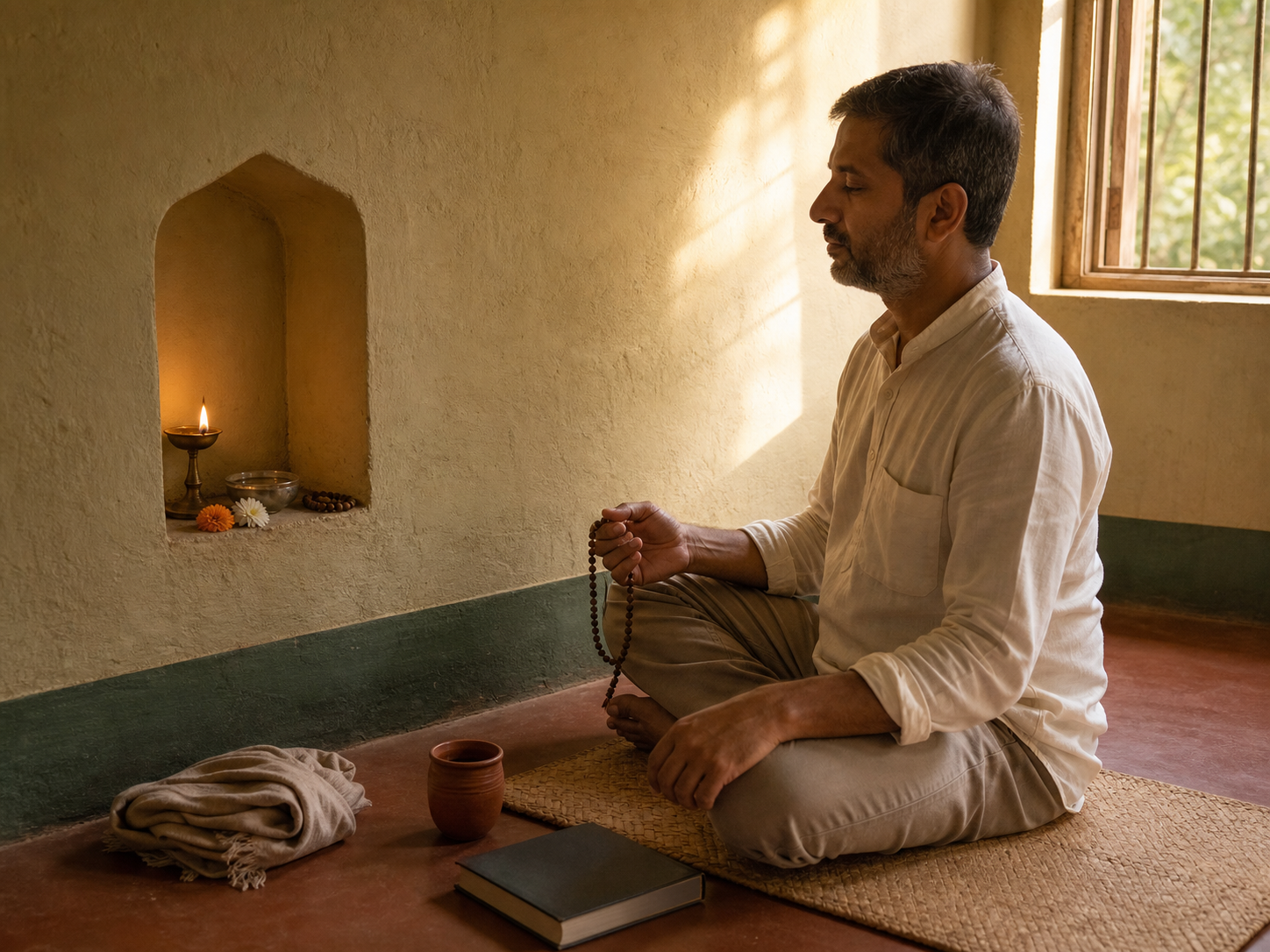
A workable routine needs a beginning, a middle, and a return point. Without those boundaries, reading tends to expand until it becomes difficult to repeat. Use the following loop whether you have a quiet personal session, a household reading, or a study circle.
- Settle the scope before reading. Write down the chapter and passage where you will begin, then choose a natural stopping point. Do not measure success by how much material you cover.
- Recover the immediate context. Recall who is speaking, who is listening, what has just happened, and what question or conflict is driving the passage. If you cannot answer, reread the preceding material before consulting a lecture.
- Read the passage itself. Reading aloud often exposes names, repetitions, changes of speaker, and words that the eye passes over. Mark unfamiliar terms, but do not interrupt every sentence to pursue them.
- Separate the layers. Notice what the Sanskrit text or translation states, what the commentator explains, what the speaker adds, and what you infer. These layers may support one another, but they are not identical.
- Write a compact study record. Preserve the passage reference, its central claim, an unresolved question, and a proportionate application. Your notes should help you re-enter the text, not reproduce the entire class.
- Begin the next sitting by retrieving rather than rereading everything. State what happened, what the passage taught, and what remained unclear. Then open the bookmark and continue.
A useful note is concrete. Instead of writing that you should become more devotional, name the response the passage actually calls for. That might mean restraining harsh speech during a recurring disagreement, remembering Krishna before a familiar duty, correcting an assumption about a character, or consulting a trusted commentary about a disputed term. Do not manufacture an application when the first honest task is simply to understand the passage.
If you miss your usual study, resume at the bookmark. Do not restart the book as an act of guilt, and do not compensate by rushing through several sections. Continuity is restored by returning to the next passage with attention.
Read with reverence without surrendering discernment
Reverence does not require vague agreement with everything you think you have heard. It requires enough patience to determine what is actually being said. Before deciding that a passage is obvious, offensive, symbolic, literal, historical, or irrelevant, ask questions in the right order.
- What is happening in the passage, and who is speaking to whom?
- What problem, desire, duty, attachment, or misunderstanding moves the narrative?
- What does the passage claim about Krishna, the jiva, bhakti, dharma, material nature, or liberation?
- Which conclusion comes from the text, which comes from a commentator, and which comes from my own assumptions?
- Does the application follow from the passage, or have I used the passage to decorate an opinion I already held?
This order matters when you encounter difficult cosmology, extraordinary events, social duties, severe judgments, or conduct that does not fit modern expectations. Calling a difficult statement merely symbolic does not interpret it. Insisting that your first literal impression must be the only orthodox reading does not interpret it either. Record the claim accurately, identify how the commentary handles it, and keep the question open until you can consult someone who knows the relevant textual and lineage context.
Choose speakers by their habits, not their prominence
Contemporary Krishna-katha remains available as a living practice through sessions by teachers such as Hanumat Presaka Swami and Vaisesika Dasa. A recording can support serious study, but the title, setting, or popularity of a speaker cannot replace discernment.
Prefer a teacher who identifies the passage and its context, distinguishes quotation from explanation, clarifies important terms, and shows how an application arises from the text. Be cautious when every passage is redirected toward the speaker’s favorite controversy, when emotion replaces explanation, or when honest questions are treated as disloyalty. A sound class should return you to the Bhagavatam with better attention, not make the text feel unnecessary.
Keep the book open while listening. Pause at a verse boundary, locate the point being discussed, and note anything you need to verify. If the speaker moves into a story or teaching from elsewhere, mark that shift. You can receive the devotional purpose of the class while still knowing which statements belong to the present passage.
Fit the method to personal, household, and group study
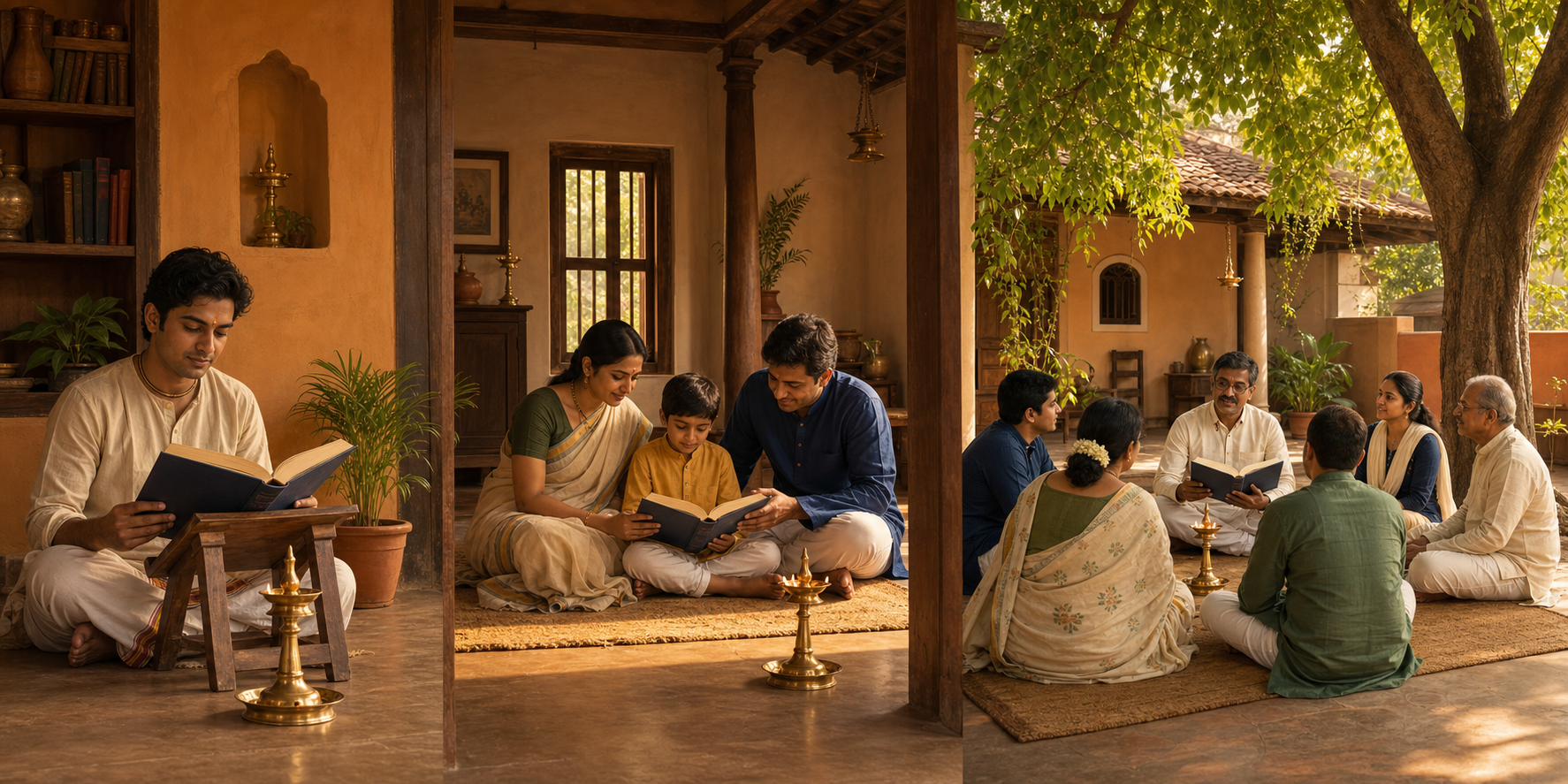
When you study alone
Personal study gives you the freedom to stop where your understanding stops. Use it. If your attention becomes thin, reduce the amount of text and read aloud. If a passage moves you deeply, remain with it, but preserve your bookmark and central question before following related talks. Otherwise a sincere moment of inspiration can quietly dissolve your study plan.
Do not turn the notebook into a performance. A short entry that lets you remember the passage is more useful than pages copied from a commentary. Copy exact wording only when the wording itself needs study, and clearly distinguish it from your paraphrase.
When you read as a household
Let the narration lead. Have someone read the passage, invite another person to retell what happened, and then receive questions. This quickly reveals whether everyone is discussing the same event. Avoid turning the session into a memory test or using the text to correct a family member indirectly.
With children, keep explanations proportionate to the story they have heard. Let them ask what a character wanted, what choice was made, and what followed. If you do not know an answer, say that it needs to be checked. An honest open question teaches better scriptural habits than an invented detail offered to preserve authority.
When you meet as a study circle
Give the facilitator a limited role: establish the passage, maintain the sequence of discussion, and record unresolved questions. Begin with the text before inviting opinions. When disagreement appears, identify whether it concerns wording, translation, commentary, lineage, or personal application. Many arguments become manageable once the actual point of difference is named.
Do not pressure participants into revealing private struggles as proof that they have applied the teaching. A group can close by naming a shared devotional practice or a question to investigate. Personal vows should remain voluntary and proportionate.
When life becomes crowded, shrink the scope rather than abandoning the method. Read a smaller passage attentively, preserve the question, and mark the return point. The essential habit is not finishing a predetermined quantity. It is learning to return to Krishna-katha with continuity, humility, and care.
Key takeaways
- Use sequential Bhagavatam reading as the backbone of your study, then choose classes and Krishna-katha that deepen the passage or question before you.
- Enter every sitting with a defined passage and leave it with a bookmark, a central claim, an open question, and a practical response.
- Keep the text, translation, commentary, speaker’s explanation, and your own inference distinguishable.
- Do not force a quick symbolic or literal verdict on a difficult passage. Establish what it says and how the relevant tradition interprets it before deciding.
- Judge a class by whether it sends you back to the Bhagavatam with greater clarity and steadiness.
- After a missed session, resume where you stopped. Continuity grows through return, not through guilt or compensatory reading.
Choose your edition and next passage now, not when your study period begins. Place the bookmark, write the reference, and decide which question will guide your hearing. At the next sitting, open there before opening a video platform. That small act puts the Bhagavatam, rather than the stream of available content, back at the center of your Krishna-katha practice.
References
- Dandavats – The Bhagavata Purana or Srimad Bhagavatam – an Overview
- Dandavats – Bhagavatam Class 4.27 1-12 | Vraj Vihari Prabhu
- Dandavats – Krishna Katha | H.H. Hanumat Presaka Swami | 2026-07-16 | ISV
- Dandavats – Krishna Katha | H. G. Vaisesika Dasa | 2026-07-19 | ISV