

A sacred thread at an examination checkpoint in Bengaluru and a Hindu delegation entering congressional offices in Washington may appear to belong to unrelated stories. The two source articles place them on the same continuum: the terms on which Hindus participate in public institutions without being expected to conceal or surrender religious identity.
Together, the cases show that religious freedom depends on more than constitutional language or public expressions of support. It also requires precise administrative rules, informed frontline decisions, credible documentation and sustained relationships between communities and institutions.
Religious freedom is tested at points of participation
The Bengaluru case concerned access to education. The source article reports that some candidates appearing for KCET 2026 at Krupanidhi PU College were asked to remove the Janeu, or janivara, before entering the examination hall; some accounts also mentioned the Kalava. The article says publicly available examination rules restricted items that could facilitate malpractice but did not appear to prohibit these religious threads specifically.
That distinction separates a defined security measure from discretionary overreach. Examination authorities have a legitimate obligation to prevent concealed notes and electronic devices. A religious marker, however, should not be treated as contraband merely because an official has not been trained to recognize it. Where inspection is genuinely necessary, a visual, respectful and narrowly tailored check can usually protect both examination integrity and the candidate’s dignity.
The Janeu is associated in a number of Hindu traditions with Upanayana, learning, discipline and religious responsibility, although its significance and observance vary among communities. The Kalava may express a devotional commitment connected with worship or a vrata. Their importance lies partly in this embodied character: Hindu practice can be expressed through what a person wears and observes each day, not only through beliefs held in private.
The Washington case concerned access to political representation. According to the second source, CoHNA’s July 3, 2026 Day of Advocacy brought Hindu Americans into direct contact with federal lawmakers and staff. The organization reported participation by more than 130 Hindus from 15 states, alongside seven congressional representatives and 12 staff members from both parties. Delegates reportedly held more than 50 meetings with congressional staff and visited over 120 offices.
The legal systems and immediate disputes are different, but the civic question is comparable. Can Hindus enter an examination hall, campus or legislature as full participants while remaining recognizably Hindu? Neither source treats religious identity and public belonging as incompatible. One examines the harm that can arise when an institution mishandles that relationship; the other examines an organized effort to shape it.
Administrative discretion can protect or diminish dignity
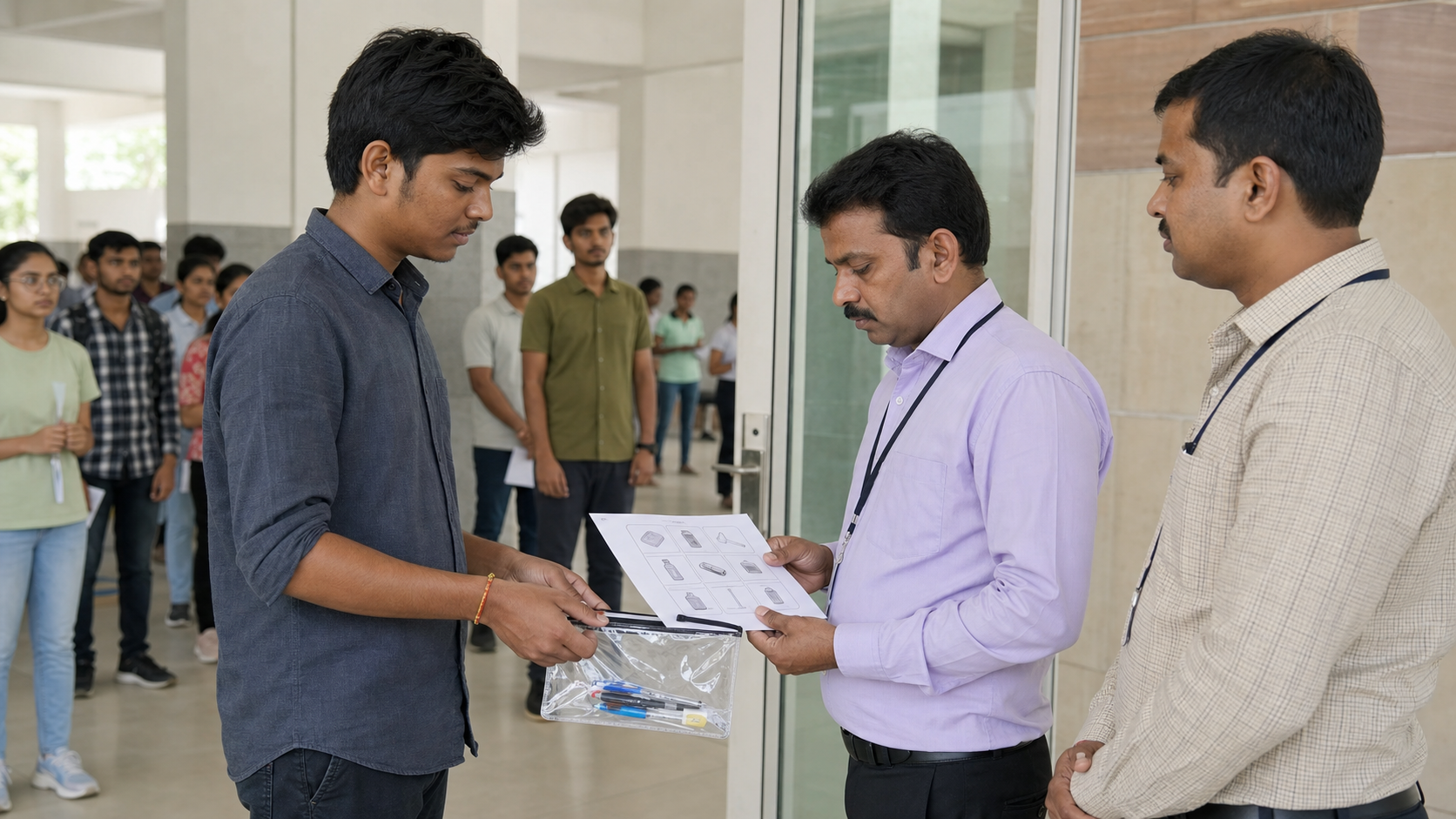
Written rights are often implemented by people working under time pressure: security personnel, invigilators, administrators and office staff. Their discretion is therefore a decisive part of religious freedom. A vague rule can leave an official afraid of overlooking a security risk and a student afraid that objecting will cost admission to an important examination. The resulting imbalance makes even a brief encounter consequential.
The KCET article reports that a subsequent committee reviewed CCTV footage and heard from students and parents. It reportedly found, on a prima facie basis, that personnel at the centre had acted intentionally despite dress-code training. The source also says that the committee recommended excluding the centre from future examinations and that suspensions and police action followed. These are reported findings rather than an independently reviewed record, but they indicate that the dispute proceeded beyond online reaction into a formal accountability process.
Article 25 of the Indian Constitution, as the first source notes, protects freedom of conscience and religious profession and practice subject to constitutional limits including public order, morality and health. That framework does not exempt every religious article from every restriction. It does place a burden on public authorities to connect a restriction to a legitimate purpose and apply it proportionately.
For examination systems, this points toward a practical institutional design: publish religious-accommodation guidance with the dress code, train staff to distinguish ordinary observances from prohibited devices, identify a senior official who can resolve doubtful cases promptly and provide a dignified inspection option. Such measures protect candidates while also giving frontline personnel a defensible procedure to follow.
Civic advocacy turns isolated encounters into standing relationships

Accountability after an incident is necessary, but a community relying only on crisis response remains dependent on the next controversy for public attention. The Capitol Hill account illustrates a different model: recurring contact through constituent visits, staff meetings, youth participation and engagement across party lines.
According to the source, participating lawmakers discussed temple vandalism, hostile rhetoric and religious freedom. Bipartisan attendance does not prove consensus on every diagnosis or proposed remedy. It does suggest that protection from religious hostility can be presented as a shared civic responsibility rather than attached exclusively to one political camp.
The account also describes Rutgers University participants discussing a progression from seeking campus representation to working with administrators and organizing an academic conference on Hinduism. This is significant as a model of institutional development: students can move from objecting to a particular event toward building literacy, relationships and durable forums in which Hindu traditions are represented with greater depth.
Armenian and Jewish allies also participated in the Washington program, according to the source. Such cooperation can broaden opposition to religious hatred without requiring communities to merge distinct histories or teachings. The same principle applies among Hindu, Buddhist, Jain and Sikh organizations: collaboration is most credible when it protects difference rather than erasing it.
This approach complements the lesson of the examination dispute. Clear internal procedures reduce arbitrary treatment from within an institution, while sustained civic relationships give affected communities a channel through which recurring problems can be raised before they become emergencies.
Evidence determines whether advocacy earns durable trust

The two accounts also show different uses of evidence. In the KCET case, footage, testimony and a committee process were reportedly used to assess a defined incident and assign responsibility. In Washington, speakers advanced broader arguments about anti-Hindu hostility, caste policy, immigration narratives and institutional citation practices.
The second article appropriately distinguishes the occurrence of those presentations from the validity of every claim made in them. It reports that Dr. Joel Finkelstein questioned efforts to incorporate caste into law and curricula, while Rep. Zoe Lofgren was described as warning that caste-specific legislation could intensify discrimination. It also says that Prasiddha Sudhakar presented research interpreting elements of immigration discourse as religious targeting and that Anang Mittal presented a Citation Integrity Dashboard intended to assess the support and transparency behind institutional claims.
Those reported presentations establish what advocates placed before participants; they do not substitute for access to methods, counterarguments or independent review. Credible advocacy should therefore separate four layers that are often blurred: the documented event, testimony about its effects, the interpretation applied to it and the remedy being requested. A disagreement at the level of interpretation should not erase a documented incident, just as the occurrence of an incident should not automatically validate every wider theory attached to it.
This discipline is particularly important when discussing prejudice. Precise language allows officials and the public to distinguish vandalism, unequal treatment, cultural ignorance, policy disagreement and contested scholarship. Each may require a different response. Accuracy narrows the space for dismissal while protecting advocacy from claims that it has exaggerated its evidence.
Key takeaways for a practical civic agenda
- Explain the practice in administrative terms. Institutions need concise information about what a religious article is, how it is worn and what respectful inspection would involve.
- Seek clarity before high-pressure encounters. Examination bodies, schools and other public institutions should publish accommodation rules in advance rather than leave sensitive decisions to improvised gatekeeping.
- Create a rapid escalation path. A trained senior official should be available when a frontline employee and participant disagree about a religious practice.
- Document incidents proportionately. Contemporary records, policy text, witness accounts and formal findings are more useful than assumptions about intent or sweeping claims about an entire institution.
- Build relationships outside moments of crisis. Constituent meetings, campus engagement and recurring contact can turn demographic presence into informed civic participation.
- Keep advocacy evidence-literate. Verified facts, personal testimony, analytical conclusions and policy proposals should be identified separately, especially when claims remain contested.
- Form coalitions without erasing differences. Bipartisan, interfaith and inter-Dharmic cooperation can defend equal treatment while allowing each community to speak in its own voice.
Hindu religious freedom will be most durable when cultural knowledge is translated into workable public rules and civic confidence is matched by evidentiary care. The next step is not simply greater visibility, but a dependable infrastructure of training, documentation, representation and respectful institutional dialogue.
References
- DharmaRenaissance Blog – Janeu at the Exam Gate: What the KCET Row Reveals About Religious Freedom
- DharmaRenaissance Blog – Hindu Advocacy Draws Bipartisan Attention on Capitol Hill