
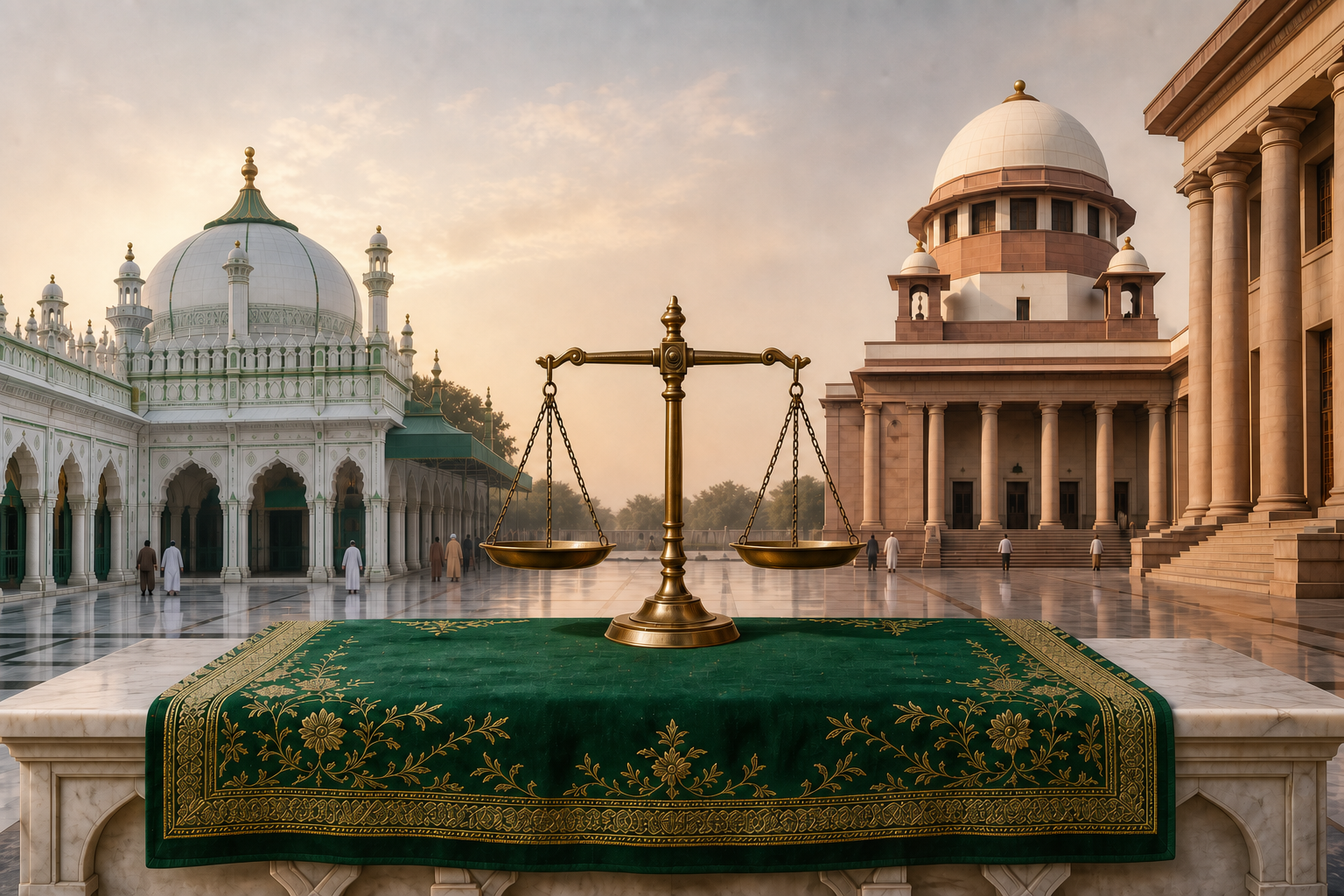
If you are trying to decide whether the Prime Minister should send a chaddar to Ajmer Sharif, do not begin with the personalities or the slogans. Begin with the rule you would want India to apply when the sacred place belongs to any community.
That shift matters because the immediate controversy contains several different questions: what a court has actually been asked to do, whether an official religious gesture violates state neutrality, whether outreach can be even-handed, and how Hindus can press a legitimate equality concern without turning worshippers into political targets.
What the petition does, and does not, establish
Hindu Sena has reportedly filed a petition seeking to restrain the Prime Minister’s ceremonial chaddar offering at the Ajmer Sharif dargah, the resting place of Khwaja Moinuddin Chishti. The same reported campaign also included an appeal to authorities concerning the name of Delhi’s Babar Road. These developments have placed questions of law, religious symbolism and historical memory into the same public argument, but they should not be treated as one indivisible issue. The requested restraint on the chaddar offering is the central legal controversy.
A petition is a request for judicial relief. It is not a judgment, an injunction or an endorsement of the petitioner’s reasoning. This distinction is essential whenever a headline says that a group has “moved court.” The filing tells you what the petitioner wants; only an order tells you what the court has accepted, rejected or left undecided.
Use correspondingly precise language when you discuss or share the development. Say that Hindu Sena has reportedly sought to restrain the offering. Do not say that the court has prohibited it, found it unconstitutional or agreed with the petitioner unless an actual judicial order establishes that outcome.
The Babar Road demand deserves the same discipline. Renaming a road raises questions about public memory, historical judgment and administrative policy. The chaddar dispute concerns an official’s participation in a faith-linked ceremony. Bundling them may produce a stronger political message, but it does not make their legal or policy tests identical.
Three questions are hiding inside the public argument

Is the gesture personal, political or official?
The identity of the person sending the chaddar is only the first part of the issue. You also need to know the capacity in which the act is performed. A private citizen’s offering, a political party’s outreach and a ceremony conducted in the name or office of the Prime Minister are not automatically the same act.
Ask who authorizes the gesture, how it is described, whether public machinery is used, and whether it is presented as personal devotion, cultural respect or an act of state. Those facts affect the neutrality argument far more than a photograph by itself. Without them, people often argue about different versions of the event without realizing it.
Does neutrality require distance or even-handed engagement?
One position holds that the state should avoid faith-linked offerings because official participation can appear to privilege a religious institution. Another holds that ceremonial visits and offerings can express respect for India’s diverse spiritual landscape without endorsing a particular doctrine. Ajmer Sharif has long been treated by many people as a site of Sufi heritage and cultural outreach, which is why supporters see the gesture as pluralist rather than sectarian.
Neither label settles the question. Calling an act “outreach” does not prove that it is neutral. Calling it “religious” does not prove that every official association with it is impermissible. The useful test is consistency: would the same principle govern respectful engagement with Hindu temples, Buddhist viharas, Jain tirthas and Sikh gurdwaras?
Is the objection about religion itself or unequal treatment?
This is where much of the Hindu concern should be stated with greater accuracy. The strongest objection is not that Muslim citizens possess sacred places or that an official must show them hostility. It is that the Indian state should not display selective solicitude: highly visible respect for one tradition combined with restriction, embarrassment or instrumental treatment of another.
If unequal treatment is the complaint, the remedy must be a rule capable of equal application. Otherwise the argument slips from constitutional parity into reciprocal sectarianism: because one community’s symbol is favored, another community’s symbol should be insulted. That reaction does not correct unequal governance. It merely reproduces the same error with a different target.
A Dharmic position needs both firmness and restraint
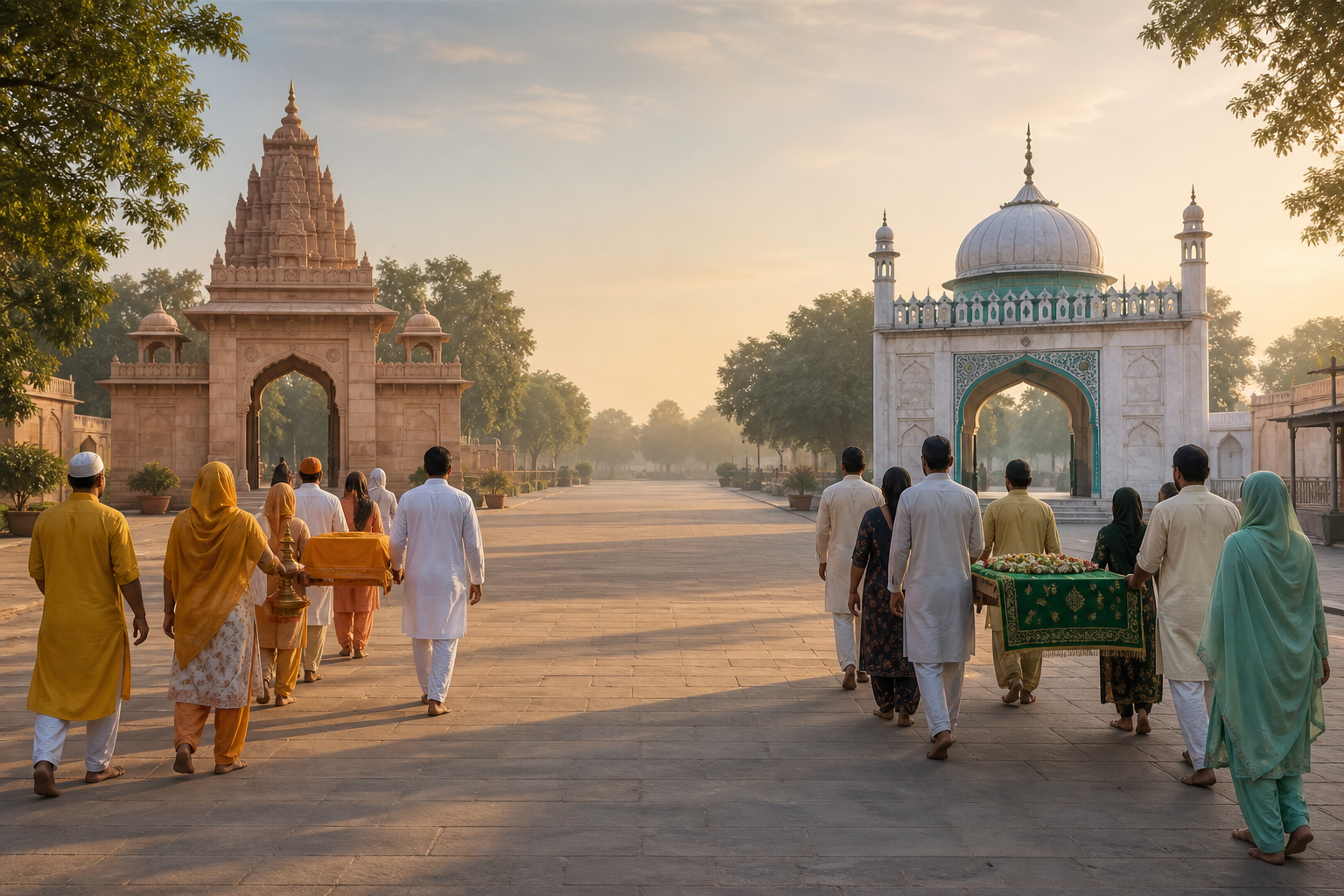
A pro-Hindu response need not choose between silence and hostility. Dharma permits clear judgment about state conduct while requiring discipline in how that judgment is expressed. Satya asks us to describe the legal situation accurately. Ahimsa asks us not to direct political anger toward ordinary worshippers. Equal dignity asks us to defend Hindu institutions without denying another citizen’s freedom of conscience.
This does not mean erasing history, pretending every religious tradition makes identical claims or suppressing disagreement in the name of harmony. Respect is not surrender, and dialogue is not historical amnesia. You can question the state’s choice of symbolism, examine whether reciprocity exists, and oppose an official act through lawful means while recognizing the human dignity of those who revere the dargah.
The distinction between a sacred community and a government decision is especially important. The Prime Minister’s ceremonial conduct is open to political and constitutional criticism. A devotee visiting Ajmer Sharif is not thereby responsible for that conduct. Keeping those targets separate makes a Hindu equality argument more credible and protects it from being reduced to communal antagonism.
Courts examining disputes at the intersection of religion and public authority may have to balance fundamental rights, equality before law and the secular character of the state. Public debate should therefore concentrate on the legal character of the official act and the consistency of the governing principle. Claims about hidden motives may excite supporters, but they do not answer either question.
How to evaluate the next headline or court update
Legal controversies move through stages, and social media routinely collapses those stages into a single claim of victory or defeat. Before you forward an update, run this short check:
- Identify the event. Was a petition filed, was notice issued, was an interim direction made, or was a final decision delivered? These are different procedural events.
- Find the exact relief sought. “Action against the chaddar” is vague. Determine whether the request concerns the offering itself, the Prime Minister’s official participation, the use of public authority, or something else.
- Separate the petitioner’s claim from the court’s words. An allegation reproduced in a case report remains an allegation unless the court adopts it.
- Check the capacity of the actor. Ask whether the Prime Minister is described as acting privately, politically or through the office of government.
- Apply a parity test. Would you accept the proposed rule if it governed official engagement with a Hindu temple, Buddhist vihara, Jain tirtha or Sikh gurdwara?
- Keep separate demands separate. The Babar Road question should be judged through transparent criteria for public names and historical memory, not treated as automatic proof for or against the chaddar plea.
This method will not tell you in advance how a court must rule. It will tell you whether a public claim is describing the case honestly. That is the first protection against becoming an amplifier for misinformation.
Key takeaways
- The reported petition asks for restraint on the Prime Minister’s ceremonial chaddar offering; filing the request is not the same as winning it.
- The central policy question is whether state neutrality means non-participation or permits even-handed cultural outreach.
- A serious equality argument must distinguish official conduct from the freedom and dignity of devotees.
- The best rule is one you would apply consistently across Hindu, Buddhist, Jain, Sikh and Islamic sacred institutions.
- The Babar Road demand concerns historical memory and naming policy; it should not be allowed to blur the distinct chaddar question.
What a durable public policy would have to provide

India can reasonably debate more than one model. It could maintain greater official distance from ceremonial offerings. It could permit cultural outreach across traditions. It could also distinguish attendance at a public commemoration from participation in a devotional act. What it cannot do credibly is rely on improvised exceptions whose only explanation is political convenience.
A defensible outreach policy would need transparent criteria. It should explain the official purpose of participation, distinguish cultural recognition from doctrinal endorsement, and show how comparable institutions are treated. A defensible non-participation policy would likewise need to operate across communities rather than appearing only when a particular tradition becomes politically inconvenient.
Perfect numerical symmetry is neither possible nor necessary. India has too many traditions, sacred calendars and institutions for every gesture to be replicated mechanically. But the underlying standard can still be equal: no community is entitled to permanent state preference, and no community should be marked for official disrespect.
That principle also clarifies the difference between pluralism and appeasement. Pluralism recognizes citizens and traditions under a common rule. Appeasement suspends the common rule to secure approval from a selected constituency. To determine which one you are seeing, examine the policy pattern rather than one ceremony in isolation.
Turn the controversy into a precise civic demand
If you contact a representative, write about the case or discuss it in your community, ask for a publicly defensible policy on official participation in religious ceremonies. Request equal criteria, a clear distinction between personal and state action, and respect for lawful worship. Those are demands that can survive a change of government and a change in the religion involved.
Resist messages that convert a procedural development into a judicial victory, or a criticism of government symbolism into hostility toward Muslims. Both distort the issue. A strong Hindu public voice gains authority when it is exact about facts, consistent about equality and restrained toward people who are not responsible for the state’s choices.
The next useful step is simple: when an order or official statement appears, read its operative words before adopting anyone’s verdict on it. Then ask whether the principle being advanced is one Bharat could apply fairly at every sacred door.
References
