

You may be caught between two lives: the one your family prepared you to inherit and the one your abilities keep drawing you toward. The first can feel like loyalty without freedom. The second can feel like freedom purchased with ingratitude. That is the wrong choice to accept.
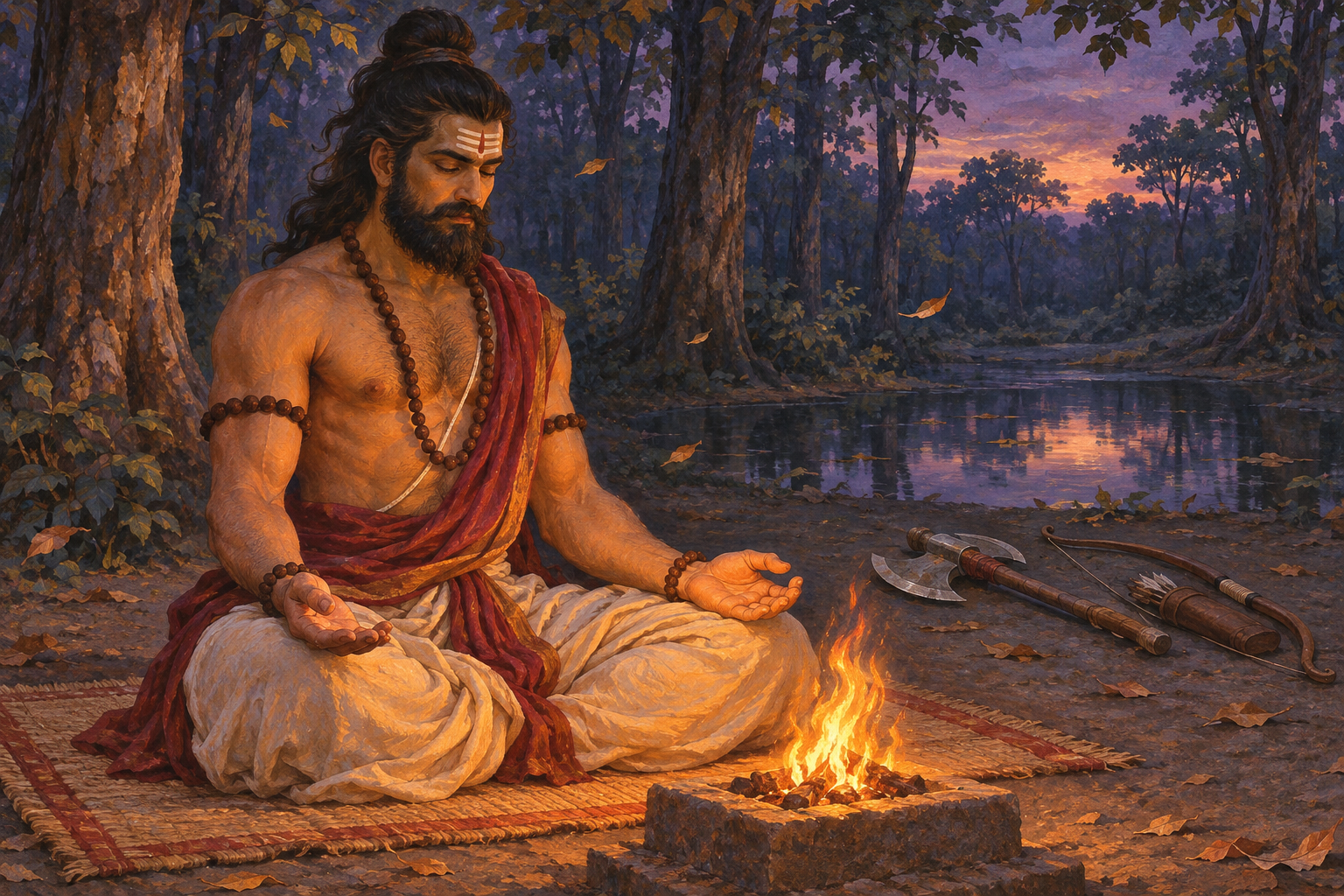
Parashurama gives you a more demanding way to decide. Revered as the sixth avatar of Bhagavan Vishnu, he was born into a family of sages associated with learning, penance, and peaceful pursuits, yet took up the axe and mastered warfare. His contrast between lineage and disposition separates three things that are often confused: what you inherited, what you are fitted to do, and what kind of person you become while doing it.
Your inheritance is a starting point, not a finished identity

A family gives you more than a surname. It gives you habits, language, examples of honour, access to particular skills, and an idea of what a respectable life looks like. These can be genuine gifts. Gratitude requires you to recognise them accurately; it does not require you to mistake them for a complete description of your nature.
Parashurama’s birth did not make his lineage irrelevant. It made the difference between lineage and inclination visible. He carried the discipline associated with a sage’s household into a martial vocation. The useful lesson is therefore subtler than simply rejecting tradition: inheritance can prepare your character even when it does not determine your occupation.
This distinction matters when a family profession, social expectation, or respected way of life has been presented to you as destiny. Birth tells you where your formation began. It cannot, by itself, settle which responsibilities you are capable of carrying well.
Before either accepting or rejecting the inherited path, make an honest inventory:
- What did your upbringing actually give you? Name disciplines, knowledge, relationships, and habits rather than using a vague label such as tradition.
- Which parts of the expected role fit you? Do not discard a real aptitude merely because it arrived through your family.
- Which activities repeatedly claim your attention? Look for work you return to after novelty and praise have disappeared.
- Which burdens are you willing to carry? A vocation includes tedious duties, correction, and consequences, not only satisfying moments.
Write your answers in verbs. Teaching, protecting, repairing, investigating, cultivating, organising, healing, building and contemplating reveal more than a prestigious job title. A title may be inherited or admired; a recurring form of useful action is better evidence of disposition.
Inclination must pass a dharmic test
Inclination matters, but not every strong desire is a vocation. Some desires come from resentment, impatience, status-seeking, fear of discipline, or the wish to shock other people. Calling every impulse authentic does not make it dharmic. It only gives appetite a noble name.
Use four tests before reorganising your life around an inclination:
- The recurrence test: Does the attraction return across different moods and circumstances, or does it appear mainly when your present duties become uncomfortable?
- The discipline test: Are you willing to practise the unglamorous skills the work requires, receive correction, and continue when you are no longer praised for being promising?
- The service test: Who benefits if you become excellent at this work? A vocation should create value, protection, understanding, beauty, order, or care beyond your own self-image.
- The consequence test: Can you accept the ordinary costs attached to the path, including limits on time, comfort, income, status, or approval?
A recurring pull that survives discipline deserves investigation. A desire that disappears as soon as practice becomes repetitive was probably attraction, not vocation. Likewise, an ability that serves only vanity may be a talent, but it has not yet been placed under dharma.
Parashurama’s axe should not be reduced to a slogan about following passion. The important fact is the divergence between expected role and demonstrated disposition. His example does not tell you that intensity is always right. It tells you not to dismiss a real capacity merely because it does not resemble the life associated with your birth.
Do not ask only, What do I want to do? Ask, What am I prepared to become reliable enough to do, and toward what rightful end? The first question identifies preference. The second begins vocational discernment.
Vocation and character answer different questions
Vocation asks what work you should undertake. Character asks what kind of person you are becoming as you undertake it. Aptitude can help you choose a field; it cannot certify your motives, restraint, honesty, or judgment.
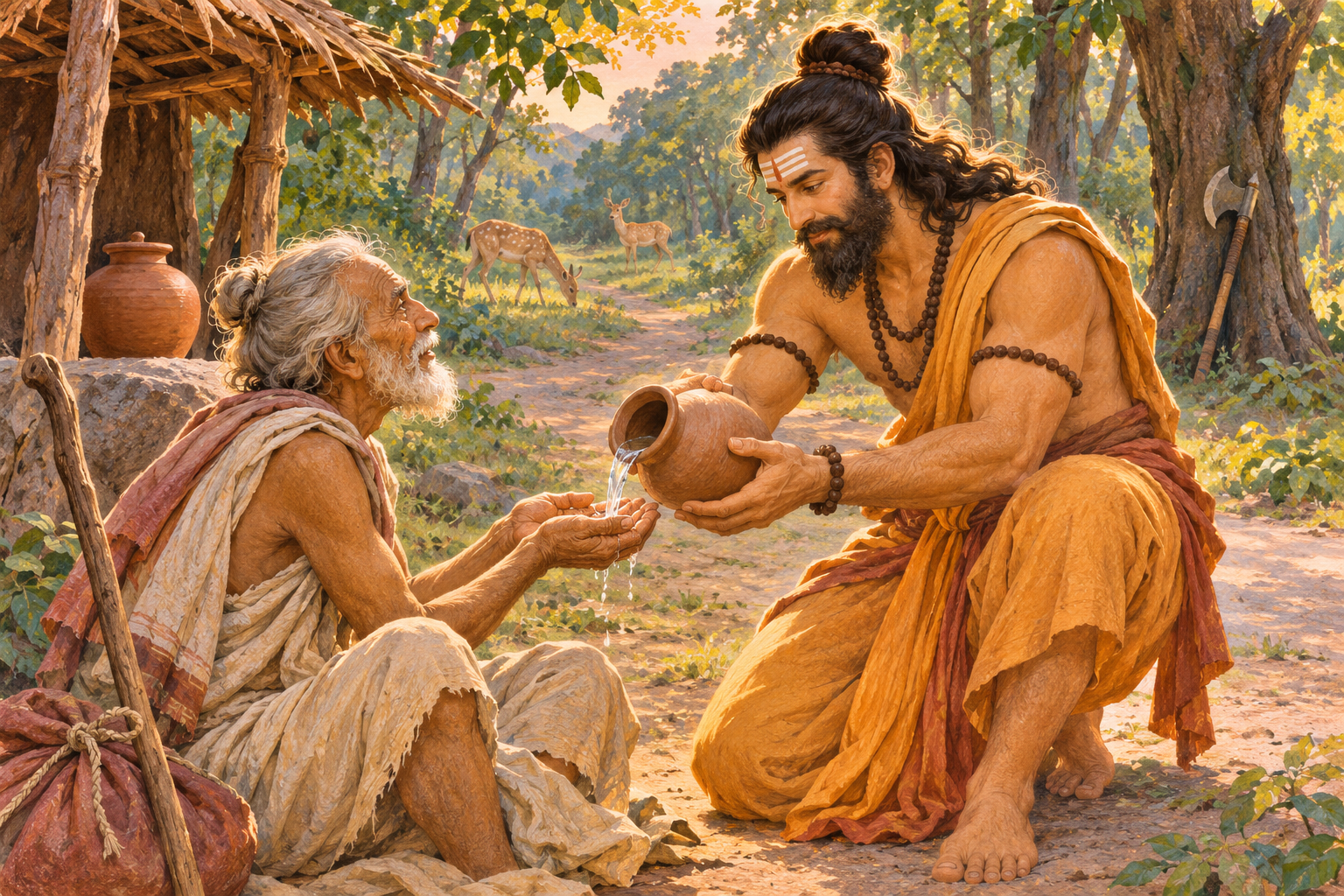
This is where a superficial reading of Parashurama can mislead. A martial inclination is not the same thing as uncontrolled aggression. The capacity to confront, protect, or fight is a tool. Anger, cruelty, and domination are defects of character, not proof of a warrior’s calling. In the same way, intellectual ability is not wisdom, religious learning is not humility, and commercial skill is not integrity.
When evaluating a possible vocation, keep two separate records. In one, note evidence of fitness: the skills you learn quickly, the problems you notice, the work others trust you to handle, and the responsibilities under which you become more attentive. In the other, note evidence of character:
- Do you keep commitments after enthusiasm fades?
- Can you exercise strength without humiliating someone weaker?
- Do you tell the truth when concealment would protect your status?
- Can you receive correction without making the critic your enemy?
- When you cause harm, do you acknowledge it and make a serious repair?
- Does greater competence make you more accountable or merely more entitled?
Do not place an impressive skill in the character column. A person may be gifted and still unreliable, courageous and still vain, learned and still dishonest. This separation protects you from choosing work merely because it flatters your strongest trait.
It also prevents another mistake: staying in unsuitable work because leaving would appear disloyal. Character is not proved by remaining permanently misplaced. It is proved by the honesty, restraint, gratitude, and responsibility with which you discern and pursue a better-fitting duty.
Choose your path without turning it into a rebellion

A vocation becomes harder to recognise when every decision is staged as a battle with your family. Opposition can tempt you to exaggerate certainty. Approval can tempt you to ignore doubt. Neither reaction helps you see clearly.
First determine what kind of objection you are hearing. Your family may be protecting status, repeating habit, questioning your evidence, or warning you about a cost you have romanticised. These objections are not equal. A demand for conformity does not deserve the same weight as a specific warning about your lack of preparation.
Handle the decision in a disciplined order:
- Name what you value in your inheritance. This shows that choosing a different occupation is not the same as despising the people who formed you.
- Present evidence, not declarations. Point to sustained work, training completed, responsibilities carried, feedback received, and failures corrected.
- State the discipline the new path requires. A credible choice includes the practice, sacrifice, and standards by which you expect to be judged.
- Invite precise criticism. Ask which skill, cost, duty, or risk your family believes you have overlooked. Specific objections can be tested; general disapproval cannot.
- Run a bounded, reversible trial where possible. A project, course, apprenticeship, service commitment, or part-time responsibility can expose the daily reality before you make an irreversible change.
- Own the consequences. If the path changes your income, obligations, or dependence on others, plan for that openly. Do not make other people silently finance a choice you call independent.
A useful explanation has four parts: I honour what I received; this is the capacity I keep finding in myself; this is the evidence that it can serve others; and this is the discipline and cost I am prepared to accept. That language is stronger than announcing that you must simply be yourself. It translates personal inclination into responsibility.
Do not resign, borrow heavily, or sever relationships merely to prove that your calling is serious. When a decision carries substantial financial or legal consequences, use a reversible test and qualified advice before committing. Courage is not measured by how difficult you make retreat; it is measured by how truthfully you face reality.
Family resistance may soften when your choice produces steadiness rather than drama. It may not. Your responsibility is not to manufacture agreement. It is to ensure that disagreement does not become an excuse for contempt, impulsiveness, or neglect of legitimate duties.
Key takeaways
- Birth gives you a setting, formation, and inheritance; it does not provide a complete vocational verdict.
- A recurring inclination is evidence to examine, not an order to obey.
- Real vocation survives practice, correction, service, and an honest accounting of consequences.
- Vocation identifies the work; character governs the way you use its powers.
- Family tradition can continue shaping your discipline even when you do not continue the family occupation.
- A dharmic choice makes you more responsible for your conduct, not less answerable to others.
Before your next decision or family conversation, make a one-page record with six headings: inheritance, recurring inclination, demonstrated ability, required discipline, service, and cost. Circle the heading under which your evidence is weakest. Work on that weakness before announcing a final decision.
Parashurama does not give you permission to worship impulse or reject lineage. He gives you a reason to look beyond inherited labels. Your task is to recognise your nature, train its capacities, submit them to dharma, and accept responsibility for what you do with them.
References

Leave a Reply
You must be logged in to post a comment.