
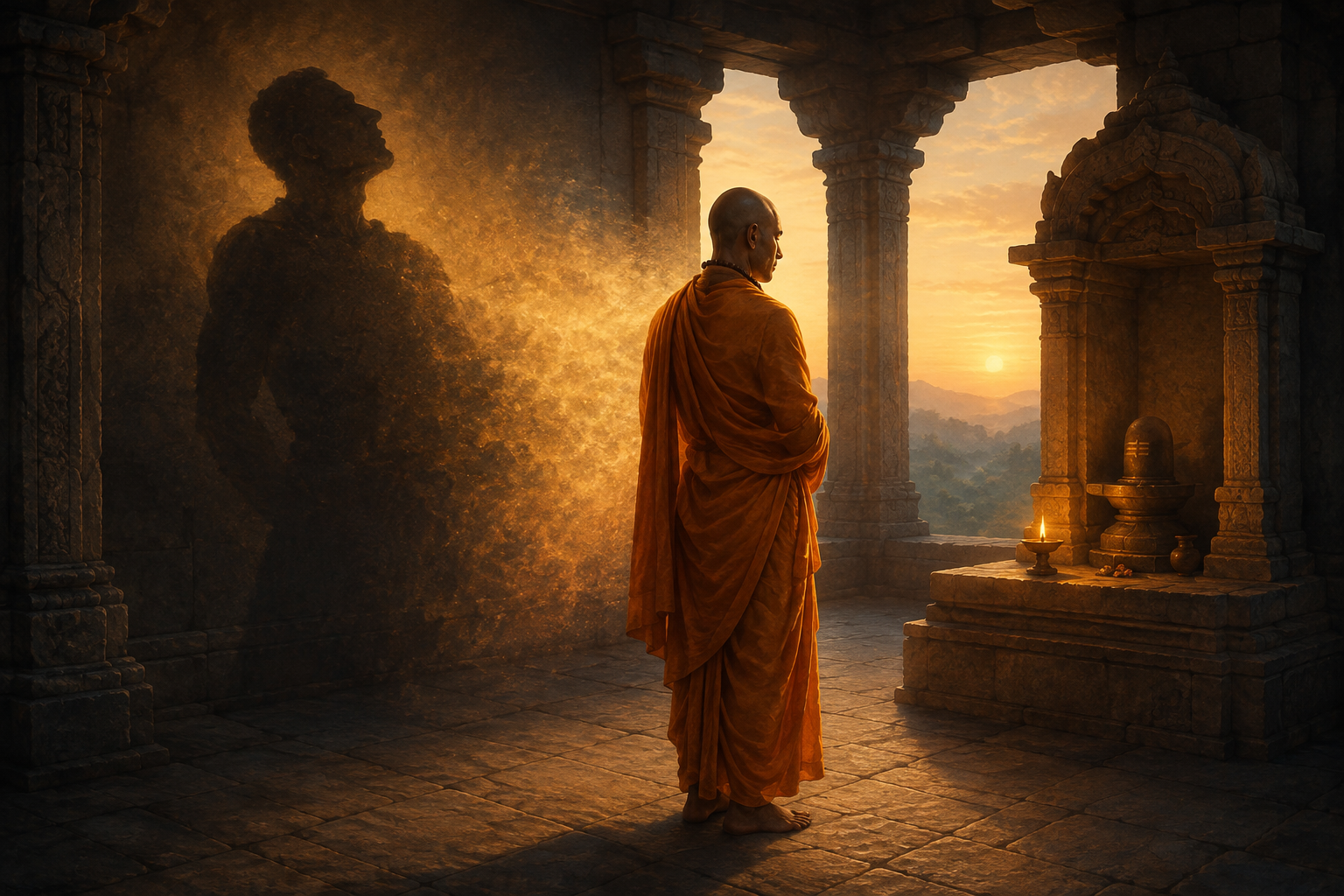
Your puja may be regular, your convictions firm, and your defence of Dharma articulate. But has your religious life made you less preoccupied with status, less eager to humiliate an opponent, and more capable of recognizing goodness beyond your own community?
That is the uncomfortable test at the heart of Vivekananda’s teaching on religion. He did not ask you to discard ritual, doctrine, community, or sacred form. He asked whether they are doing their proper work: dislodging the ego, directing the mind toward the Divine, and producing conduct worthy of your profession of faith.
The first test: does worship dethrone the ego?
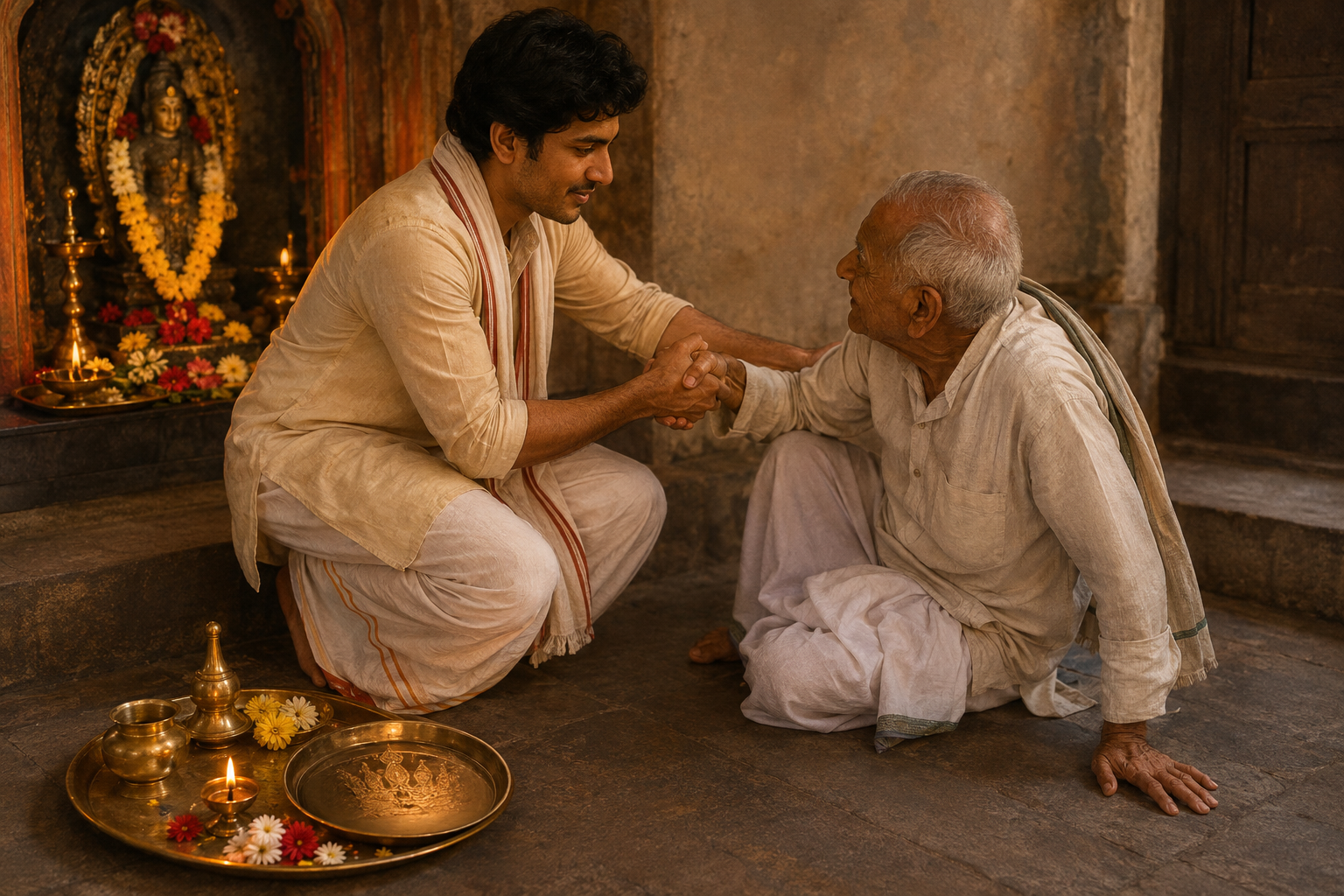
During his Detroit lecture on Hindu philosophy on 15 February 1894, Vivekananda warned that religion could become a hobby, a fashion, or a convention followed with the crowd. He even described some complacent believers as “unconscious atheists.” The phrase was severe because the problem was severe: a person can profess belief in God while arranging life as though comfort, reputation, and self-interest were the only realities that matter.
This criticism is not aimed at honest doubt. A sincere doubter may be wrestling with truth more seriously than someone who repeats sacred words but refuses every demand those words make. Vivekananda’s target was the gap between religious identity and religious transformation.
He placed self-forgetting love at the centre. That does not mean erasing your personality, tolerating abuse, abandoning duties, or becoming unable to set a boundary. It means that the ego no longer gets to make every decision around its hunger for praise, victory, possession, and control. You still act with strength, but you stop treating your own importance as the measure of everything.
You can examine your practice through three questions:
- Practice: What did you actually do: puja, japa, meditation, seva, study, kirtan, or another discipline?
- Cost: What claim of the ego did the practice ask you to surrender: the last word, public credit, resentment, convenience, or the wish to appear spiritually superior?
- Fruit: What changed in your next difficult encounter: your speech, patience, honesty, generosity, courage, or willingness to correct yourself?
The third question prevents religious busyness from masquerading as growth. More ceremonies, lectures, pilgrimages, and arguments can coexist with an untouched ego. The purpose is not to despise these forms. It is to complete them. After worship, choose a fitting action: make the apology you have delayed, share credit without advertising your generosity, fulfil an overlooked duty, or refuse the pleasure of an unnecessary insult.
If nothing in your conduct can be traced to your practice, do not immediately add another practice. First ask why the one you already have is not crossing the distance between altar and action.
Pluralism does not require surrendering conviction

Vivekananda rejected the claim that one religious community possesses the only road to spiritual perfection. His reason was not vague politeness. Good and holy people are found in different countries and outside one’s inherited faith. Their lives are evidence that spiritual possibility cannot be confined to a single label.
We never fight any religion.
Swami Vivekananda, Detroit, 1894
This is easily misunderstood. It does not mean that all doctrines are identical, that every practice is equally sound, or that harmful conduct becomes acceptable when clothed in religious language. Traditions can disagree about God, the Self, liberation, revelation, authority, ritual, and the structure of reality. Serious dialogue does not conceal those differences.
The distinction is between disagreement and monopoly. You may believe that a teaching is incomplete or mistaken without claiming that everyone outside your formulation is incapable of holiness. You may defend Dharma vigorously without needing to imagine that the Divine has left the rest of humanity spiritually barren.
When you encounter another path, use four disciplines:
- Describe it accurately. Do not refute a caricature that its practitioners would not recognize.
- Name the real disagreement. Separate a metaphysical difference from a difference in vocabulary, custom, or historical experience.
- Look at spiritual fruit. Notice whether the path can form people of truthfulness, restraint, compassion, sacrifice, and courage.
- Present Dharma without threat or contempt. Confidence can explain what is true without demanding another person’s humiliation.
This standard also applies within Hindu society. Attachment to sect, lineage, guru, philosophy, or method can become another form of ahankara. If devotion to your chosen form makes you incapable of respecting sincere devotion in another sampradaya, the label has begun to defeat the purpose.
Vivekananda’s pluralism is therefore demanding. It asks you to combine intellectual discrimination with spiritual humility. You must care enough about truth to disagree and care enough about the sacred to refuse hatred as your method.
Understand murti worship from the worshipper’s inner act
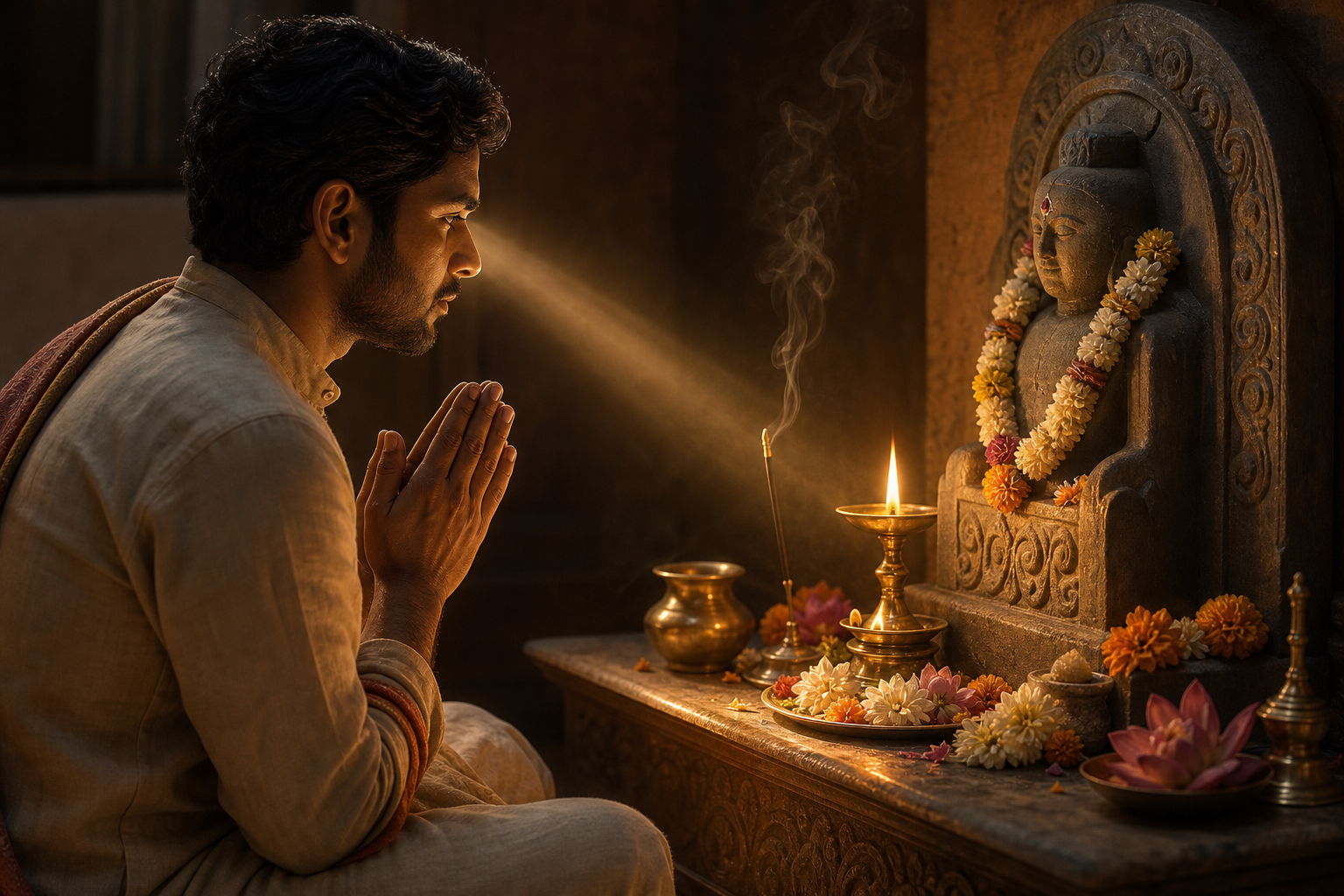
Critics of Hindu practice often judge only what is visible: a person bows before a form. Vivekananda redirected attention to what the worshipper is doing inwardly. In his Detroit explanation, the devotee stood before the image, closed his eyes, and contemplated, “I am He”.
The sequence matters. The visible form gathers attention; closing the eyes turns that attention inward; contemplation prevents the material object from becoming the final limit of thought. The form is not merely something to look at. It participates in a discipline that moves from perception toward realization.
Do not turn this particular explanation into an exhaustive account of every Hindu school. Hindu sampradayas do not all describe the relation among devotee, deity, image, and ultimate reality in identical metaphysical language. Vivekananda’s answer nevertheless corrects a basic error: an external posture cannot tell you the entire content of an act of worship.
If murti worship is part of your practice, make that inner movement deliberate:
- Arrive with one spiritual intention. Bring gratitude, surrender, clarity, fearlessness, or another quality appropriate to the deity and occasion, rather than an undirected list of desires.
- Let the form collect the mind. Attend to the murti, mantra, gesture, offering, and presence instead of performing them while mentally elsewhere.
- Turn inward. When the outer act permits, close your eyes and remain with the reality toward which the form points.
- Carry the recognition outward. Ask how the worship should alter the way you treat the next person, especially someone from whom you expect no reward.
If you are explaining murti worship to a non-Hindu, begin with the complete act rather than a defensive slogan. Describe both the outer form and the inner cognition. Ask what the worshipper understands, intends, and seeks to realize. Judging the bow while ignoring the consciousness behind it is like judging a sacred text by the shape of its letters while refusing to read the meaning.
Universal respect is not civilizational submission

Vivekananda’s openness did not make him timid before contempt. In a crowded Detroit address on 21 February 1894, he confronted the practice of sending trained and funded missionaries to India who abused Hindu religion and denounced Hindu ancestors. He also exposed the unequal expectation underneath the encounter: Hindus were expected to absorb insult quietly, while even mild criticism of American religious culture caused offence.
He then turned Christian claims back toward Christian conduct. His call to “go back to Christ” contrasted the life of Jesus, who had nowhere to lay his head, with religion preached through luxury. This was not a rejection of the spiritual greatness found in another faith. It was precisely the opposite: he took the stated ideal seriously enough to judge the society that invoked it.
That combination remains useful whenever you face an anti-Hindu caricature. You do not have to choose between indiscriminate hostility and embarrassed silence. A disciplined response has four parts:
- Identify the precise falsehood. Is the critic confusing a symbol with the ultimate reality, one historical abuse with an entire civilization, or one school with all Hindu traditions?
- Correct it from within the tradition’s own categories. Explain what practitioners intend and what the practice is meant to cultivate.
- Name a double standard when it is real. Ask whether the critic interprets other religions through their highest theology while reducing Hinduism to its crudest caricature.
- Keep self-criticism available. Defending Dharma does not require pretending that every Hindu individual, institution, or custom is beyond examination.
Universalism without self-respect becomes unilateral submission. Civilizational pride without self-examination becomes another collective ego. Vivekananda refused both. He could affirm holiness beyond Hinduism, defend Hindu practice against abuse, and ask every audience to live by the truth it claimed to honour.
This gives you a sharper standard for cultural advocacy. The goal is not to win by reproducing the opponent’s contempt. It is to correct the falsehood, preserve dignity, and make the moral standard reciprocal. A living tradition can receive accurate criticism. A self-respecting community need not accept abusive misrepresentation as the price of appearing tolerant.
Key takeaways
- Religious identity is not the same as religious transformation; examine what your practice changes in your conduct.
- Selfless love means loosening the ego’s demand for praise, control, and victory, not abandoning dignity or duty.
- The existence of holy people beyond one’s own community defeats claims of an exclusive monopoly on spiritual perfection.
- Pluralism permits clear doctrinal disagreement while rejecting coercion, contempt, and spiritual arrogance.
- Murti worship must be understood through both the visible act and the devotee’s inward contemplation.
- Respect for other religions is compatible with a firm defence of Hindu Dharma and an honest critique of hypocrisy.
At your next act of worship, identify one habit of ego that normally survives it: the need for the last word, the wish to be praised, resentment toward another group, or indifference to an inconvenient duty. Decide what contrary action will complete the worship before you leave it. Do not discard the form. Let the form bear fruit.
References
