

Your body has changed, your convictions may have changed, and the roles by which people know you can disappear without warning. Yet you continue to use the word “I” as though it points to something more stable than any one condition. What, exactly, does it point to?
The idea of jivatma gives you a precise way to investigate that question. It does not require you to deny the body, dismiss psychology, or pretend that every Dharmic tradition gives the same answer. It asks you to distinguish the person you can describe from the consciousness to whom that description appears, then test whether living from that distinction produces greater clarity, responsibility, and freedom.
Before asking whether the self survives, locate what changes

Most confusion begins because the word “self” is made to carry several meanings at once. It can mean your body, personality, memories, family identity, social position, moral character, or the bare fact that experience is present to you. These meanings overlap in ordinary life, but they are not interchangeable.
Your biographical identity is the person whose name appears on documents and whose history can be narrated. It matters. Dharma does not ask you to neglect that person’s duties. But biography is assembled from changing conditions: childhood memories, learned habits, relationships, abilities, wounds, preferences, and responsibilities. Jivatma refers to something more fundamental: the individual conscious self associated with the body-mind complex but not reducible to it. Karma and samskara connect this conscious self to an embodied history, while prakriti supplies the changing field in which that history unfolds. This is the central distinction within a Vedantic inquiry into consciousness and personal continuity.
Vedanta makes the distinction practical by separating the gross body, the subtle body, and the causal condition of embodied existence. The pancha-kosha, or five-sheath, model offers another map. Instead of telling you to believe that you are “not the body,” it gives you layers to examine:
- Annamaya kosha: the food-formed body. Its age, strength, appearance, comfort, and discomfort change, while each change becomes something you know.
- Pranamaya kosha: the vital layer associated with breath and life processes. Energy rises and falls, but its movement is noticed.
- Manomaya kosha: the layer of thought, emotion, sensory interpretation, attraction, and aversion. A thought can dominate you and then vanish.
- Vijnanamaya kosha: the discerning and deciding faculty. Even the judgment “this is right” or “I was mistaken” can be observed and reconsidered.
- Anandamaya kosha: the sheath associated with deep ease or bliss. Because this condition also appears and recedes, Vedantic inquiry does not simply equate a pleasant inner state with the ultimate self.
You can begin examining these layers without forcing a metaphysical conclusion. Sit before taking in the day’s messages or demands. Let the breath remain natural, and proceed carefully:
- Notice a bodily sensation. Name it as an experience: “pressure,” “warmth,” “tension,” or “movement.”
- Notice the condition of the mind. Is it planning, remembering, resisting, anticipating, or rehearsing?
- Notice an emotion without turning it into an identity. Replace “I am anger” with the more exact observation, “anger is present and known.”
- Notice the faculty making these distinctions. Judgment, interpretation, and attention are themselves available to awareness.
- Ask, without rushing to answer, “What is aware of all these changes?” Remain with the question instead of producing a slogan.
This exercise does not prove that an immortal entity has been found. It establishes a more modest but necessary fact: the contents of experience and the awareness of those contents should not be treated as identical without argument. That distinction is where serious inquiry begins.
What continuity and consciousness can – and cannot – establish

Three features of experience make the jivatma account philosophically compelling: continuity, first-person awareness, and moral agency. None is a knockdown proof by itself. Each identifies something that a complete account of personal identity must explain.
First, your body and mental life undergo continual alteration, yet experience retains a first-person structure. Childhood, youth, maturity, changing beliefs, and changing relationships are all gathered under “my life.” Memory helps organize that continuity, but a memory is still something presently known. The jivatma view locates continuity in the conscious subject rather than in an unchanging collection of memories or physical parts.
A process-based account can respond that no permanent substance is required: continuity may consist in an ongoing chain of physical and psychological relations. That is a serious alternative, not something to brush aside. The useful question is therefore not merely whether change occurs. It is whether an impersonal chain of change fully accounts for the subject to whom the chain appears as a life.
Second, an external account of the brain and an internal experience of pain, color, love, or grief do not seem to be the same kind of description. Neuroscience can identify increasingly rich correlations between physical activity and reported experience. Correlation alone, however, does not settle whether consciousness is produced by matter, carried through matter, or fundamental in its own right. The jivatma hypothesis treats awareness as irreducible, with the body-mind serving as its embodied field rather than its ultimate source.
The explanatory gap is not proof of jivatma. “Science has not reduced consciousness” does not logically entail “therefore the soul exists.” It does mean that a purely material conclusion should not be smuggled in as though correlation had already established reduction. Intellectual honesty requires the same restraint on both sides.
Third, you do not encounter life only as a series of causes. You also encounter reasons, obligations, and choices. A merchant deciding between fairness and easy profit is not merely describing what will happen; the merchant is considering what ought to happen. Secular ethics can take that moral space seriously, so morality alone does not prove a soul. The jivatma account nevertheless provides a coherent subject who can understand duty, bear responsibility, form tendencies, and redirect conduct.
When you weigh the view, keep the questions separate:
- Continuity: What makes changing experiences members of one life rather than an unrelated succession?
- Consciousness: Does a complete third-person description explain the presence of first-person experience, or only its observable conditions?
- Agency: Who understands a reason, accepts an obligation, and becomes answerable for a choice?
A strong case for jivatma must address all three without using one unanswered question as automatic proof of another. You are looking for the account with the greatest coherence and the fewest hidden assumptions, not the one that supplies the quickest consolation.
Do not flatten different Dharmic answers into one

Dharmic traditions share disciplines and ethical commitments, but they do not all make the same claim about personal identity. Even Vedantic schools disagree about the jivatma’s ultimate relation to Brahman or the Supreme. Those differences affect what liberation means and how spiritual practice should be understood.
| Tradition or school | Understanding of individual identity | Practical correction |
|---|---|---|
| Advaita Vedanta | Atman is ultimately non-different from Brahman; separate individuality is superimposed at the highest level of analysis. | Discriminate the witnessing consciousness from every changing identification, without turning nonduality into an excuse to neglect ethical duty. |
| Vishishtadvaita | The jivatma is real and remains a dependent mode of the Divine within unity-in-difference. | Do not confuse spiritual unity with either personal independence from the Divine or the erasure of real individuality. |
| Dvaita | The soul and the Supreme are eternally distinct. | Treat dependence, devotion, and moral responsibility as real relations, not temporary appearances to be discarded. |
| Gaudiya Vaishnavism | The jivatma is minute and eternal, finding fulfillment in loving service to the Supreme. | Shift the center of identity from possession and control toward bhakti and seva. |
These positions cannot be combined merely by saying that they are “all the same underneath.” Advaita’s ultimate nonduality, Vishishtadvaita’s unity-in-difference, Dvaita’s eternal distinction, and the Gaudiya emphasis on the minute serving soul are substantive claims. Before adopting a conclusion, ask which claim you are actually examining: that the self is eternal, that its separateness is ultimately superimposed, that it remains a real dependent individual, or that it is eternally distinct from the Supreme.
The differences become sharper beyond Vedanta. Buddhism’s teaching of anatta does not affirm jivatma under another name. It redirects attention toward dependent origination, the instability of what is grasped as self, non-clinging, and the cessation of suffering. A Buddhist discipline can sharpen your observation of impermanence and attachment without supplying a Vedantic conclusion about an eternal conscious individual.
Jain anekantavada contributes a different safeguard: reality can admit many-sided descriptions, and your chosen angle should not be mistaken for exhaustive knowledge. This is not an instruction to treat contradictions as meaningless. It is a discipline against claiming more than your standpoint can establish. Sikh remembrance of Ik Onkar, Naam Simran, and seva similarly keeps inquiry from becoming self-enclosed speculation. The question “Who am I?” must eventually affect whom and how you serve.
Across these differences, ahimsa, truthfulness, self-discipline, compassion, remembrance, and service provide shared ground. You can cooperate in these virtues without pretending that jivatma and anatta are equivalent doctrines. That combination of conviction and precision makes inter-Dharmic dialogue more trustworthy.
Test the soul-view where identity is actually threatened
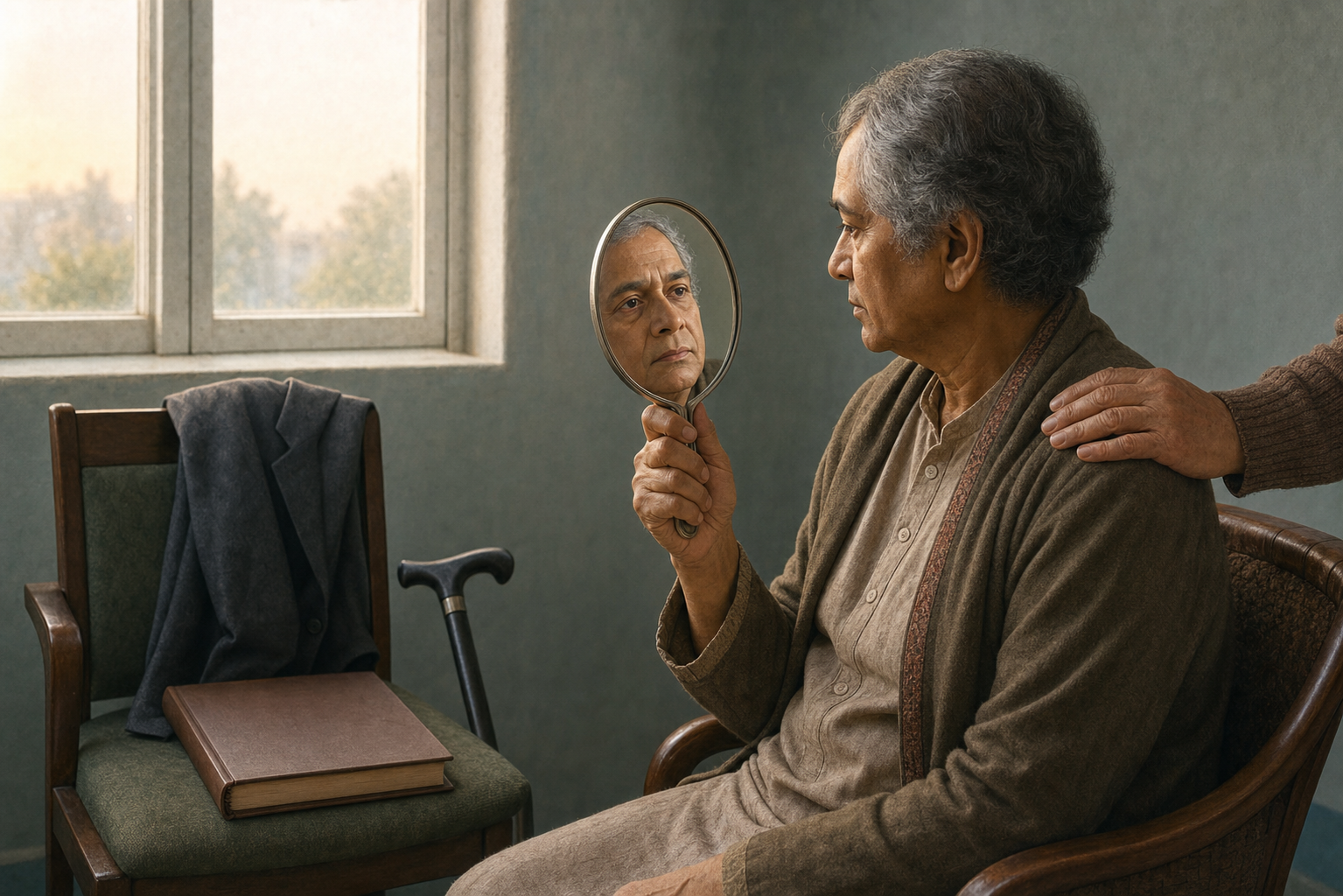
A belief about jivatma is easy to repeat while life remains agreeable. Its practical meaning appears when status is challenged, praise is withheld, an outcome is uncertain, or an old identity no longer fits. At that point, the issue is not whether you can recite “I am not the body.” It is whether you can act without allowing bodily fear, wounded prestige, or mental agitation to become your sole authority.
Vedanta’s threefold method – shravana, manana, and nididhyasana – prevents the inquiry from collapsing into either blind belief or endless abstraction:
- Shravana, systematic listening: Receive a coherent teaching in context. Study the Bhagavad Gita’s treatment of the unborn and undying self as part of its larger teaching on action, discipline, devotion, and liberation. A detached quotation is not a complete philosophy.
- Manana, critical reflection: State the reasoning in your own words and give the strongest alternative a fair hearing. Ask whether the witness is being inferred from grammar, memory, awareness, or all three. Identify where your conclusion depends on a particular Vedantic school.
- Nididhyasana, contemplative assimilation: Bring the distinction into situations that activate attachment. Notice what changes when success, failure, approval, discomfort, or anger appears. The purpose is not to suppress experience but to stop granting every passing condition the authority to define you.
You can organize ordinary practice around the same method. Begin the day with mantra-japa from your own lineage; in Gaudiya Vaishnavism, this may include the Hare Krishna mantra. Let the repetition gather scattered attention and orient it toward devotion rather than self-display. Gentle awareness of the breath can help settle attention, but a calmer nervous system is not metaphysical proof. The relevant test is what you do with the steadiness that practice creates.
At work or at home, use one difficult decision as a laboratory. Separate four things before acting: the bodily reaction, the emotional narrative, the duty belonging to your role, and the motive from which you intend to act. Then apply nishkama karma. Perform the duty carefully while loosening the demand that the result must confirm your worth. Non-attachment does not mean indifference to quality or consequence. It means that praise, possession, and control no longer have the final vote.
Karma should deepen responsibility, not fatalism. Actions cultivate tendencies, and tendencies shape future choices and circumstances. Present conduct therefore matters precisely because a trajectory can be redirected. Do not use karma to declare that another person’s suffering is deserved, and do not use a past tendency as an excuse for present conduct. The actionable question is always, “What tendency am I strengthening through this choice?”
End the day with behavioral evidence rather than a report of spiritual moods. The most useful measures of soul-oriented practice are deliberately modest:
- Was any part of mantra, meditation, or scriptural reflection genuinely undistracted?
- Did you perform any service that offered no immediate repayment, recognition, or advantage?
- After anger appeared, how long did it continue to govern speech and action?
- Did you tell the truth when distortion would have protected your image?
- Did the soul-view make you more accountable to others, or merely more certain about yourself?
These observations cannot verify immortality in the way a physical measurement verifies an object. They can reveal whether your interpretation of jivatma is reducing possessiveness and reactivity or quietly feeding spiritual ego. A doctrine that leaves conduct untouched has not yet been assimilated.
The same standard extends beyond private practice. If every living being is approached as more than disposable matter, fair dealing, kindness toward animals, ecological care, patience across differences, and solidarity with neighbors follow as expressions of dharma. Vasudhaiva Kutumbakam, the world as one family, becomes credible only when inconvenience does not cancel kinship.
Key takeaways for your next difficult decision
- Name the changing layer: Is the pressure coming from bodily discomfort, emotion, social identity, memory, judgment, or attachment to an outcome?
- Do not confuse observation with proof: Recognizing that thoughts are witnessed opens the inquiry into jivatma; it does not by itself complete the argument for immortality.
- Keep the philosophical claim precise: An eternal individual soul, nondual atman, a dependent mode of the Divine, an eternally distinct soul, and Buddhist anatta are not interchangeable answers.
- Identify your dharma before defending your image: Ask what honesty, non-harm, fairness, and responsibility require if praise and fear are removed from the calculation.
- Act without making the outcome your identity: Give the work full attention, then refuse to let success or failure determine the worth of the conscious self.
- Judge assimilation through conduct: Look for shorter rule by anger, steadier attention, truthful speech, and service that is not bargaining for a return.
The next time your identity feels threatened, do not answer immediately from the loudest layer. Notice the body, mind, role, and desired outcome. Ask what is aware of them, decide which understanding of the self you are actually committed to, and let the next action show whether that commitment has become dharma.
References
