

You often know the wiser response after the difficult moment has passed. During the moment itself, a criticism tightens your chest, an interruption heats your face, or a familiar habit pulls you forward before reflection has a chance to appear. By the time you are constructing an argument, the reaction is already under way.
Vipassana is useful precisely at that earlier point. It trains you to notice craving and aversion as changing bodily events, remain present without obeying them, and recover the freedom to choose what you do next. Compassion then becomes more than a belief. It becomes the quality of action available when anger, fear, pride, and desire are no longer making the decision for you.
The reaction begins in the body, not in the argument

A reactive episode can feel as though it begins with a thought: someone has disrespected you, something must be corrected, or an uncomfortable experience has to end. Look more closely and you may find an earlier event. The jaw has clenched. Breathing has changed. Pressure has gathered behind the eyes. Heat is spreading through the face. The thought explains the reaction, but sensation often announces it first.
A practical map looks like this:
- Something makes contact with your senses or memory.
- A pleasant, unpleasant, or neutral bodily tone appears.
- The mind leans toward keeping the pleasant experience or removing the unpleasant one.
- A story forms around that preference.
- An urge becomes speech, withdrawal, grasping, accusation, or some other action.
This is not a rigid scientific sequence. Several parts can arise almost together. It is still a useful map because it shows where practice can intervene. Trying to manufacture compassion after the story has become a prosecution case is difficult. Noticing pressure in the jaw is simpler.
At your next low-stakes irritation, postpone the analysis of the other person. Find the strongest sensation in your own body and describe it without emotional shorthand. Instead of calling it anger, notice heat, constriction, pulsing, hardness, trembling, or movement. Identify where it begins and ends. Notice whether it stays uniform or changes.
Your task is not to force the sensation away. That would merely turn aversion into a meditation technique. Stay close enough to observe some change in intensity, texture, location, or boundary. This is anicca made practical: what felt solid is revealed as an event in motion. The sensation may remain unpleasant, but it no longer has to function as a command.
Equanimity gives you a third choice

Most habitual responses fall into two families. You indulge an impulse by following it, or suppress it by pretending it should not be there. Vipassana trains a third possibility: know the impulse fully without feeding it and without fighting it.
In classical Dharmic language, raga and dvesha are craving and aversion. Craving says the pleasant must continue. Aversion says the unpleasant must stop. Both convert a passing condition into a demand. Equanimity does not make every sensation agreeable; it removes the assumption that comfort must be secured before you can act wisely.
This distinction matters outside meditation. Non-reactivity does not mean tolerating dishonesty, remaining in danger, or refusing to set a boundary. You can end a conversation, reject a demand, correct an error, or leave an unsafe situation without hatred directing the act. If immediate safety is at stake, protect yourself and seek appropriate help; a meditative pause is not a requirement before urgent action.
For a simple body-observation practice at home:
- Sit in a stable position that does not require deliberate strain.
- Move attention systematically through the body rather than chasing only the loudest sensation.
- Include pleasant, unpleasant, and neutral areas. Otherwise the scan itself becomes another form of preference.
- When an urge appears, notice its bodily expression and the demand attached to it: keep this, remove that, move now, stop now.
- Return to direct sensation whenever fantasy, memory, self-criticism, or argument takes over.
- Before getting up, observe the overall condition of the body and mind without grading the session.
Success is not a perfectly quiet mind or an uninterrupted scan. It is one reaction detected before it becomes conduct. A distracted sitting in which you repeatedly return can train exactly the capacity you need during an argument.
Do not turn bodily observation into a way of dismissing health concerns. An unpleasant sensation is not automatically dangerous, but a dangerous condition is not merely a meditation object. Stop and obtain appropriate clinical assessment for severe, persistent, unexplained, or worsening physical symptoms. If meditation brings overwhelming memories, panic, dissociation, or impaired daily functioning, pause the practice and speak with a qualified mental-health professional as well as an experienced teacher. Vipassana is not a substitute for medical or psychological care.
Compassion is non-reactivity expressed in relationship

Compassion begins when you stop treating your first aversion as a final verdict on another person. Someone can behave badly without being reducible to that behavior. You can hold the person accountable without adding humiliation, revenge, or a fantasy of their permanent badness.
This does not require sentimental feelings. It requires a clearer question. Instead of asking how to discharge your anger, ask what response now reduces avoidable harm while preserving truth. Sometimes the answer is patient listening. Sometimes it is a firm refusal. Sometimes it is an apology. Sometimes compassion for everyone affected requires a consequence.
Use these questions when a conflict activates you:
- What happened factually, before I add motive or character judgment?
- What sensation is present, and what does it urge me to do immediately?
- Am I trying to solve the problem or transfer my discomfort to someone else?
- What boundary protects dignity and truth without unnecessary injury?
- What action would I still consider right after the bodily surge has changed?
The same discipline applies inwardly. If you notice hostility and then condemn yourself for having it, aversion has merely changed targets. Accurate recognition is enough: hostility is present; it has a bodily form; it is changing; it need not be enacted. Responsibility grows from that honesty more reliably than it grows from shame.
Vipassana has a specifically Buddhist history, and the Dharmic traditions should not be collapsed into one interchangeable system. Yet its working principles have a recognizable resonance across the Dharmic family: ahimsa directs conduct away from harm; abhyasa and tapas value disciplined repetition; Jain samayik cultivates equanimous awareness; and Sikh seva turns inner orientation toward service. The common thread is practical rather than merely doctrinal. Character is trained through what you repeatedly notice, refrain from feeding, and choose to do.
This is why compassion cannot be separated from equanimity. Without equanimity, compassion is easily captured by preference: tenderness for people you like, indifference toward strangers, and moral fury toward those you dislike. With equanimity, you can oppose a harmful act without needing hatred to sustain your opposition.
Know what a ten-day Vipassana course asks of you
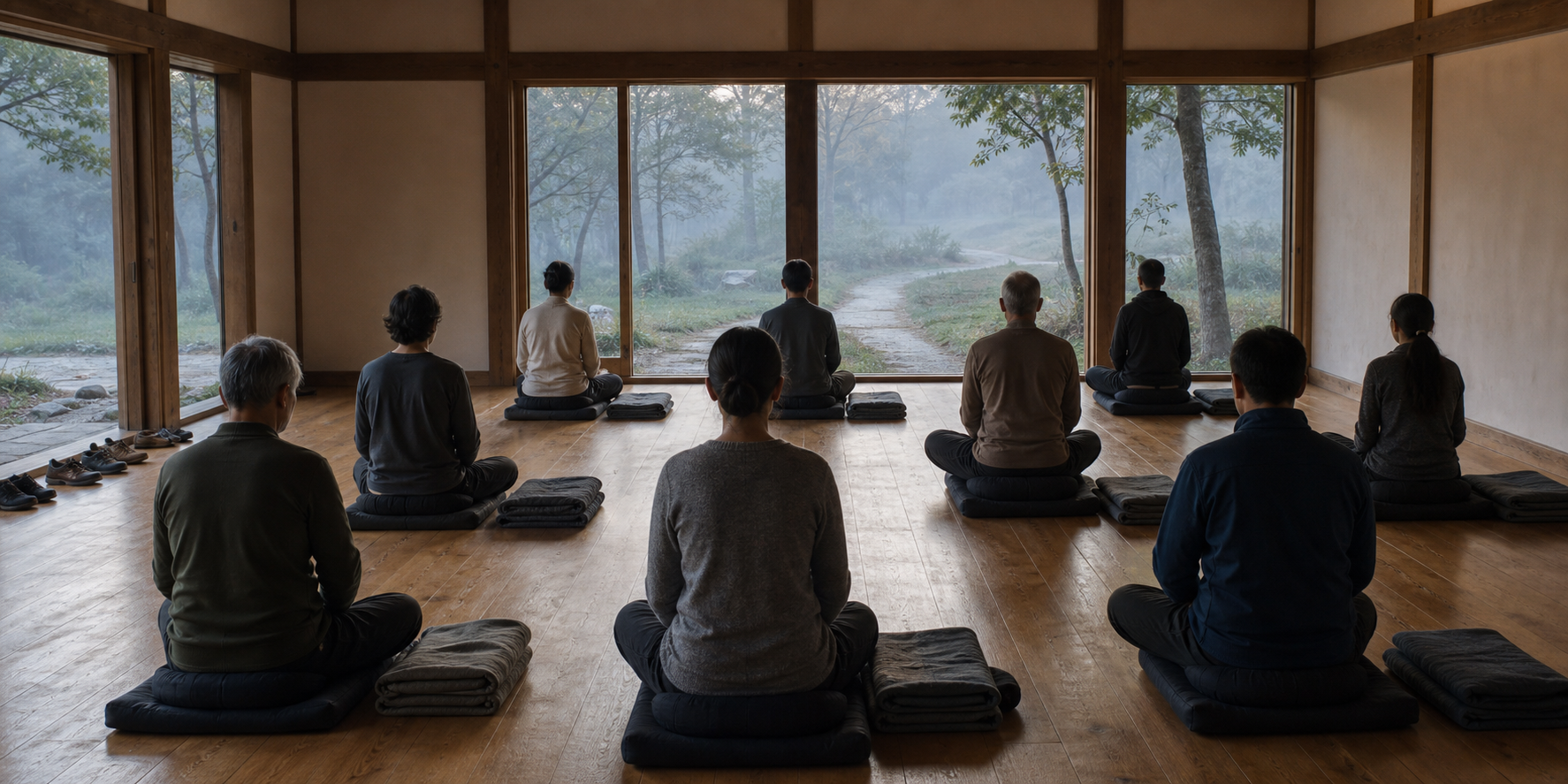
A ten-day course can provide an unusually concentrated setting for this training, but it should not be mistaken for a wellness holiday. In the format associated with S. N. Goenka, participants surrender their phones and refrain from conversation, eye contact, reading, and journaling. The day begins with a 4:00 a.m. bell, formal practice runs from 4:30 a.m. to 9:00 p.m. with breaks, and the schedule contains roughly ten hours of meditation each day. Simple vegetarian meals and evening discourses support a tightly structured environment.
The restrictions remove familiar exits. You cannot reach for a notification, seek reassurance through another person’s expression, or turn a difficult sitting into a journal entry. That does not necessarily make the mind quiet. Fantasy, worry, memory, comparison, irritation, and elaborate imaginary conversations may become more visible. Their visibility is not proof that meditation has failed. It is the material the practice has uncovered.
Before enrolling, decide on the basis of the actual discipline rather than the word retreat. Ask yourself:
- Can I enter a rule-bound environment without treating every restriction as a contest of will?
- Am I prepared to encounter boredom, discomfort, and mental noise without expecting entertainment or constant reassurance?
- Can my physical and psychological needs be accommodated safely within the course structure?
- Am I willing to follow instruction without turning the course into a personal experiment with competing techniques?
- Can I release the expectation that an intense experience must produce enlightenment, healing, or a new identity?
Obtain the current requirements directly from the centre you are considering. Discuss relevant medical or psychological conditions with the organisers and an appropriate clinician before committing. The disciplined container can be valuable, but intensity is not automatically beneficial, and endurance is not the same as equanimity.
Comparison is another trap. A person sitting motionless nearby may look serene while wrestling with an inner storm. You cannot infer another practitioner’s mind from posture, and measuring your practice against that appearance adds a new layer of craving. The useful measure is quieter: are you becoming more able to notice a reaction without immediately converting it into harm?
Use the pause in your next ordinary conflict
The value of practice appears when silence ends. Choose one recurring, manageable trigger rather than waiting for your most painful conflict. It might be a dismissive message, a family interruption, an unpleasant sound, an online provocation, or the urge to defend yourself before you understand what was said.
- Catch the cue. Identify the first bodily sign that the familiar reaction has begun.
- Ground attention. Feel contact with the chair, floor, or surrounding air so the provoking sensation is not the whole field of awareness.
- Observe without bargaining. Notice the sensation’s location, texture, movement, and urge without demanding that it disappear.
- Separate fact from interpretation. State what actually happened before assigning motive, identity, or moral worth.
- Choose the smallest honest action that does not create needless harm. Speak, set a boundary, ask a question, delay a non-urgent reply, or decline to participate.
- Review conduct rather than outcome. You cannot control the other person’s response, but you can examine whether craving or aversion chose yours.
When writing an angry message, for example, notice whether pressing send promises immediate relief. Relief is not the same as usefulness. Let the bodily demand change before deciding whether the message is accurate, necessary, and proportionate. In a family conversation, a pause should include a clear intention to return; otherwise silence can become avoidance or punishment. In an online dispute, declining to publish a contemptuous reply may be a complete act of restraint, not an unfinished argument.
Apply the same method to pleasant experience. Reactivity is not confined to anger and fear. Praise can produce grasping, success can become an identity that must be defended, and comfort can generate anxiety about loss. Observe pleasure without rejecting it and without asking it to become permanent. Equanimity is tested by what attracts you as well as by what repels you.
Key takeaways
- Catch reactivity as bodily sensation before its story hardens into certainty.
- Do not indulge an impulse or suppress it; observe it without treating it as an order.
- Equanimity is compatible with firm boundaries, urgent protective action, and accountability.
- Compassion asks which truthful response reduces unnecessary harm, not which response feels nicest.
- A ten-day course is rigorous training, not leisure or a substitute for clinical care.
- Judge practice by conduct in ordinary life: fewer compulsive reactions and more deliberate actions.
The next time a familiar trigger arrives, do not demand that you feel compassionate immediately. Find the sensation first. Let it reveal its changing nature. Then choose your words. That small sequence is where Vipassana stops being an idea and begins to shape how another person encounters you.
References
