
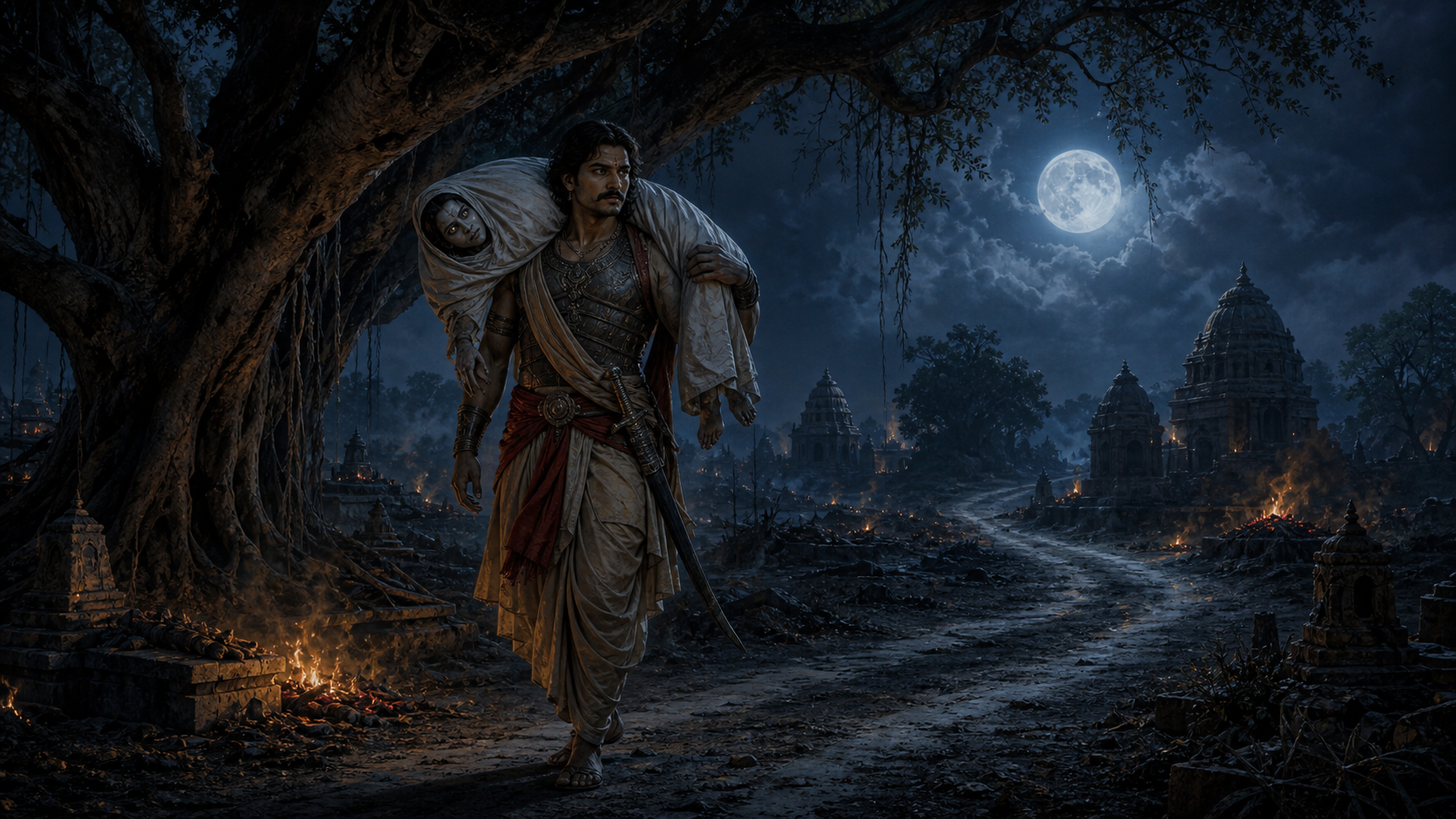
If you are trying to decide whether Betal is a ghost, a demon, a deity, or an Indian version of a Western monster, a one-word answer will mislead you. The vetala matters because it cannot be contained by one of those labels. It inhabits boundaries, unsettles the confident, and asks questions that expose the difference between a clever answer and a dharmic one.
That makes vetala mythology useful beyond the supernatural tale. Its corpse, cremation ground, unblinking gaze, and moral riddles give you a practical way to examine fear, attachment, duty, and judgment. The decisive question is not simply whether you believe such a being exists. It is whether you can recognize the human weakness that the vetala brings into view.
Why the vetala cannot be reduced to a ghost

Vetāla is the Sanskrit name behind the regional forms Betal and Baital. Across retellings, the name describes a cluster of characteristics rather than a perfectly uniform species: association with death-boundary places, the capacity to inhabit or animate a lifeless body, disturbing intelligence, and an unusual ability to uncover concealed motives.
The animated corpse invites comparison with a zombie, but that comparison stops being useful almost immediately. A zombie is usually frightening because it has lost rational agency. The vetala is frightening because it possesses too much awareness. It speaks, observes, reasons, remembers, and makes the human protagonist account for his judgment. The dead body supplies the horror, but the questioning intelligence supplies the moral force.
Nor should every subtle or death-associated being in Hindu tradition be collapsed into the same category. Terminology varies among textual, ritual, and regional settings, but the following distinctions provide a sound starting point:
| Term | Typical narrative emphasis | What to notice |
|---|---|---|
| Bhūta | An earth-bound spirit | The continuing attachment of a subtle being to a place or condition |
| Preta | A recently departed being that has not completed its transition toward pitṛ status through the appropriate rites | The importance of transition, obligation, and ritual care for the departed |
| Piśāca | A more explicitly malevolent presence | Pollution, destructive appetite, or harm |
| Vetala | A liminal, corpse-associated intelligence | Thresholds, scrutiny, unresolved motives, and tests of judgment |
Treat that table as an orientation, not an inflexible census of the unseen world. Hindu traditions preserve local distinctions as well as overlapping popular usage. Along parts of the Konkan coast and in Goa, for example, Betal also appears in village guardianship traditions. A figure that appears ominous in one setting can protect communal order in another.
This diversity changes how you should read a particular story or shrine tradition. Look first at what the vetala does. Does it deceive, test, warn, guard, possess, or disclose? The function within the narrative is more informative than a generic label such as ghost. Hindu mythology often preserves meaning through relationships and actions, not through a single standardized catalogue of creatures.
The riddle cycle turns fear into ethical pressure
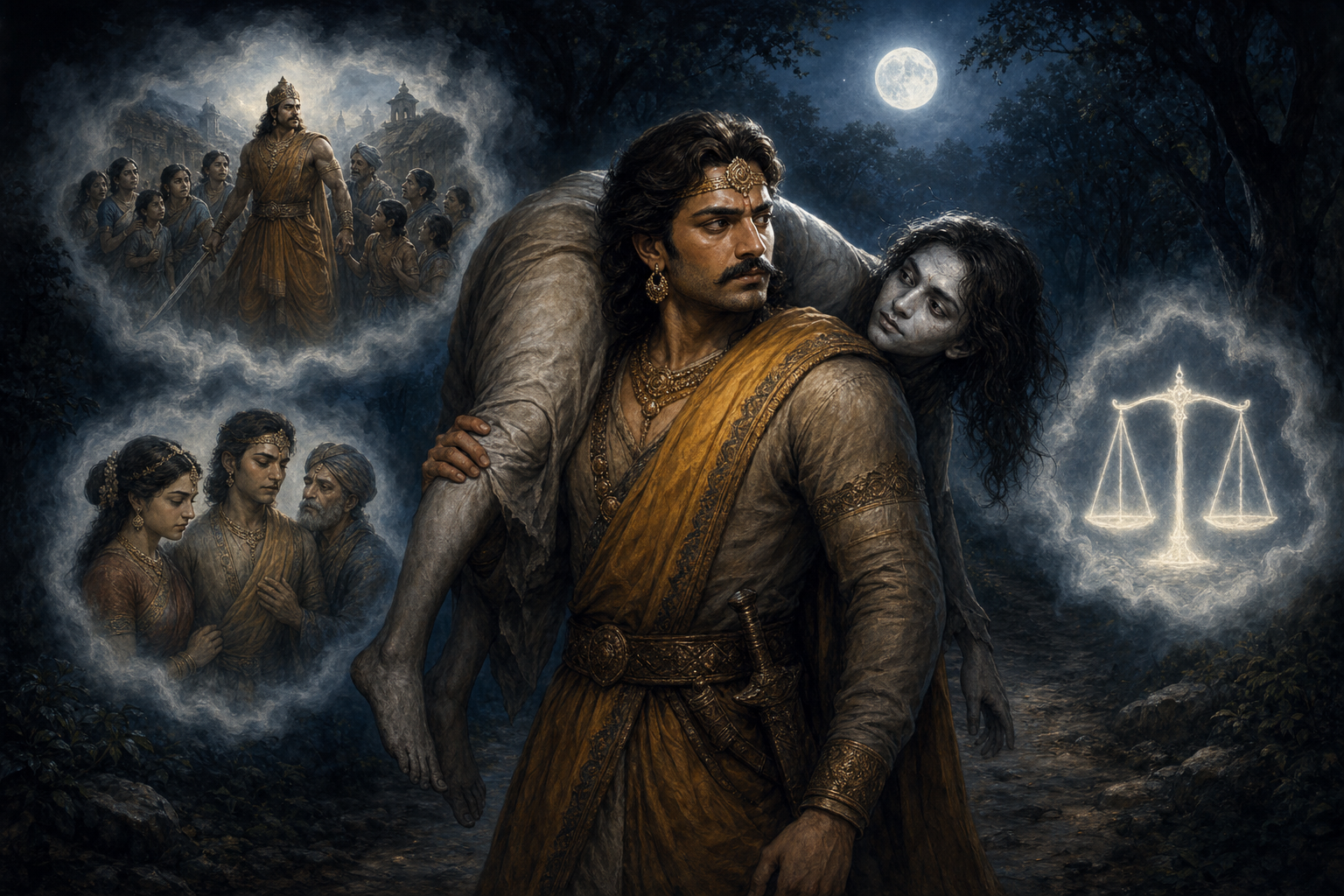
The best-known literary appearance of the figure is the Vetāla Pañcaviṃśati, widely remembered through such names as Baital Pachisi and Vikram and Betaal. In its recurring pattern, a king identified in different traditions with Vikramāditya or Trivikramasena must carry a corpse-inhabiting vetala through a cremation ground while observing a demanding vow. During the journey, the vetala tells a morally difficult story and requires the king to judge it.
The king’s problem is deliberately constructed so that an intelligent answer carries a cost. If he recognizes the answer and speaks, he breaks the required silence and loses his immediate progress. Yet silence, when he knows what justice requires, would turn restraint into evasion. The journey therefore tests more than logical skill. It asks whether truthful judgment remains binding when truth frustrates your own objective.
Four features make this structure an unusually effective school of moral reasoning:
- The cremation ground removes ordinary comfort. The king must reason while surrounded by darkness, death, and uncertainty. Ethical clarity that survives only in a safe room is not yet dependable character.
- The physical burden prevents detached theorizing. The king is not judging from a throne. He must continue carrying the very being that disrupts his plan.
- The riddle places duties in conflict. Loyalty, gratitude, kinship, promise-keeping, justice, and compassion may all make legitimate claims. The difficulty comes from deciding which claim governs the particular case.
- The answer must be explained. A conclusion without a governing principle may be a preference, an impulse, or a defense of status. Explanation reveals whether the judgment can withstand scrutiny.
This is why the vetala works as more than a villain. It behaves like an examiner who is indifferent to the king’s rank. Royal authority cannot make a weak answer correct. Courage cannot replace discernment. Even silence, normally associated with discipline, becomes ethically compromised when it is used to avoid a truth that duty requires one to state.
There is a useful warning here for anyone reading the tales as simple puzzles. Solving them quickly is not the point. The real work is noticing which relationship is biasing your answer. If you defend the ruler because he is the ruler, the relative because of kinship, or the promise because it is a promise, the vetala has already found the attachment controlling your judgment.
How to read a vetala tale as training in dharma
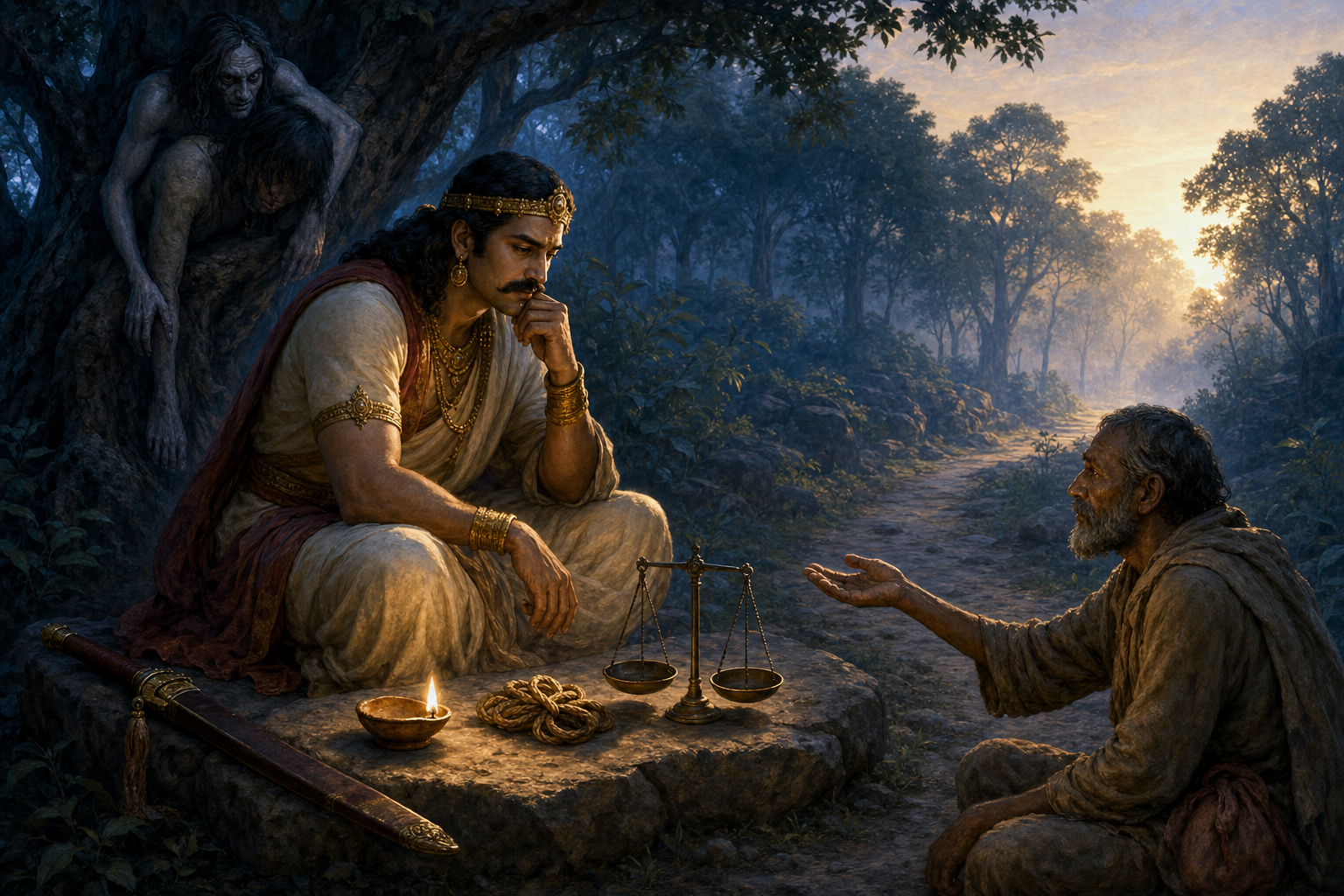
Dharma is not moral improvisation, but neither is it a mechanical rulebook in which one maxim answers every conflict. A vetala tale often gives several characters a defensible claim. Your task is to determine which claim has greater moral weight in that context and to state why. The Indic emphasis on yukti, disciplined reasoning, is essential here: context-sensitive judgment is not permission to choose whatever you already wanted.
Use this six-step method when you read one of the riddles:
- State the decision in one sentence. Strip away the supernatural scenery temporarily. Write the precise question the king must answer: who acted justly, who bears responsibility, or which duty should prevail?
- List every relevant role and promise. Identify rulers, parents, children, spouses, teachers, guests, protectors, dependants, and those who made explicit vows. A role creates a duty, but it does not automatically make that duty supreme.
- Separate conduct, intention, and consequence. Ask what each person did, what that person appears to have intended, and who was helped or harmed. A favorable outcome does not purify a selfish motive, while a sincere motive does not erase foreseeable harm.
- Find the attachment that distorts judgment. Look for fear, pride, possessiveness, gratitude, family partiality, or concern for reputation. Then ask whether your preferred answer changes when the names and social ranks are exchanged.
- Name the governing principle. Do not stop at a verdict. Complete the sentence: this duty prevails here because it protects justice, prevents a greater wrong, honors a legitimate obligation, or refuses to make an innocent person bear another’s burden.
- Test what your answer licenses. Imagine turning your reasoning into a rule for future cases. If it excuses cruelty whenever loyalty is invoked, or permits any promise to override the safety of an innocent person, the principle is too broad.
Consider a generic conflict between keeping a promise and preventing harm. Declaring that promises must always be kept is neat but incomplete. You must ask what was promised, whether the promise itself was dharmic, who will suffer from its fulfillment, and whether the person making it had the moral authority to bind others to its cost. Conversely, breaking a promise cannot be justified merely by announcing compassionate intentions. The claimed necessity must survive impartial examination.
This method also stops you from treating the king’s answer as a slogan detached from the case. A judgment may be correct because of the relationships, knowledge, and responsibilities present in that particular dilemma. Alter one of those facts and the answer may change. The durable lesson is therefore not just the verdict. It is the disciplined path by which the verdict was reached.
When two answers still appear plausible, ask which one requires less special pleading. A dharmic explanation should not depend on hiding a relevant victim, granting one favored person an exemption, or changing the principle halfway through the case. The vetala’s scrutiny is valuable precisely because it gives prestige, sentiment, and self-deception nowhere to hide.
What the corpse, cremation ground, and gaze disclose

Mythic symbols do not operate like a codebook in which every image has one permanent translation. Their meanings emerge from the work they perform in the story. The vetala’s recurring images can nevertheless direct your attention toward several consistent moral and contemplative questions.
- The cremation ground confronts impermanence. A śmaśāna is where social display, possession, beauty, and bodily certainty meet their limit. In Śaiva, Śākta, and Tantric symbolism, this is not merely a frightening backdrop. It is a place where attachment is exposed. When you encounter the setting, ask which worldly certainty the character is still trying to protect.
- The animated corpse separates appearance from agency. The body appears lifeless, yet a powerful intelligence speaks through it. As a narrative device, this disrupts an easy equation between outward form and inner identity. It also asks what unresolved desire, duty, or consequence continues to move a person after the apparent end of a matter.
- The gaze reverses the direction of judgment. The human traveler enters thinking he is the observer of a strange being. He soon discovers that he is being assessed. The wider South Asian vocabulary of dṛṣṭi and nazar expresses a cultural intuition that attention can unsettle its object, but the ethical response is steady perception rather than panic about every glance.
- The question gives fear a voice. An unnamed terror can dominate the imagination. Once it asks a precise question, it becomes something that can be examined. The vetala repeatedly converts atmospheric dread into an obligation to think and answer.
- The fierce retinue strips fear of moral authority. Vetalas appear within cremation-ground imagery associated with Bhairava and Kālī. Skulls, jackals, darkness, and unsettling attendants do not constitute permission for cruelty. They dramatize the impermanence that ordinary life allows us to avoid.
- The guardian form protects a boundary. Regional Betal traditions remind you that a threshold being need not be hostile. A village boundary, crossroads, or cremation ground marks a place where normal order becomes uncertain. The guardian’s vigilance represents the discipline required where categories and obligations meet.
These motifs become more useful when you turn them back toward yourself. What are you unwilling to acknowledge because it threatens your identity? Which unfinished obligation keeps returning after you have declared the matter closed? Are you afraid of an external watcher, or of having your own motive seen clearly? The mythology does not force a single psychological answer, but it prevents the frightening image from remaining empty spectacle.
The cremation-ground motif also permits a wider dharmic conversation without pretending that Hindu, Buddhist, Jain, and Sikh teachings are identical. Buddhist charnel-ground contemplation faces impermanence to weaken attachment and enlarge compassion. Jain reflection directs attention toward ahiṃsā, restraint, and purity of intention. Sikh practice places remembrance of the Divine Name, simran, against fear and superstition. Their doctrines and methods remain distinct, yet each refuses to grant dread the final word over disciplined awareness and ethical conduct.
Use the symbolism without feeding superstition
For a difficult decision
You do not need a cremation ground to face a vetala-like test. It appears whenever fear, loyalty, ambition, or embarrassment makes a simple moral fact hard to say. Use the following practice before a consequential conversation:
- Write the decision as a question that can be answered. Avoid vague formulations such as what should happen. Name who must do what.
- Write the duties involved in separate lines. Do not combine family loyalty, contractual obligation, compassion, and justice into one general feeling.
- Name the person who bears the cost of each possible answer. Pay special attention to anyone who has little power to object.
- Write your preferred answer and the principle supporting it. Then replace the favored person with someone you dislike and see whether the principle remains stable.
- Identify what you fear losing: approval, status, money, belonging, an image of yourself, or freedom from conflict.
- Choose the smallest honest action that moves the matter toward resolution. That may be asking for a missing fact, correcting a false statement, acknowledging a duty, or refusing to make an irreversible decision under pressure.
This exercise does not guarantee a painless answer. Vetala stories rarely confuse dharma with convenience. Its value is narrower and more realistic: it helps you distinguish the difficulty of the decision from the attachment that makes you resist examining it.
For a nightmare or frightening night experience
Nightmares, a sensed presence, or a staring figure during the transition between sleep and waking can feel completely real. Hindu households may interpret such experiences through the language of bhūtas, pretas, Amavasya, or protective ritual. Modern readers may also recognize stress-related dreams, hypnagogic imagery, or sleep paralysis. You do not have to mock one vocabulary in order to use sensible care from another.
Begin with orientation, not interpretation. Turn on a light, notice the room around you, slow your breathing, and establish whether you are fully awake. A clean lamp, mantra, prayer, sacred water, breath meditation, or simran may help restore steadiness when these are part of your tradition. If you light a flame, keep it on a stable surface and never leave it unattended.
Do not tell a frightened child or vulnerable adult that a supernatural entity is definitely present. That can intensify fear and disturb sleep long after the original event. Do not ridicule the experience either. A better response is to acknowledge that it felt frightening, help the person orient to the present room, and restore a calm routine.
Mythology can supply meaning, discipline, and devotional language; it cannot diagnose a sleep or mental-health condition. If episodes recur, create a risk of injury, cause severe distress, or impair daytime life, seek help from a qualified health professional. A spiritual practice can accompany appropriate care, but it should not be used to prevent it.
The language of the three guṇas can still serve as a reflective vocabulary. Sattva points toward clarity and balance, rajas toward agitation, and tamas toward heaviness or obscuration. Use those terms to notice the effects of conduct, stimulation, and routine on your state of mind, not as medical labels. An ordered sleep space, moderation, truthful conduct, and a regular contemplative practice make the lesson concrete: steadiness is cultivated before the frightening hour, not improvised only after it arrives.
Key takeaways
- A vetala is best understood as a liminal, questioning intelligence, not simply as a Hindu equivalent of a zombie or vampire.
- The Vikram and Betaal riddles test whether truthful judgment can survive fear, personal interest, and conflicting obligations.
- The cremation ground represents confrontation with impermanence; the corpse destabilizes easy assumptions about identity; the gaze turns the judge into the judged.
- A sound moral reading identifies roles, motives, consequences, attachments, and the principle that makes one duty prevail in a particular case.
- Devotional practices may steady you after a nightmare, but supernatural certainty should never replace practical sleep care or qualified professional help when distress persists.
The next time you meet the vetala, resist the urge to classify it and move on. Pause at the riddle. Name the duty in conflict, find the attachment hiding inside your first answer, and state the principle you would accept even if it worked against you. That is where the frightening tale begins to perform its dharmic work.
References
