

You sit for meditation, notice a thought, and ask, “Who is aware of this?” Then the harder questions arrive. Is the witness your deepest individual self, or is it Brahman itself? Is the world a barrier to realization, an appearance within consciousness, or the real body of the Divine? Does liberation end individuality or fulfill it?
You do not need to blur these questions into a vague message that “everything is one.” Vedanta becomes more useful when you keep consciousness, reality, and liberation distinct. Advaita and Vishishtadvaita then offer two coherent maps. Understanding their differences will help you choose a practice whose method actually leads toward the freedom it describes.
Begin with three questions, not one spiritual slogan
The word “consciousness” can refer to awareness itself, an individual conscious being, the mind’s changing condition, or the capacity to know. Confusing these meanings makes an apparent agreement between schools look deeper than it is.
Separate your inquiry into three questions:
- What is conscious? Ask whether awareness belongs to the body-mind, to an enduring individual self, or to Brahman as ultimate reality.
- What is the status of what appears? Ask how bodies, thoughts, objects, time, and the material universe are related to the ultimate.
- What changes in liberation? Ask whether freedom is the removal of mistaken identification or the perfected condition of a soul that remains eternally distinct.
You can apply this distinction during an ordinary moment of irritation. The angry thought is known. The bodily tension is known. The person before you is also a conscious being, not merely an object in your experience. Vedanta asks you to examine the knower, but it also asks you to understand the reality and value of what is known. A complete view must account for both.
Advaita and Vishishtadvaita draw different maps of the same terrain

These two schools share Sanskrit vocabulary and a concern with release from bondage, yet they do not use every term in the same way. The following distinctions prevent the most common category errors.
| Question | Advaita Vedanta | Vishishtadvaita |
|---|---|---|
| What is the deepest self? | Atman is identical with Brahman, the non-dual reality and unchanging witness. | Each jeeva is a real, enduring conscious self, distinct from other selves and wholly dependent on Brahman. |
| Why do we feel bound? | Ignorance produces identification with the body-mind and its changing conditions. | The jeeva’s capacity for knowledge is contracted in bondage, although its essential nature remains conscious. |
| How is the world understood? | Body, mind, pleasure, and other changing conditions are known through consciousness and cannot define the Self. | Achit, including material nature and time, is real, insentient, purposeful, and sustained by Brahman. |
| What is liberation? | The removal of ignorance and recognition that Atman is Brahman; freedom is not a newly acquired object or experience. | The liberated jeeva retains individuality, possesses uncontracted knowledge, enjoys bliss, and serves Brahman. |
| What disciplines lead toward it? | Shravana, manana, and nididhyasana: systematic learning, reasoned reflection, and steady contemplation. | Bhakti, prapatti, and kainkarya: devotion, wholehearted surrender, and loving service. |
Advaita: distinguish awareness from everything awareness knows
Advaita begins with a precise act of discrimination. Thoughts change, moods change, and the sense of personal identity changes, yet each is presented to awareness. Pure consciousness, or chit, is distinguished from chidabhasa, the consciousness reflected through the mind. Bondage continues when you treat the body-mind complex and its reflected, conditioned awareness as your final identity.
The analysis of waking, dream, and deep sleep sharpens this inquiry. The contents of waking differ from those of dream, while thoughts are absent in deep sleep. Advaita directs attention toward the unchanging witness across these changing conditions. Use this as a contemplative investigation, not as a phrase to memorize: notice what changes in each state, what can later be reported, and why no particular mental content can be the permanent Self.
This also changes what you seek from spiritual practice. Atmananda is not a pleasant mood or even the refined joy associated with a subtle mental condition. Every mood arrives, changes, and departs. The bliss of the Self is unconditional because it is not produced by an object, sensation, success, or temporary quieting of thought.
Liberation in this map is therefore not an extraordinary experience added to you. Any experience has a beginning and an end. Moksha is the removal of ignorance concerning what you have always been. That is why ethical preparation, discrimination, dispassion, disciplined attention, and a genuine longing for freedom matter: they make the mind capable of receiving and steadily assimilating the knowledge instead of converting it into another attractive idea.
Vishishtadvaita: recognize real difference within divine unity
Ramanujacharya’s Vishishtadvaita begins from another account of unity. Chit comprises the countless conscious jeevas. They are real, eternally significant, and distinct from one another, but none is independent of Brahman. A jeeva’s capacity for knowing can contract in bondage and expand in liberation; liberation does not abolish the one who knows, loves, and serves.
Achit is the insentient dimension of reality. It includes prakriti, the material substratum associated with the three gunas, as well as time. Insentient does not mean worthless, evil, or unreal. Matter has a place in the divine order and remains completely dependent on Brahman.
The central relationship is the body-soul model of chit, achit, and Brahman. Souls and the universe form the body of Brahman, while Brahman is their indwelling ruler and the only independent reality. Unity does not require the erasure of plurality. Difference is real, but it exists within an inseparable dependence on the Divine.
This map makes devotion more than an emotional aid for reaching an impersonal conclusion. Bhakti belongs to the structure of reality because the worshipper and Brahman are genuinely related. Prapatti aligns the dependent self with its divine ground. Kainkarya fulfills rather than dissolves individuality. The liberated jeeva does not disappear; its knowledge, love, and capacity for service become unobstructed.
Avoid the shortcuts that turn Vedanta into confusion

The greatest practical errors usually begin with a true term used outside its proper framework. Watch for these five shortcuts.
- “I am the witness, so my conduct does not matter.” In Advaita, ethical discipline prepares and stabilizes the mind for liberating knowledge. If witness language makes you less accountable, you are using it to protect identification rather than examine it. Correct the harm first; contemplate from honesty rather than evasion.
- “A peaceful meditation proves realization.” Peace is valuable, but a mental state remains conditioned and temporary. When calm appears, notice that it too is known. Do not turn it into a trophy or panic when it passes.
- “Witnessing means suppressing thought and emotion.” An observed thought does not have to be denied. The relevant distinction is between the changing content and the awareness by which it is known. Let the content be seen clearly before deciding how to act.
- “Achit is unconscious, so matter can be treated as disposable.” Vishishtadvaita places the material world within the body of Brahman. Apply that insight to food, consumption, technology, and the environment: use what is needed with gratitude and restraint instead of treating sacred dependence as unlimited permission.
- “All Vedantic schools reach the same conclusion in different words.” Advaita’s recognition of Atman as Brahman and Vishishtadvaita’s perfected, enduring jeeva are not interchangeable descriptions. You can respect both without pretending that individuality both disappears as an ultimate distinction and remains eternally real in the same philosophical sense.
Do not choose a school merely because one sentence feels comforting. Ask which account of self, world, bondage, and liberation you are prepared to study as a whole. A path becomes testable only when its starting assumptions, discipline, and promised freedom remain coherent with one another.
Build a daily practice that matches the liberation you seek
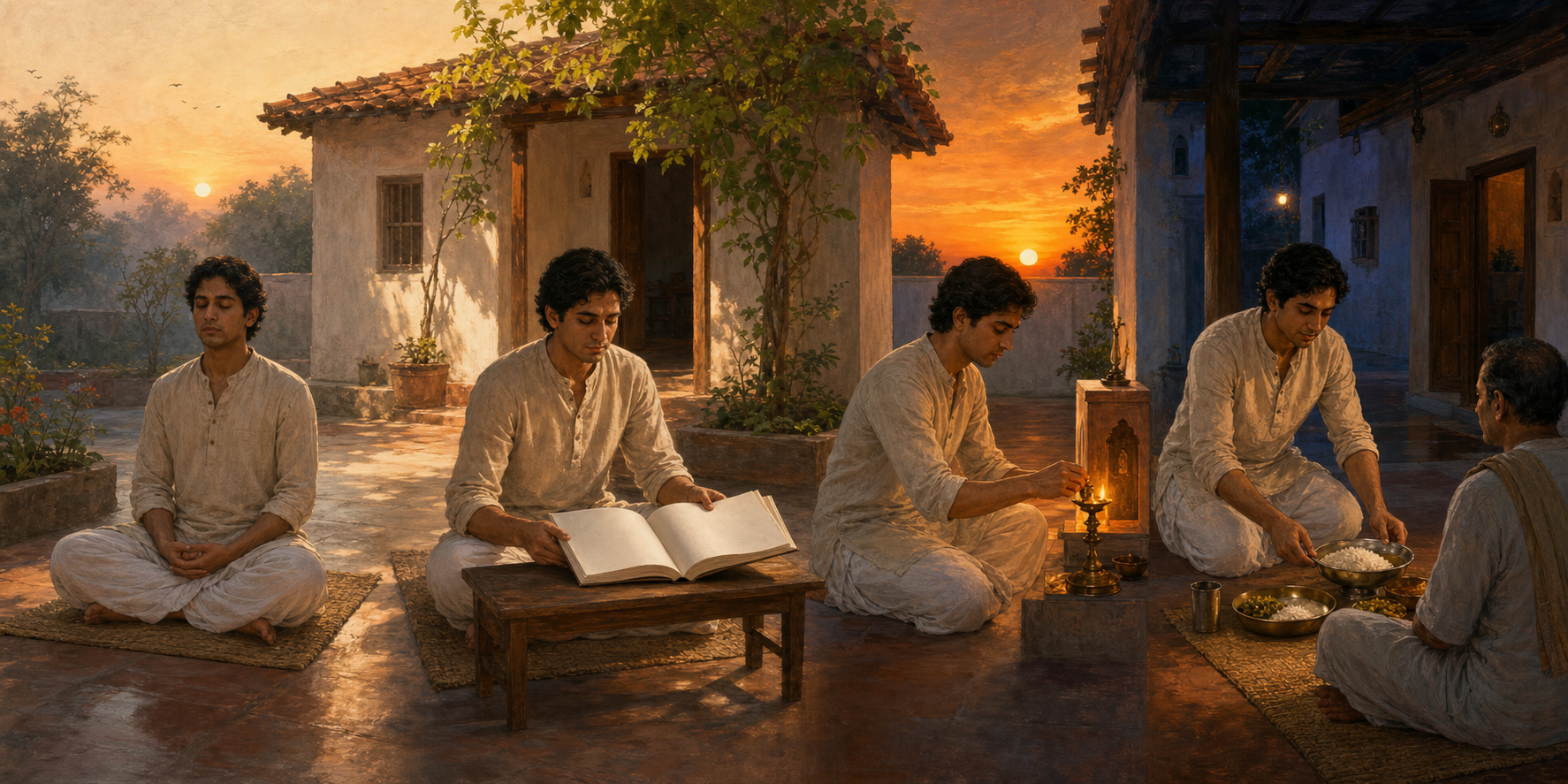
Japa, dhyana, study, contemplation, surrender, and seva can all belong to dharmic life. Their role changes with the philosophical map. Start with one primary orientation so that your practice does not move toward one goal while your beliefs describe another.
An Advaita-oriented sequence
- Prepare ethically. Bring to mind a recent moment of dishonesty, grasping, or avoidable reactivity. Decide on the concrete correction required. A disturbed conscience cannot be bypassed with metaphysics.
- Practise shravana. Study a short, coherent teaching from within a trusted guru-shishya parampara. Identify its exact claim about Atman rather than collecting inspiring lines from incompatible systems.
- Practise manana. State your strongest objection in writing. For example: “If awareness is not the mind, why does awareness appear limited when the mind is tired?” Reason through the distinction between pure consciousness and its reflection instead of suppressing the question.
- Practise nididhyasana. Sit quietly and notice sensations, images, memories, and the sense of being a meditator as known appearances. Whenever you grasp at a special state, ask whether that state is present to awareness and therefore changeable.
- Carry discrimination into action. During the next difficult interaction, notice the reaction before calling it “me.” That small separation gives you room to choose patience and truthfulness without denying what the mind is experiencing.
The measure is not how blank the mind becomes. Look for less dependence on objects and circumstances to establish completeness, less automatic identification with thought, and more equanimity when conditions change.
A Vishishtadvaita-oriented sequence
- Begin with remembrance. Use japa or another established devotional practice to turn attention toward Brahman as the indwelling and sustaining reality, not merely as an object requested to improve circumstances.
- Examine dependence. Choose something involved in your day – your body, a meal, a tool, or the time available to you – and recognize that it is real but not independently possessed or sustained.
- Practise prapatti. Identify where self-will is demanding absolute control. Offer the action and its outcome to Brahman while still carrying out your duty carefully. Surrender is not negligence.
- Make kainkarya concrete. Serve a person, community, temple, living being, or shared environment in a way that meets an actual need. Do not reduce the recipient to a prop for your own spiritual progress.
- Review your relationships. Ask whether you treated other conscious selves as bearers of real dignity and whether you treated material things as entrusted parts of a sacred order. Repair the specific failure you find.
Here the measure is not emotional intensity alone. Look for devotion becoming steadier, surrender reducing possessiveness, consumption becoming more restrained, and service becoming less dependent on praise. If the world is genuinely related to Brahman, reverence must become visible in how you handle people and things.
Key takeaways for choosing your next step
- Separate the question of who knows from the question of whether the known world is real and valuable.
- In Advaita, liberation removes ignorance of the non-dual identity of Atman and Brahman; it is not the production of a permanent pleasant state.
- In Vishishtadvaita, conscious selves and the insentient universe are real, distinct, and inseparably dependent on Brahman.
- Do not mix Advaita’s final non-duality with Vishishtadvaita’s eternal individuality as though the difference were merely verbal.
- Judge practice by reduced misidentification, possessiveness, and reactivity, together with greater ethical clarity, compassion, devotion, or service.
Your next step can be simple and exact. Write the headings “consciousness,” “reality,” and “liberation” on a page. Under each, state what you currently believe in one sentence. Then ask whether those three sentences belong to one coherent path. Where they conflict, do not invent a compromise. Take that precise question into systematic study, reflection, contemplation, and guidance within a living parampara.
When the question returns in meditation – “Who is aware?” – you will now know what else must be examined. Follow the answer through your view of the world, your treatment of other beings, and your understanding of freedom. Vedanta becomes transformative when its metaphysics and your conduct cease pulling in different directions.
References
- DharmaRenaissance Blog – Complete Guide to Chit and Achit in Ramanuja’s Vishishtadvaita: Discover Unity and Insight
- DharmaRenaissance Blog – Complete Guide to Panchadasi’s Twelfth Chapter: Discover and Master Atmananda
