
You may know Sri Caitanya through kirtana yet still wonder why devotees approach Katwa with unusual gravity. The answer is not merely that an initiation occurred there. Katwa preserves the moment when renunciation became the threshold of a wider devotional mission.
If you plan to visit, do not treat the sacred courtyard as another stop to photograph and leave behind. Approach it with three questions: what changed at Katwa, how is that change remembered, and what should become different in your own practice after you encounter it?
Katwa marks a change of direction, not a disappearance
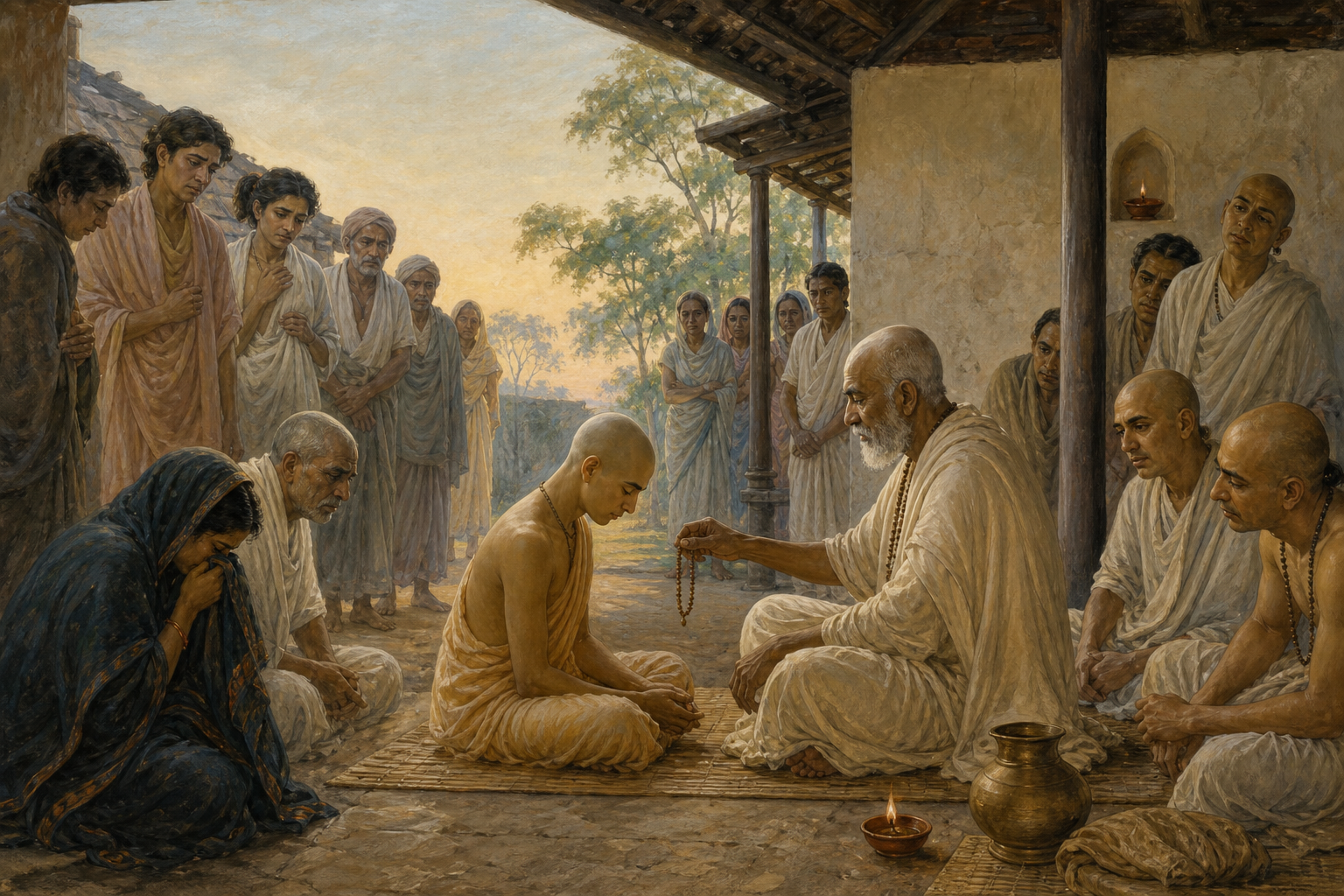
Katwa’s significance begins with a precise event: Sri Caitanya formally accepted sannyasa from Kesava Bharati Maharaja. Both parts of that statement matter. The acceptance was formal rather than an impulsive withdrawal, and it took place through a teacher rather than as a self-declared spiritual identity.
Sannyasa is often translated simply as renunciation, but that English word can mislead you. It may sound like rejection, defeat, isolation, or indifference to the world. At Katwa, the movement runs in another direction. A personal act of relinquishment becomes inseparable from a devotional life whose effects extend far beyond the individual renunciant.
This is why Katwa should be read as a hinge in Caitanya’s life. The rite is remembered as a turning point that helped propel a broader bhakti renaissance. Renunciation did not make devotion smaller or more private. It redirected identity, authority and effort toward a larger spiritual purpose.
That distinction protects you from two opposite mistakes. One is romanticising sannyasa as escape from ordinary responsibilities. The other is reducing it to a strategic change of public status. Neither captures the relationship between surrender and service that gives Katwa its devotional force. The outer rite matters, but its meaning becomes visible in what follows from it.
You therefore do not need to imitate the outward form of Caitanya’s renunciation to learn from it. The useful question is closer to home: which attachment to prestige, control or self-presentation is obstructing the service already proper to your stage of life? Katwa asks for honest examination, not theatrical renunciation.
The courtyard joins historical memory to living devotion
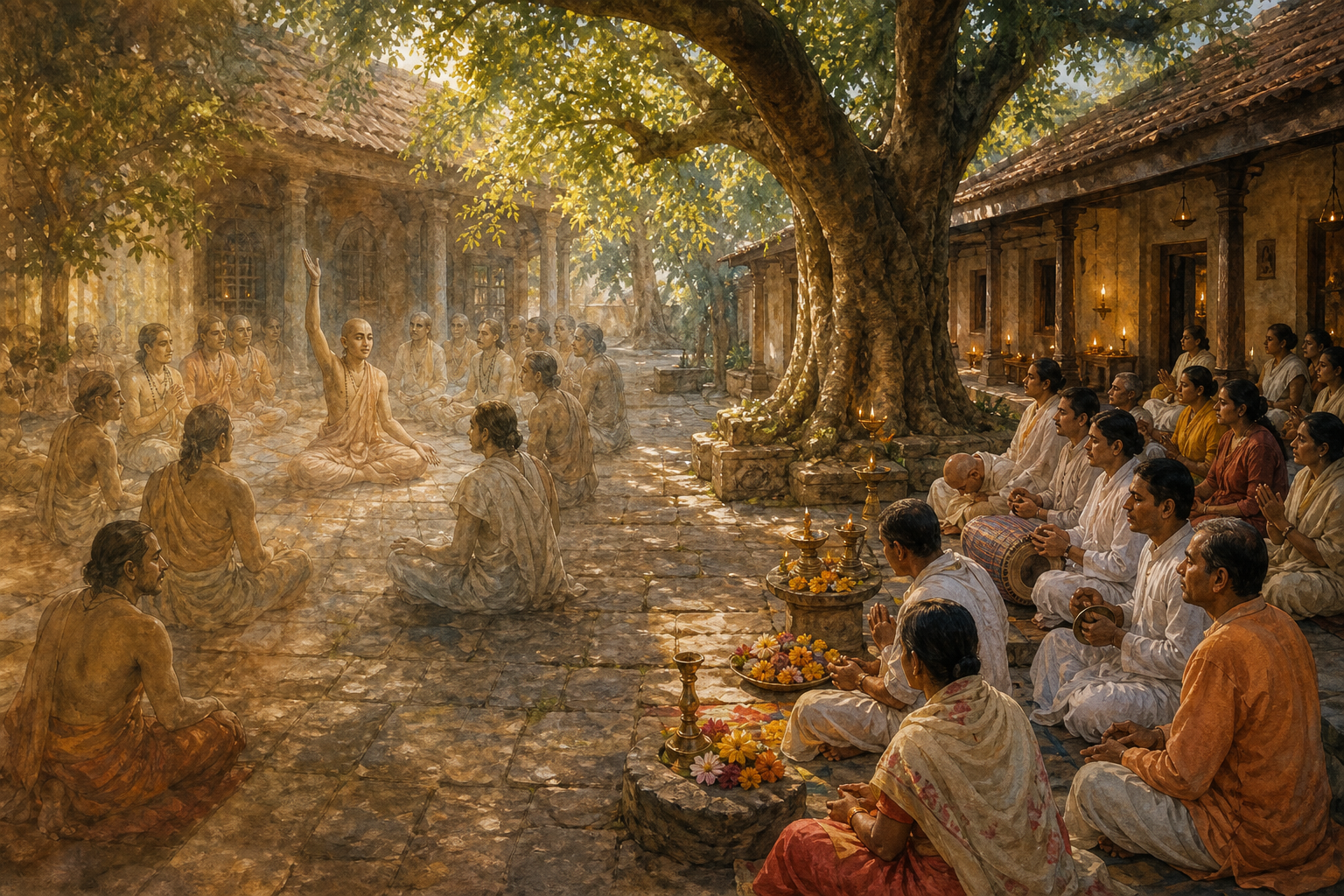
A sacred place can become either a museum in the visitor’s mind or a screen for unexamined imagination. Katwa calls for a more disciplined response. Its courtyard is revered as the place where the sannyasa rite unfolded, but the location remains meaningful because a community continues to remember, narrate and worship there.
Three layers meet in that courtyard. There is the remembered event: Caitanya’s acceptance of sannyasa from Kesava Bharati Maharaja. There is devotional interpretation: the event is understood as a decisive expression of surrender and mission. There is present practice: pilgrims hear the account, chant together and place themselves within a continuing tradition of remembrance.
Do not collapse these layers into one another. Historical attention asks what happened and where. Devotional attention asks what the event reveals about surrender, guru and service. Ritual participation asks how the memory should shape your conduct now. Keeping the questions distinct does not weaken faith. It helps you listen without demanding that one kind of knowledge perform every task.
Kirtana is especially important here. An attentive visit may include extended narration followed by sustained congregational chanting. The chanting is not background music added to a historical presentation. It is a way of receiving the memory through voice, attention and shared participation.
This changes how you should use your time at the site. Facts give you orientation, but constant information-gathering can keep the place at a distance. Allow narration to clarify the event. Then allow kirtana to do a different kind of work. Listen to the cadence, participate as local practice permits, and notice whether your attention settles or continues searching for the next spectacle.
The courtyard also teaches that sacred geography is relational. A tirtha is not meaningful only because something happened on its ground. Its memory is carried by teachers, custodians, pilgrims and practices. Respect for the place therefore includes respect for the community that has kept its significance intelligible.
How to undertake Katwa as pilgrimage rather than sightseeing
Arrive with one question worth carrying
Before travelling, complete this sentence in your own words: “At Katwa, I want to understand…” Keep the question narrow. You might ask how renunciation can deepen service, why a formal teacher-disciple relationship matters, or how kirtana preserves spiritual memory. A defined question prevents the visit from dissolving into disconnected impressions.
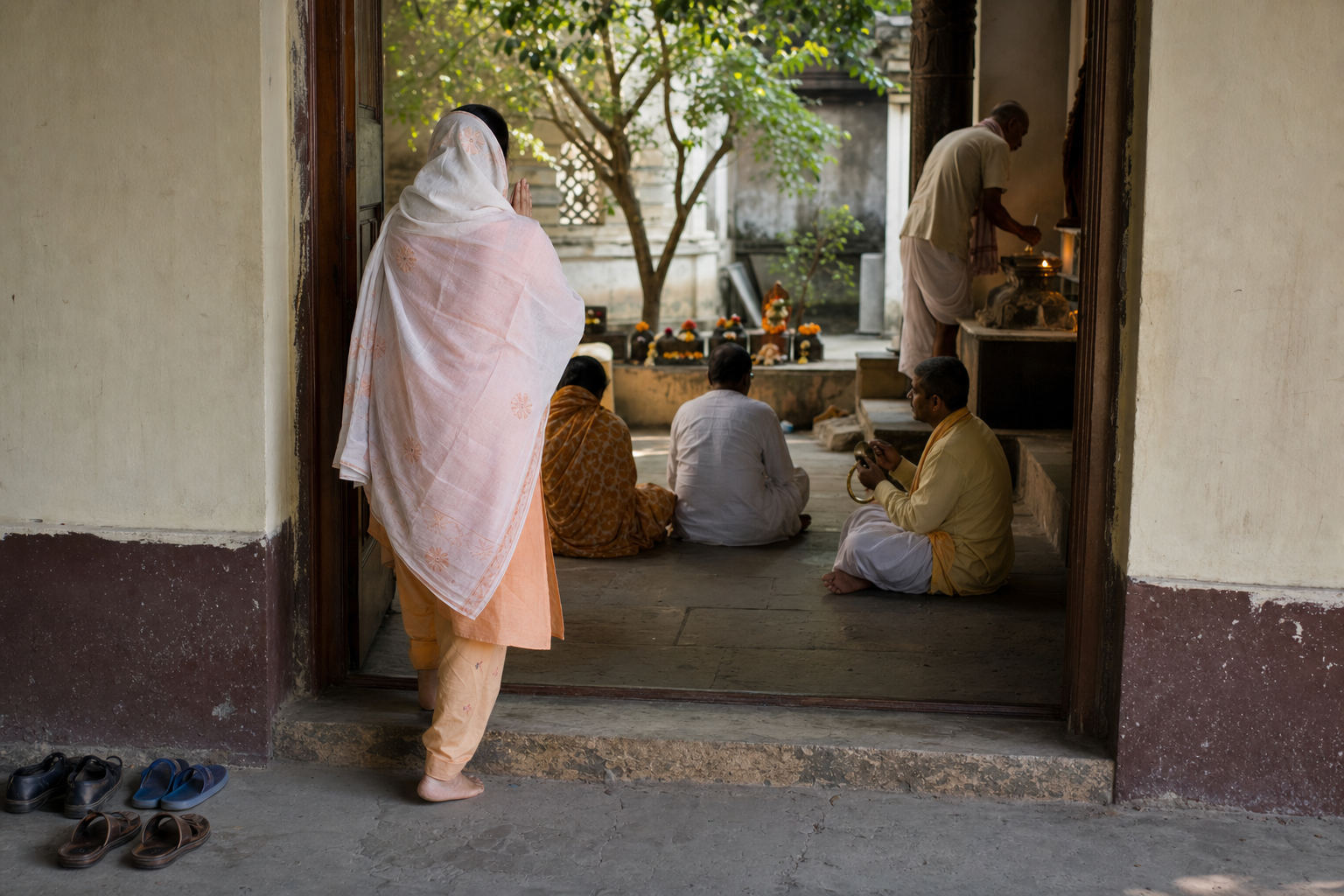
Confirm current access arrangements and practical timings with local custodians before setting out. These details can change, and devotional significance does not make unverified travel information reliable. Once there, follow local directions concerning footwear, seating, photography and participation rather than assuming that ordinary tourist habits are appropriate.
Begin with the irreducible facts
Orient yourself before reaching for elaborate interpretation. Name the place, the rite and the teacher: Katwa, sannyasa and Kesava Bharati Maharaja. This simple discipline matters because sacred narratives can accumulate details in retelling. Beginning with the secure core helps you receive further narration without confusing devotional elaboration with the basic event.
Give the narration unhurried attention
Do not listen merely for a dramatic detail that can be repeated later. Listen for structure. What does the narration present as the point of decision? How are guru, renunciation and mission related? Which part describes the outward rite, and which part interprets its spiritual meaning? These questions turn hearing into study without reducing devotion to detached analysis.
Let kirtana be practice, not a soundtrack
If congregational chanting is taking place and visitors are welcome to join, participate according to the guidance given there. Put away the urge to document every moment. Attend to pronunciation, rhythm and the shared response. If you do not know the local form, quiet listening is more respectful than conspicuous improvisation.
You do not need to manufacture an emotion. Pilgrimage is not validated by tears, excitement or an immediate sense of transcendence. Steady attention is already a meaningful discipline. The test comes later, when you see whether the visit has made your practice more regular, your service less self-centred or your speech about the tradition more careful.
Close with a commitment suited to your actual life
Do not leave Katwa with a grand promise that your responsibilities or spiritual standing cannot support. Choose one bounded response: protect an existing period of kirtana from distraction, study the meaning of sannyasa under qualified guidance, serve a devotional community without seeking recognition, or give up one habit of self-display that weakens your practice.
This is not a substitute for initiation, nor is it permission to invent private vows. Caitanya’s acceptance of sannyasa was formal and received through Kesava Bharati Maharaja. Your response should preserve that lesson about guidance rather than turning a sacred rite into a do-it-yourself symbol.
Shared dharmic values should clarify Katwa, not flatten it
Katwa can support thoughtful conversation across dharmic traditions, but only if comparison begins with specificity. This is a Gauḍiya Vaisnava sacred place associated with Caitanya’s sannyasa, Kesava Bharati Maharaja and the continuing practice of kirtana. Those particulars should be named before broader parallels are drawn.
Renunciation, compassion and self-cultivation carry importance across Hindu, Buddhist, Jain and Sikh traditions. Congregational sound also offers a point of resonance: kirtana is integral to Hindu bhakti, while musical devotion is deeply cherished in Sikh practice. Resonance, however, is not equivalence. Similar disciplines can operate within different teachings, institutions and understandings of liberation.
A responsible comparison follows a clear order. First name the tradition and event on their own terms. Then identify the shared discipline, such as renunciation or devotional music. Finally acknowledge that the traditions may explain its purpose differently. This approach produces respect without erasing inherited distinctions.
For example, you can say that Katwa preserves the Gauḍiya Vaisnava memory of Caitanya’s sannyasa and that the site can prompt reflection on renunciation across dharmic paths. You should not imply that every path understands sannyasa, monastic discipline or sacred music in the same way. Unity becomes more credible when it has room for difference.
This principle also improves cultural preservation. A sacred site does not serve harmony by becoming generic. It serves harmony by keeping its own memory intact while welcoming careful recognition of values that neighbours can understand. Katwa’s contribution to a wider dharmic conversation depends on the clarity of its Gauḍiya Vaisnava identity.
Key takeaways for understanding and visiting Katwa
- Remember the secure core: at Katwa, Sri Caitanya formally accepted sannyasa from Kesava Bharati Maharaja.
- Read the event as a redirection of identity toward a wider devotional mission, not as a simple retreat from the world.
- Approach the courtyard through historical attention, devotional reflection and present practice without confusing those distinct layers.
- Receive kirtana as disciplined participation in communal memory, not merely as atmosphere for a sacred-site visit.
- Carry home one realistic practice of surrender or service, while leaving formal vows and initiatory questions to qualified guidance.
Katwa will be most useful to you when it becomes more than an admired episode in Caitanya’s life. Before you plan the journey, write the one question you intend to carry into the courtyard. After the visit, answer it with one practice you can honestly sustain. That movement from attention to discipline is how sacred memory remains alive.
References
