

If the phrase living martyr sounds like an instruction to court death, stop there. The Sikh ideal points in the opposite direction. It asks you to remain alive to responsibility so completely that fear, comfort, anger, and self-interest cannot purchase your silence.
The real question is not whether you can suffer dramatically. It is whether you can remain truthful, useful, disciplined, and free of hatred when doing the right thing carries a cost. Read that way, Zinda Shaeed gives you a demanding but practical standard for public action, community service, and ordinary moral decisions.
Begin with witness, not death

Zinda means living, while shaheed carries the sense of a witness: someone whose conduct testifies to truth. The combined honorific describes an ethical horizon rather than a death-seeking role. Its emphasis falls on continuous, embodied testimony. A person bears witness through the use of a lifetime, not merely through the manner in which that life ends.
This distinction protects the ideal from a dangerous misreading. Pain is not automatically holy. Risk is not automatically brave. Anger is not proof of commitment, and death is not the desired result. The moral weight of sacrifice depends on what it protects, how it is undertaken, and whether it serves life rather than vanity, vengeance, or spectacle.
- Suffering without a just purpose is suffering, not shaheedi.
- Public attention without useful service is performance, not witness.
- Fearlessness without discipline becomes recklessness.
- Resistance without compassion can reproduce the wrong it claims to oppose.
- A sacrifice that needlessly endangers other people fails the protective purpose of the ideal.
The paired Sikh qualities nirbhau and nirvair sharpen the definition. To be nirbhau, without fear, is not to pretend that danger does not exist. It is to keep fear from governing your duty. To be nirvair, without enmity, is not to become indifferent to injustice. It is to oppose wrongdoing without making hatred your identity.
That combination is difficult because human beings often use one virtue to escape the other. Compassion can become an excuse for passivity; courage can become an excuse for cruelty. The living martyr accepts neither escape. You protect the vulnerable and restrain the ego at the same time.
Other dharmic traditions offer related moral images. The Hindu sthitaprajna remains steady in wisdom, while the jivanmukta embodies freedom during life. The Buddhist bodhisattva accepts an enduring responsibility toward suffering beings. Jain discipline binds conviction to vows, ahimsa, and austerity. These are not interchangeable doctrines, and their teachings about force differ. Their family resemblance lies in disciplined self-transcendence: the person accepts a cost so that truth, compassion, or the welfare of others does not have to be abandoned.
You can use that shared ground for cooperation without flattening the traditions. A Sikh, Hindu, Buddhist, and Jain need not agree on every theological question before serving food, supporting education, preserving an archive, protecting a threatened neighbour, or restoring damaged land. Dharmic unity becomes credible when it produces shared responsibility rather than merely shared vocabulary.
The saint-soldier keeps courage under moral command

The Sikh synthesis of sant-sipahi, the saint-soldier, prevents the living martyr from becoming either a passive spectator or an undisciplined combatant. The saintly dimension orders the interior life through remembrance, humility, and freedom from malice. The soldierly dimension accepts responsibility for resisting injustice and defending those who cannot safely defend themselves. Remove either half and the ideal is distorted.
The Khalsa, formed at Anandpur Sahib and entered through Amrit Sanchar, gives this synthesis a disciplined communal form. Courage is not treated as a private mood. It is joined to rehit, accountability, service, and a public obligation to uphold dignity. That is why a loud claim of bravery means little if the claimant refuses discipline or treats other people as disposable.
Two historical anchors show what Sikh shaheedi protects. Guru Arjan’s martyrdom in 1606 and Guru Tegh Bahadur’s sacrifice in 1675 are remembered through different but complementary forms of witness. Guru Arjan represents composure and spiritual sovereignty under duress. Guru Tegh Bahadur’s sacrifice is remembered as a defence of freedom of conscience, including the freedom of people outside his own community. The beneficiary of righteous sacrifice is therefore not restricted to one’s own group.
This outward concern is expressed in sarbat da bhala, the welfare of all. It gives you a way to test supposedly religious courage: does the action enlarge the field of dignity, or merely secure advantage for a faction? A deed can be costly and still be sectarian. Personal loss does not turn an unjust aim into a just one.
The eighteenth-century Sikh experience broadened the repertoire of witness through organized defence, social guardianship, and collective care. The sword and the langar cannot be read as unrelated symbols. One resists the forces that prey upon life; the other feeds and restores life. Protection that ends when the confrontation ends is incomplete. People also need food, shelter, education, trust, and institutions capable of surviving the crisis.
The idea of dharam-yudh, righteous resistance, must therefore remain morally bounded. A sound application asks whether force is necessary, whether peaceful means have been exhausted, whether the response is proportionate, whether non-combatants are protected, and whether malice has been refused. These restraints are not weaknesses attached to courage after the fact. They are part of what makes courage righteous.
- If rhetoric delights in punishment more than protection, its centre has shifted from duty to vengeance.
- If opponents must be stripped of human dignity before action feels possible, nirvair has already been abandoned.
- If dramatic confrontation is chosen before patient service, negotiation, documentation, or institution-building, sacrifice may be serving the actor’s image.
- If vulnerable people will bear most of the foreseeable cost, the plan contradicts the very people it claims to defend.
None of this requires you to make a solitary, theatrical intervention in a dangerous situation. Protecting someone can mean moving that person away from immediate danger, summoning appropriate trained help, preserving evidence, providing shelter, or joining an accountable collective response. The living-martyr ideal is not a private licence to declare war, ignore consequences, or place bystanders at risk.
Train your response before the moment of pressure
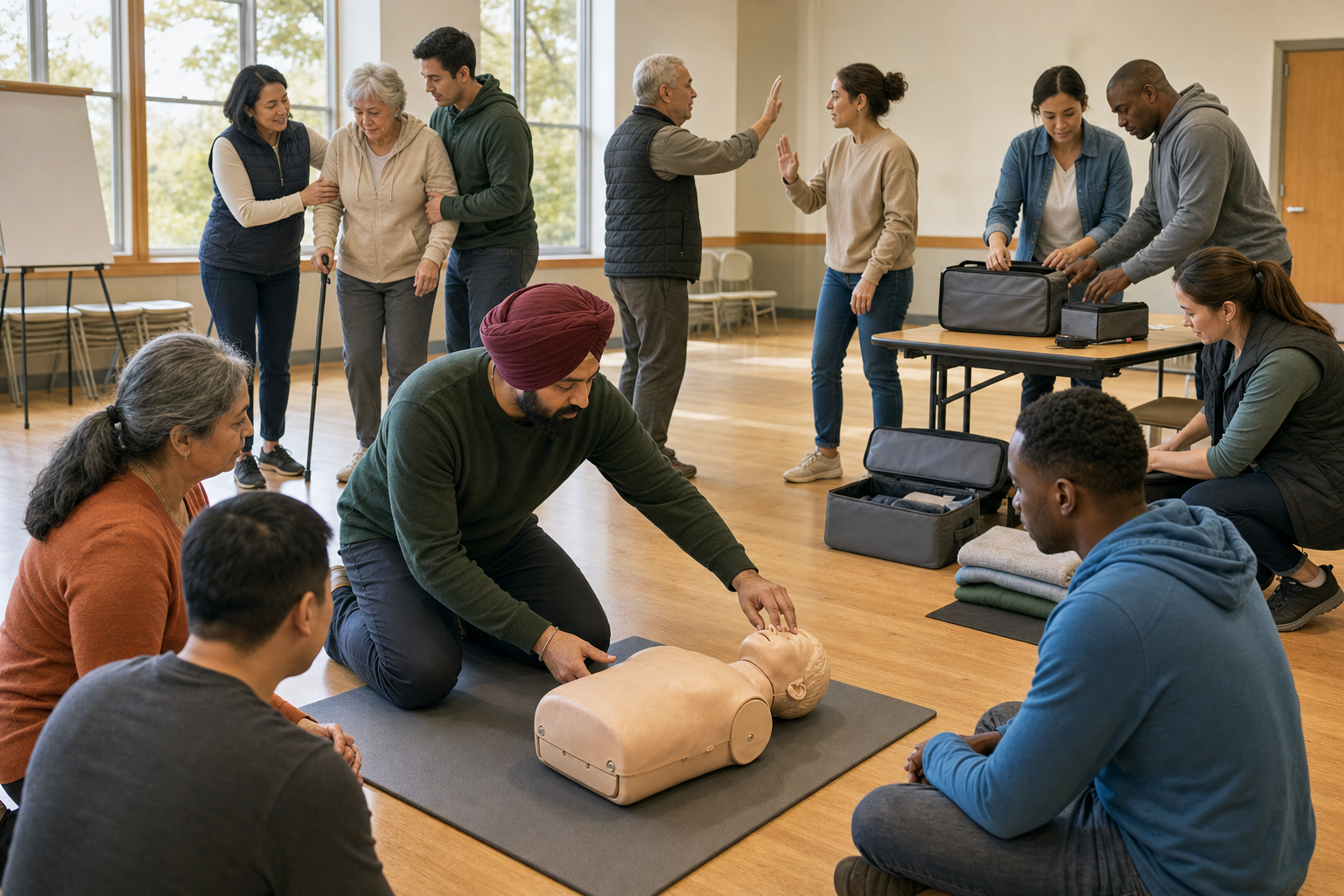
Fearless conduct rarely appears from nowhere during a crisis. Sikh practice forms it through a repeated ecology of remembrance and responsibility. Simran, seva, rehit, kirtan, ardas, and sangat perform different but connected work. Remembrance loosens the ego’s grip. Discipline reduces the temptation to improvise morality around personal convenience. Prayer places action before a horizon larger than the self. Sangat supplies correction and accountability. Seva turns intention into material benefit.
Amrit Sanchar belongs within that specifically Sikh path of initiated, rehit-centred life. It should not be reduced to an inspirational metaphor or borrowed as a productivity technique. A non-Sikh can learn from the ethical structure, but learning respectfully means recognizing the difference between admiring a discipline and claiming an initiation one has not undertaken.
For an immediate decision, you can apply the same moral sequence without pretending that it replaces rehit or guidance from a mature sangat:
- Remember before reacting. Interrupt the first surge of fear, humiliation, or anger. Ask what duty remains when the need to win the moment is removed.
- Name the person or good being protected. Replace a vague claim such as defending the community with a concrete answer: whose safety, dignity, freedom, education, food, or future is at stake?
- Invite correction. Put the intended action before people capable of challenging your ego, not only before those likely to applaud you.
- Choose a form of seva. Attach the moral stance to useful work. A denunciation without care for the affected person leaves the task unfinished.
- Account for the aftermath. Identify who will bear the cost, how resources will be handled, and what remains when public attention moves elsewhere.
This sequence reveals why quiet duties can carry the spirit of living shaheedi. Telling the truth when silence would protect your status may be witness. Keeping transparent accounts when concealment would benefit your allies may be witness. Continuing an unglamorous service after public attention disappears may be witness. The cost need not be fatal or even visible. It must be real enough that self-interest had something to gain from abandoning the duty.
Education and institution-building belong here. The Singh Sabha emphasis on education, ethical reform, and durable institutions shows that courage can operate through classrooms, publications, and organized welfare. A school that forms truthful, scientifically capable, civically responsible graduates may defend a community more deeply than a season of angry speeches. The key is not to romanticize the institution either: stewardship must be transparent, teachers must be accountable, and service must reach the people named in its mission.
The honorific itself also demands historical discipline. Regional memory can attach titles such as Zinda Shaeed to different people or preserve different details about the same figure. Bhai Takhat Singh is associated with the title in particular narratives, especially in connection with service and educational uplift, but reverence should not be used to manufacture certainty where the record varies.
If you teach, publish, curate, or share such a history, separate three things: the moral meaning of the honorific, the community that preserves a particular attribution, and the biographical details that can be documented. Check the provenance of letters and records. Label oral history as oral history. Preserve regional variants instead of silently combining them. Record who supplied a recollection and when. This care does not weaken sacred memory. It prevents a worthy life from being made dependent on claims that cannot withstand examination.
Use five questions when duty becomes costly
The living martyr is best understood as a decision standard, not as a label you claim for yourself. Before speaking, resisting, donating, organizing, or asking anyone else to accept a risk, work through five questions.
- Is it truthful? Can you state the case without an unverified allegation, an exaggerated number, an edited fragment, or a derogatory description of an entire group?
- Who is protected? Can you identify the vulnerable person, freedom, shared resource, or public good that benefits? If the only clear beneficiary is your reputation or faction, stop.
- Are the means restrained? Use the least harmful effective means. If coercion or force is contemplated, ask whether it is necessary, proportionate, a genuine last resort, and protective of uninvolved people.
- What is governing your interior state? Fear may be present, but it cannot be commander. Anger may alert you to a wrong, but enmity cannot choose the target or method.
- What constructive remainder will exist? Look for a fed family, a safer person, a preserved record, an educated student, restored land, a functioning institution, or another observable form of welfare.
When the conflict is online
Digital outrage rewards speed, humiliation, and tribal certainty. A living witness slows down long enough to verify the claim, preserve relevant evidence, correct falsehood without a communal slur, and distinguish a person’s wrongdoing from the dignity owed to every person. If someone has been harmed, move attention toward a concrete remedy. Repeating an inflammatory claim merely to condemn it can enlarge the harm while creating no protection.
The practical test is simple: if deleting the performative part of your response leaves no useful action behind, the response is not finished. Add the call, donation, correction, archive, referral, or organized service that assists the affected person. Do not confuse reach with result.
When the responsibility belongs to an institution
A gurdwara, school, relief group, cultural body, or community association cannot rely on noble language alone. Institutionalized compassion needs clear responsibility for funds, selection criteria that can be explained, records that can be examined, and a way for affected people to raise concerns. Transparent stewardship is a form of witness because opacity often protects comfort and status at the expense of trust.
Langar and relief work show why hospitality must be organized as well as heartfelt. Identify the actual need, the intended recipients, the people responsible for delivery, and the plan for continuity. During a crisis, the visible distribution may be only the first stage. Recovery also requires a handoff to stable local care, education, health support, or livelihood assistance where those needs exist.
When the threatened life is ecological or cultural
Protecting Punjab’s aquifers, reforesting common land, and greening gurdwara precincts are contemporary forms of responsible seva. Ecological degradation usually rewards neglect in the present while transferring the cost to farmers, families, and future generations. A living-martyr ethic refuses that transfer. It pairs concern with measurable custodianship: a named site, responsible stewards, maintained records, and care that continues after the ceremonial launch.
Cultural preservation requires similar seriousness. Digitizing a manuscript is not enough if its origin, date, language, ownership, and chain of custody disappear. Oral histories need consent, attribution, contextual notes, and searchable metadata. Multilingual repositories can widen access, but trustworthy access depends on distinguishing an original item from a transcription, translation, commentary, or later recollection.
These fields may appear far removed from martyrdom because no battlefield is visible. That is precisely why the word living matters. A civilization also loses life through exhausted soil, vanished records, dishonest institutions, neglected students, and communities trained to substitute grievance for capacity. Long service confronts those losses before they become irreversible.
Key takeaways
- Zinda Shaeed means a continuing witness to truth, not a person seeking death or suffering for its own sake.
- The Sikh saint-soldier joins courage to remembrance, discipline, humility, protection, and freedom from enmity.
- Shaheedi is judged by the life or dignity it protects, not by the drama, visibility, or personal cost of an action alone.
- Truthful speech, restrained means, accountable stewardship, and constructive seva distinguish principled resistance from performative outrage.
- Education, langar, relief work, ecological care, and trustworthy historical preservation can all carry the living-martyr ethic.
The next time you hear a shaheedi narrative, do not stop at admiration. Choose one living continuation of its duty. Name who will benefit, what truthful action is required, what comfort you are prepared to surrender, who will hold you accountable, and what useful result should remain.
Then begin with the burden already within reach: a service shift that needs consistency, a student who needs support, a threatened neighbour who needs an accountable ally, a neglected record that needs preservation, or a shared resource that needs a steward. You do not need to call yourself a living martyr. The name matters less than becoming a reliable witness to life.
References
- SikhNet – Bhai Takhat Singh and the ‘Zinda Shaeed’ Ideal: Sikh Courage, Education, and Dharmic Unity
