
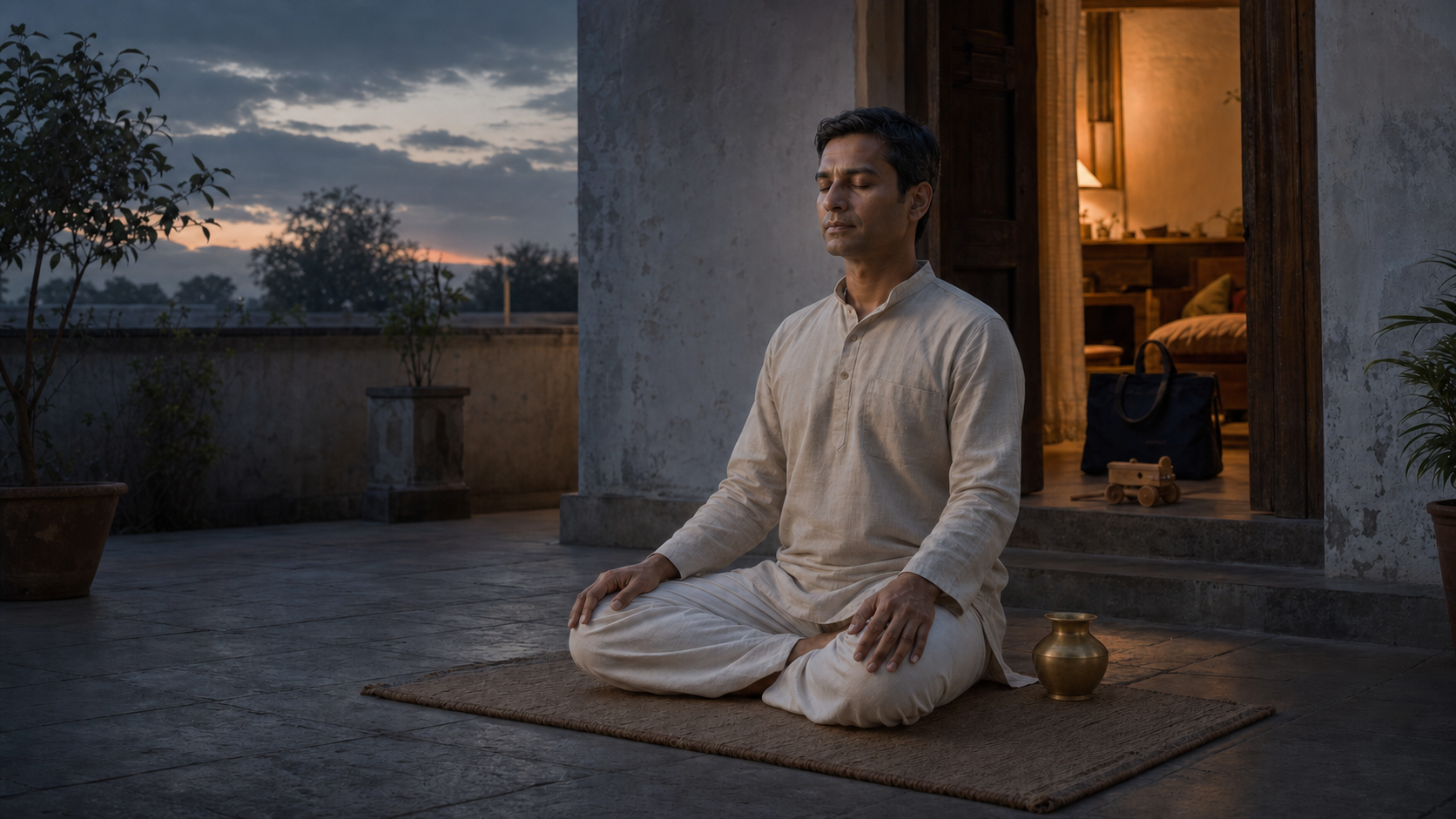
You may feel drawn to the Tapasvi ideal yet wonder whether it leaves any place for family, work, community, or ordinary human affection. The useful question is not whether you can imitate the outward life of a renunciant. It is whether every sight, appetite, emotion, and thought can still command you.
The Tapasvi gives you a demanding measure of inner freedom. It separates spiritual appearance from spiritual mastery, while also showing how disciplined restraint can begin long before the mind becomes completely still.
The ideal begins where spiritual performance ends
In ordinary use, Tapasvi can refer broadly to an ascetic practitioner. The uncompromising ideal goes much further: a Tapasvi is not made by temporary meditation or seasonal withdrawal; outward sight, sensory activity, action, and even mental movement have come to rest. This is not occasional concentration. It is an enduring inward condition.
That severity matters. If the word is reduced to anyone who fasts, sits silently, wears austere clothing, or spends time in seclusion, its challenge disappears. Yet the opposite mistake is just as serious: copying the physical appearance of the completed state and calling the imitation realization.
Closing your eyes does not by itself end your dependence on appearances. Refusing food does not necessarily weaken greed. Remaining silent can conceal an argument that continues in the mind. Withdrawing from society can remove temptation, or it can merely remove the people who contradict you. The outward act tells you very little until you examine the attachment beneath it.
- Seclusion is not proof. You can carry comparison, resentment, and fantasy into a quiet room.
- Discomfort is not proof. Pain can strengthen vanity when it becomes evidence of being more serious than other people.
- Silence is not proof. Speech may stop while accusation and self-justification continue internally.
- Reputation is not proof. Needing to be known as disciplined is another form of dependence on the outer world.
Use a simpler test: what has become less capable of controlling you? If a practice makes you more truthful, less reactive, and less hungry for recognition, something real is happening. If it mainly creates a spiritual identity, the practice may be feeding the very outward orientation it is supposed to burn away.
Four gates show whether your tapas is becoming inward

The severe description of the Tapasvi identifies four movements that have fallen quiet: looking outward, following sensory demands, rushing into action, and producing thought. You should not pretend that preliminary discipline equals their complete cessation. You can, however, use each movement to find the point at which you are still being pulled.
Look at what captures your eyes
Visual attention rarely announces itself as bondage. It appears as another glance at a message, another check of someone else’s status, another product inspected without need, or another image consumed because stillness feels uncomfortable.
Before opening an app, a feed, or a shopping page, state the purpose in plain language. If you cannot name what you intend to do, do not open it yet. This is not the Tapasvi’s final withdrawal from sight. It is a practical way to discover how often sight recruits the mind before choice has entered the process.
Distinguish enjoyment from obedience
A sense object is not automatically an enemy. The revealing question is whether you can encounter a pleasant taste, sound, comfort, or possession without needing repetition, possession, or immediate satisfaction.
Choose a boundary attached to a familiar activity. Keep the phone away from the place where you pray. Eat without adding a second stream of entertainment. Let music end without immediately replacing it. The boundary should expose compulsion, not manufacture suffering. Notice the moment enjoyment becomes bargaining: just a little more, just this time, just because the day was difficult.
Interrupt the jump from impulse to action
The capacity to act gives every passing state a route into the world. Anger becomes a message. Envy becomes belittling speech. Fear becomes avoidance. Desire becomes an unnecessary purchase. Tapas appears in the interval where the impulse is fully felt but not automatically obeyed.
When you are angry, do not use restraint to evade a necessary conversation. Delay the reply until you can state the truth without using it as punishment, and then perform the duty that remains. Mere inactivity is not mastery. The practical achievement is action freed from the first command of the impulse.
Treat thoughtlessness as an attainment, not an order
The completed Tapasvi is described as holding no thought. A beginner cannot reach that condition by angrily commanding the mind to become blank. The command itself becomes another thought, followed by frustration, measurement, and self-judgment.
During prayer, japa, or meditation, notice a thought without opening negotiations with it. Return to the chosen focus. Do the same when a fantasy offers pleasure, a grievance asks to be rehearsed, or an imagined argument demands another hearing. You are training non-cooperation with mental movement; you are not claiming that movement has permanently ceased.
A householder must not make other people pay for austerity

The Tapasvi’s complete inward withdrawal cannot be copied casually by someone whose duties still require outward action. If children, elders, colleagues, or a community legitimately depend on you, disappearing from responsibility is not made sacred by calling it renunciation.
Apply a consequence test before adopting a discipline. Ask who will carry the work, cost, uncertainty, or fear created by your choice. If your austerity gives you spiritual satisfaction while quietly transferring your responsibilities to someone else, it is not merely a private practice.
- Does the practice help you keep promises more reliably, or does it make ordinary obligations seem beneath you?
- Does it reduce harsh reactions, or give you a new reason to judge people with different disciplines?
- Does it clarify what is necessary, or make family members manage the consequences of an avoidable extreme?
- Would you continue the practice if nobody knew about it?
- Can you stop or revise it when duty clearly requires a change, without treating flexibility as spiritual failure?
This does not mean comfort should always win. It means restraint must be honest about its consequences. A demanding practice may inconvenience you; it should not become a concealed method of controlling, neglecting, or humiliating other people.
Do not infer dangerous physical practices from the Tapasvi ideal. Severe restriction of food, deliberate loss of sleep, prolonged isolation, self-inflicted pain, or stopping medical treatment can cause real harm. If a discipline affects nutrition, sleep, medication, or mental stability, seek guidance from a qualified spiritual teacher and an appropriate healthcare professional. Spiritual austerity is not a substitute for medical or psychological care.
Begin with the next impulse that usually defeats you

You do not need an invented ordeal. Begin where your freedom is already compromised. The most useful practice is often attached to a small, recurring moment because that is where self-deception has become routine.
- Name the pull. Choose a recurring impulse such as checking the phone when uncomfortable, replying while angry, buying for relief, repeating gossip, or seeking praise for an act of service.
- Set a visible boundary. Attach it to the situation itself: the phone remains outside the prayer space, no message is sent in the first heat of anger, and an unverified accusation is not repeated.
- Meet the urge without bargaining. Notice what the mind promises will happen if you obey. Do not argue with every promise. Let the urge be present while the action remains unperformed.
- Complete the duty behind the emotion. Restraint should leave you able to pray, work, apologize, speak truth, care for someone, or make a necessary decision. Do not confuse avoiding action with purifying it.
- Conduct a private accounting. Before sleep, ask: What pulled me outward? Where did I obey immediately? Where did I retain the ability to choose? Record the answer for accountability, not self-congratulation.
Success is not a dramatic experience or a blank mind on command. At this stage, success is a little more space between stimulus and response, followed by a cleaner action. When a boundary becomes easy, do not create pain merely to feel advanced. Deepen the same discipline or apply it to a more consequential attachment.
Keep most of this work quiet. A trusted teacher or accountability companion may need to know what you are practicing, especially when correction or safety is involved. A wider audience usually does not. Public narration can turn restraint into a source of recognition before it has touched the underlying need to be seen.
Key takeaways
- The complete Tapasvi ideal concerns enduring freedom from outward sensory, active, and mental movement, not an occasional display of austerity.
- An external form has value only when it weakens compulsion rather than strengthening pride, avoidance, or spiritual identity.
- For everyday practice, examine what captures sight, commands the senses, rushes into action, and keeps thought circulating.
- If you still hold family or social duties, judge austerity partly by its effects on the people who legitimately depend on you.
- Begin with a recurring impulse, set a concrete boundary, remain present to the urge, and then perform the duty that remains.
- Do not improvise practices that endanger food, sleep, medication, physical safety, or mental stability.
At the next moment when an impulse normally becomes action, do not ask whether you look like a Tapasvi. Ask whether you can remain fully present without obeying it. Keep the boundary, complete your duty, and let that quiet act of freedom reveal where the deeper work must continue.