
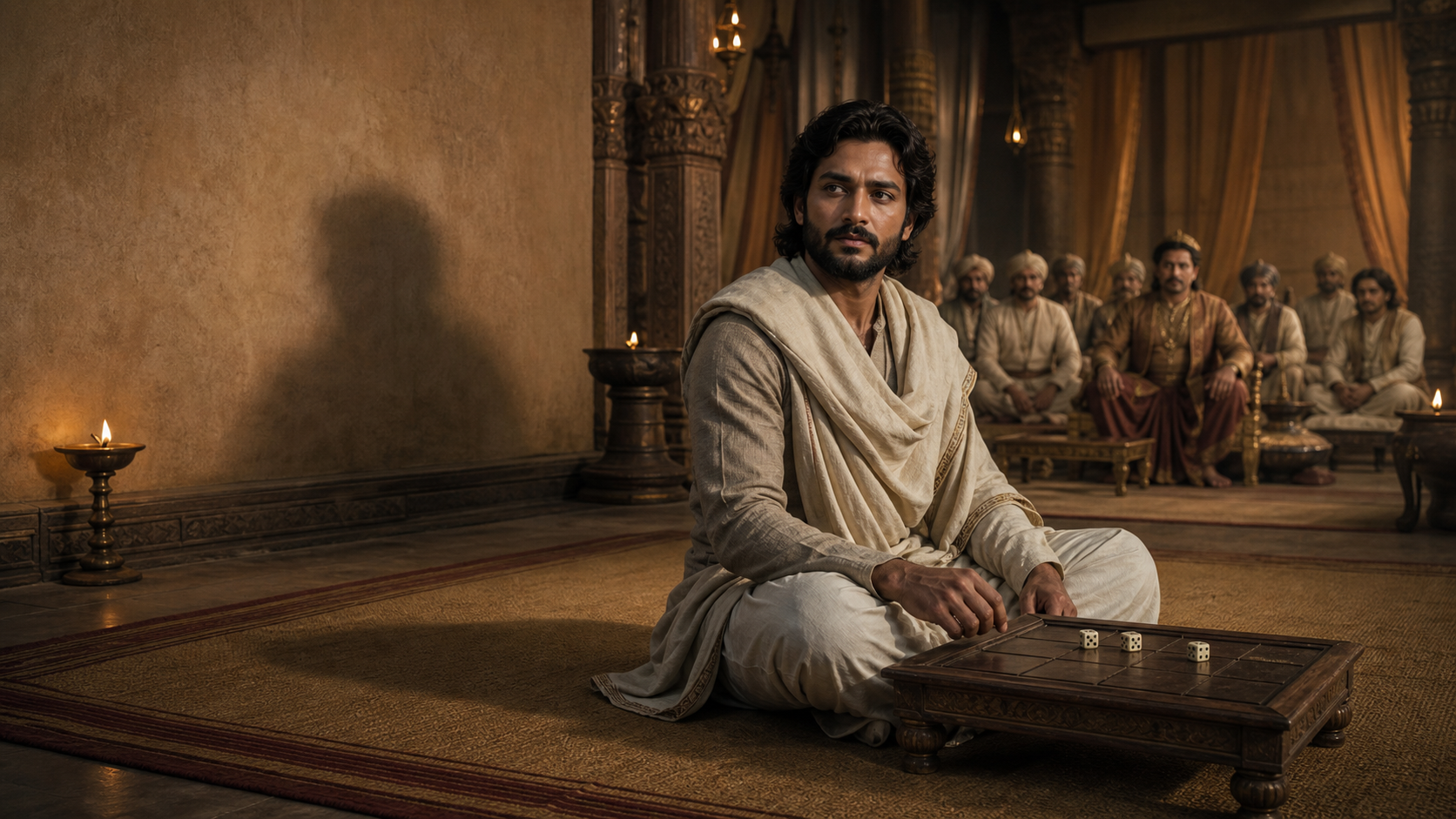
The puzzle is hard to miss. After dice had cost Yudhishthira his kingdom, freedom, honour and family security, why would he make dice part of his disguise in Virata’s court?
Reading this merely as another bout of gambling makes his choice look absurd. Reading it as proof that he had completely conquered temptation goes too far. His identity as Kanka belongs in the narrow space between those conclusions: Yudhishthira turned knowledge associated with his gravest public failure into a controlled means of protecting the Pandavas during their most vulnerable year.
Kanka’s dice were a disguise, not another royal wager
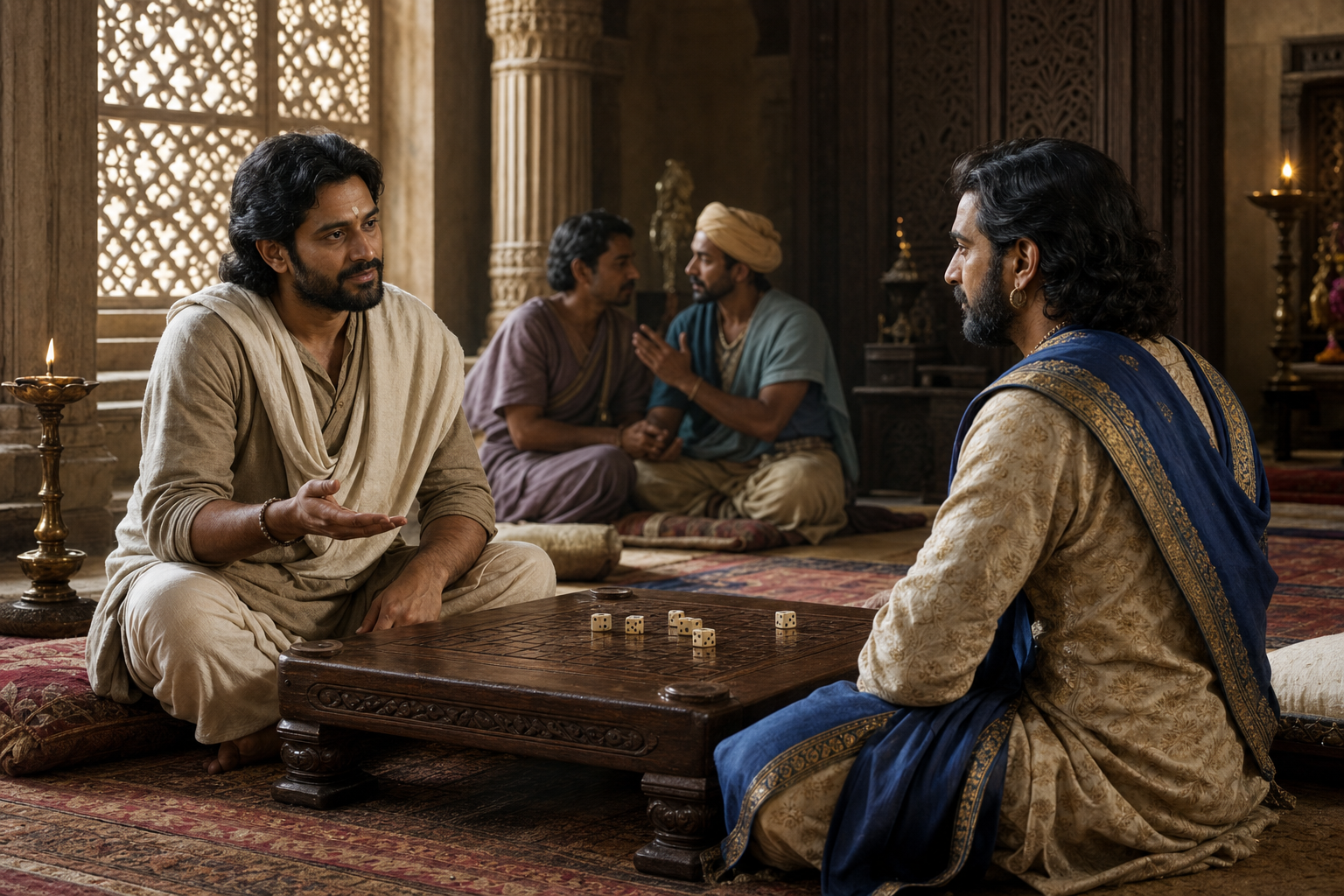
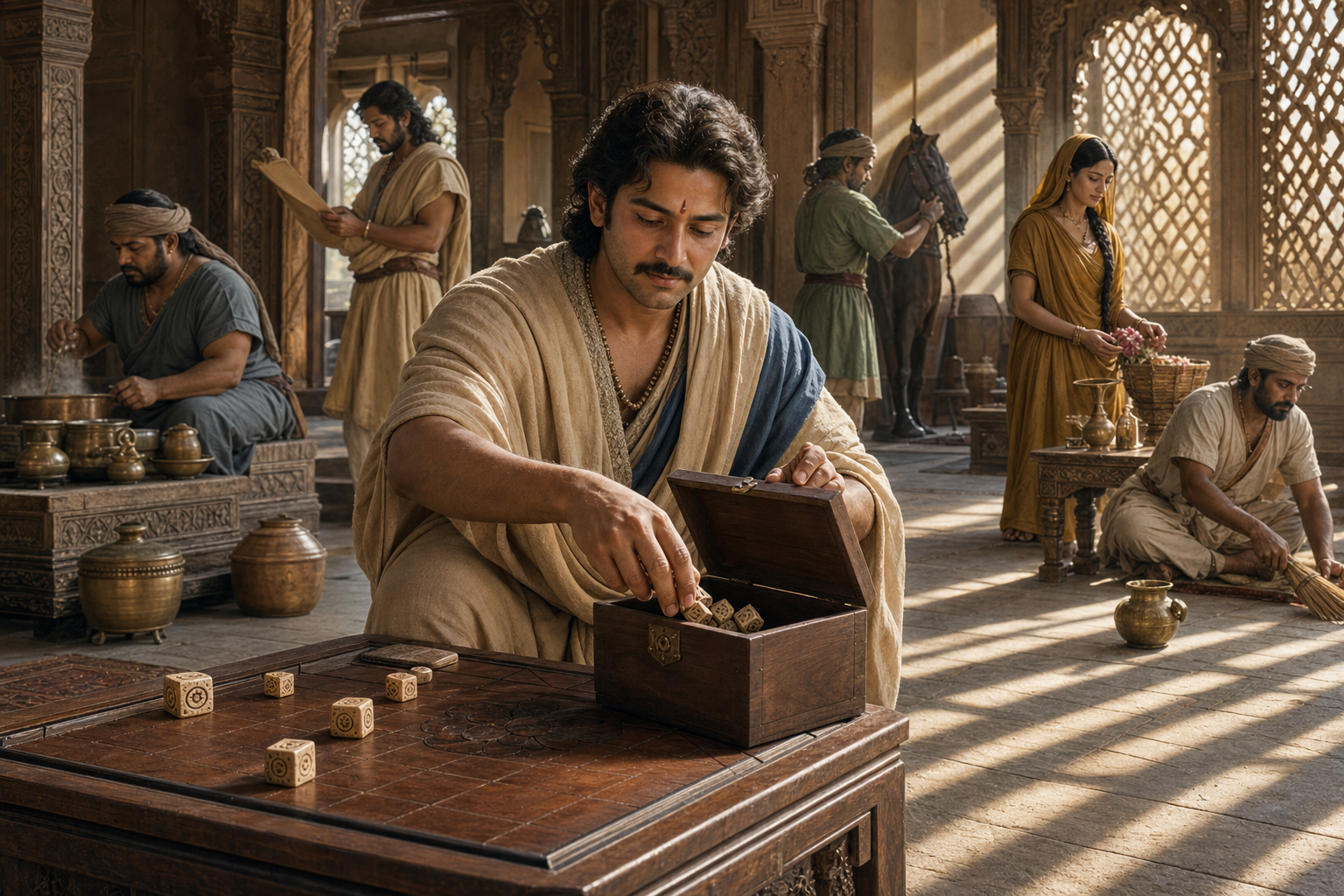
After twelve years in the forest, the Pandavas had to spend a thirteenth year concealed in the kingdom of Virata. Yudhishthira entered King Virata’s court as Kanka, a brahmin court companion skilled in dice. The role was not an arbitrary costume. It was credible because it rested on knowledge he already possessed.
Kanka’s position solved several practical problems at once:
- It gave Yudhishthira a believable function in a royal court without presenting him as a warrior-king.
- It kept the eldest Pandava near Virata, where he could observe the court and help preserve the larger plan.
- It allowed him to perform a familiar activity instead of imitating an unfamiliar profession under constant scrutiny.
- It transformed a weakness once connected with his ruin into part of the Pandavas’ protective disguise.
Dice themselves were not the shield. Plausibility was. A disguise holds when conduct, knowledge and social position fit together well enough that other people stop asking questions. Yudhishthira could convincingly be Kanka because the mask used something real.
The contrast with the earlier dice hall is therefore essential. In the Kuru assembly, gambling became the channel through which the stakes expanded from property and sovereignty to human beings. In Virata, knowledge of dice was subordinated to a defined duty: remain unrecognized and help the family complete its exile. The object was the same, but its place in Yudhishthira’s life was different.
Does the Kanka disguise prove that his gambling habit was cured?
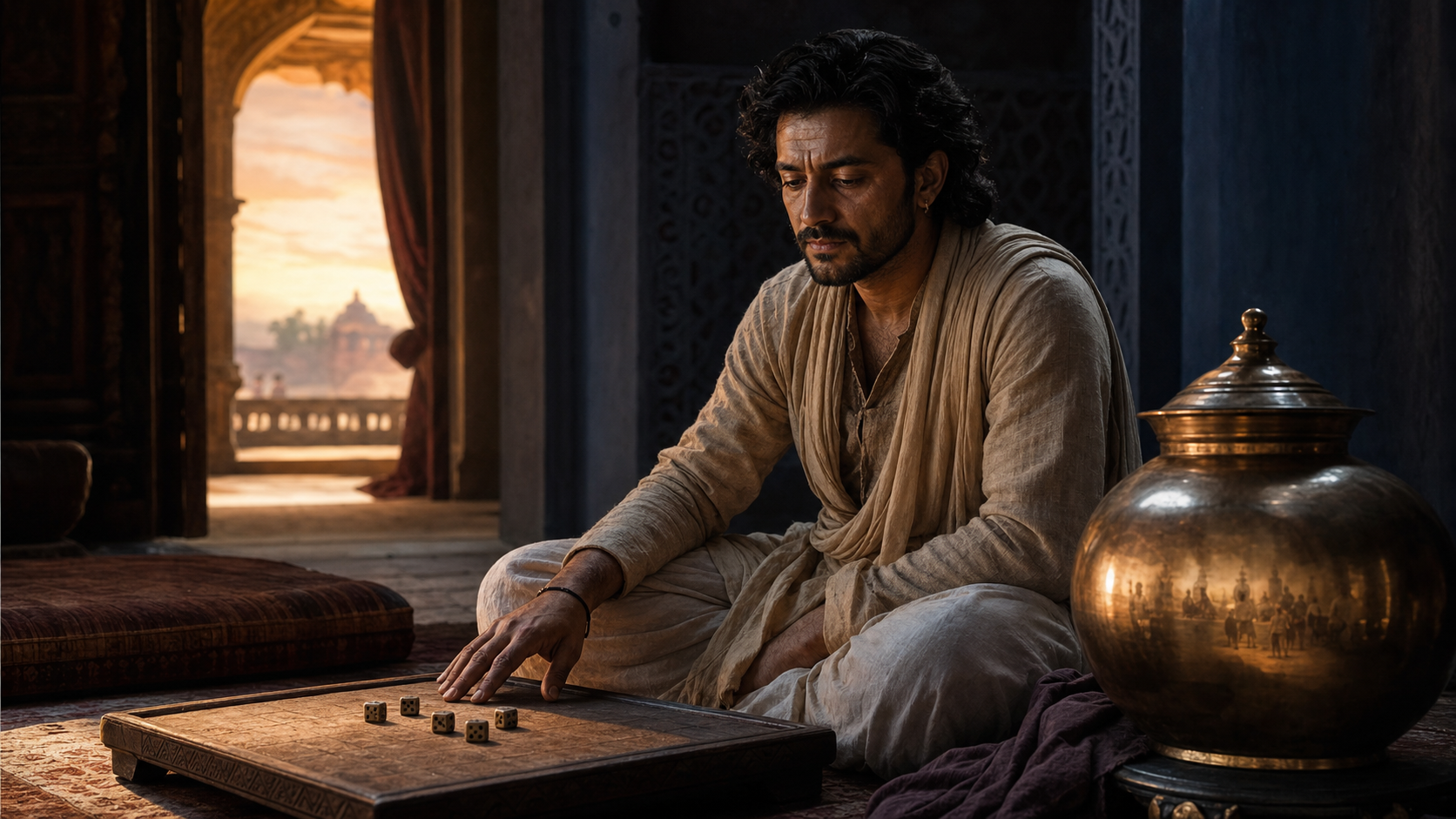
No. It proves less than that, but it also reveals more than a simple relapse would.
Calling Yudhishthira an “addict” can be useful as a modern moral interpretation, especially when describing his disastrous inability to withdraw from the first game. Yet the Mahabharata is not a clinical history, and the Kanka episode does not provide an account of treatment, withdrawal or recovery. We should not force a modern diagnosis into a narrative that is examining duty, attachment, judgement and consequence in its own terms.
Three distinctions keep the reading honest:
- Skill is not the same as compulsion. Knowing the game well enough to serve as a court player does not tell us whether Yudhishthira still felt an uncontrolled desire to wager.
- Exposure is not the same as relapse. The incognito-year narrative does not revolve around Yudhishthira chasing losses, trying to recover his kingdom through gambling or again placing his dependants at stake.
- Controlled conduct is not proof of an inner cure. A person can behave differently because circumstances, duties and boundaries have changed even while an old attraction remains unresolved.
The most defensible conclusion is that Yudhishthira placed a dangerous competence inside a constrained role. He did not erase the past, and the disguise did not absolve him of the first dice disaster. It showed that a capacity implicated in failure could be put under a different governing intention.
Virata’s blow shows why the old arena remained dangerous
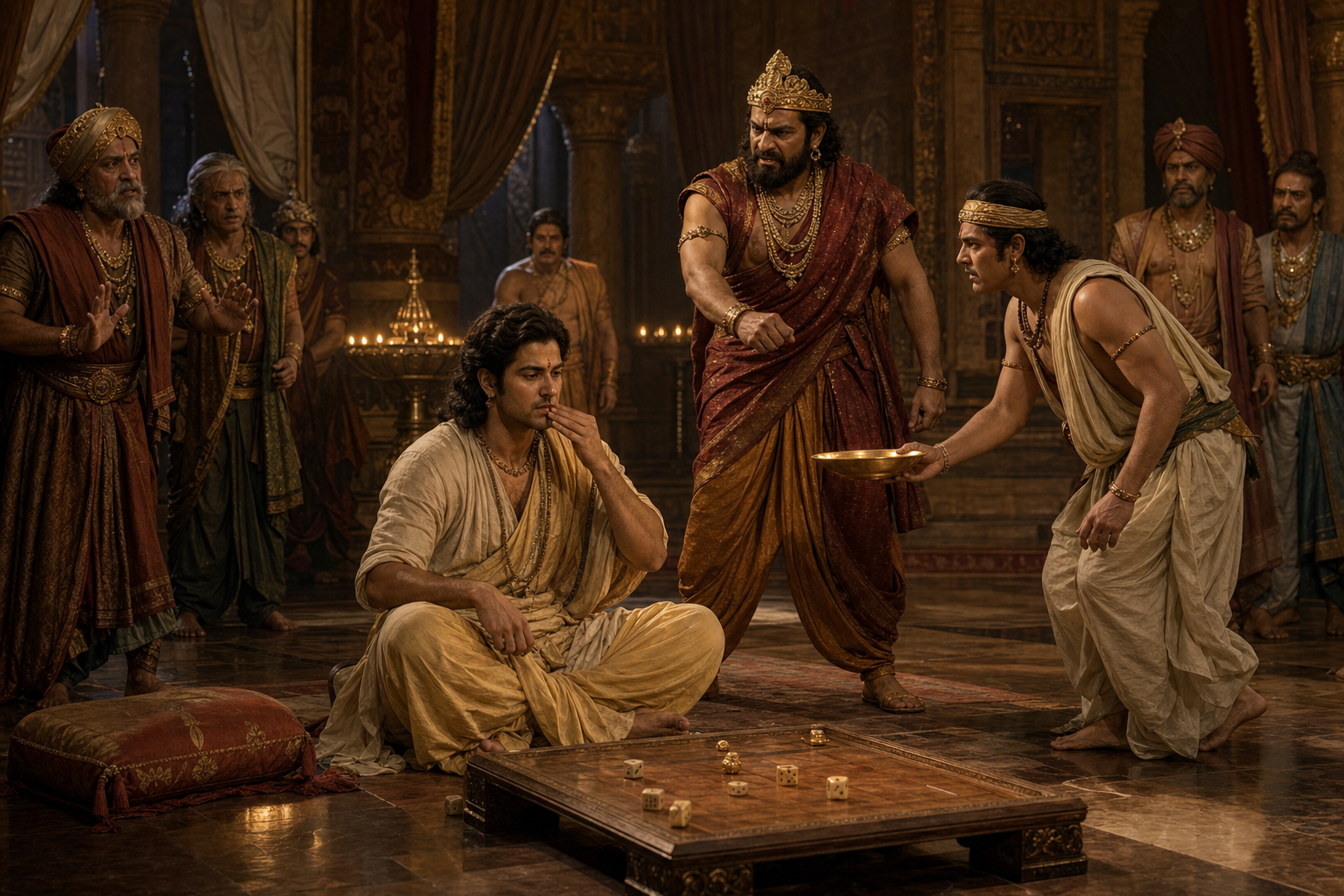
A later scene prevents us from romanticizing Kanka’s role. Near the end of the incognito period, Virata plays dice with him while celebrating Prince Uttara’s apparent victory. Kanka repeatedly gives Brihannala the credit that Virata wants reserved for his son. The king becomes angry and strikes Kanka in the face with a die, drawing blood.
This time, dice do not defeat Yudhishthira through an escalating wager. The danger comes from courtly pride, concealed truth and unequal power meeting around the gaming board. The object associated with his earlier humiliation becomes the object used to wound him.
Yudhishthira’s crucial action is not a clever throw. It is restraint after the blow. Retaliating as a wronged king or warrior could expose him and endanger everyone sharing the disguise. He absorbs the insult because the collective obligation is more important than immediate vindication.
That is a stronger sign of change than merely handling dice without losing. Earlier, he allowed the momentum of a game to carry him beyond defensible limits. In Virata, he refuses to let humiliation pull him away from the duty governing the incognito year. The instrument remains dangerous, but his response is no longer governed by its momentum.
A dharmic test for turning weakness into useful knowledge
The lesson is not that every vice is secretly a gift. That slogan would excuse too much. Yudhishthira’s first gambling disaster caused real suffering, and later usefulness does not make the earlier conduct righteous. The practical lesson is narrower: knowledge acquired through failure can sometimes serve dharma when desire is displaced by duty and firm limits change how the knowledge is used.
You can test such a transformation with four questions:
- What exactly is being reused? Separate the capacity from the harmful pattern. Kanka uses familiarity with dice and royal company; he does not need to repeat the ruinous staking of the Kuru game.
- Whose welfare does the action serve? The earlier game exposed Yudhishthira’s family and subjects to the consequences of his decisions. The Kanka role serves the Pandavas’ shared survival during the incognito year.
- Are the boundaries real? A changed intention means little if the same unlimited stakes, secrecy and escalation remain. In Virata, dice have a limited courtly function within a larger mission.
- What happens under provocation? Transformation becomes visible when pride is injured. Yudhishthira’s refusal to answer Virata’s blow with open retaliation shows that the governing priority is now the vow, not his wounded status.
This test also prevents a dangerous personal misreading. If gambling is causing debt, concealment, repeated broken promises or loss of control, Kanka is not permission to keep testing yourself around bets. Put distance between yourself and gambling, protect access to money, involve someone trustworthy and seek qualified addiction support. An epic analogy can clarify responsibility; it is not a treatment plan.
For less destructive habits, the same distinction still helps. Do not ask only whether an old weakness can be made useful. Ask what prevents the old pattern from taking command again. If you cannot name the boundary, the beneficiary and the conduct expected under pressure, you have not yet turned the weakness into disciplined knowledge.
Key takeaways
- Yudhishthira becomes Kanka because a convincing disguise must rest on an ability he can sustain under scrutiny.
- His use of dice in Virata differs from the Kuru game in purpose, stakes and responsibility; it is not simply a repetition of the earlier catastrophe.
- The disguise does not prove that every attachment to gambling disappeared, nor does it cancel his accountability for the first game.
- Virata’s violent reaction shows that the gaming space remains dangerous even when Yudhishthira’s intention has changed.
- The clearest evidence of growth is Yudhishthira’s restraint under humiliation, when protecting the shared vow takes priority over defending his rank.
When you return to this episode, do not stop at the irony of a ruined gambler becoming a court dice-player. Follow the change in intention, stakes, beneficiary and response under pressure. Those four details show whether Kanka is merely hiding Yudhishthira’s past or whether Yudhishthira has begun to govern what once governed him.