
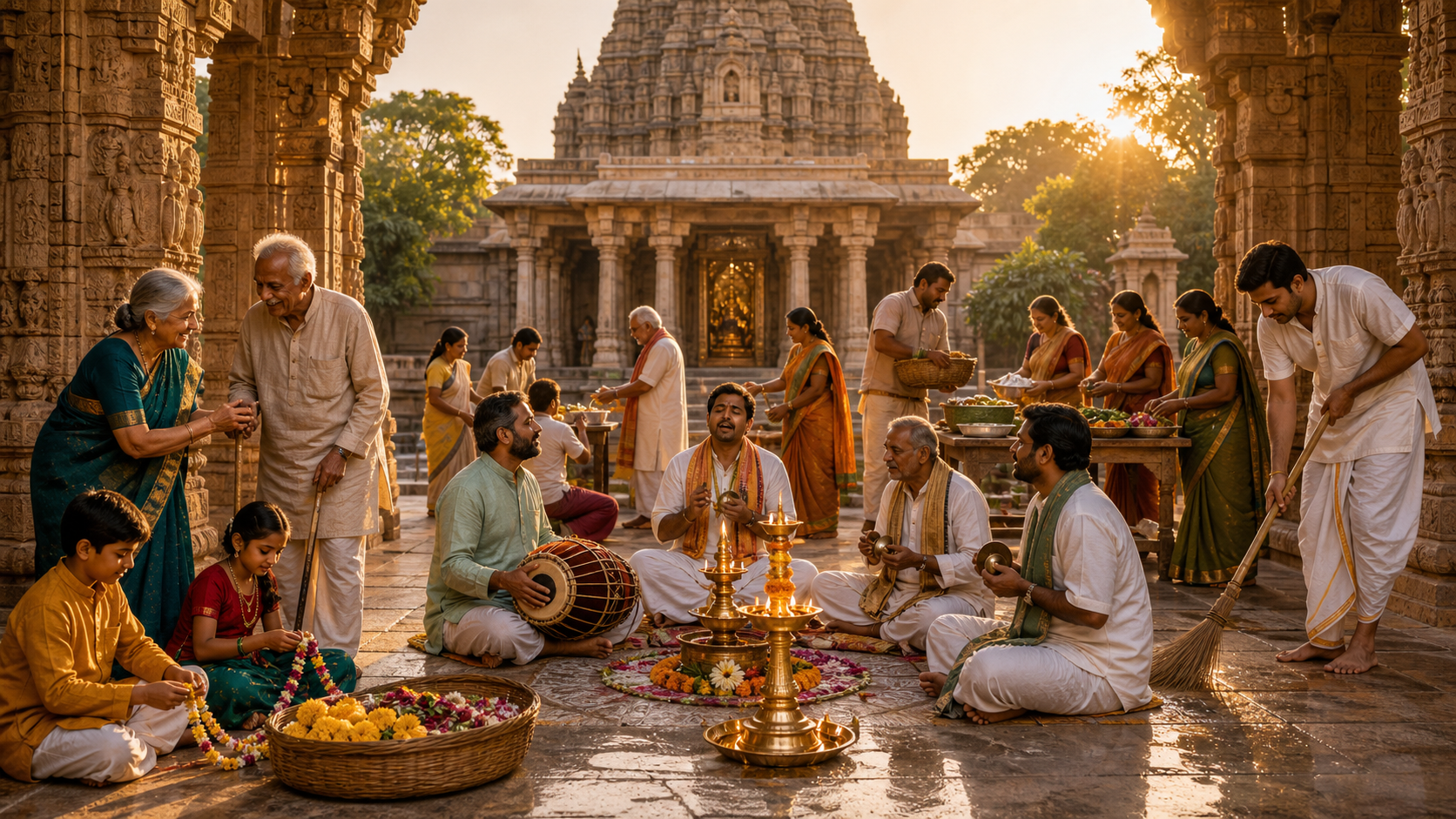
You may want a stronger Hindu presence in public life without reducing Dharma to election slogans, angry reactions, or a vague claim that every tradition is the same. The practical starting point is Bhakti: worship that forms habits, binds people to sacred places, and turns reverence into responsibility.
The test is simple. Can your devotion help preserve a living tradition, teach someone younger, solve a local problem, or support principled cooperation? If it can, Bhakti has already entered public life without surrendering its spiritual centre.
Bhakti becomes public before it becomes political
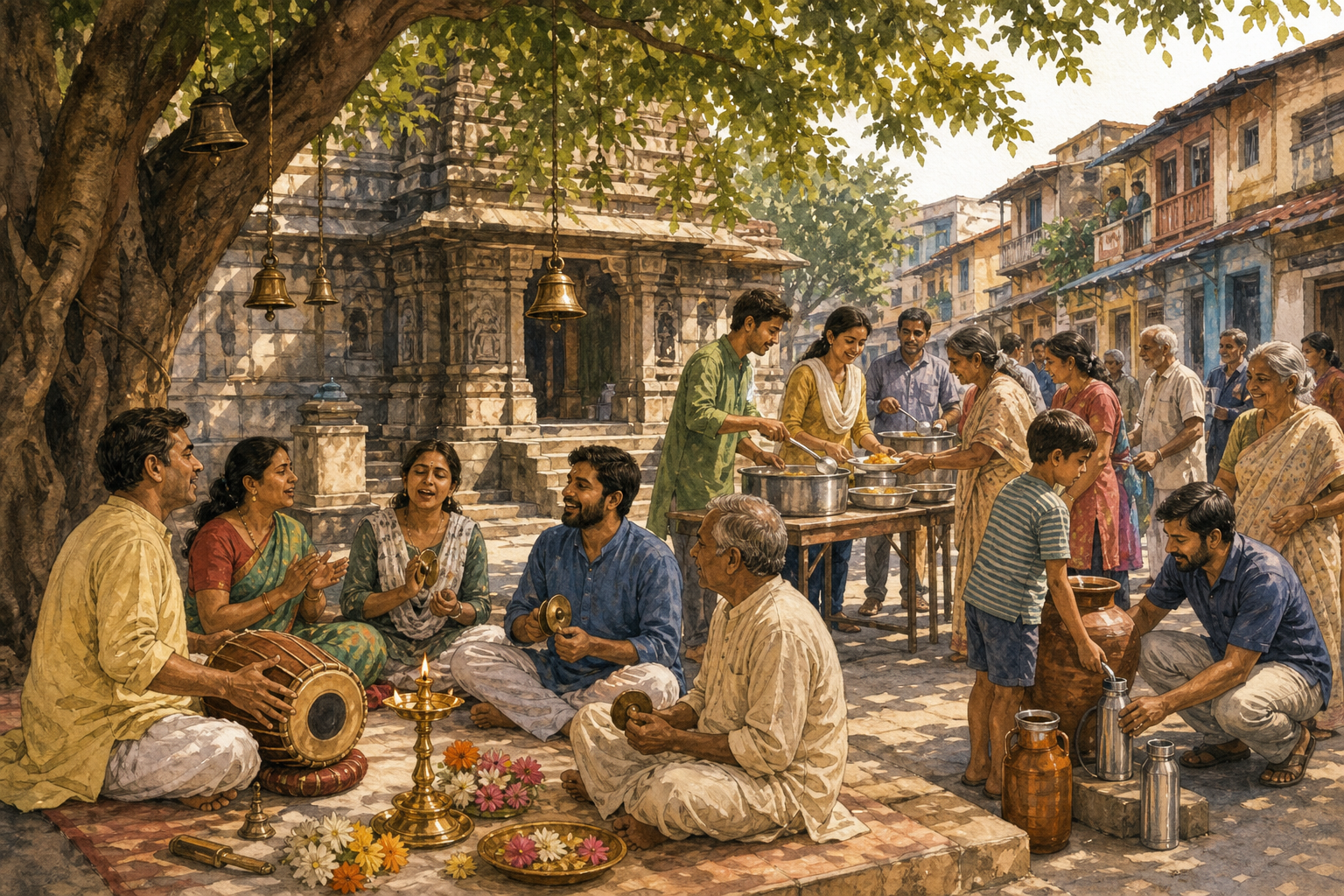
Public Hindu life does not begin with a manifesto. It begins when sacred names, temple routes, offerings, festival dates, family memories, and duties of hospitality remain part of ordinary speech.
Consider the young woman climbing to the Yoga Narasimha Swamy Temple at Sholingur, one of the 108 Divya Desams. When monkeys took her offering bag, she addressed them as Narasimha and Anjaneya, recovered the flowers and money they left behind, offered a brief namaskaram, and continued towards the shrine. Her response was neither a theological lecture nor a staged display. It revealed a world in which deity, landscape, animal life, pilgrimage, affection, and discipline still belong to one field of meaning.
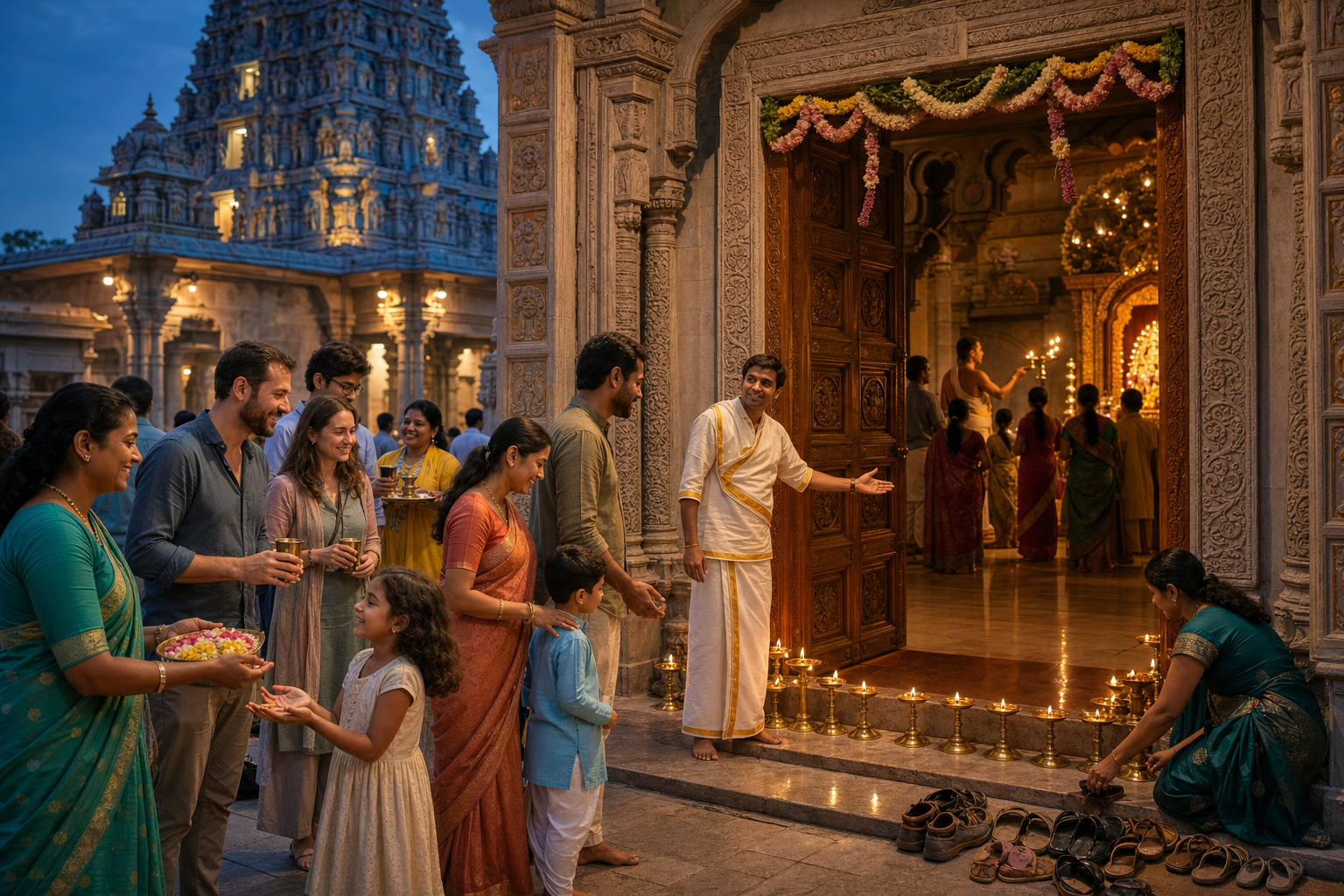
That is what embodied Bhakti does. It places the sacred inside repeated conduct. Because the conduct is repeated, it can survive periods in which elite language, political fashion, or mass media treat temple culture as marginal. A family that still knows why it climbs a particular hill, carries a particular offering, or returns for a particular utsava possesses more than private sentiment. It carries civilizational memory.
The 2019 darshana of Atti Varadarajaswamy at Kanchipuram shows the same mechanism on a vast scale. The fig-wood murti is brought from an underground chamber in the Varadaraja Perumal Temple tank once every forty years and was available for worship for forty-eight days. The occasion drew lakhs of devotees as well as visitors associated with both the DMK and AIADMK. Accounts hold that the murti had been concealed during an earlier period of political turbulence and military incursions. The careful formulation matters: the history carries an element of reported tradition, while the ritual continuity and mass participation are visible facts.
You should not read such participation as proof that every visitor shares one political position. Its importance is different. A deeply rooted observance can establish the public frame into which political figures must enter. The temple, deity, calendar, and devotees remain central; the visiting leader is temporary.
If you want to strengthen this layer of Hindu life in your locality, begin with a small cultural inventory:
- Name the living observance. Record the local festival, yatra, vrata, procession, recitation, or darshana that people actually practise. Do not begin with a generic campaign detached from place.
- Recover its memory. Ask what elders, priests, hereditary custodians, artisans, and regular devotees know about the murti, route, customary offering, song, or sacred site.
- Identify the weak link. It may be poor explanations for young visitors, missing local-language material, difficulty for elderly pilgrims, neglected records, or a lack of volunteers.
- Make the knowledge usable. Prepare a clear guide to the observance, its terms, expected conduct, and practical arrangements. Digital media are valuable when they direct people back towards informed participation rather than replacing it with spectacle.
- Leave the institution stronger. Store photographs, oral memories, permissions, translations, volunteer notes, and other records where the relevant community can use them again.
This is cultural advocacy in its most durable form. It does not wait for outsiders to validate the tradition, and it does not depend on outrage to attract attention.
Dharmic unity requires common work, not common theology
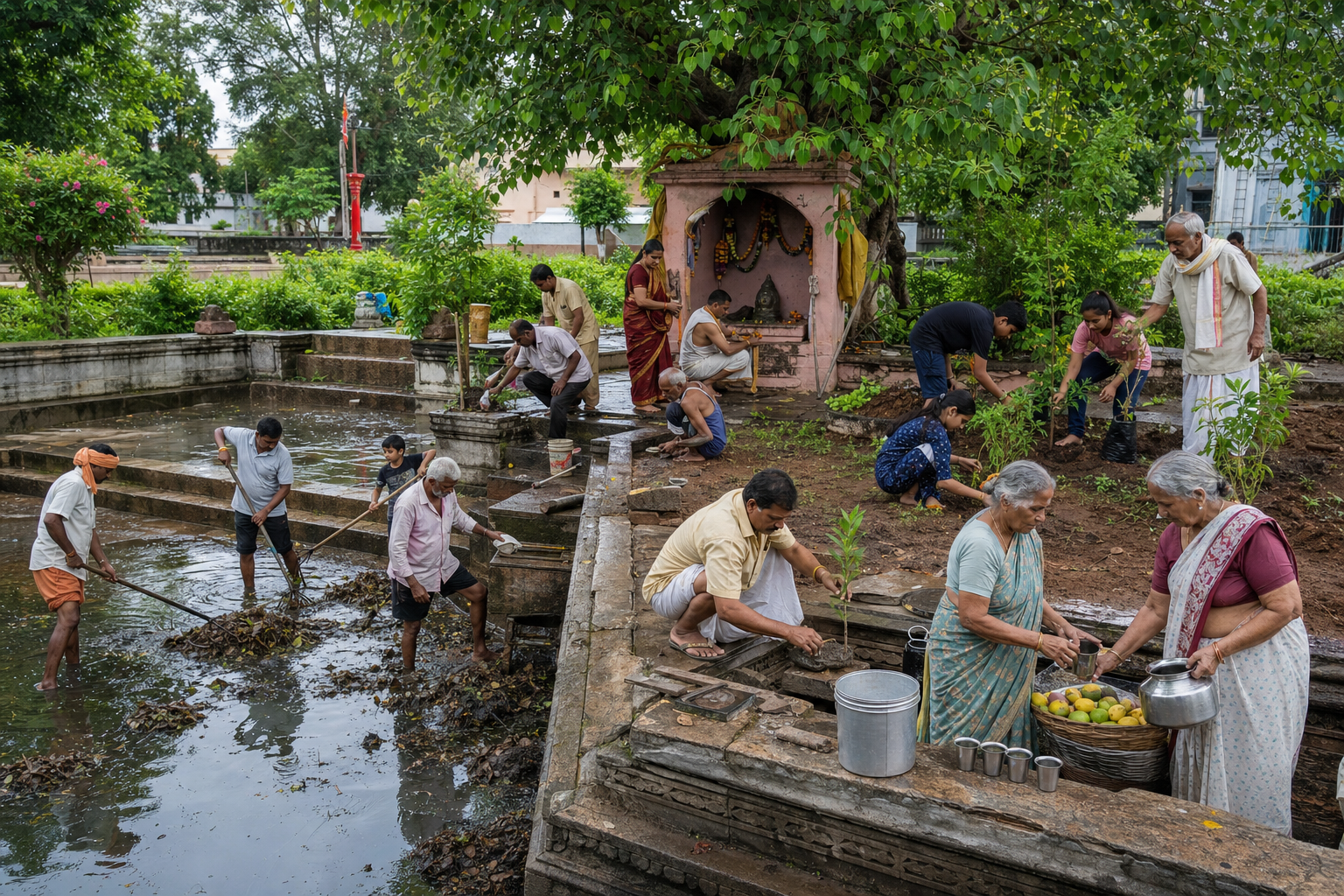
Calls for Hindu, Buddhist, Jain, and Sikh unity often fail in one of two ways. One approach ignores real doctrinal and ritual differences. The other treats every difference as a reason cooperation is impossible. Neither approach is necessary.
Dharmic unity is most credible when understood as a partnership of responsibility. Ahimsa, dana, seva, shraddha, self-cultivation, sacred learning, and care for community provide substantial ethical ground for cooperation. Their definitions and applications are not identical in every tradition, and they need not be. Agreement on a public duty does not require a shared metaphysics.
Verul, or Ellora, gives this distinction a physical form. Hindu, Buddhist, and Jain sacred heritage can coexist within one civilizational landscape without the caves becoming interchangeable. In the same spirit, a Kolhapur gathering around Pujya Avimukteshwaranand connected discussion of Hindu public life with youth engagement, cultural education, the preservation of temples and manuscripts, and dialogue across the Dharmic family. Sikh participation in the wider Dharmic framework adds another distinct history and vocabulary; unity does not require placing it retroactively inside Ellora’s particular religious landscape.
Use three circles when planning a joint initiative:
- The inner circle is integrity. Each sampradaya or panth retains authority over its own worship, texts, sacred vocabulary, lineage, and internal discipline. A joint platform does not acquire the right to rewrite them.
- The middle circle is literacy. Participants explain their traditions accurately and allow genuine differences to be heard. A Jain account of ahimsa, a Buddhist account of ethical cultivation, a Sikh account of seva, and a Hindu account of Bhakti should not be forced into one formula.
- The outer circle is cooperation. Communities can support heritage education, manuscript preservation, care for sacred sites, youth instruction, relief work, and civic ethics without pretending that all their doctrines are identical.
Before you put several Dharmic names on an event poster, ask four practical questions. Who is qualified to speak for each participating tradition? Which terms need explanation? What concrete work will remain after the gathering? Does the format preserve each community’s dignity, or use its presence merely to decorate a predetermined message?
These questions prevent ceremonial unity from becoming tokenism. They also make participation easier for people who value cooperation but reasonably resist theological flattening.
Keep the temple at the centre without turning it into a party office
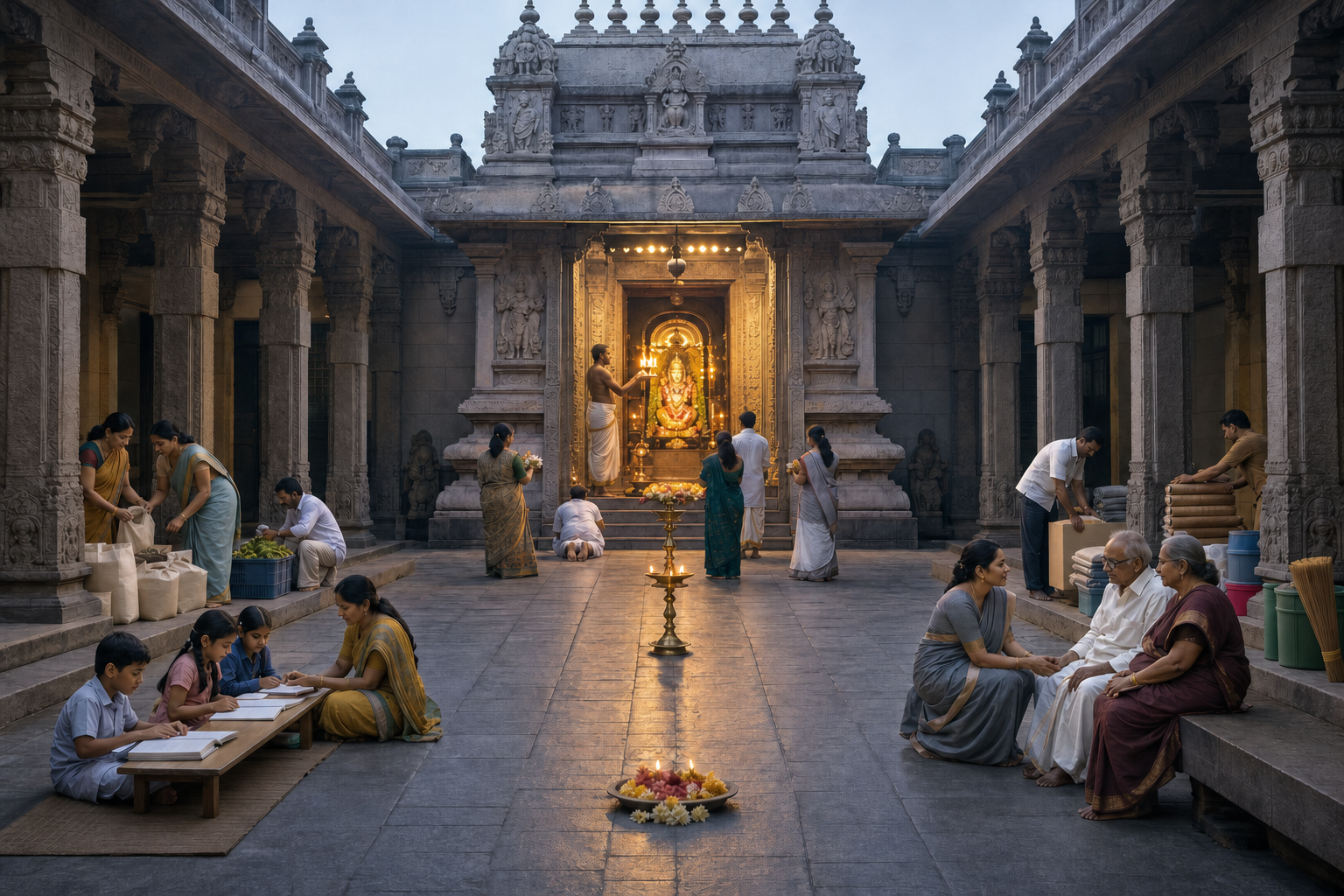
Bhakti has political consequences because it shapes loyalties, moral expectations, and collective memory. It is not, however, a substitute for policy, administration, scholarship, or civic organisation. Confusing these roles weakens both worship and public action.
The Atti Varadarajaswamy observance offers a useful model. Its public importance came from the deity’s rare darshana, the continuity of worship, and the participation of devotees. The presence of leaders from competing political formations demonstrated reach; it did not make either formation the owner of the sacred occasion.
A healthy relationship between temples and public figures follows that order. Leaders may seek darshana, assist lawful preservation, improve access, or listen to community concerns. They should enter a discipline that already exists. The ritual should not be rewritten as a party performance, and devotees should not be treated as a captive vote bank.
When your temple, cultural forum, or volunteer group receives political attention, apply the same rules to everyone:
- Keep the deity, sacred history, and purpose of the observance prominent in the programme and public communication.
- Publish clear rules for access, photography, speaking roles, processions, and ritual conduct, then apply them consistently to public guests.
- Separate an individual’s darshana or civic assistance from institutional endorsement of that person’s party.
- Do not let a speech displace worship, interrupt a customary sequence, or turn volunteers into a political audience.
- Describe financial and organisational responsibilities clearly so that assistance does not become an informal claim of ownership.
- Evaluate the occasion by what it left behind: better heritage records, stronger volunteer capacity, improved pilgrim support, informed youth, or a protected custom.
The same discipline should govern ideologically charged discussions. Presenting a text such as Why do we need a Hindu Rashtra? can open a serious conversation about culture, ethics, and political order. A book presentation alone is not civic achievement. The discussion earns trust when participants define their terms, accept questions, avoid loyalty tests, and connect ideals to responsible work.
Bhakti supplies moral energy. Institutions must convert that energy into competence. If a gathering produces stirring language but no better teaching, preservation, service, or accountability, it has used devotion without serving it.
Pluralism needs clear boundaries as well as hospitality
A confident Hindu public life can welcome conversation without pretending that familiar words always carry familiar meanings. This is especially important when another religious setting adopts Hindu vocabulary, structures, or ritual forms.
Missionary adaptation in Tamil society has a long history associated with figures such as Robert de Nobili and Bishop Robert Caldwell. Indian-language Biblical usage has drawn on terms including Paramatma, Deva Putra, Deva Mata, and Prabhu. More recent adaptations have included names such as Jesus Sahasranama and Jesus Gayatri Mantra, as well as dhvajasthambha-like features near churches. These borrowings can seek cultural familiarity, but resemblance does not establish theological equivalence.
The weakest response is either indiscriminate hostility or passive confusion. Hostility makes careful explanation harder. Passivity allows important distinctions to disappear. The stronger response is to teach what the original form means, identify how it has been altered, and ask whether the adaptation is transparent about the difference.
When you encounter a Dharmic form in a new religious setting, use this sequence:
- Identify the form precisely. Is it a sacred title, mantra structure, litany, architectural feature, festival practice, or philosophical term? Do not argue from visual resemblance alone.
- Explain its Dharmic use. State where the form belongs, how practitioners understand it, and what discipline or theology gives it meaning.
- Examine the new claim. Ask whether the adopted term is being used as a loose translation, a cultural bridge, or an assertion that two incompatible concepts are the same.
- Look for transparency. Respectful exchange names the borrowing and allows the original community to describe its own tradition. Ambiguous persuasion obscures the difference precisely because familiarity lowers a listener’s guard.
- Respond with proportion. Correct the meaning, document the adaptation, and request honest labelling. Do not attribute a hidden motive unless there is evidence for it.
This approach protects pluralism because it treats people as capable of informed choice. Respect does not require silence about differences. Nor does boundary-setting require contempt for another faith.
Dharmic cooperation needs the same honesty. Hinduism, Buddhism, Jainism, and Sikhism can share civic commitments while describing liberation, authority, worship, selfhood, and sacred history differently. Clear speech makes unity stronger because no participant has to wonder what was quietly surrendered.
Key takeaways for your next public initiative
- Begin with a living practice. Build around an actual temple, observance, pilgrimage, text, lineage, or heritage need rather than an abstract identity slogan.
- Turn memory into transmission. Record the names, meanings, routes, customs, and local histories that a younger participant would otherwise miss.
- Define unity through responsibility. Cooperate on seva, education, preservation, and ethical public life while retaining doctrinal and ritual distinctions.
- Keep political participation subordinate to sacred purpose. Welcome lawful support, but do not give a party ownership of a deity, festival, temple, or devotional community.
- Pair openness with semantic clarity. When Dharmic forms are borrowed or reinterpreted, explain the original meaning and insist on transparent differences.
- Judge rhetoric by its residue. Ask what became better after the speeches ended: knowledge, access, records, volunteer discipline, institutional trust, or preservation.
At the next local observance, choose one weak link you can actually strengthen. It may be a missing explanation, an elder who needs assistance, a neglected record, a young volunteer who needs instruction, or a custom that has never been documented clearly. Speak to the relevant temple committee, matha, vihara, Jain sangha, gurdwara, scholar, or volunteer group, and offer work that respects its authority. That is how Bhakti becomes a durable public force: not by leaving worship behind, but by carrying its discipline into service.
References
- DharmaRenaissance Blog – Tamil Nadu’s Quiet Bhakti Resurgence: Grassroots Devotion Reframes Dravidian Politics
- DharmaRenaissance Blog – Kolhapur Gathering Honors Pujya Avimukteshwaranand; HJS Highlights Dharmic Unity
