

You may have encountered Tara in a Hindu shrine, a tantric account, or a Buddhist image and wondered whether these are different names for the same deity. The most useful answer is neither a flat yes nor an absolute no.
Tara belongs to a shared Indic sacred inheritance, but Hindu and Buddhist communities understand her through their own teachings, aims, and forms of practice. If you keep both kinship and difference in view, her fierce appearance and compassionate purpose become much easier to understand.
The short answer: connected, but not interchangeable
Hindu and Buddhist Tara traditions are historically and spiritually related. Her presence in both is a striking example of how tantric forms of worship moved across religious boundaries in ancient India. That connection is real. It does not require us to pretend that the two traditions make identical theological claims.
| Question to ask | In a Hindu setting | In a Buddhist setting |
|---|---|---|
| What frames Tara? | The traditions of the Goddess and divine power, often expressed through the language of Shakti | The Buddhist path of awakening, compassion, wisdom, and liberation |
| How should her fierceness be read? | As divine power confronting ignorance, bondage, and disorder | As compassionate power acting decisively against the causes of suffering |
| What determines the meaning of a practice? | The Hindu lineage, theology, ritual setting, and understanding of the Goddess | The Buddhist lineage, teaching, ritual setting, and understanding of awakening |
This distinction prevents two opposite errors. The first is to erase every difference by declaring that all forms of Tara are simply identical. The second is to treat Hindu and Buddhist traditions as sealed compartments with no shared history. A sound reading acknowledges continuity without collapsing one tradition into the other.
Shared sacred language does not mean identical doctrine
Religions do not develop in isolation. Hindu and Buddhist practitioners lived within the same broad Indian civilisation, encountered related philosophical questions, and worked with overlapping tantric forms. Tara therefore should not be approached as a modern curiosity produced by two unrelated systems accidentally choosing the same name.
At the same time, a shared image or ritual vocabulary does not settle what that image means. A mantra, visual form, gesture, or fierce expression receives its full significance from the tradition using it. In a Hindu context, Tara is approached through Hindu understandings of divinity, the Goddess, and liberating power. In a Buddhist context, she is approached through Buddhist understandings of awakening, compassionate activity, wisdom, and release from suffering. Her precise status and interpretation may also vary among lineages within the same religion.
When you meet a statement such as “Tara is the same in both religions,” ask what kind of sameness is being claimed. It may mean historical relationship, resemblance in imagery, a shared spiritual function, or strict theological identity. Those are four different claims. The first three can reveal genuine kinship without requiring the fourth.
This is also a better way to discuss influence. You do not need a crude contest over ownership to recognise that ideas circulated within Bharat’s religious world. Look instead at how each community received Tara, placed her inside its own account of liberation, and preserved a distinctive relationship with her.
Why fierce Tara can still embody compassion

A wrathful face often creates the greatest confusion. Modern viewers are trained to read a frightening appearance as evidence of evil, cruelty, or uncontrolled anger. That assumption is unreliable in tantric sacred art.
Tara brings together fierce compassion and liberating wisdom. Wrath, in this setting, is not ordinary irritation enlarged to divine proportions. It points to an energy that refuses to compromise with ignorance and bondage. Compassion need not always appear gentle; when suffering is urgent, compassionate action may be protective, swift, and severe toward the forces that sustain it.
You can test an interpretation by asking two questions: What is Tara’s force directed against, and what is its intended result? If the force confronts delusion, fear, attachment, or another obstacle to liberation, while its result is protection or freedom, the image is expressing purposeful spiritual power rather than malice.
This distinction matters outside the study of Tara. It teaches you not to classify Dharmic imagery through appearance alone. A serene figure is not necessarily passive, and a fearsome figure is not necessarily demonic. Function, context, and teaching must come before surface reaction.
How to read a Tara image without guessing
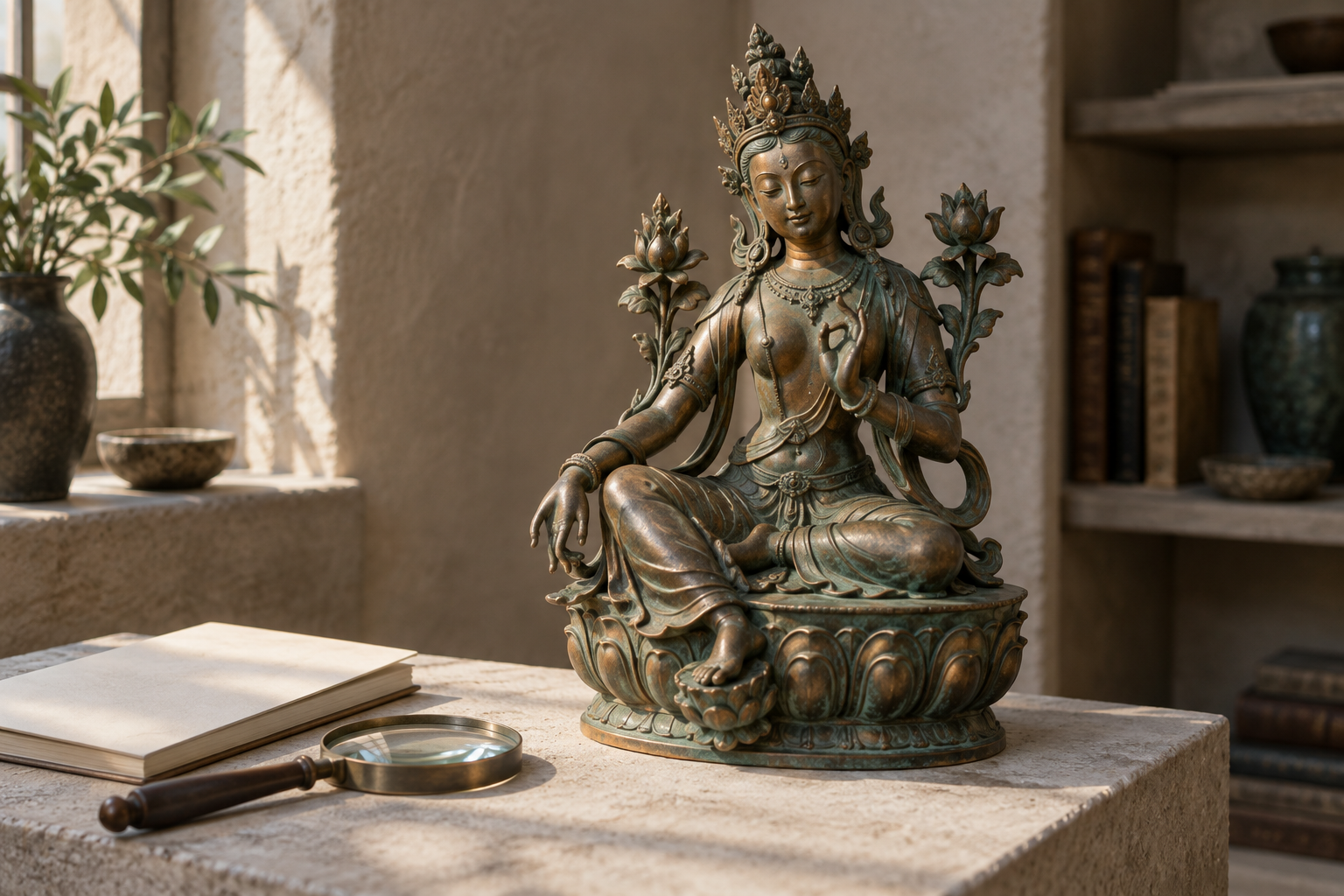
An unfamiliar image can tempt you into instant identification. Resist that impulse. The safest method is to move from context to detail, rather than building a conclusion from one colour, posture, or expression.
- Identify the religious setting. Note whether the image comes from a Hindu temple, Buddhist monastery, household shrine, ritual manual, museum display, or modern devotional shop. The setting establishes the first layer of meaning.
- Use the name supplied by the community. Read the label, inscription, or liturgical context before relying on visual resemblance. Similar-looking sacred forms can serve different roles.
- Read the whole composition. Expression, gesture, posture, implements, surrounding figures, and ritual use work together. One feature by itself rarely provides a secure identification.
- Ask what Tara does. Is the emphasis on wisdom, protection, compassion, liberation, the destruction of ignorance, or several of these at once? Function often explains fierce imagery better than appearance does.
- Ask which doctrine interprets the image. A Hindu explanation should be grounded in the relevant Hindu framework; a Buddhist explanation should be grounded in the relevant Buddhist framework. Do not transfer a technical meaning automatically from one to the other.
- Leave uncertainty visible. If the lineage or ritual context is unknown, say that the image resembles a form of Tara rather than claiming an exact identity. Careful uncertainty is more respectful than confident mislabelling.
This sequence gives you a practical standard for books, museum captions, social-media graphics, and discussions at home. Context first, attributes second, theology third. Reversing that order is how attractive similarities turn into misleading claims.
Devotion and tantric practice are not the same decision
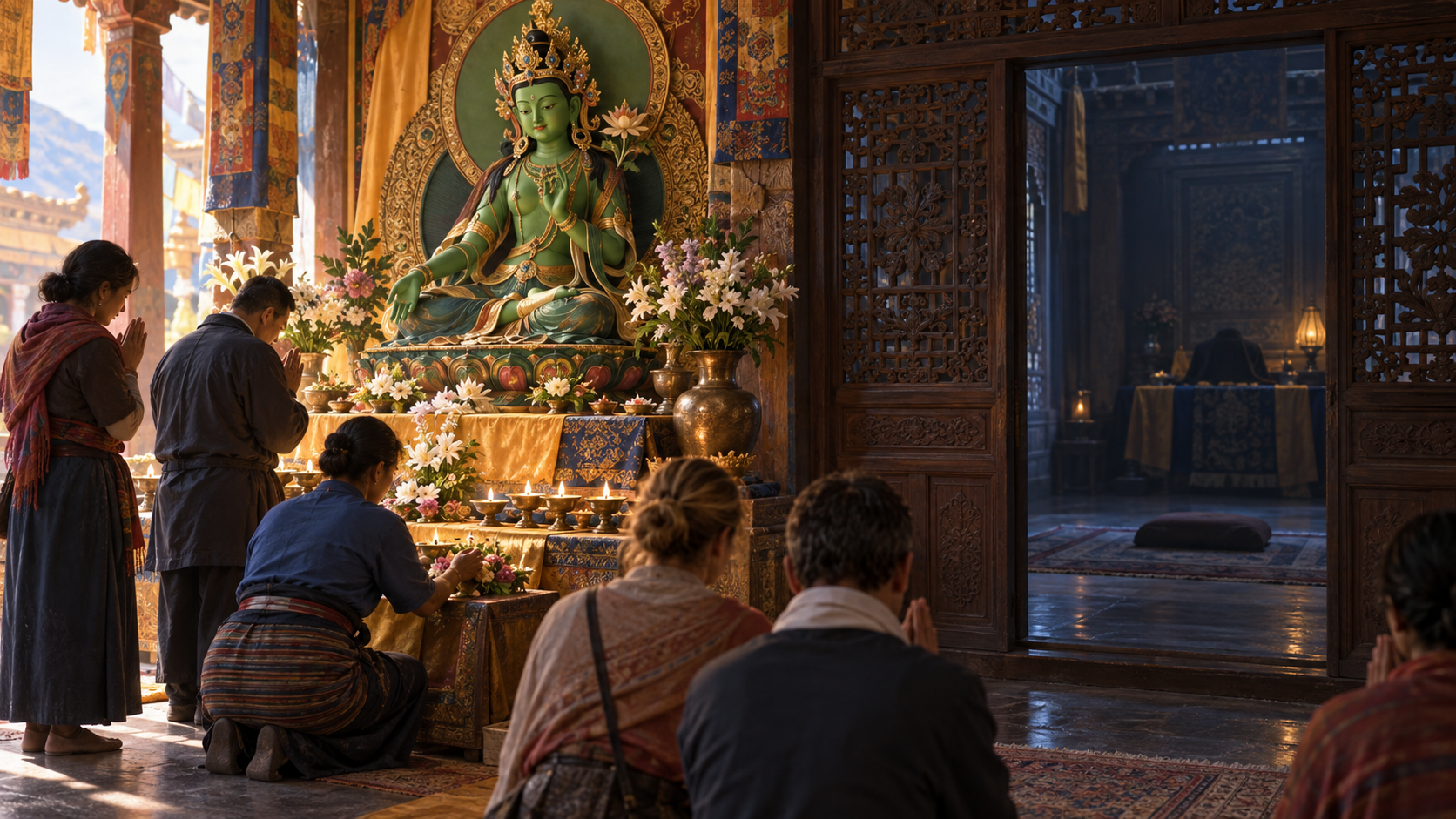
Learning about Tara, respectfully viewing her image, and feeling devotion toward her are not identical to undertaking a specialised tantric practice. Tantra is not merely dramatic imagery plus a mantra found online. Its disciplines belong to living traditions in which teachings, ritual procedures, and interpretation are transmitted within a defined framework.
If Tara draws you toward practice, begin by deciding which tradition you actually intend to follow. Then seek instruction from a qualified teacher or established community within that tradition. Ask what the practice presupposes, whether formal transmission is required, and which observances accompany it. Do not combine fragments from unrelated Hindu and Buddhist liturgies simply because they use the same divine name.
This is not a demand to deny shared Dharmic roots. It is recognition that relationship and interchangeability are different. Respect for the larger Indic family becomes more credible when it includes respect for each member’s internal discipline.
How to speak about Tara across traditions

The words you choose can either clarify Tara’s shared heritage or turn it into a sectarian argument. Three habits make a substantial difference.
- Name the context. Say “in this Hindu tradition” or “in this Buddhist lineage” when making a theological claim.
- Describe kinship precisely. Shared Indic origins, overlapping tantric culture, and related spiritual functions are clearer than the vague assertion that everything is the same.
- Let practitioners define their own worship. A useful comparison begins after each tradition has been described in its own terms, not before.
A Hindu can honour Tara’s Buddhist presence without pretending that Buddhist doctrine is a branch of Hindu theology. A Buddhist can acknowledge Tara’s place in India’s Goddess traditions without treating her Hindu worship as an irrelevant copy. Neither acknowledgement weakens conviction. It replaces caricature with historical and spiritual maturity.
When a discussion becomes a dispute over who owns Tara, return to the question that religious practice itself considers more important: How does this form lead the practitioner away from ignorance and toward freedom? That question does not erase historical inquiry. It keeps history connected to the liberating purpose for which the sacred form is revered.
Key takeaways
- Tara’s Hindu and Buddhist forms belong to a genuinely connected Indic and tantric history.
- Historical relationship does not make the two traditions theologically interchangeable.
- Her wrathful appearance can express compassion acting forcefully against ignorance and bondage.
- To interpret an image, establish its community, lineage, ritual setting, and spiritual function before drawing conclusions from appearance.
- For actual practice, follow the discipline of one living tradition under appropriate guidance rather than assembling a private mixture from isolated elements.
The next time you encounter Tara, do not begin by asking whether one community’s form cancels the other’s. Identify the context, learn what liberating work she performs there, and allow shared heritage and distinct theology to remain visible together. That is the surest way to approach her with both Dharmic confidence and intellectual honesty.
References

Leave a Reply
You must be logged in to post a comment.