
At sixty, ISKCON’s most consequential inheritance is not simply an institutional timeline. It is a set of relationships linking remembered history, repeatable devotional practice, scriptural interpretation and ethical self-correction.
Three anniversary-period reflections illuminate those relationships from different directions: a biographical discussion of A.C. Bhaktivedanta Swami Prabhupada, a six-hour London kirtan, and a New York exposition on King Prithu’s sacrifices and Indra’s envy. Read together, they show how a bhakti tradition remains living rather than merely commemorated.
A diamond jubilee measured in transmission
The biographical and London accounts both locate ISKCON’s founding under A.C. Bhaktivedanta Swami Prabhupada in 1966. The reflection on Srila Prabhupada Lilamrita specifies incorporation in New York and places it within a longer journey that included Prabhupada’s 1965 voyage aboard the Jaladuta. It then describes the period from 1966 to 1977 as one of translation, travel, teaching, temple establishment and institutional formation.
That account treats memory as more than inspirational storytelling. It presents Srila Prabhupada Lilamrita, authored by Satsvarupa dasa Goswami and published by the Bhaktivedanta Book Trust, as both devotional biography and a work assembled from letters, journals, interviews, magazine articles and other contemporaneous records. Its recommendation to compare the narrative with correspondence, recorded lectures and early memoirs is important: a mature tradition preserves reverence while remaining attentive to provenance and genre.
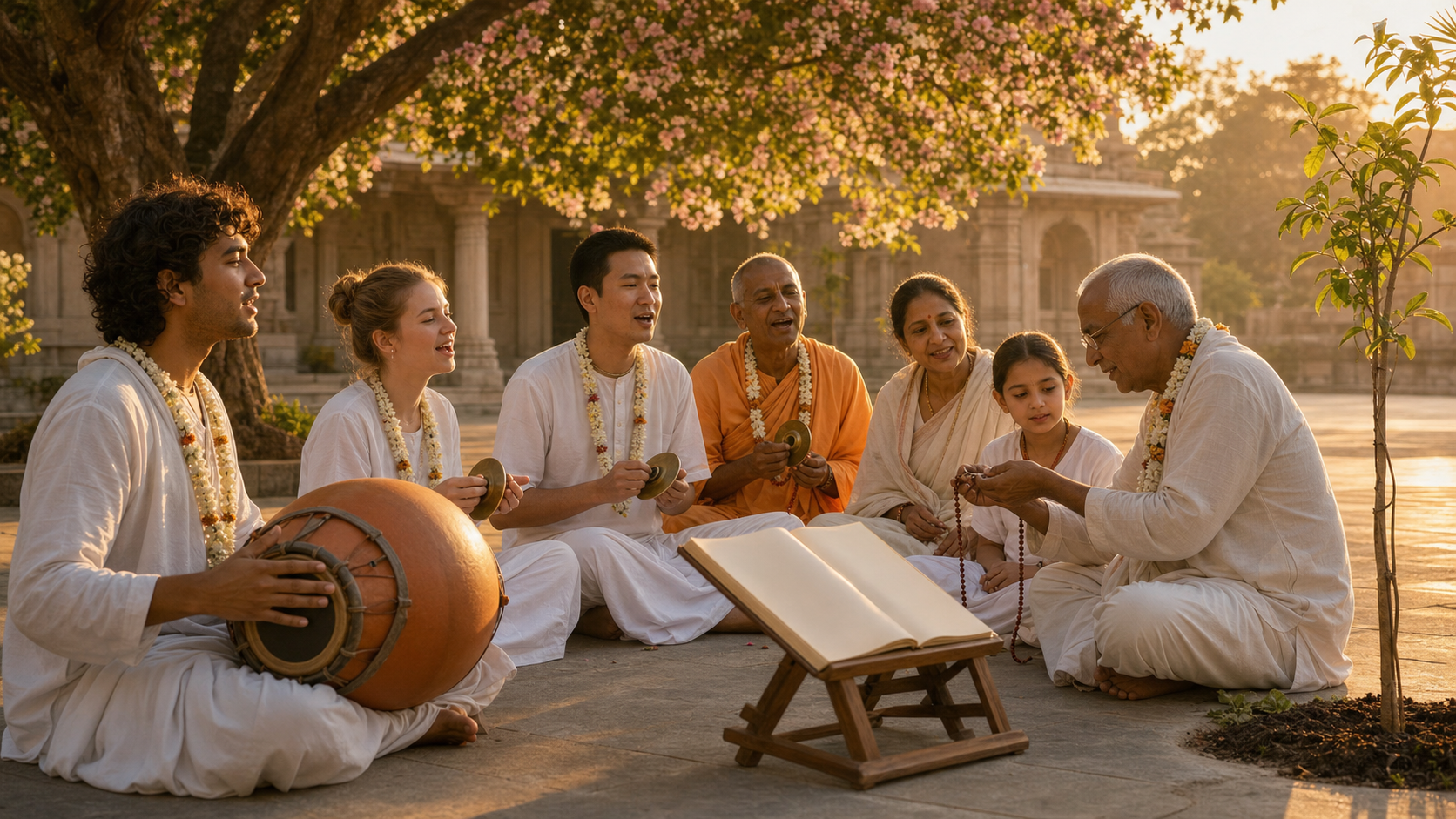
The London anniversary report shows the same inheritance operating through participation. It describes a six-hour kirtan at ISKCON London’s Radha-Krishna Temple on 21 June 2026, coinciding with International Yoga Day. On that same reported date, the biographical source describes a discourse by HG Daivi Shakti Mataji about the continuing relevance of Srila Prabhupada Lilamrita. The juxtaposition is instructive: one gathering revisited the movement’s formative memory, while another embodied its central practice through collective sound.
An anniversary therefore becomes meaningful when one generation can hand another both a trustworthy account of why the mission began and a practicable way to inhabit it. Archives without practice can become static memorials; practice without memory can lose its orientation. ISKCON’s living legacy depends on their continued interaction.
Three carriers of a living bhakti tradition
The sources describe three distinct but interdependent carriers of continuity. Each answers a different question about what, precisely, must survive an anniversary.
| Carrier | Primary form | Question it answers | Failure it helps expose |
|---|---|---|---|
| Historical memory | Biography, letters, testimony and institutional records | How did the mission take shape, and how should its decisions be remembered? | Memory detached from evidence or context |
| Embodied practice | Japa, sankirtana, scriptural study, ethical discipline and service | How does inherited theology become a daily and communal way of life? | Celebration reduced to performance or identity |
| Scriptural conscience | Interpretation of narratives such as Prithu’s sacrifice and Indra’s disruption | By what standard should ritual, leadership and ambition be judged? | Prestige, envy and outward form displacing inner purpose |
The biographical reflection reports that Prabhupada translated bhakti theology into repeatable disciplines: daily japa, congregational chanting, scriptural study and observance of the four regulative principles. This matters because movements are not transmitted by ideas alone. Habits give doctrine a schedule, an ethical shape and a place within ordinary life.
The London report makes that embodiment audible. It describes call-and-response chanting shaped by changing melodies, rhythms and tempos, with instruments supporting the assembly rather than replacing it. Alternation between contemplative passages and energetic crescendos allows participants to sit, sing, clap or move while returning attention to the maha-mantra. The extended format thus presents kirtan as sustained devotional discipline as well as public celebration.
The analysis of Srimad-Bhagavatam 4.19.13, drawing on a New York satsanga by HG Hansarupa das, adds an evaluative dimension. In its reading of King Prithu’s sacrifices, yajna is an architecture of responsibility involving disciplined action, social order and transcendental purpose. Indra’s envy supplies the warning: when ritual achievement becomes a vehicle for status, the outer form can remain while its moral center deteriorates.
The source connects that scriptural principle to ISKCON through sankirtana-yajna, congregational chanting understood as the sacrifice suited to the present age. This makes kirtan more than an inherited cultural marker. Its authenticity must be assessed by what it cultivates: remembrance, humility, service and freedom from the competitive impulses illustrated in the Prithu narrative.
Fidelity becomes credible through adaptation and accountability
The three accounts resist a false choice between preserving a lineage and adapting it. The Lilamrita reflection presents guru-shishya parampara as a means of transmitting knowledge and forming character, while emphasizing Prabhupada’s ability to teach across languages and continents. The London report shows one result of that translation: devotional music, sacred food culture, festivals and study functioning within a multicultural city and among multiple generations.
Both sources invoke the Gaudiya Vaishnava teaching of achintya-bhedabheda, simultaneous oneness and difference between the Divine and all beings. The London account finds a practical image of that teaching in kirtan: many distinct voices participate in one devotional intention. The metaphor also clarifies why cultural openness need not require theological vagueness. A tradition can welcome participation while speaking in its own devotional vocabulary.
The sources extend this hospitality across the broader dharmic landscape. The London article notes parallels with Sikh Gurbani Kirtan, Buddhist mantra and melodic recitation, and Jain stavans. The Prithu analysis instead compares ethical emphases such as service, nonviolence, disciplined cultivation and humility about truth claims. These comparisons do not establish that the traditions are interchangeable. They identify shared practices or virtues while leaving their distinct doctrines intact.
Adaptation also requires accountability. The Prithu narrative supplies an internal critique of spiritual opportunism, while the biographical source emphasizes mission-centered governance, responsible resource use and comparison of documentary evidence. Together they suggest that loyalty to a founder is not demonstrated by celebration alone. It is demonstrated by allowing the founder’s scriptural purpose to question institutional habits, leadership motives and uses of prestige.
How to read the legacy beyond the anniversary
The sources support three practical tests for the next phase of ISKCON’s public life. First is transmissibility: can newcomers participate in chanting, study and service without needing cultural expertise before they begin? The London account’s emphasis on the congregational voice and the accessibility of response lines offers one answer.
Second is historical depth: can practitioners distinguish devotional meaning from documentary claims while valuing both? The Lilamrita discussion models this by honoring the theological category of lila and simultaneously encouraging the comparison of records, recollections and dated events.
Third is ethical consequence: do worship and leadership produce truthfulness, restraint, compassion, stewardship and service? The Prithu exposition makes this test unavoidable. Ritual precision and institutional accomplishment remain incomplete if envy or the desire for recognition governs them.
These tests shift attention from the mere duration of an organization to the quality of its transmission. Kirtan, biography and scripture each preserve something indispensable, but their strongest contribution appears when sound becomes service, memory becomes responsibility and interpretation becomes self-examination.
Key takeaways
- ISKCON’s sixty-year legacy is sustained through the interaction of documented memory, disciplined practice and scriptural evaluation.
- The 2026 biographical reflection and London kirtan illustrate two complementary forms of remembrance: narrating the founding mission and embodying it collectively.
- The Prithu and Indra narrative provides an ethical safeguard by warning that religious form can be compromised by envy, status seeking and spiritual opportunism.
- Adaptation is most credible when accessibility, fidelity to lineage, historical care and accountability develop together.
As ISKCON moves beyond its diamond jubilee, the most durable tribute will be communities capable of receiving this inheritance, examining it honestly and expressing it through devotion that remains inseparable from service and character.



References
- DharmaRenaissance Blog — Decoding ŚB 4.19.13: Prithu’s Sacrifices, Indra’s Envy, and the Power of Dharmic Unity
- DharmaRenaissance Blog — Srila Prabhupada Lilamrita Revisited: HG Daivi Shakti Mataji on Bhakti’s Living Legacy (2026)
- DharmaRenaissance Blog — 6-Hour Kirtan in London: Commemorating 60 Years of ISKCON with Soul-Stirring Sankirtan (21 June 2026)