
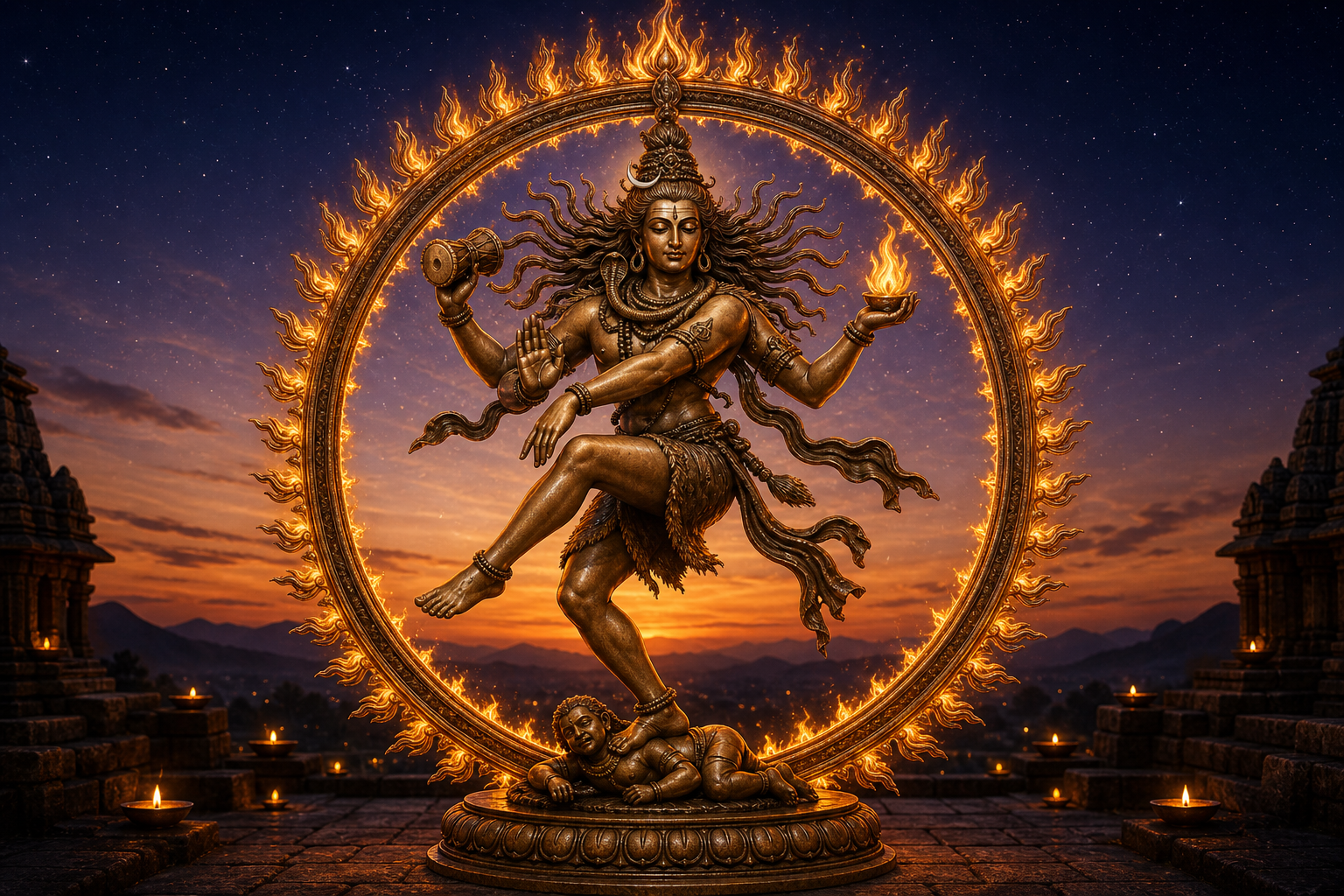
You may know Nataraja as the magnificent dancing form of Shiva, yet still wonder what His dance has to do with an ordinary evening. Sandhya Tandava answers that question at the precise moment when daylight weakens, unfinished duties press on the mind, and one part of life must give way to another.
The dance does not ask you to flee change. It teaches you how to stand within change without becoming confused by it. Once you learn to read its gestures, dusk can become a disciplined pause for worship, honest self-examination, and one deliberate correction before you enter the night.
Dusk is a junction, not a leftover hour
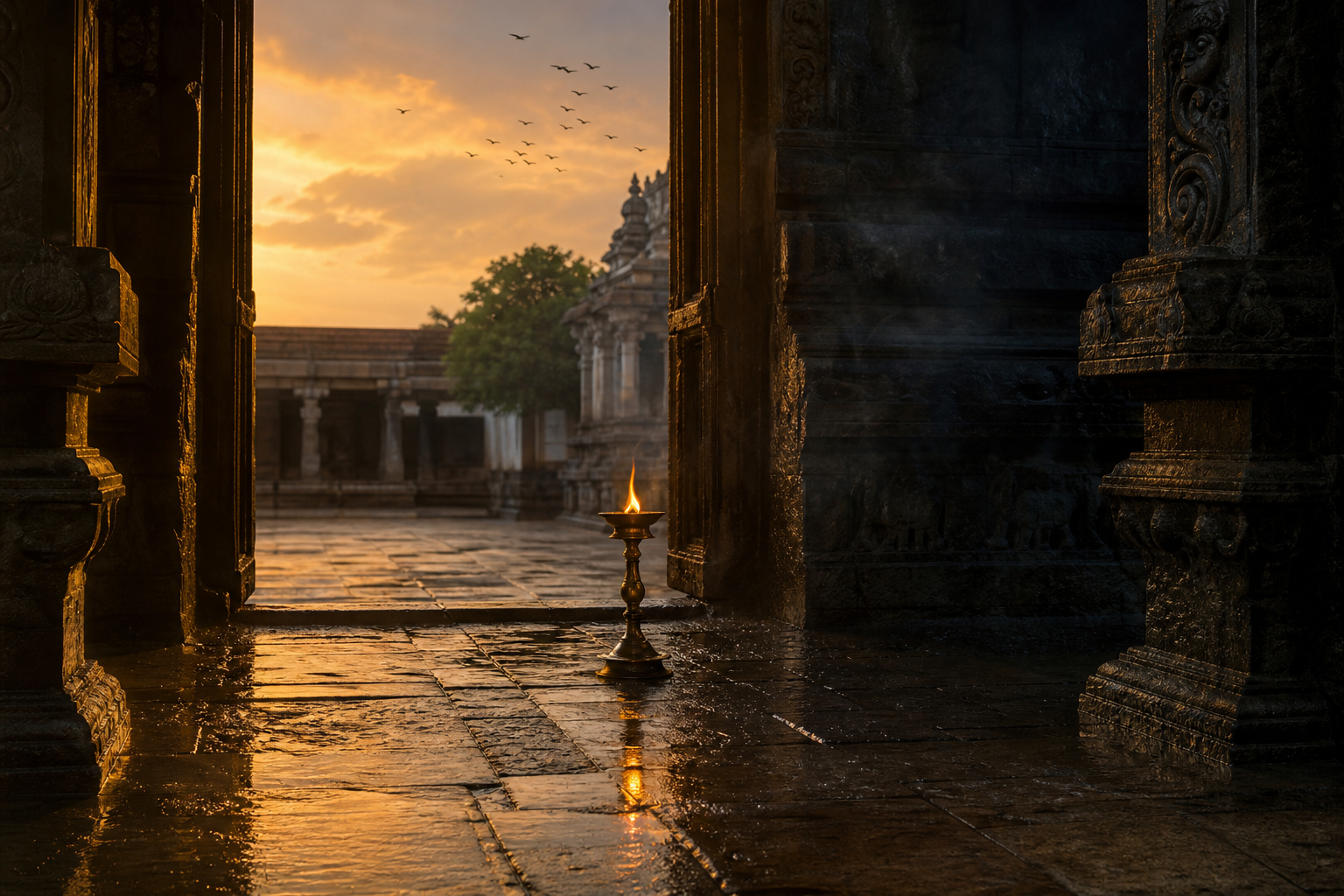
Sandhya means a junction: a meeting point at which one condition has not entirely vanished and the next has not fully arrived. Hindu ritual life recognizes three daily junctions: dawn, noon, and dusk. Sandhya Tandava is especially associated with the evening transition, when day yields to night.
This distinction matters because a junction demands a different kind of attention from a settled period. In the middle of the day, you can easily believe that your current work, emotion, or difficulty will continue indefinitely. Dusk contradicts that belief before your eyes. Light recedes, activity changes character, and the senses receive a visible lesson in impermanence.
Tandava names the vigorous, dynamic mode of dance associated with Shiva. It is commonly set beside lasya, the graceful mode. Vigour here should not be mistaken for disorder or rage. Nataraja’s movement is powerful because it is measured. Every gesture has a place, and every apparent opposition – creation and dissolution, motion and stillness, fear and assurance – belongs to a larger rhythm.
You will encounter different catalogues of Shiva’s dances. Some traditions enumerate eight, others sixteen, and the names and classifications can vary across texts, regions, and lineages. Sandhya Tandava appears in some of these traditions, but it should not be forced into a single universal list. The enduring point is clearer than any disputed catalogue: Shiva’s dances disclose different cosmic functions and different ways of meeting reality.
That also means you need not search for one exact clock minute and become anxious about missing it. Follow the evening observance maintained by your family, temple, or lineage where one exists. Otherwise, begin as the natural transition becomes apparent in your place. The purpose is to become conscious at the junction, not to turn sandhya into another deadline.
Read Nataraja as a sequence of spiritual choices
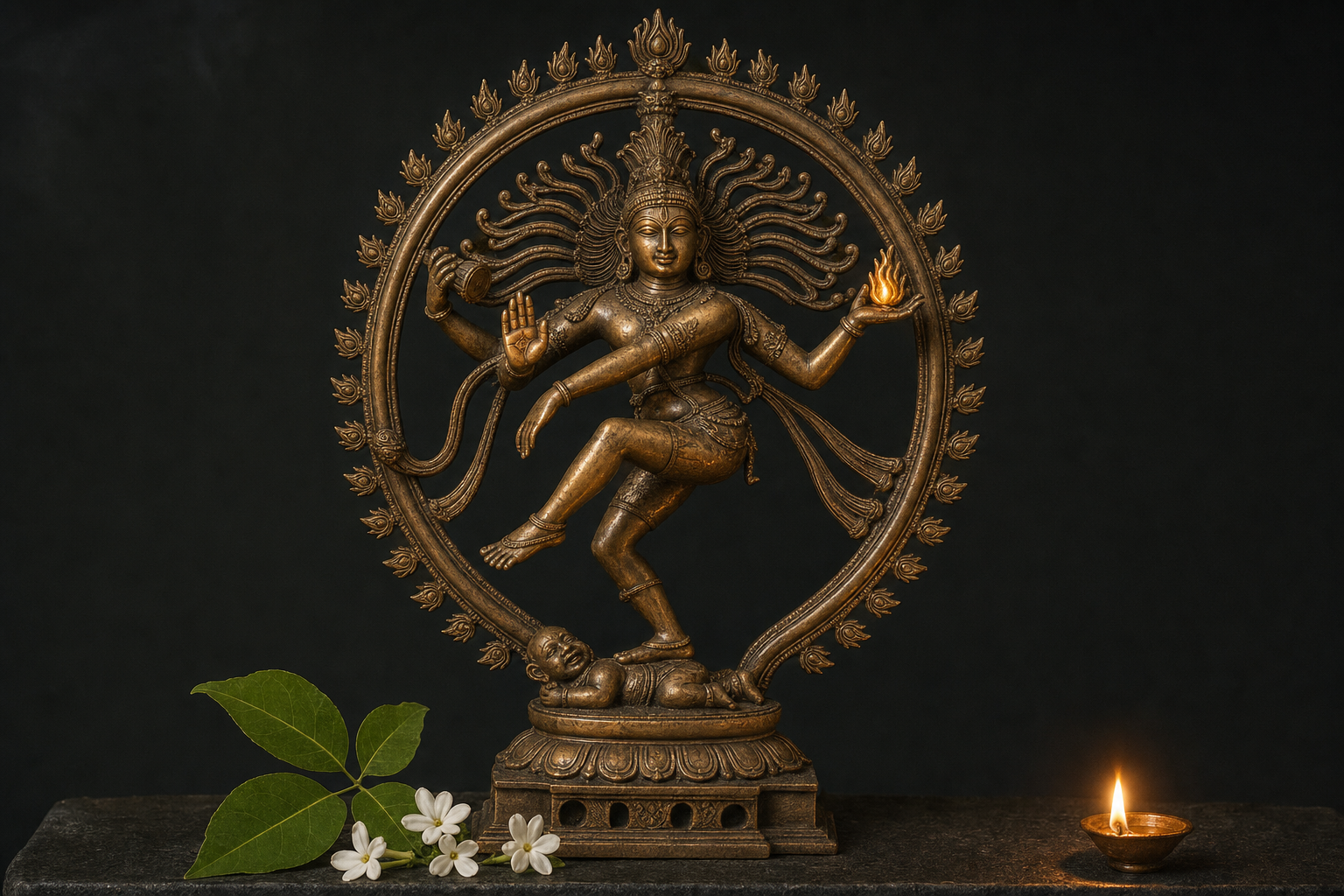
Do not treat every image of dancing Shiva as a literal picture of one named performance. The familiar Nataraja form provides a theological grammar through which Sandhya Tandava becomes intelligible. The icon does not merely decorate an idea. It makes a complete teaching visible at once.
The following questions are contemplative prompts, not fixed translations of the icon or substitutes for traditional worship. Use them to connect Nataraja’s symbols with the transition you are actually living through.
| What you see | What it discloses | A question for dusk |
|---|---|---|
| The ring of fire | The ceaseless pulse in which forms arise, endure, and pass away | What changed today despite my wish to hold it still? |
| The damaru | Primordial vibration, rhythm, and the emergence of ordered expression | What worthy beginning needs a clear first beat? |
| The flame | Transformative dissolution rather than meaningless destruction | What has completed its purpose and should now be released? |
| The abhaya mudra | Assurance in the presence of change | Which fear can I meet without letting it command my conduct? |
| The hand indicating the raised foot | Attention directed toward liberation | Where am I being shown a freer way to respond? |
| Apasmara beneath the planted foot | Forgetfulness and ignorance held under conscious restraint | What truth or duty did I forget while reacting today? |
The two feet deserve particular attention. One remains grounded upon Apasmara while the other is raised in liberation. Freedom is therefore not presented as denial of the world. Awareness becomes stable enough to keep forgetfulness from ruling, and that stability makes release possible.
Apasmara is not simply an enemy to be hated. The figure remains within the composition because forgetfulness remains a recurring human possibility. You can subdue it through remembrance, discipline, and insight, but triumphalism would only create another form of blindness. When you notice your own carelessness at dusk, the fitting response is correction with humility.
The abhaya gesture is equally practical. It does not promise that nothing will end or that every outcome will suit you. The flame is still present. Assurance comes from recognizing that dissolution belongs within a sacred order and need not destroy your inner steadiness. This is courage with open eyes, not reassurance purchased by ignoring reality.
Parvati’s place as the principal witness completes the teaching. Shiva is not imagined as an isolated power performing before emptiness. The witness invokes the inseparability of Shiva and Shakti – consciousness and energy, stillness and expression. The same complementarity appears in the Ardhanarishvara principle. At twilight, when light and shadow coexist, their unity becomes something you can perceive rather than merely define.
This prevents a common misreading of Nataraja as a symbol of destruction alone. The drum, flame, protecting hand, uplifted foot, encircling fire, and witnessing Shakti must be read together. Remove creation, preservation, concealment, or grace, and the dance becomes smaller than the tradition that formed it.
Chidambaram reveals the stillness inside the dance
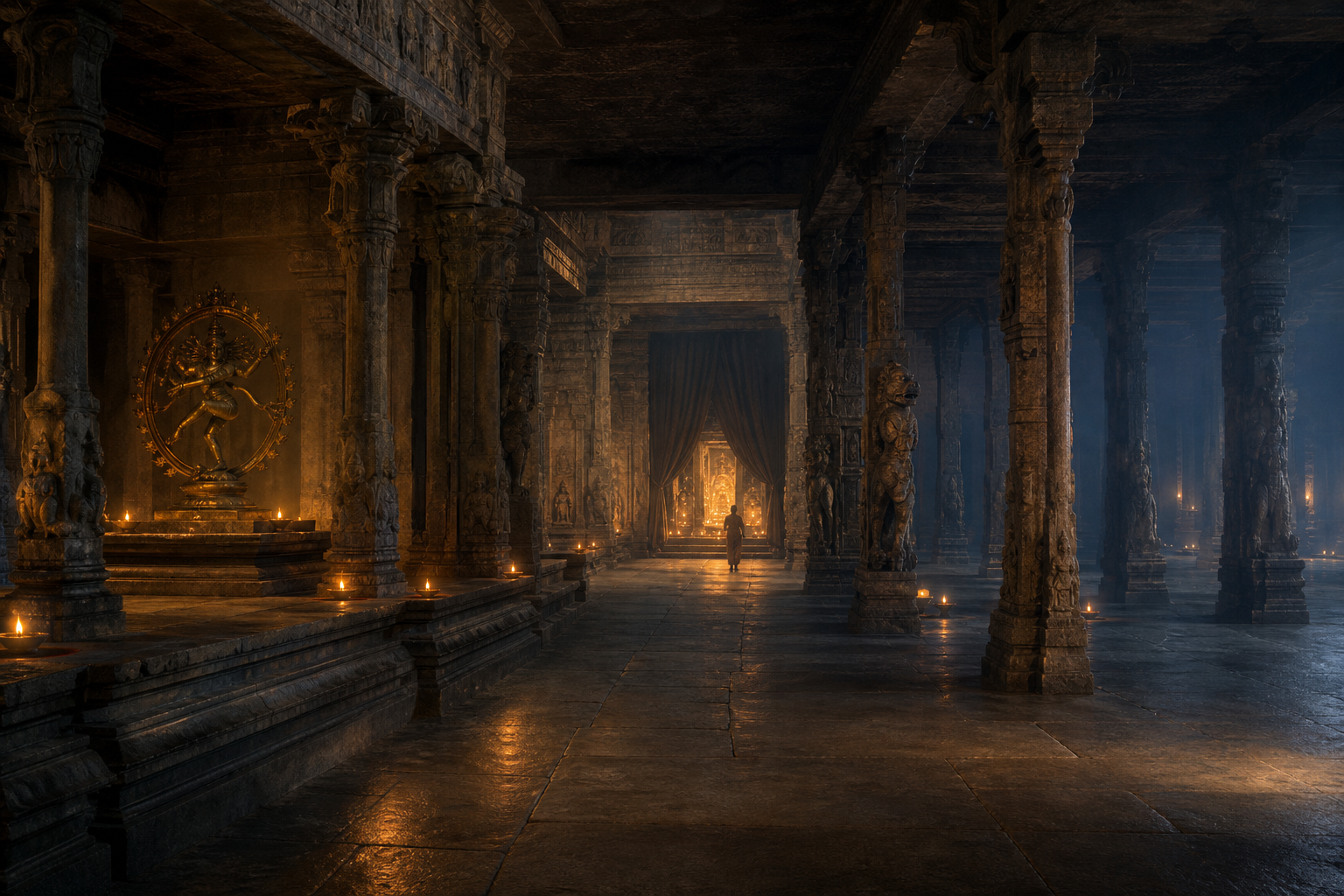
Chidambaram gives architectural and ritual form to this vision. In the Ponnambalam, the Golden Hall of Dance, Nataraja embodies the five cosmic acts: srishti, creation; sthiti, maintenance; samhara, dissolution; tirobhava, concealment; and anugraha, grace.
These are not five unrelated divine jobs. They form one movement. Something appears, receives support, passes away, remains partly veiled, and is finally met by grace. Your own evening contains the same pattern in miniature. A conversation began, a duty was sustained, an expectation ended, part of the truth remained hidden, and help arrived in a form you may or may not have recognized.
The Chidambara Rahasya, associated with the akasha-linga behind the curtain, directs attention toward space and apparent emptiness. This is the necessary counterweight to the spectacle of the dancer. Movement can be seen because space receives it. Sound can be heard because silence surrounds it. If your contemplation of Tandava leaves no room for stillness, you have noticed only half the teaching.
Arudra Darshan in the Tamil month of Margazhi brings Nataraja’s cosmic functions into public devotion through procession, hymn, lamp, and communal worship. Evening temple liturgy carries the same grammar on a more regular scale. Bells, conches, cymbals, Tevaram hymns, and deepa-aradhana do not merely create atmosphere. They gather wandering attention and return it to the sacred transition.
If you attend a twilight arati, resist the urge to consume it as a visual event. Notice the order of experience. Sound interrupts ordinary thought. Flame gathers the eyes. The deity becomes the center. The assembled devotees share a rhythm. Darkness then deepens outside without becoming spiritually empty. Participating attentively will teach you more than trying to collect every image on a phone.
Bharatanatyam carries this theology into performance through adavus, karanas, abhinaya, kauttuvams dedicated to Nataraja, and jatis that can evoke the damaru’s cadence. When watching such a presentation, follow the relationship between propulsion and pause. Look for the moment when a powerful movement resolves into a lucid pose. The still point is not an interruption of Tandava; it allows the movement’s meaning to become visible.
The civilizational reach of Shiva’s dancing form is also written into sacred art. Elephanta, Ellora, Badami, and Thanjavur preserve major expressions within Bharat, while Shiva imagery across Southeast Asia, including at Angkor Wat in Cambodia, bears witness to a wider cultural reception. What traveled was more than an attractive pose. Cosmology, artistic discipline, devotion, and royal temple culture could meet within one legible form.
Build a dusk observance you can actually sustain
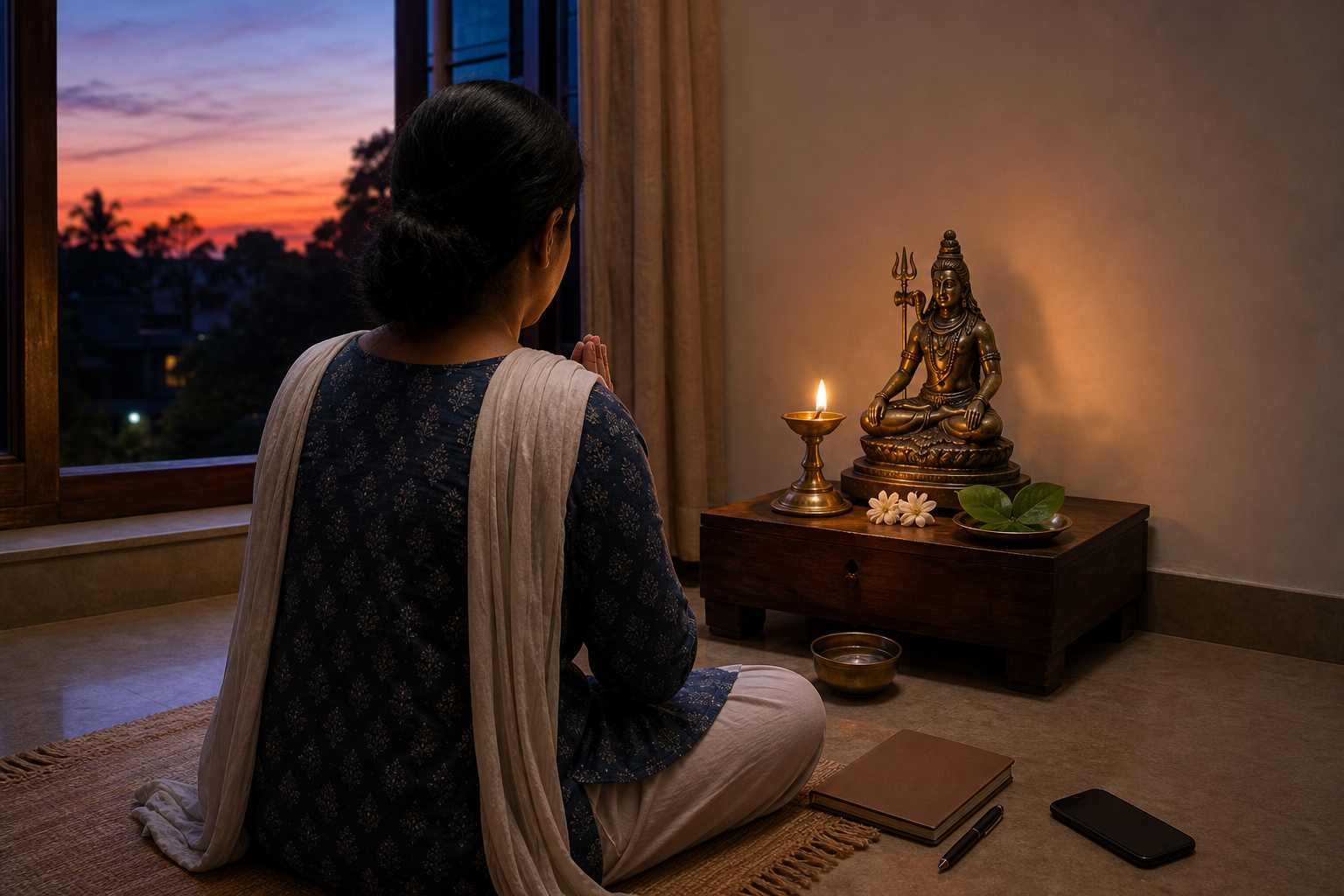
You do not need to reproduce temple liturgy at home. Nor should a homemade sequence be treated as a replacement for the practice given by your guru, sampradaya, or family tradition. Where such guidance exists, follow it. Where it does not, a restrained household observance can help you meet dusk in the spirit of Sandhya Tandava.
- Recognize the transition. Pause when daylight is giving way rather than waiting until the evening has already dissolved into distraction. Put down the task in your hands and acknowledge that one phase of the day is ending.
- Prepare one clean place. Clear the immediate area around your shrine or chosen seat. If you light a lamp, place it on a stable, fire-safe surface and keep it attended. When an open flame is unsafe, sit without one; the inner act of attention is more important than taking a needless risk.
- Become a witness before becoming a judge. Let your breathing settle naturally. Observe the day without immediately defending your conduct or condemning yourself. Parvati’s witnessing presence offers a better model than restless self-argument: attentive, relational, and steady.
- Invoke Shiva simply. Recite the Panchakshari, Namah Shivaya, according to your customary form, or maintain a short period of silence. If hymn recitation belongs to your practice, verses from the Tevaram or the Shiva Mahimna Stotra can give the mind a sacred cadence.
- Choose one Nataraja symbol. Do not run mechanically through every possible interpretation. On one evening, attend to the damaru and a necessary beginning. On another, contemplate the flame and a necessary ending. When fear dominates, remain with abhaya. When confusion dominates, remember Apasmara.
- Finish with one concrete act. Correct an omission, release an unnecessary grievance, prepare the next rightful task, or offer an apology that should not be delayed. Reflection becomes dharmic when it changes conduct.
Keep the sequence modest enough to survive an ordinary week. A complicated ritual performed briefly and then abandoned will not train attention. If your evening is crowded, protect the essential order: stop, remember Shiva, witness the day, and choose one correction. Depth comes from sincerity and continuity, not from adding decorative complexity.
Do not measure the observance by whether it produces a special mood. Some evenings will feel peaceful; others will expose agitation that was already present. Sandhya Tandava is not a technique for manufacturing serenity. It is a discipline of remaining aware while one condition changes into another.
It is also unhelpful to turn dusk into a productivity exercise. The final concrete act matters, but efficiency is not the deity. Worship first restores right orientation: the individual life is placed within a cosmic rhythm rather than treated as the measure of everything. Better action follows from that reorientation.
Let the dance change how you enter the night
The five cosmic acts can become an evening ethical examination without being reduced to a checklist. Ask what you began and whether it deserved beginning. Notice what you sustained and whether it was a duty or merely an attachment. Admit what needs to end. Recognize where your understanding remains concealed or partial. Then leave room for anugraha – grace that cannot be manufactured by personal control.
This examination changes the way you handle conflict. The presence of Apasmara directs attention toward forgetfulness before blame: Which duty was forgotten? Which fact was ignored? Which person was reduced to a convenient caricature? Subduing ignorance begins with refusing to make your own mind exempt from scrutiny.
The same twilight sensitivity appears elsewhere in the Dharmic family, though the rites and theologies remain distinct. Buddhist communities may close the day with evening chanting and puja. Jain devasi pratikraman centers ethical recollection and renewal. Sikhs recite Rehraas Sahib at dusk with remembrance, gratitude, and resilience. These practices should not be blended into a generic ceremony. Their convergence lies in recognizing that a threshold is a powerful time to recollect what human activity makes us forget.
That shared cultural grammar offers a grounded basis for Dharmic solidarity. Unity does not require flattening Shiva bhakti, Jain ethical discipline, Buddhist recollection, and Sikh prayer into interchangeable forms. It asks us to recognize a common seriousness about time, self-command, remembrance, and conduct while honoring the integrity of each path.
Key takeaways
- Sandhya Tandava presents Shiva’s dance at dusk, the junction where day passes into night and change becomes directly perceptible.
- Tandava is vigorous and ordered, not a synonym for destruction; Nataraja holds creation, maintenance, dissolution, concealment, and grace within one rhythm.
- The damaru, flame, abhaya mudra, uplifted foot, and Apasmara give you a practical grammar for examining beginnings, endings, fear, freedom, and forgetfulness.
- Parvati’s witnessing presence keeps the dance relational and expresses the inseparability of Shiva and Shakti.
- A sustainable household observance can be simple: recognize dusk, light a lamp where safe, remember Shiva, witness the day honestly, and make one concrete correction.
At the next dusk, choose just one symbol of Nataraja and let it question you. Then make one change before night settles. Sandhya Tandava becomes living wisdom when Shiva’s cosmic rhythm is answered by greater clarity in your own conduct.