
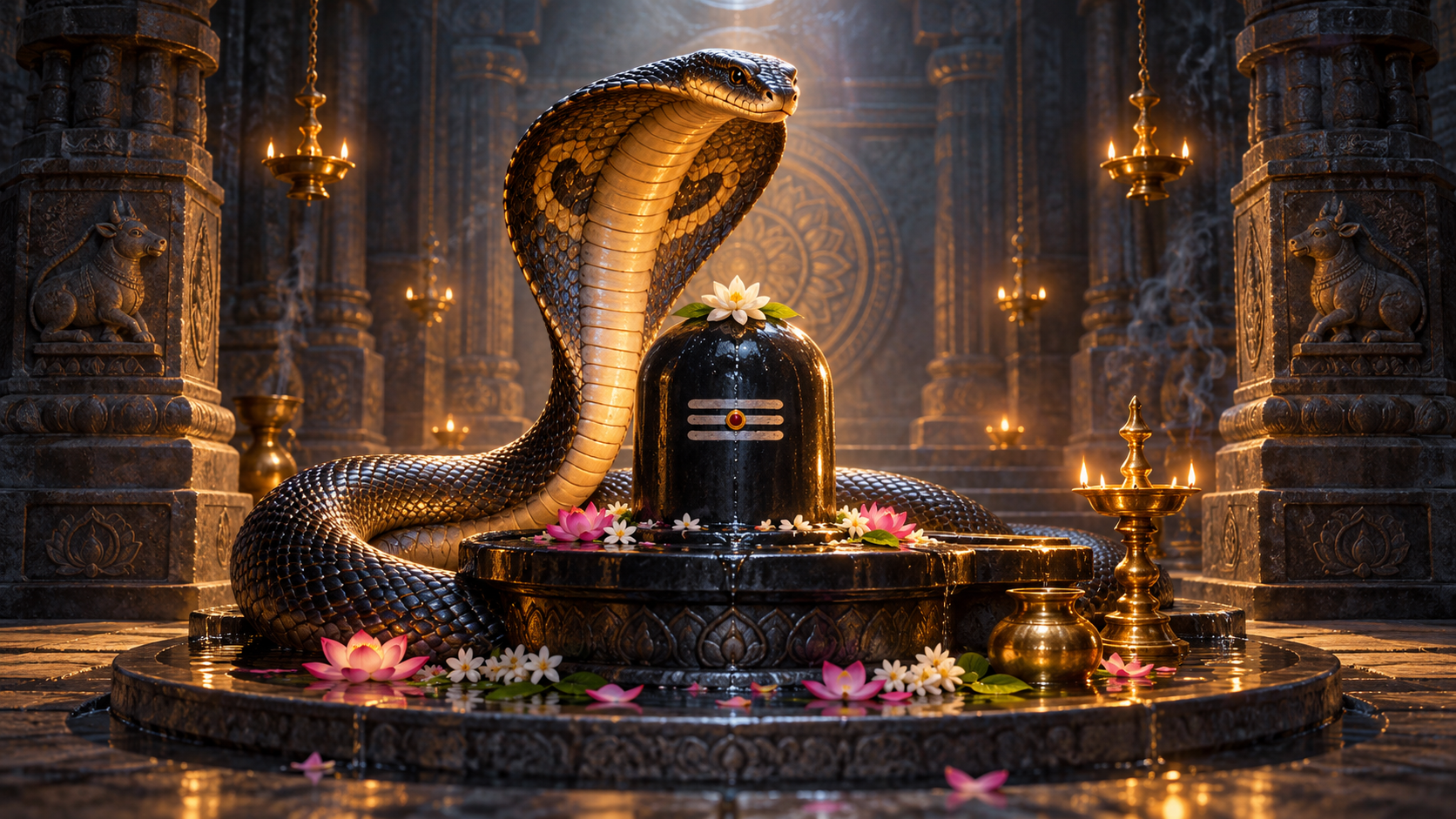
You see a serpent beside a divine form, in a temple carving, or in a devotional image. Should you read it as danger, protection, spiritual energy, or something else? The answer lies in the relationship between the serpent and the sacred setting, not in the animal considered by itself.
In Hindu symbolism, the serpent does not have to lose its dangerous power before it can become sacred. Its power is brought into divine order. That shift gives you the key to the image: look for wisdom, protection, cosmic energy, self-control, and the recurring movement of creation.
Sacred context changes the meaning of the serpent
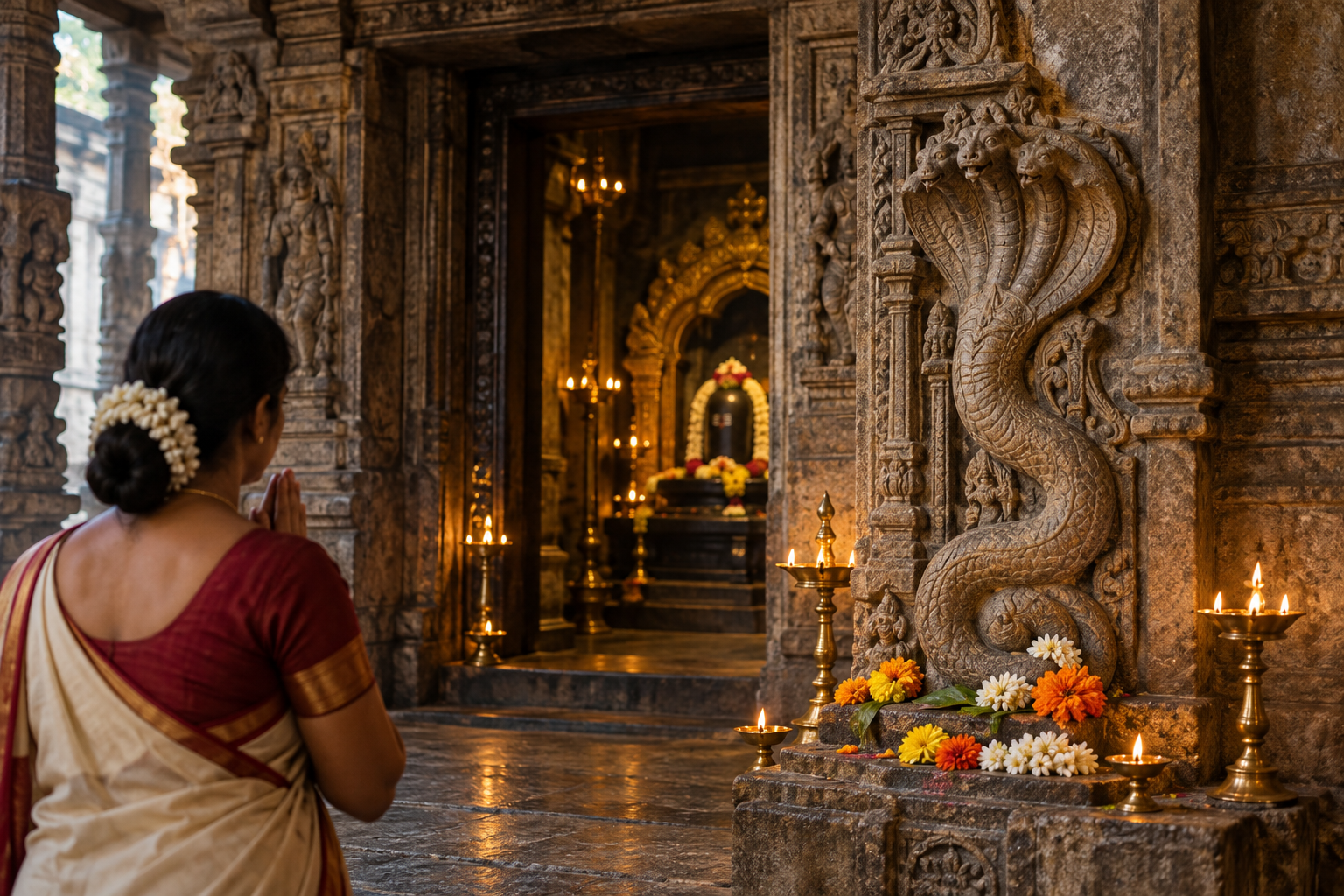
An ordinary snake can produce an immediate response: stop, watch, keep your distance. Sacred imagery begins with that recognizable potency but does not end with fear. The Sanskrit word bhujangam refers to a serpent or snake, while the divine Bhujangam can signify wisdom, protection, cosmic energy, self-control, and the continuing cycle of creation.
This means you should not isolate the serpent from the rest of an image. A serpent presented as part of divine order is doing different symbolic work from an animal presented merely as a threat. Its sacred setting converts raw potency into meaningful power.
When you encounter serpent imagery, begin with three questions:
- What is the serpent’s relationship to the divine? Is it presented harmoniously within the sacred scene, or as something opposed to order?
- Which quality does the image emphasize? Look for protection, wisdom, energy, restraint, or a sense of cosmic continuity.
- What qualifies its power? If self-control and divine order are absent from your interpretation, you may be mistaking sacred power for aggression.
These questions keep you from imposing a one-note meaning on the image. They also prevent the opposite mistake: treating every possible meaning as equally important in every setting.
Five meanings form one coherent spiritual teaching

Wisdom, protection, energy, self-control, and cyclical creation are not five unrelated labels. They describe how great power becomes Dharmic. Energy supplies capacity. Wisdom gives it direction. Self-control governs its use. Protection becomes its outward responsibility. The cycle of creation places it within a reality larger than individual desire.
Wisdom means alert and disciplined awareness
The serpent’s association with wisdom asks you to distinguish knowledge from awareness. Knowledge can remain abstract. Awareness notices what is present, including danger, impulse, consequence, and timing.
Apply this meaning when you face a decision that cannot be repaired by enthusiasm alone. Before acting, ask what you have noticed but not yet admitted. Sacred wisdom is not cleverness used to justify desire. It is the clarity that sees both power and consequence.
Protection is strength placed in service
Protection changes the moral direction of power. Strength is no longer valuable merely because it can overcome resistance. It becomes sacred when it guards what should be preserved.
When protection appears to be the central meaning, identify what the sacred scene treats as worthy of care. Then bring the question into your own conduct: does your strength create security for a rightful responsibility, or does it simply enlarge your control over others? The difference is the difference between guardianship and domination.
Cosmic energy is capacity, not mere intensity
Calling the serpent a sign of cosmic energy does not mean that every intense feeling is spiritually authoritative. Anger, excitement, fear, and ambition can all feel powerful. Feeling powerful does not make an impulse wise.
Read energy together with the other four qualities. Ask where that energy is directed, what restrains it, what it protects, and whether it serves creation rather than disorder. This prevents a spiritual symbol from becoming an excuse for impulsiveness.
Self-control is the test of sacred power
Self-control is not weakness and it is not the denial of power. It is the capacity to possess force without being possessed by it. This is the meaning that disciplines all the others.
If an interpretation glorifies force but ignores restraint, it is incomplete. Use a simple test: does the reading make mastery of the self more important than mastery over someone else? If not, return to the image and reconsider what divine order contributes to its meaning.
The cycle of creation places change in a larger rhythm
The serpent can also point toward creation as a continuing cycle rather than a single, completed event. Under this reading, endings and beginnings belong to a larger movement. Change is real, but no passing condition exhausts reality.
This does not require you to call every loss beneficial. It asks for a more precise question: what has actually ended, what may now begin, and which duty remains through the transition? The symbol becomes useful when it steadies your attention without making you passive.
Fear is transformed rather than simply denied

One of the most useful features of sacred-serpent symbolism is its refusal to pretend that power is harmless. The ordinary serpent can inspire fear. The divine serpent preserves that sense of potency while placing it under wisdom and self-command.
The Dharmic movement here is neither panic nor careless familiarity. It is transformation. Fear can become vigilance. Vigilance can become understanding. Understanding can guide restrained action. The original energy remains, but your relationship to it changes.
You can use the symbol as a reflection prompt when a strong emotion or difficult situation unsettles you:
- Name the power present. Is it fear, anger, ambition, responsibility, or the ability to affect another person?
- Name what needs protection. Identify a duty, boundary, relationship, or principle instead of defending pride in the abstract.
- Choose the restraint. Decide what you will not say or do while your judgment is clouded.
- Choose the constructive act. Direct the available energy toward protection, clarity, or responsible renewal.
This is a method of personal reflection, not a claim that every serpent image prescribes the same practice. A particular temple, lineage, or sacred setting may give an image a more exact meaning. Let that context take priority over a generalized interpretation.
A practical method for reading serpent imagery
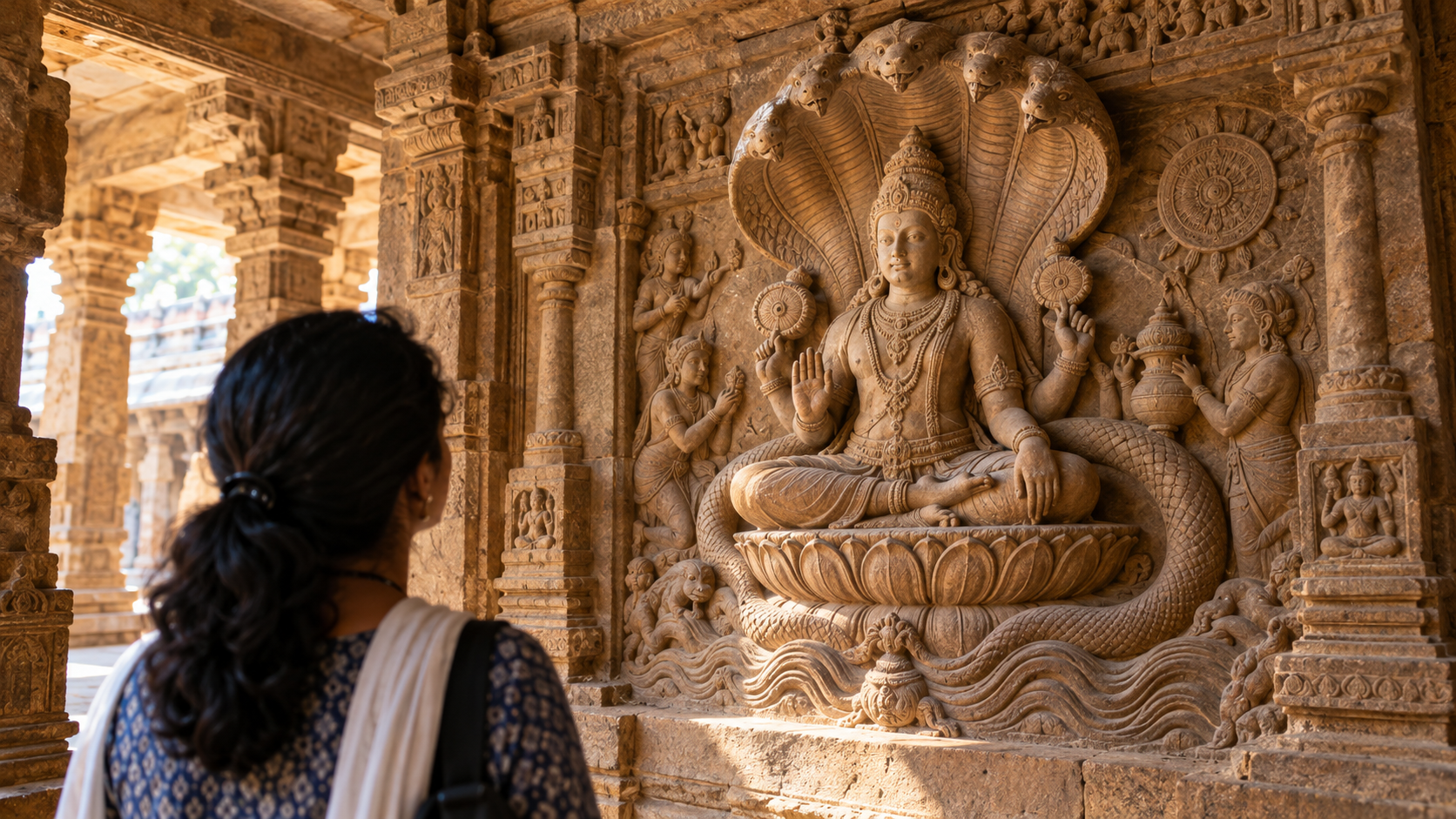
You do not need to guess at every theological detail to read an image attentively. Use the following sequence when you encounter a sacred serpent in art, worship, or study:
- Describe before interpreting. Notice whether the serpent appears integrated into the sacred scene or presented as a disruptive presence. Do not begin with the assumption that serpent automatically means evil or automatically means energy.
- Select one primary meaning. Choose the quality most clearly supported by the setting: wisdom, protection, cosmic energy, self-control, or cyclical creation.
- Add one qualifying meaning. Protection may be qualified by wisdom. Energy may be qualified by self-control. Change may be qualified by continuity. This keeps the reading focused without making it simplistic.
- Test the interpretation ethically. Ask whether it places power within responsibility and restraint. A reading that celebrates domination is difficult to reconcile with the serpent as a sign of self-mastery.
- State the lesson in one sentence. Try the form: Power becomes sacred when it is guided by ______ and used for ______. Fill the blanks from the actual image rather than from preference.
Three common misreadings to avoid
- Serpent means evil. This erases the Hindu sacred meanings of wisdom, protection, disciplined energy, and creation.
- Serpent means whatever the viewer wants. Symbolism is rich, but it is not arbitrary. The sacred setting and the serpent’s role must constrain your reading.
- Spiritual energy means uncontrolled force. Cosmic energy and self-control belong in the same symbolic field. Removing restraint reverses the lesson.
The strongest interpretation is usually not the one with the most associations. It is the one that explains why the serpent is present, how it relates to divine order, and what that relationship asks you to notice.
Key takeaways
- In a Hindu sacred setting, the serpent can signify wisdom, protection, cosmic energy, self-control, and the recurring movement of creation.
- Its power is not erased. It is brought under divine order and given a protective, constructive, or contemplative direction.
- Context decides which meaning deserves emphasis; no single label should be imposed on every image.
- Self-control is the best test of an interpretation because it distinguishes sacred power from aggression.
- The symbol becomes personally useful when it helps you turn fear into vigilance, energy into responsibility, and change into purposeful action.
The next time you meet a sacred-serpent image, pause before assigning it a fixed meaning. Identify the power it represents, the wisdom that directs that power, and the duty it protects. Then complete the sentence: power becomes sacred when it is mastered and placed in the service of Dharma.
References

Leave a Reply
You must be logged in to post a comment.