

You may know that Shivaduti is associated with Saptami and still be unsure what to do when the day arrives. The useful answer depends on two checks: whether it is Shukla or Krishna Saptami, and whether you have an initiated Srividya practice or are making a simple household remembrance.
Keeping those questions separate lets you honour the calendrical connection without turning it into an invented mantra, offering list, or elaborate ritual. You can observe the day meaningfully while remaining honest about what your lineage has, and has not, taught you.
The relationship is specific to Srividya
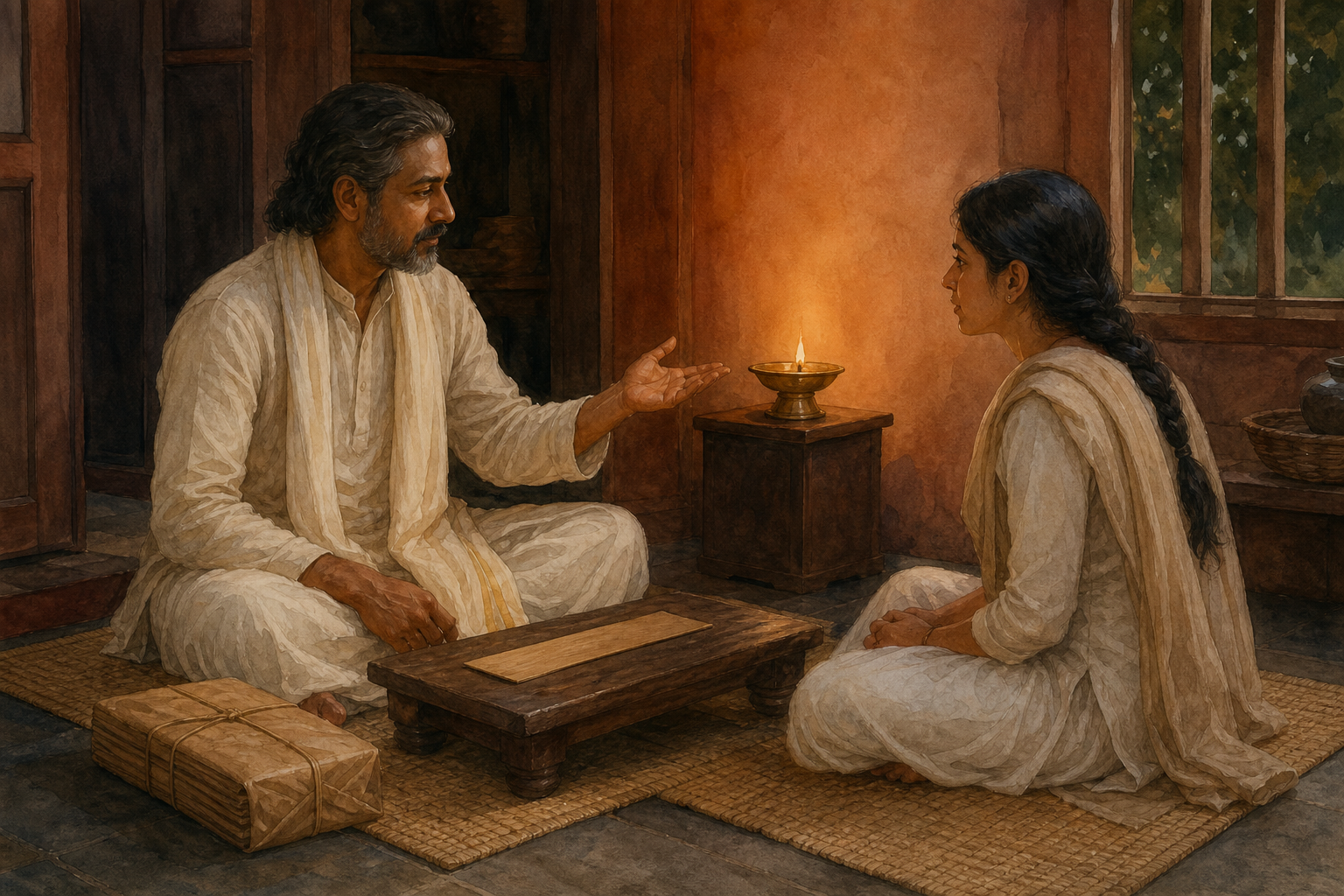
Within Srividya, the Nitya Devis form an ordered cycle of sixteen goddesses associated with the lunar days of a fortnight. Shivaduti is the seventh Nitya Devi and presides over Saptami, the seventh tithi in both the waxing and waning halves of the lunar cycle.
This gives you three connected facts rather than one loose devotional label: Shivaduti is a Nitya Devi, she occupies the seventh place in that cycle, and her temporal correspondence is Saptami. When you make a calendar note or explain the association to someone else, keep all three together. Removing the Srividya setting can make a precise relationship sound like a universal rule for every Hindu observance held on Saptami.
Calling Shivaduti the goddess of Saptami therefore does not mean that every Saptami vrata, temple festival, or family custom belongs to her. Hindu traditions can give the same tithi more than one devotional association. The relevant question is not simply, “What happens on Saptami?” It is, “How is Saptami understood in the Nitya cycle followed by this Srividya tradition?”
Shivaduti also carries a messenger dimension within the worship of Shakti. You can use that theme carefully in contemplation: notice whether you receive dharmic instruction clearly, whether you distort it when passing it on, and whether you act when duty becomes plain. Treat this as a focus for reflection, not as permission to manufacture theology or ritual details.
Saptami must be identified as a tithi, not a date

Saptami is not the seventh date of a civil month. It is the seventh lunar day within a paksha. Shukla paksha is the waxing half, while Krishna paksha is the waning half. A lunar month consequently contains both Shukla Saptami and Krishna Saptami, and Shivaduti’s stated correspondence covers Saptami in both halves.
That does not prove that every formal detail must be identical on the two Saptamis. A presiding-deity relationship establishes the calendrical correspondence; it does not, by itself, supply the complete liturgy. If your guru, paddhati, temple, or family tradition distinguishes between the two halves, that instruction takes precedence over a generic calendar entry.
Use this short process before planning an observance:
- Open a reliable panchanga configured for your location. Do not identify Saptami merely because a civil date is numbered seven.
- Find the beginning and ending times of Saptami. A tithi can occupy only part of a civil day or extend across portions of two dates.
- Record the paksha explicitly: Shukla Saptami or Krishna Saptami. Writing only “Saptami” leaves out information you may need later.
- Check whether your sampradaya uses a particular rule involving sunrise, the time of worship, or another ritual criterion. Follow that rule consistently rather than choosing whichever calendar label is most convenient.
- If you have no special lineage rule, make your simple remembrance while the local panchanga identifies Saptami. Do not advertise a narrower “Shivaduti muhurta” unless a trusted tradition actually provides one.
A practical calendar entry should read: place, paksha, Saptami beginning time, Saptami ending time, and the observance rule you are following. This small record prevents the most common confusion: treating a location-dependent lunar interval as though it were an all-day date printed identically everywhere.
A simple observance that respects lineage

The Shivaduti-Saptami correspondence tells you whom the tithi is linked with in the Nitya cycle. It does not automatically prescribe a complete household puja. If you have received a formal Srividya practice, use it exactly as taught. If you have not, a restrained act of remembrance is more respectful than assembling technical fragments from unrelated websites or videos.
- Confirm that Saptami is current in your local panchanga and note whether it is Shukla or Krishna paksha.
- Set the boundary of your practice. An initiated practitioner should follow the received sequence. An uninitiated devotee should not self-assign a bija mantra, nyasa, yantra procedure, or restricted ritual merely because it is publicly visible.
- Prepare a clean prayer space. Use a representation of Devi already accepted in your household or tradition rather than choosing an unverified image and declaring it to be Shivaduti’s required form.
- Offer only what is already customary in your ordinary worship, such as water, a flower, or a safely tended lamp. These are general gestures of reverence, not a claim that a particular list is mandatory for Shivaduti.
- Remember Shivaduti by name and acknowledge her place as the seventh Nitya associated with Saptami. If you have an authorized mantra, recite it as instructed. Otherwise, speak a plain personal prayer without calling it a traditional mantra.
- Sit quietly with one concrete question: What dharmic responsibility do you already understand but continue to postpone? End with pranam and choose one proportionate action that can begin during the tithi.
If you want words for a personal prayer, you might say: “Shivaduti Devi, accept this remembrance. May my speech serve dharma, and may I act on what is right.” This is a suggested English prayer, not a scriptural quotation, received mantra, or substitute for initiation.
The value of this simple form lies in its clear boundary. You are acknowledging an established relationship between Devi and the lunar day while refusing to pretend that general reverence is the same as a complete Nitya puja.
What the Saptami association does not authorize
A single calendrical association is easy to overextend. Keep these distinctions in view when you encounter confident but unsupported ritual instructions:
- “Seventh Nitya” does not mean the seventh day of a Gregorian calendar month. The relevant unit is Saptami tithi.
- Association with both waxing and waning Saptami does not establish that the same formal ritual must be performed in both halves.
- Presiding over Saptami within Srividya does not make every Hindu Saptami observance a Shivaduti practice.
- An image, mantra, colour, direction, offering, repetition count, or promised result does not become authoritative merely through frequent online repetition.
- A household prayer made on Saptami is not equivalent to initiated worship of the Nitya Devis.
If you want to move from remembrance into formal worship, ask a qualified teacher precise questions. Which paksha is intended? Which calendrical rule determines the ritual time? What mantra and sequence belong to the practice? Who is authorized to perform it? What preparation and closing procedure are required? Specific answers tied to a living sampradaya are more useful than a long collection of unattributed ritual claims.
This restraint is not a lesser form of devotion. In mantra- and lineage-based practice, accuracy protects meaning. It also prevents you from presenting a personal adaptation as though it carried the authority of Srividya.
Key takeaways for your next Saptami
- Shivaduti is the seventh of the sixteen Nitya Devis and is associated with Saptami in the Srividya framework.
- Saptami occurs in both Shukla and Krishna paksha; always record which one you are observing.
- Use a local panchanga and check the tithi’s actual beginning and ending times rather than relying on the civil date alone.
- Follow received instructions if you have them. Without initiation, keep the observance to honest remembrance and ordinary household reverence.
- Do not invent Shivaduti-specific mantras, offerings, iconography, timings, or promised benefits when your tradition has not supplied them.
Before the next Saptami, create a calendar note with the paksha and local tithi timings. When it arrives, worship only within the boundary you genuinely possess, then carry one clear dharmic responsibility into action. Precision in the calendar and restraint in practice are themselves ways of treating the Nitya tradition with respect.
References
