

If the end of the Yadu dynasty leaves you wondering whether Krishna abandoned his own family, you are noticing the episode’s real moral difficulty. How can the protector of the Yadus also permit their dissolution?
Within the Bhagavata’s bhakti framework, the answer is neither that Krishna lost control nor that the Yadus were helpless puppets. Krishna retained responsibility for the conclusion of his earthly pastimes, the Yadus remained answerable for their conduct, and no outside power was made to carry a burden that did not belong to it. That distinction gives you a much more useful way to think about divine will, human agency, family loyalty, and leadership.
Responsibility was distributed, not erased
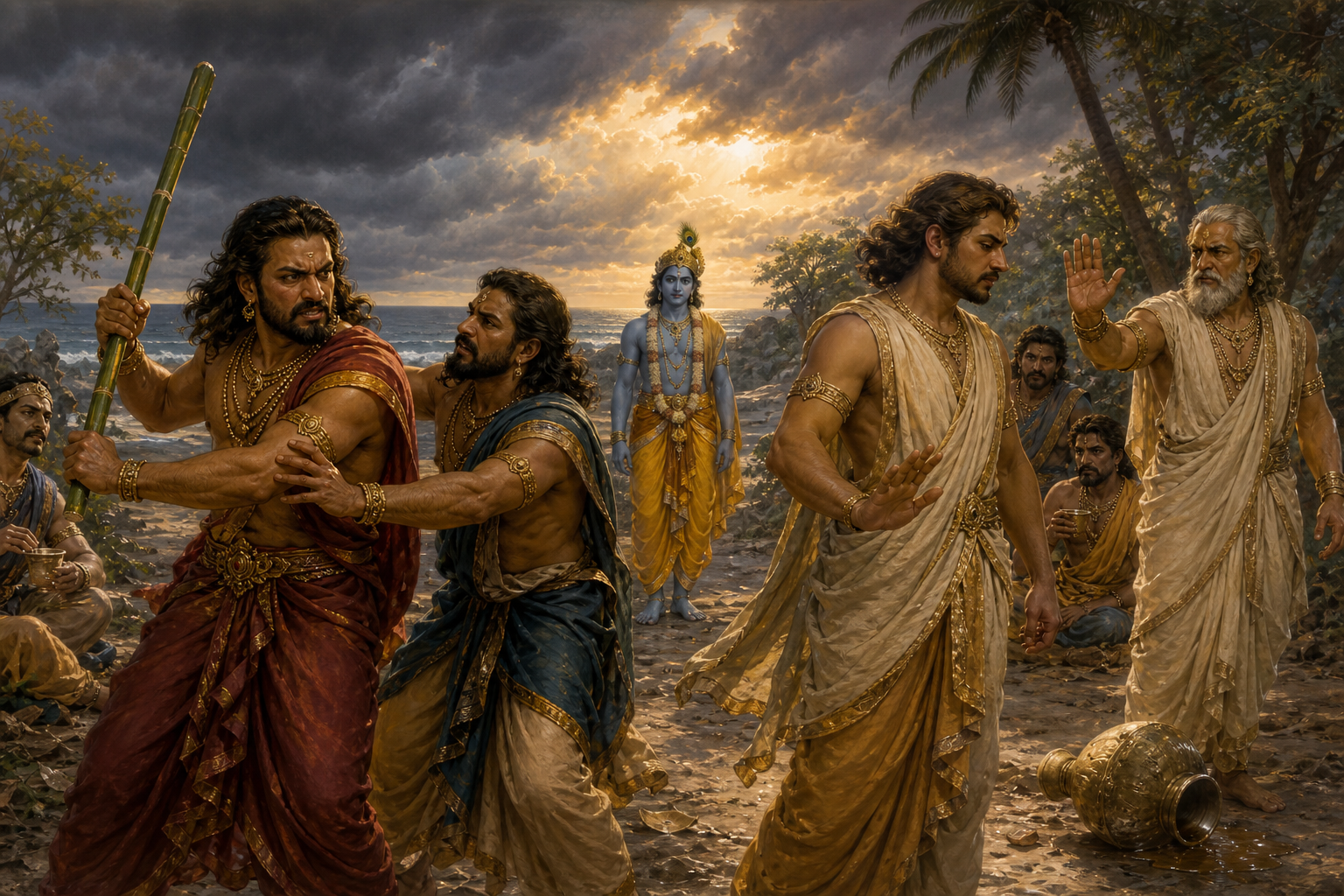
Srimad Bhagavatam 11.1.4 supplies the decisive distinction: because the Yadus were Krishna’s own family, no being within the universe, not even the demigods, was empowered to destroy them. Their dissolution arose through their own actions while also serving the divine conclusion of Krishna’s earthly pastimes.
Three forms of responsibility therefore operate at once:
- The Yadus bear responsibility for the actions through which their internal disorder reaches its consequence.
- Krishna bears responsibility for the divine ordering of the outcome and for refusing to appoint an external destroyer.
- Other beings are kept outside the act, so they do not acquire needless karmic entanglement in the destiny of Krishna’s family.
This prevents two opposite errors. If you say Krishna did everything, you erase the Yadus’ agency. If you say Krishna merely watched events unfold, you erase divine governance. The bhakti understanding preserves both: creaturely action remains morally meaningful even when divine will encompasses the larger conclusion.
Responsibility, in other words, does not require Krishna to be the immediate actor in every event. It means that he does not evade the moral weight of what belongs to his own divine purpose.
Kinship increased Krishna’s duty; it did not grant immunity
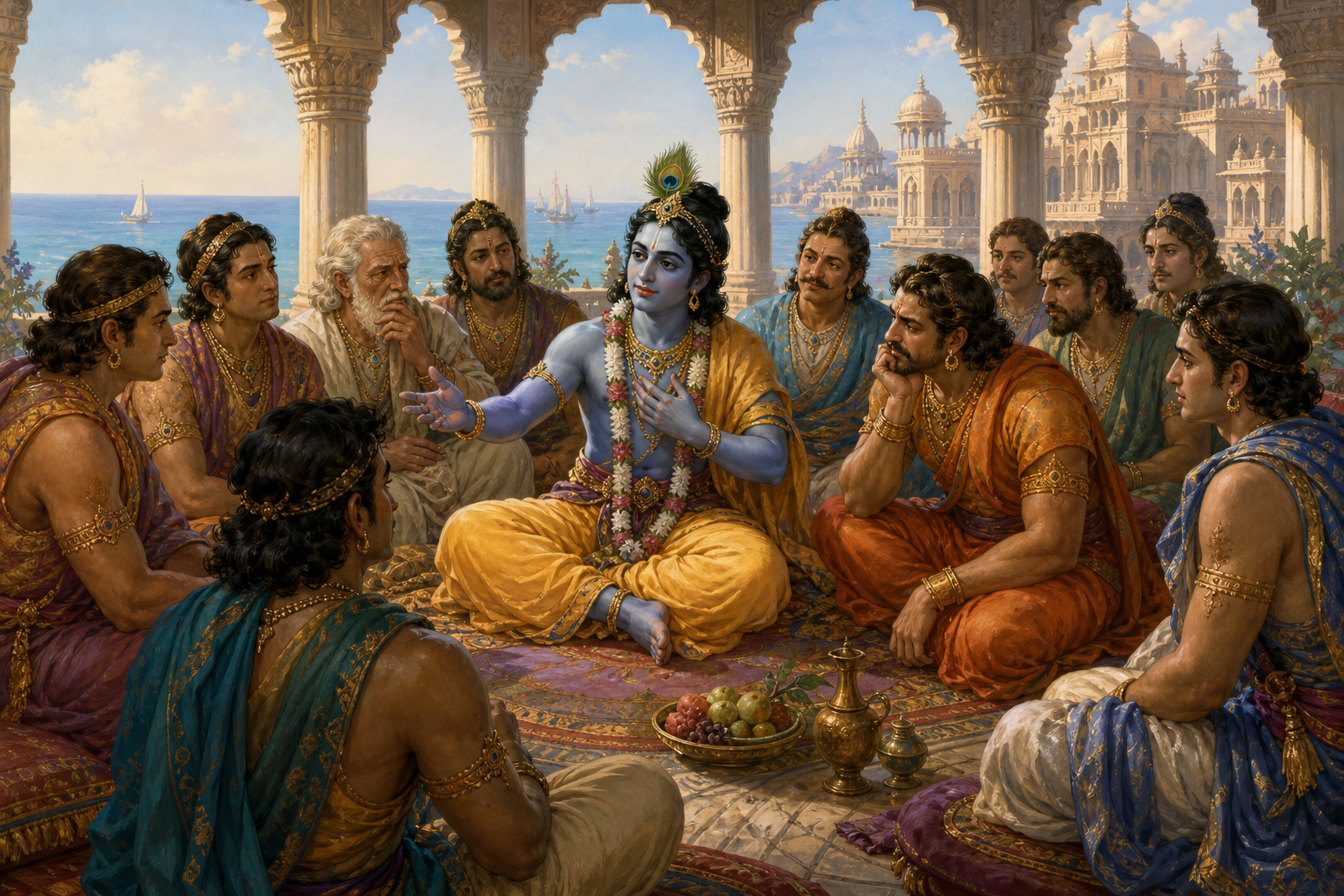
Family loyalty is often mistaken for unconditional protection from consequences. The Yadu episode rejects that idea. Krishna’s closeness to the dynasty does not place it beyond dharma. Yet that same closeness prevents him from transferring its fate to an unrelated agent.
This is why Krishna’s responsibility cannot be reduced to punishment. A powerful ruler can easily find a subordinate to perform a painful act and then deny ownership of it. Krishna does the opposite. He allows no outside party to become the convenient instrument of his family’s end. Divine authority is joined to moral accountability rather than deniability.
Justice and compassion meet at this point. Compassion does not mean cancelling every consequence. Justice does not mean spreading harm as widely as possible. The Yadus encounter the result of disorder arising among themselves, while outsiders are protected from being drawn into an act carrying grave karmic weight. The consequence remains, but its moral burden is not exported.
There is also a lesson in renunciation. A dynasty closely related to Krishna cannot be preserved merely as an emblem of prestige. Lineage does not outrank dharma, and intimacy with the Divine is not a licence for pride. If your interpretation makes family status more important than accountability, it has missed the sharp edge of the episode.
Key takeaways from the Yadus’ end
- Krishna did not outsource the fate of his own dynasty to the demigods or another external power.
- The Yadus’ actions remained consequential; divine will did not turn them into morally empty instruments.
- Krishna’s impartiality appears in his refusal to exempt his own family from the consequences of disorder.
- His compassion appears in protecting outsiders from unnecessary karmic involvement.
- For you, the practical lesson is to own grave decisions instead of delegating their moral cost for the sake of convenience or appearances.
Four misreadings that the episode does not support
- Family love requires shielding relatives from every consequence. Krishna’s relationship with the Yadus shows a more demanding love. Kinship calls for care, but it does not convert adharma into acceptable conduct.
- Divine will cancels personal agency. The account holds divine purpose and the Yadus’ own actions together. Invoking destiny to excuse pride, resentment, or destructive choices removes precisely the accountability the episode preserves.
- Every family or community must resolve serious wrongdoing internally. The Yadus occupy a unique theological relationship with Krishna. Their story is not a rule for concealing abuse, danger, crime, or misconduct from lawful authorities. When an outsider is needed for safety, impartial judgment, or a duty of care, seeking that help is responsible action rather than moral outsourcing.
- A human leader may engineer conflict and call the result divine justice. Krishna’s divine position cannot be claimed by an ordinary officeholder, parent, teacher, or community leader. The usable lesson is to accept responsibility, restrain harm, and examine internal disorder. It is not permission to manipulate people into destroying one another.
You may recognize ethical resonances across Dharmic traditions without pretending that their theologies are identical. Jain and Buddhist commitments to ahimsa and self-restraint, Sikh teachings on seva, santokh, and principled duty, and Hindu teachings on dharma and devotion all direct attention away from blame and toward disciplined conduct. The shared practical question is simple: are you regulating your own power before making someone else bear its consequences?
Use a responsibility test before a conflict hardens

The Yadu episode becomes useful when it changes what you do before a difficult decision. In a family dispute, temple committee, voluntary organization, workplace, or public office, ask these five questions in order:
- What actually belongs to me? Name the decision, promise, neglected duty, or harmful action for which you have authority. Avoid vague statements about what “everyone” did when your own part can be identified.
- Am I delegating work, or delegating guilt? Practical tasks can be assigned. Moral ownership cannot. If you authorize a serious decision, explain its basis yourself and remain answerable for its effects.
- Who could be needlessly implicated? Do not recruit relatives, junior colleagues, devotees, or public supporters merely to fight a battle that began with your own grievance. Use a neutral mediator when communication needs help, but do not turn the mediator into a proxy for retaliation.
- What internal disorder are we refusing to see? Look specifically for pride in status, factional loyalty, resentment, refusal of correction, or a desire to humiliate. These conditions often matter before the visible clash does.
- What action corrects the problem without widening it? A clear boundary, admission, restitution, transparent review, or impartial intervention may serve dharma better than public punishment. If safety or a legal duty requires outside involvement, obtain it promptly and remain accountable for making that call.
In a family, this may mean speaking directly instead of sending another relative to deliver an accusation. In a community, it may mean recording who authorized a decision, stating the reason, and providing a fair way to challenge it. In public service, it means that the office exercising power also carries the duty to explain, review, and correct its use.
A devotee can add three questions before acting: Am I protecting dharma or protecting my status? Am I trying to correct harm or to make someone else punish the person who offended me? Can I accept accountability if the result exposes my own mistake? These questions turn humility from an attractive idea into a method of discernment.
The next time a decision carries grave consequences, do not begin by asking who can be made to carry it. Write down what is yours, who might be unnecessarily drawn in, and which part of the disorder must first be corrected within. That is how Krishna’s responsibility for the Yadus becomes a living discipline rather than a distant theological puzzle.
References
