
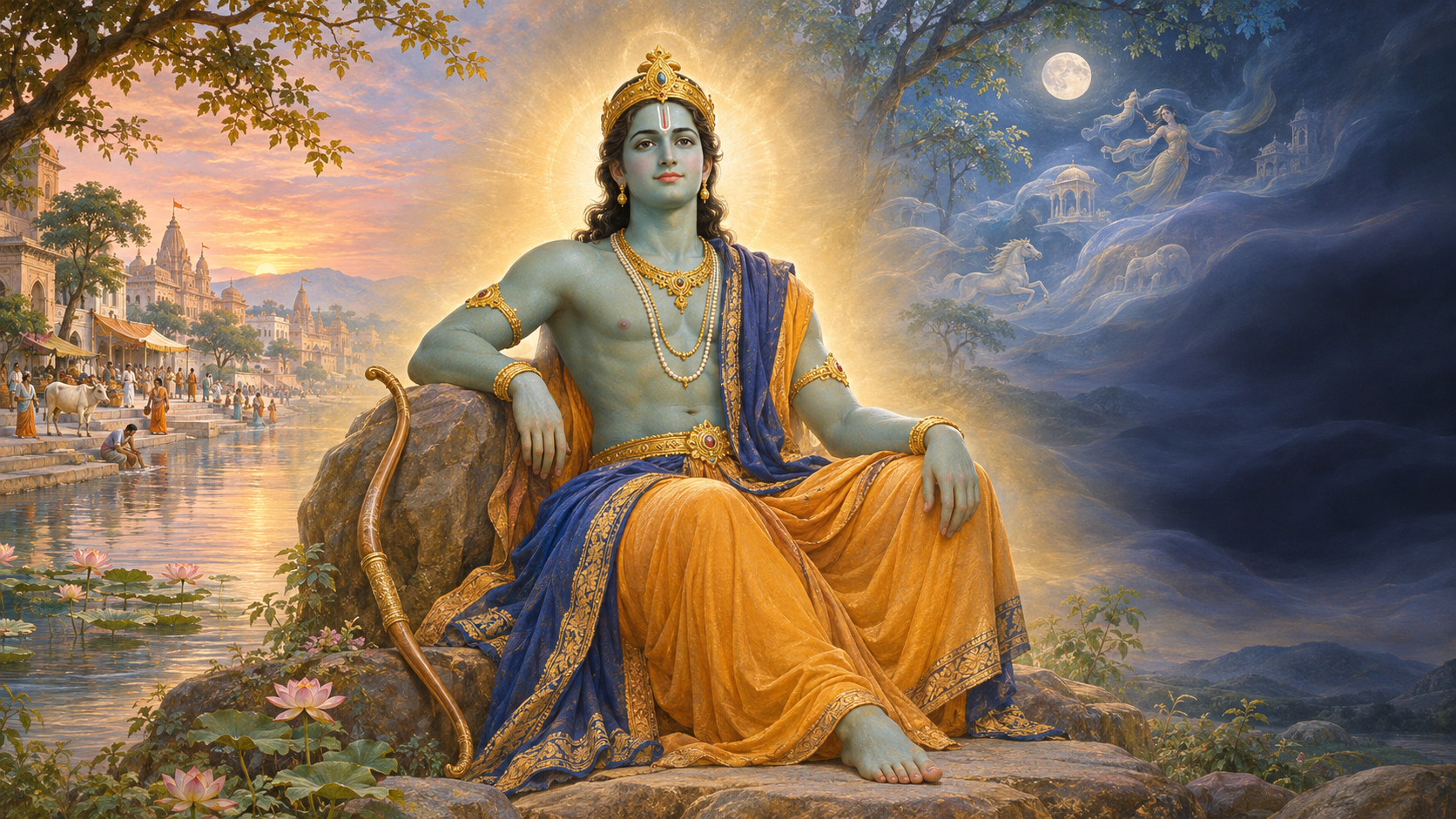
If the phrase Rama as Turiya has left you wondering whether Rama is being reduced to an abstract idea, the short answer is no. The teaching asks you to recognize a deeper dimension of Rama: not only the Lord encountered through name, form and sacred narrative, but the changeless consciousness by which every experience is known.
This distinction matters in practice. Without it, you may spend years looking for Turiya as an extraordinary meditation experience. Once the distinction is clear, waking life, dreams, sleep, prayer and difficulty all become places where you can examine the same question: what changes, and what knows the change?
The fourth is not the next state you enter

Vedanta maps ordinary experience through jagrat, svapna and sushupti, while Turiya is described as the transcendent fourth. Jagrat is waking, svapna is dream, and sushupti is deep sleep. You move through these three repeatedly. Each has its own field of experience, and each gives way to another.
| State | What is present | What you should notice |
|---|---|---|
| Jagrat, waking | The body, senses and a world experienced as external | Objects, thoughts and moods continually change |
| Svapna, dream | A dream body, dream identity and dream world | A complete field can appear without the waking environment |
| Sushupti, deep sleep | No differentiated object is available to ordinary recollection | The state begins and ends; it is not permanent realization |
| Turiya, the fourth | The awareness in whose light the other three are known | It is not another temporary condition added to the sequence |
The word fourth can mislead you if you imagine a sequence of four rooms: first waking, then dream, then sleep, and finally Turiya. Turiya is different in kind. It is not a special episode waiting beyond sufficiently deep sleep. It is the ever-present witness of waking, dream and deep sleep.
Use impermanence as your first diagnostic. A sensation arrives and passes. A thought appears and disappears. A dream feels immediate and then ends. Even serenity in meditation can deepen, weaken and be remembered afterward. Whatever has these movements is an experience known to you. It cannot, merely by becoming pleasant or subtle, be the changeless witness.
This does not make peaceful states worthless. A quiet mind can make contemplation easier. The error is treating quietness as Turiya itself. If peace comes and goes, its arrival and departure are known. Turn your attention from the quality of the experience to the fact that it is known.
Why Rama is identified with the eternal witness
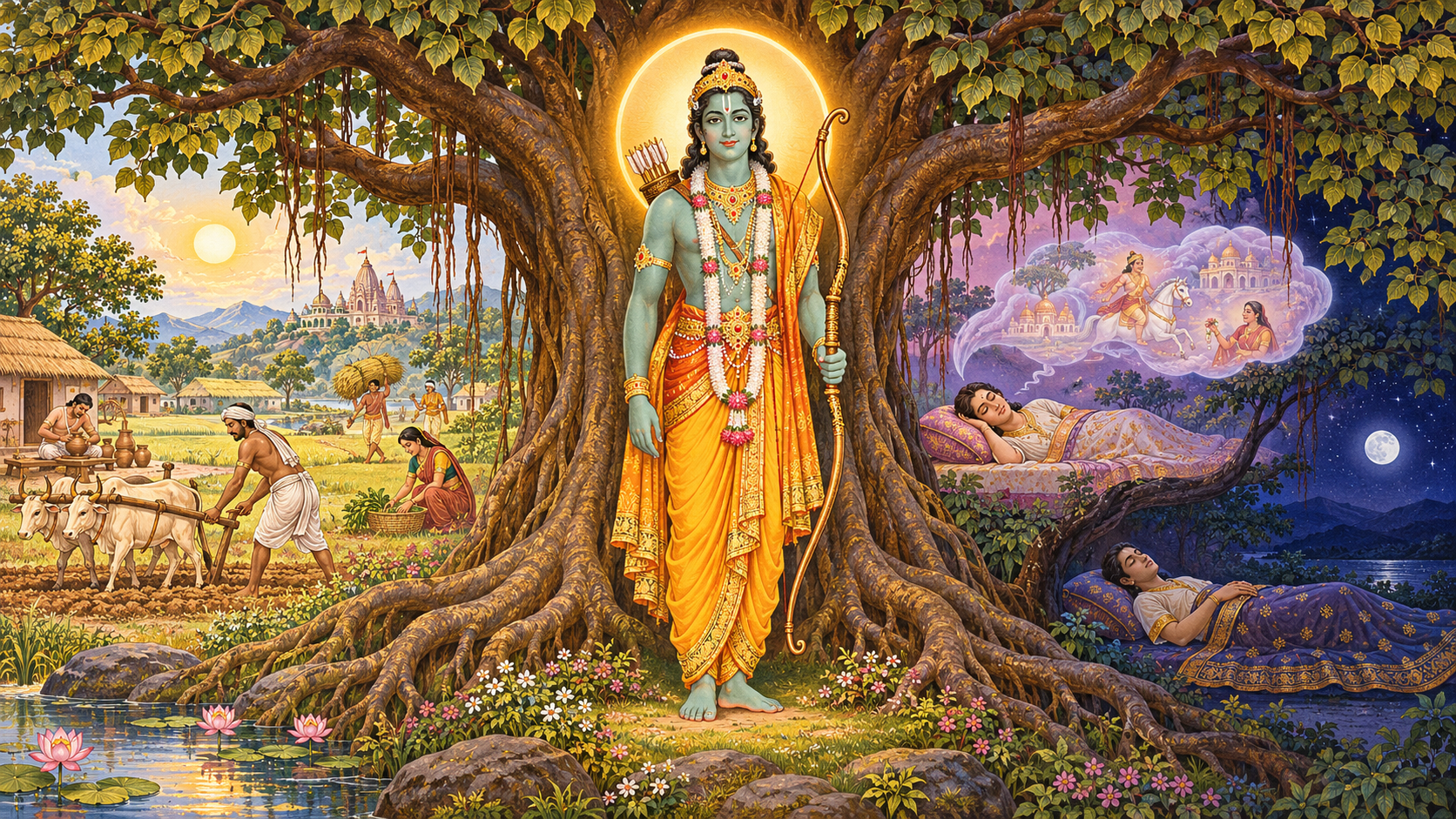
In the Adhyatma Ramayana’s Vedantic vision, Rama is understood as Turiya, the eternal witness beyond waking, dream and deep sleep. This does not demote Bhagavan into a psychological metaphor. It discloses the depth of what the name Rama signifies.
At the level of sacred narrative, Rama acts within the world. The events surrounding him involve relationship, duty, conflict, separation and restoration. At the contemplative level, Rama points to the reality that is not altered by any passing condition. The same name therefore meets the devotee through loving remembrance and directs the seeker toward the ground of consciousness.
You do not have to choose between these approaches. Bhakti need not be discarded when inquiry begins, and philosophical inquiry need not empty Rama of divine presence. The name gives the heart a sacred orientation; the teaching about Turiya prevents the mind from confining Rama to an object that appears only when imagined.
That point changes the meaning of remembrance. If Rama were available only as a mental picture, remembrance would cease whenever the picture disappeared. If Rama is Turiya, the awareness by which the picture’s presence and absence are known is itself the doorway to recognition. A vivid image may help devotion, but vividness is not the measure of proximity to Rama.
The witness must not be confused with a second person hidden inside your head, watching the first person live. Anything you can picture as an inner observer is another mental object. Turiya is not a small spectator standing apart from life. It is the consciousness because of which the body, the world, the inner observer and the thought I am watching are all known.
This understanding also guards against spiritual avoidance. To recognize the witness is not to become careless about dharma. A detached pose, indifference to suffering or refusal to perform a necessary duty is still conduct within waking life. It can be observed, questioned and corrected. Awareness is not an excuse for inaction; it frees you to act without making every passing reaction the whole of who you are.
Test the teaching in your own experience
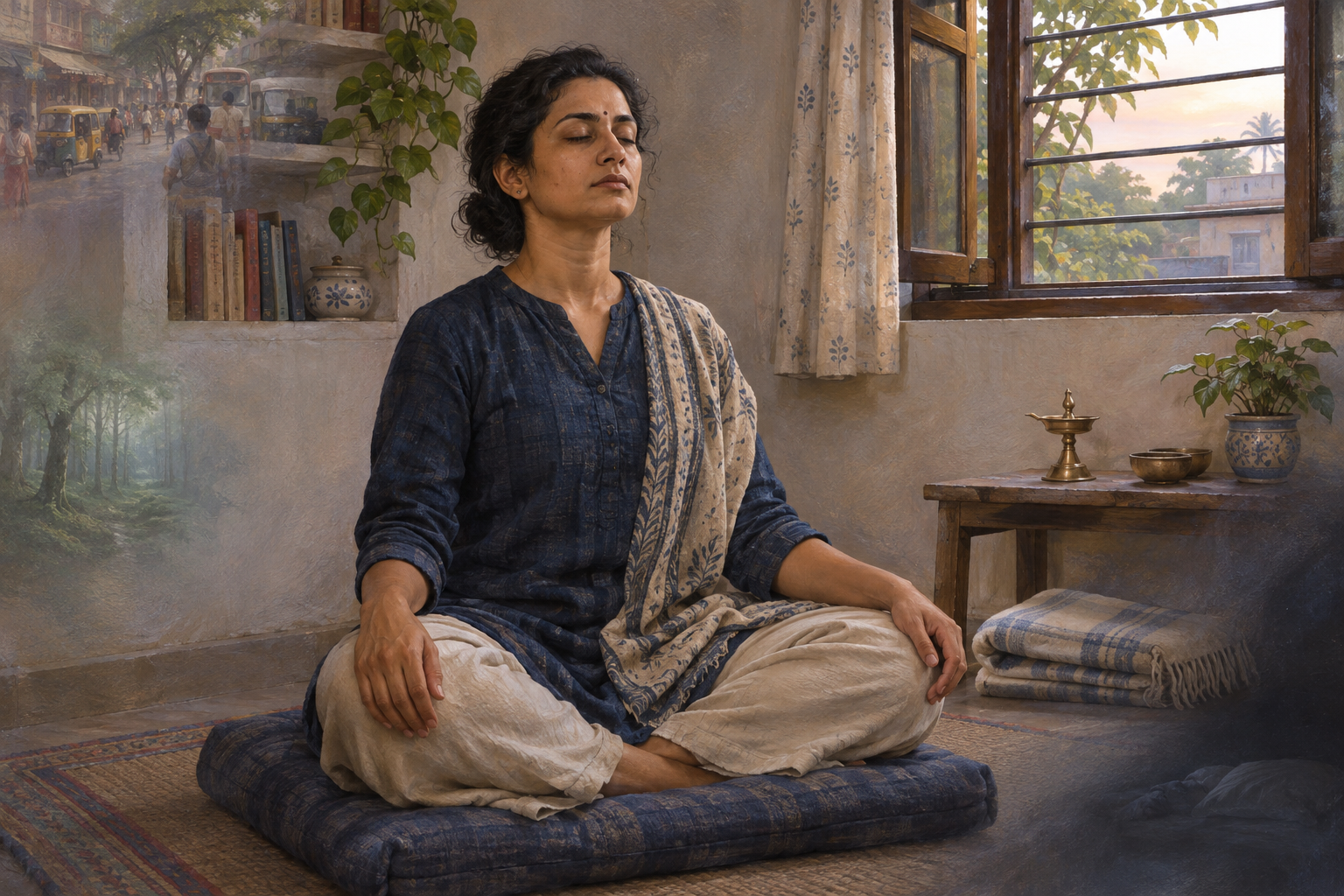
You do not need to manufacture an altered state to begin. Work with experiences already available to you. The purpose of the following contemplation is not to produce Turiya, as though awareness were absent and had to be created. It is to notice how quickly you identify the knower with something that is itself known.
- Begin with waking experience. Notice a bodily sensation, a sound and a thought. Do not try to improve them. Ask what they have in common. However different their contents may be, each is present because it is known.
- Notice that the contents move. The sound ends, the sensation shifts, and one thought replaces another. Say inwardly, without drama: these are changing objects of awareness.
- Recall a dream. Do not interpret its imagery. Notice that the dream presented a world, a point of view and events that seemed immediate while the dream lasted. That entire field passed when waking began.
- Consider deep sleep carefully. Do not picture it as a black screen. A black screen would still be an image known by the mind. Simply recognize that differentiated objects are not available in the way they are during waking and dream, and that deep sleep also gives way to another state.
- Turn from the known toward knowing. Ask, What knows this present thought? Do not accept an image, sensation or verbal answer as the witness. Each proposed answer is itself something you can notice.
- Bring in Rama-nama. Repeat Rama gently. Notice the name arise, remain briefly and subside. Notice that silence is known as surely as sound. Let the name return attention to the awareness in which both appear.
- Carry the distinction into action. Before an impulsive response, separate three things: the event, your mental reaction, and the awareness of that reaction. Then perform the action that dharma requires instead of treating the first surge of thought as a command.
The decisive step is the fifth, and it is also where the mind usually substitutes a concept for recognition. You may answer, consciousness knows it, and then move on. Instead, remain with the question long enough to notice that every definition, image and conclusion is appearing within the very knowing you are trying to grasp.
Do not measure the exercise by unusual sensations. If light, bliss, stillness or emotion appears, acknowledge it as another known experience. If nothing striking happens, the inquiry has not failed. The ordinary fact of knowing is easy to overlook precisely because it is not one more spectacular object in the mind.
Four mistakes that obscure the teaching
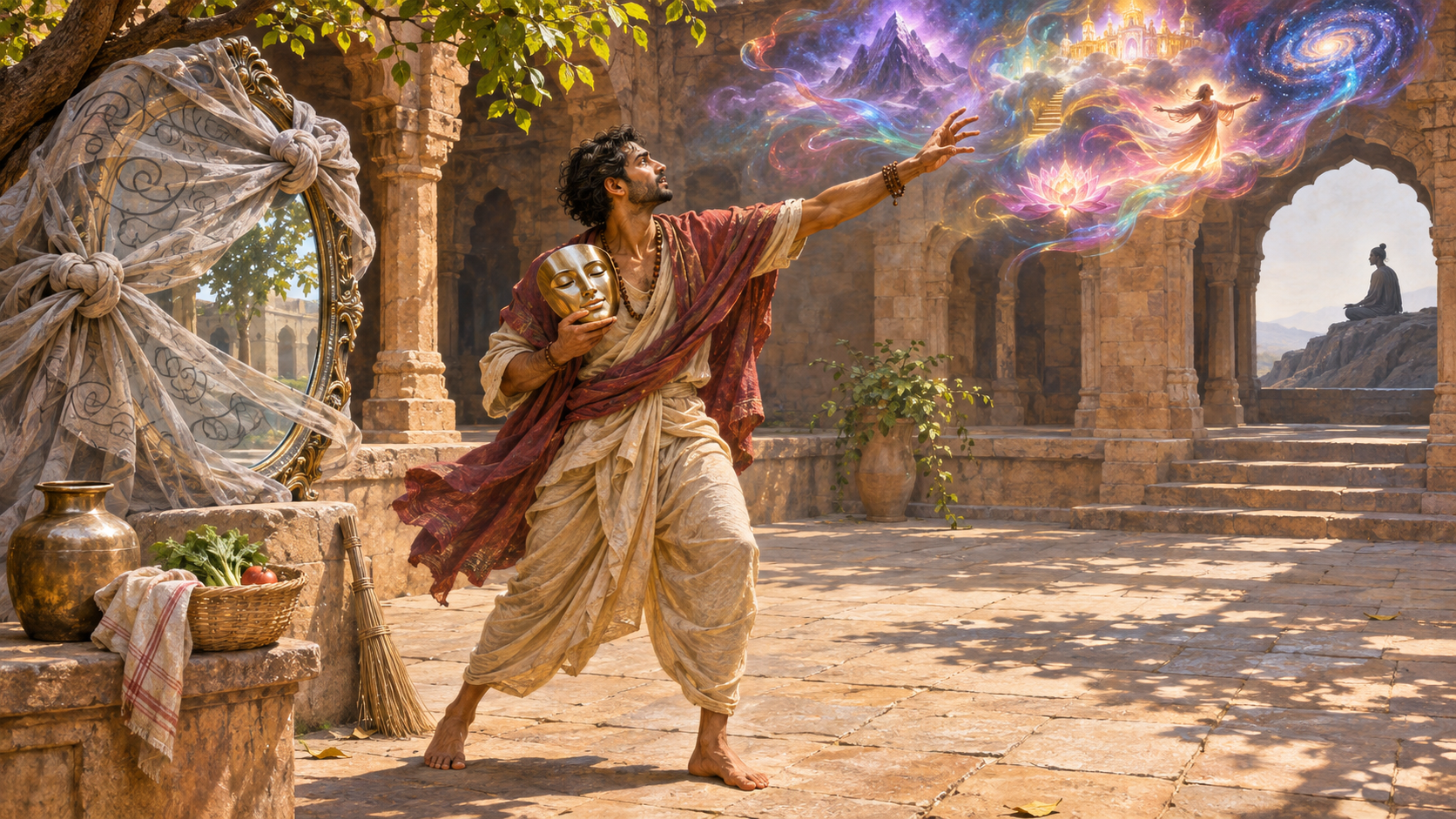
Mistaking Turiya for a peak experience
A peak has a beginning, an intensity and an end. Turiya cannot be identified with a peak merely because the experience is rare or powerful. When you find yourself trying to reproduce yesterday’s meditation, ask a more useful question: what knew yesterday’s stillness, today’s restlessness and the desire to compare them?
Equating deep sleep with realization
Deep sleep may be free of the differentiated objects that occupy waking and dream, but it remains one of the three changing states. You enter it and leave it. Turiya is not valuable because it resembles blankness; it is the witness by which the appearance and disappearance of every state can be understood.
Turning the witness into emotional numbness
Numbness, withdrawal and the thought none of this matters are all experiences that can be noticed. They are not proof of transcendence. If witness language makes you less truthful, less responsible or less responsive to another person’s suffering, use that consequence as evidence that a mental stance has been mistaken for spiritual clarity.
Making a grand declaration too quickly
Repeating Rama is Turiya is not the same as seeing what the statement demands of your identity. Test your understanding when praise, insult, success or disappointment arrives. Can you notice the reaction before becoming completely defined by it? Can you remain responsible without making the role, emotion or outcome absolute? That is a more honest test than the confidence of your philosophical vocabulary.
Key takeaways
- Jagrat, svapna and sushupti are changing conditions: waking, dream and deep sleep.
- Turiya is not a fourth temporary episode after the first three. It is the ever-present awareness by which the three are known.
- Understanding Rama as Turiya reveals Rama as the eternal witness without reducing Bhagavan to a mere metaphor.
- A peaceful meditation is still an experience. Its presence and absence are known, so peace itself should not be mistaken for Turiya.
- Rama-nama can support inquiry when you notice both the sound of the name and the silence after it within the same awareness.
- Recognition of the witness should deepen responsible action, not become an excuse to avoid dharma.
At your next transition into waking, dreaming or sleep, do not strain to find a hidden fourth state. Notice the state that is present, notice that it changes, and return to the question the teaching places before you: what knows the change? Let the name Rama keep that inquiry sacred, steady and connected to the dharma you must live.
References

Leave a Reply
You must be logged in to post a comment.