

You may feel drawn to Rajarajeshwari Devi yet wonder what her majestic form has to do with the tiny Bindu found in Shakta thought. One appears richly personal and sovereign; the other has no length, breadth or visible form beyond a point.
You do not have to choose between them. Rajarajeshwari gives devotion a name, presence and relationship. The Bindu gathers that relationship toward its undivided source. Understanding this movement can make your worship more coherent without turning a simple home practice into an imitation of an initiated ritual.
Rajarajeshwari and the Bindu address different needs
The name Rajarajeshwari presents Devi as sovereign: not merely one power competing with other powers, but the authority before which every lesser claim to control becomes relative. That makes her worship especially searching. You may approach her asking for strength, order or protection, but her royal form also asks who actually rules your attention, speech and conduct.
The Bindu approaches the same question from the opposite direction. It is described as a dimensionless point from which manifestation arises. It has no extension, yet it signifies the concentrated possibility of extension. It therefore should not be mistaken for a miniature picture of the universe. It indicates the undivided seed from which differentiation becomes possible.
A useful Shakta reading holds these two movements together. Rajarajeshwari is the sovereign presence to whom you can offer devotion. The Bindu is the sign that her many expressions do not require many independent sources. Form lets the heart approach; the point keeps the mind from mistaking any single appearance for the limit of Shakti.
This also corrects a common misunderstanding about image worship. A murti or devotional image is not valuable because the Divine has been reduced to an object. It is valuable because embodied attention needs somewhere to arrive. The Bindu then reminds you that the presence approached through one form is not exhausted by that form.
What the Shakta Bindu asks you to notice

The Bindu can look almost too simple to deserve sustained attention. Its simplicity is precisely the point. A complex image gives the senses many places to move; a point removes those alternatives. It makes dispersion visible.
During worship, notice how quickly the mind leaves its chosen center. It may move toward a desired result, a remembered conversation, a fear, or an argument about whether the practice is being performed correctly. The practical lesson is not that every thought is an enemy. It is that attention continually becomes many, while the Bindu signifies the possibility of gathering it without denying what has appeared.
Three distinctions will keep this symbol from becoming vague:
- The Bindu is not merely decoration. If you see only a dot, you miss its function as a sign of concentrated origin.
- Dimensionless does not mean worthless or absent. The apparent nothingness of the point represents undivided potential, not a barren void.
- Concentration is not the final prize. Steadier attention matters because it lets you see how the many can arise without becoming severed from the one.
You can test whether this understanding is becoming practical. After worship, ask whether your mind is a little less divided between competing impulses. If contemplation of the Bindu produces only fascination with an esoteric symbol, the point has remained outside you. If it helps you recognize distraction and return to a governing center, the symbol has begun to do its work.
Vijayadashami makes the inner movement visible

Temple alankaram can express theology through a sequence that devotees can see. During the Dasara Sharan Navaratri observance at Kanakadurga Temple, different forms of Goddess Durga are worshipped on successive days. On 20 October 2026, the tenth day and Vijayadashami, Kanakadurga is adorned as Sri Rajarajeshwari Devi.
Do not read such an alankaram as a trivial costume change. The visible form gives devotees a particular doorway into Devi. The succession of forms shows diversity, while the continuity of the worshipped Goddess prevents that diversity from breaking into unrelated powers. Rajarajeshwari on Vijayadashami brings the sequence under the sign of sovereignty.
This is also a practical way to understand the relationship between Rajarajeshwari and Bindu. The festival offers multiple forms across time. The Bindu expresses their concentrated unity. One movement unfolds; the other gathers. Neither cancels the other.
If you attend an alankaram or contemplate an image at home, carry three questions with you:
- Which scattered concern am I bringing before Devi?
- What has been ruling my attention without deserving that authority?
- What single dharmic responsibility should govern my next action?
These questions turn sovereignty from a decorative royal theme into self-examination. They also prevent the Bindu from becoming a purely abstract idea.
Key takeaways
- Rajarajeshwari gives sovereign Shakti a personal form through which devotion can approach.
- The Shakta Bindu signifies an undivided, dimensionless origin from which multiplicity can arise.
- Form and Bindu are complementary: one opens relationship, while the other gathers attention toward unity.
- Vijayadashami alankaram lets devotees encounter this principle through an ordered sequence of Devi’s forms.
- A simple contemplative use of the Bindu is not the same as performing a consecrated or lineage-specific ritual.
A simple practice that respects the boundary of initiation
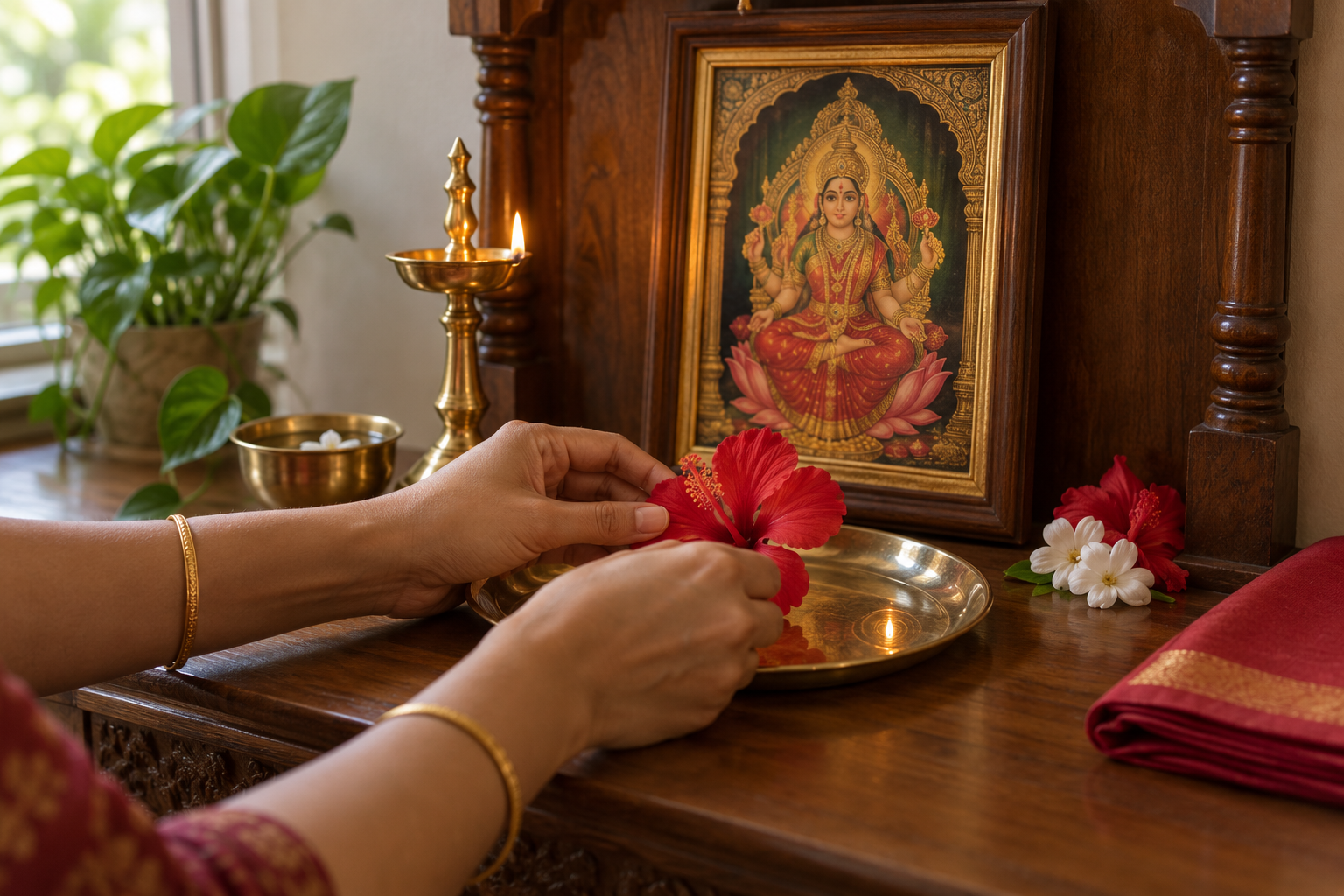
You can bring this understanding into ordinary devotion without borrowing restricted mantras or assembling fragments of advanced ritual. The aim is not to claim an initiation you have not received. It is to let the relationship between sovereign form and gathered attention shape an honest practice.
- Prepare one stable focus. Use an image of Rajarajeshwari Devi, or sit with her name as your devotional center. Keep the space orderly enough that arranging objects does not replace worship.
- Name what needs to be governed. Before beginning, state one concrete concern in a sentence. Choose something within your responsibility: undisciplined speech, a neglected duty, divided attention or a decision you have been avoiding.
- Approach Devi personally. Offer a respectful salutation and repeat her name gently. Let the royal form mean that every smaller impulse is being placed before a higher center, not that you are seeking domination over other people.
- Gather attention into a point. Rest your gaze comfortably on a small visual point, or imagine attention settling into a center. When thoughts branch outward, notice the movement and return. Do not fight the thought or build a story around the distraction.
- Return from the point to action. End by choosing one dharmic act connected to the concern you named. Make the apology, complete the duty, restrain the careless remark or give the delayed answer. Worship of sovereignty should become responsible self-government.
A dot used in this way is a contemplative aid; it should not be represented as a formally consecrated sacred diagram. If you want to undertake a practice involving restricted mantra, ritual installation or a complex lineage method, seek instruction from a qualified teacher within that tradition. Copying disconnected instructions may reproduce the outer sequence while losing the discipline that gives it meaning.
Keep the practice small enough to repeat sincerely. The next time you worship Rajarajeshwari, bring one scattered part of your life before her, gather it toward the Bindu, and leave with one action that restores dharmic order.
References
- Hindu Pad – Vijayadashami Alankaram in Vijayawada Temple Navaratri 2026 | Rajarajeshwari Devi
- Hindu Blog – The Bindu: The Sacred Dot That Holds the Cosmos

Leave a Reply
You must be logged in to post a comment.