
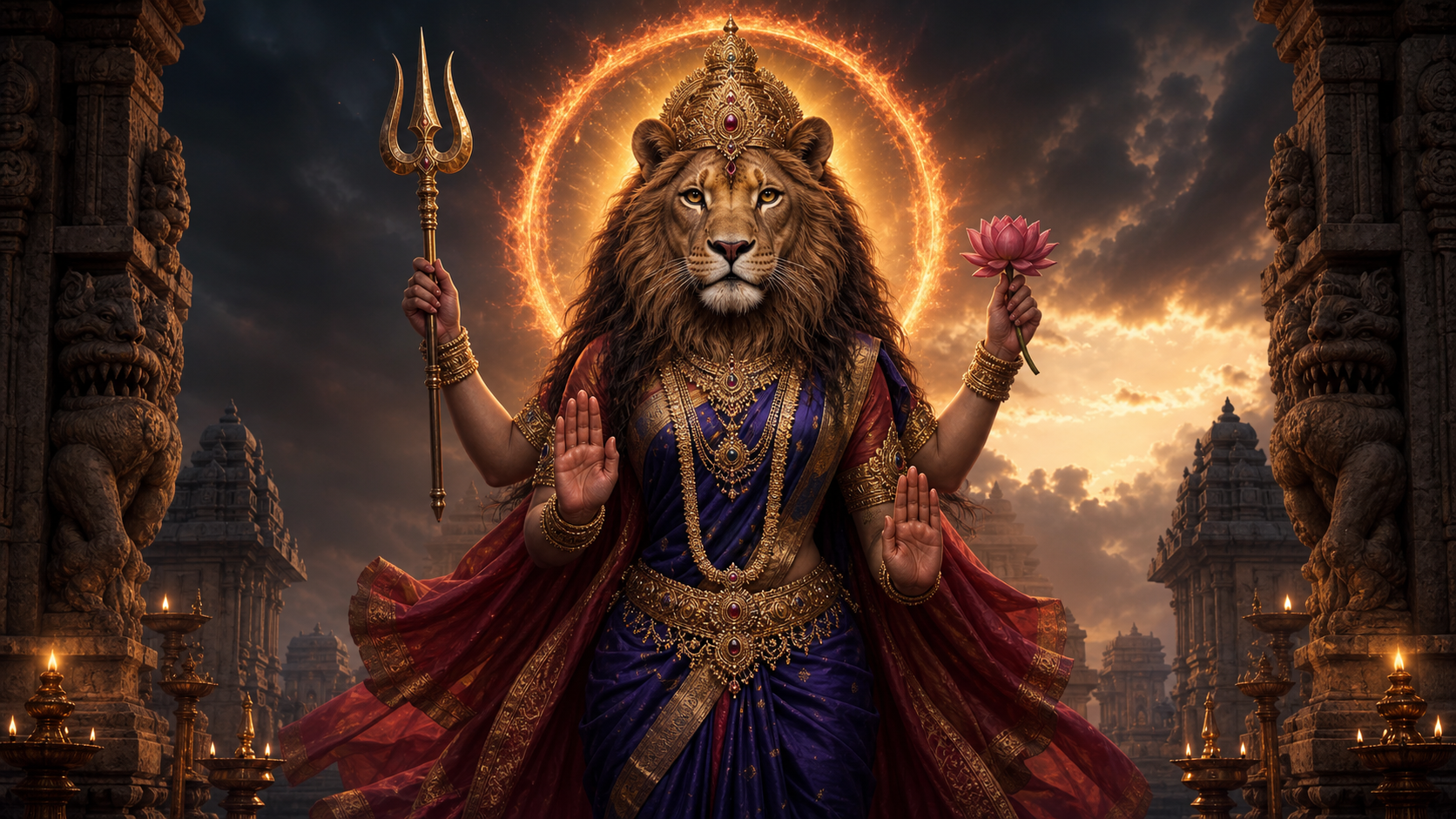
If Pratyangira Devi’s lion-headed form leaves you unsure whether you are seeing sacred power, divine wrath, or something meant only for Tantric specialists, do not let the image force a false choice. You can understand what the form teaches without pretending that every ritual associated with it is yours to improvise.
The essential discipline is to separate three questions: what the icon communicates, what Shakta theology says about Devi, and how a particular tradition conducts worship. Keeping those questions distinct allows you to approach Pratyangira with reverence while avoiding both fear and sensationalism.
Ugra describes sacred intensity, not an evil goddess
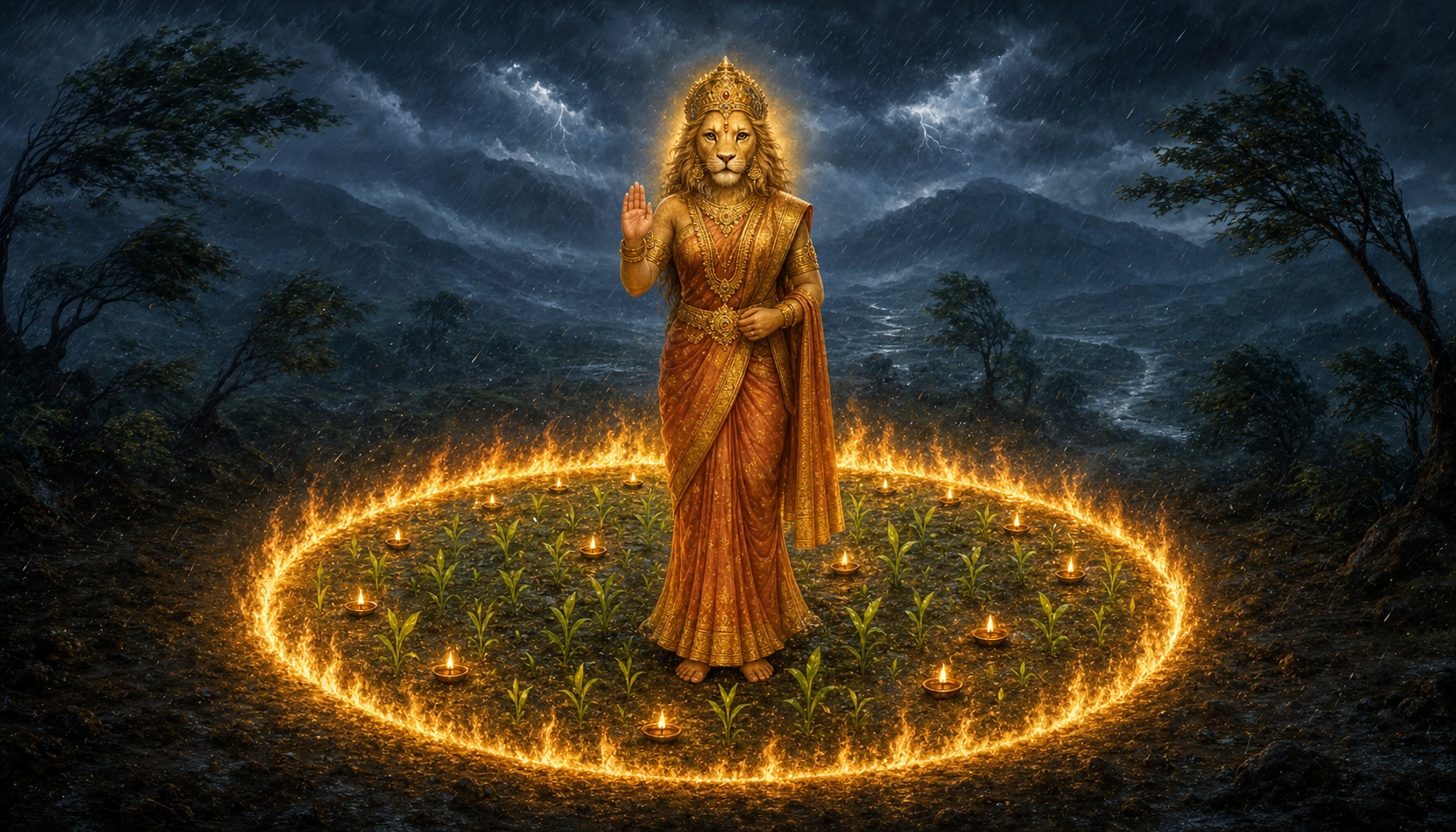
Pratyangira Devi is remembered as a lion-headed, ugra manifestation of Parvati within Shakta and Tantric traditions, also known as Kritya, Narasimhika, and Atharvana Bhadrakali. That identification gives you the foundation for interpreting her. Her ferocity does not place her outside Devi; it reveals a fierce possibility within Shakti itself.
The Sanskrit category ugra indicates fierceness, intensity, or a form that inspires awe and fear. It should not be translated automatically into the moral categories of evil, demonic, or malicious. Those categories answer a different question. Ugra tells you about the mode in which divine power appears. It does not tell you that the power has become adharmic.
This distinction matters because many modern viewers unconsciously equate holiness with a calm face, gentle posture, and reassuring mood. Pratyangira refuses that limitation. If the Divine encompasses the power by which disorder is confronted, boundaries are defended, and destructive momentum is stopped, then sacred presence cannot always look mild. A form suited to confrontation will not resemble a form suited to consolation.
That does not make fierceness an independent virtue. Human rage, revenge, and domination do not become sacred merely because someone places Devi’s name over them. In a Dharmic reading, force must remain governed by discernment and right order. Otherwise, what appears to be devotion may be the ego giving its aggression a religious costume.
Three common readings therefore need correction:
- Do not demonize the form. A frightening appearance is not evidence of moral evil. Begin with her stated identity as Devi rather than importing the visual grammar of traditions in which every fearsome being is an adversary of God.
- Do not reduce her to human anger. Ugra Shakti is not simply a larger version of irritation or temper. The symbolism concerns divine intensity, not permission to lose self-command.
- Do not turn her into an occult weapon. A deity is not a technique for magnifying personal hostility. If your interpretation begins and ends with gaining power over other people, it has already displaced Devi with the desires of the worshipper.
When you encounter fierce iconography, ask a precise question: what assumption about the sacred is this form breaking? In Pratyangira’s case, the first answer is clear. Divine femininity cannot be confined to softness. Shakti includes the intensity before which the ordinary ego cannot remain comfortable or sovereign.
The lion head is theology expressed through form
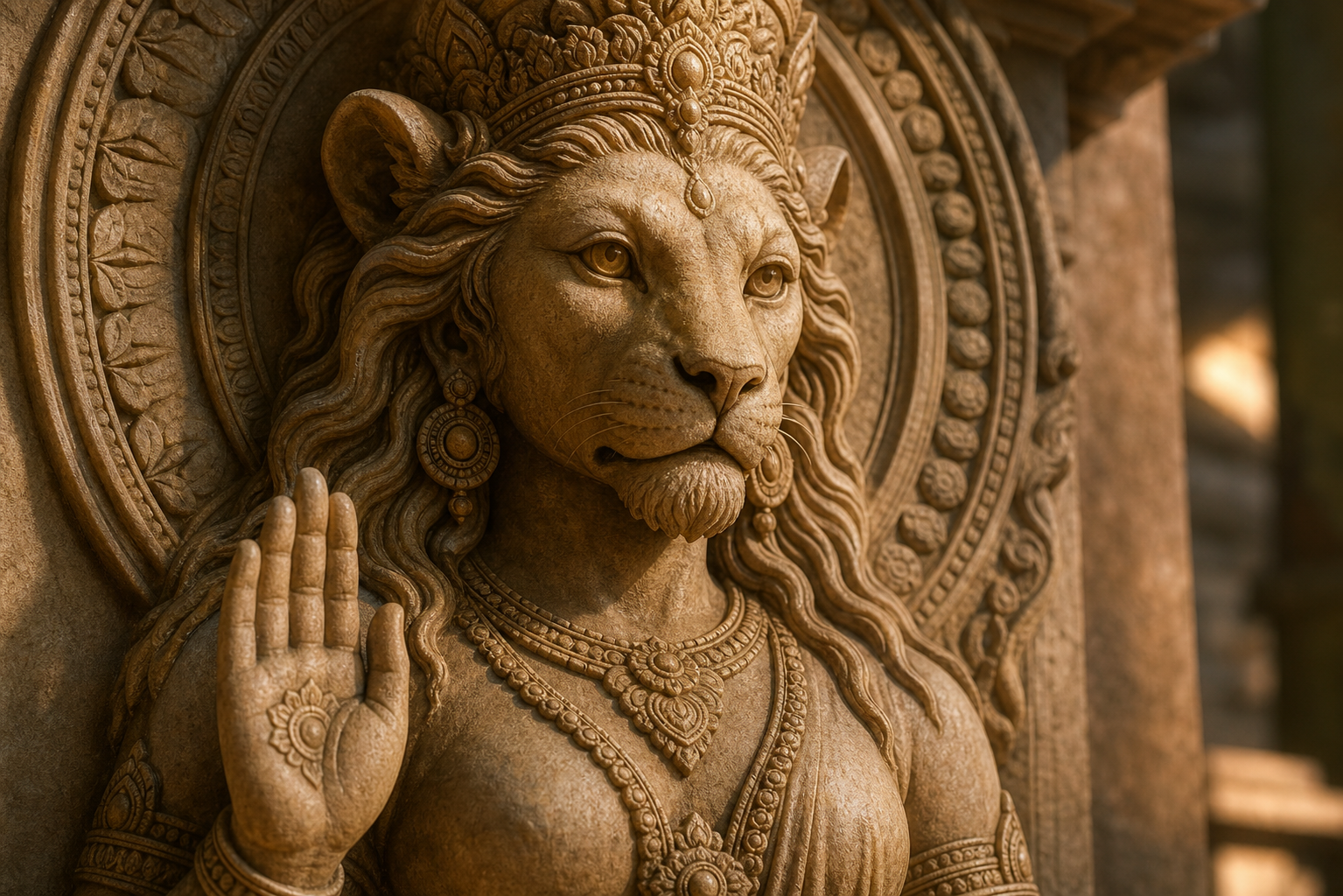
A sacred image is not a rebus in which every feature has one fixed dictionary definition. Iconography works through relationships. A lion can evoke raw strength, danger, alertness, and sovereign presence, but the meaning of Pratyangira’s lion head arises from its union with the identity of Devi. The animal feature does not replace divine intelligence. It changes how that intelligence is encountered.
The form crosses familiar categories. It is neither an ordinary human portrait nor merely an image of an animal. That crossing is itself instructive. It prevents you from assuming that divine personhood must reproduce ordinary human appearance, temperament, or social expectation. Shakti can be personal without being domesticated and intelligible without being reduced to the familiar.
A lion’s presence also changes the emotional distance between viewer and image. You do not meet it casually. The icon asks for steadiness, attention, and respect before it offers conceptual comfort. This is one reason fierce sacred forms can teach differently from serene ones: the viewer’s reflex to control the encounter is interrupted at the beginning.
Use the following three-step method whenever you interpret Pratyangira’s icon:
- Describe before interpreting. Begin with what you can actually identify: the head is leonine, the figure is Devi, and the overall mode is fierce. Do not add a story merely because an image feels dramatic.
- Name the association. Say that the lion suggests strength, danger, command, or an intensity beyond ordinary human presentation. Calling this an association keeps an interpretation honest.
- Mark the boundary of the claim. The lion head does not, by itself, establish a particular origin narrative, mantra, ritual privilege, or relationship to every other lion-associated deity. Those claims require their own traditional context.
This method protects you from two opposite mistakes. The first is literalism: treating the icon as though it were only a report about physical anatomy. The second is free association: attaching any meaning you like because symbolism appears subjective. Traditional symbolism lies between those extremes. The visible form constrains interpretation, while theology supplies its horizon.
If you are comparing different images of Pratyangira, do not assume that every variation in colour, implements, posture, or surrounding figures has the same explanation. First identify which details are consistent in the tradition that produced the image. Then seek that tradition’s account of them. A detail borrowed from another image cannot safely be made the key to the whole theology.
The most useful symbolic insight is therefore not simply that the lion means power. It is that conscious, divine power appears here in a form that cannot be made harmless for the viewer’s convenience. Pratyangira asks you to hold intelligence and untamed intensity together without turning either into its opposite.
Her relation to Parvati keeps fierce and gentle Shakti whole
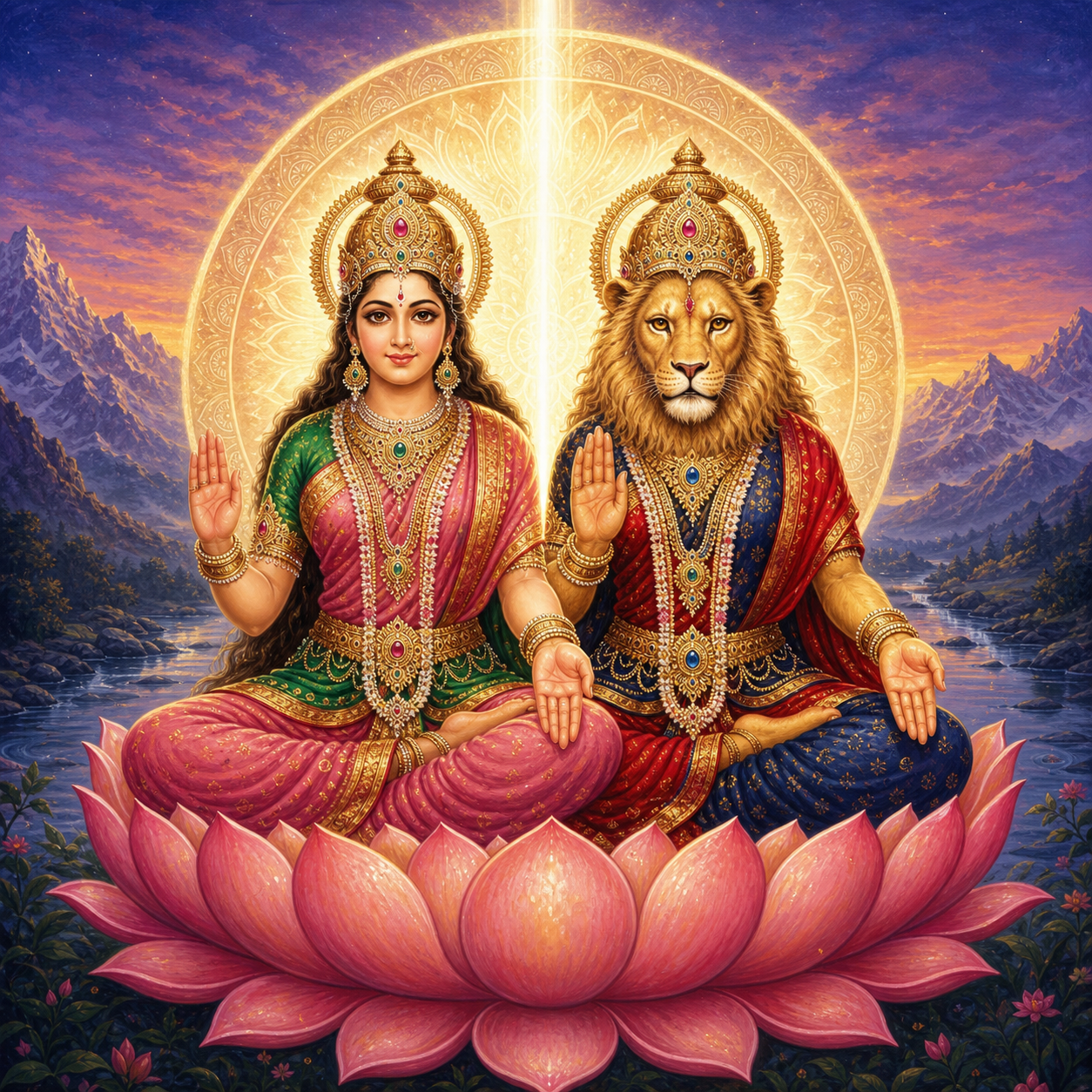
One Shakti can be encountered through contrasting forms
Identifying Pratyangira as a manifestation of Parvati prevents a simplistic division between a good, gentle goddess and a dangerous, fierce one. The two modes need not represent competing divine principles. They can disclose the range of Shakti: the same sacred reality may nurture in one relation and overwhelm resistance in another.
This is not a claim that every Shakta school explains manifestation in exactly the same metaphysical language. Shakta and Tantric traditions contain real internal variety. The more modest point is also the more useful one: Pratyangira’s fierceness should be interpreted within the continuity of Devi, not as a fall away from her.
In a Shakta theological frame, Shakti is not merely an impersonal battery owned by someone else. Shakti is divine agency: the capacity through which manifestation, relationship, knowledge, concealment, transformation, and withdrawal become possible. A named goddess gives that power a form through which a devotee can enter into relation. The form is therefore neither a decorative costume nor an exhaustive container for the limitless Divine.
This gives you a second important distinction. Unity does not make every form interchangeable. If all forms arise within Shakti, it does not follow that their names, mantras, icons, or ritual procedures can be mixed at will. Theological continuity explains how contrasting forms can belong to Devi. Ritual specificity explains why each form must still be approached on its own terms.
Multiple names are clues to context, not complete histories
The names Pratyangira, Kritya, Narasimhika, and Atharvana Bhadrakali place the goddess within several overlapping fields of recognition. It is tempting to take an English gloss or a familiar part of one name and build a complete genealogy from it. Resist that shortcut. A divine name can carry textual, regional, sectarian, and ritual associations that a translation alone cannot preserve.
Narasimhika, for example, may prompt you to interpret everything through the better-known figure of Narasimha. Atharvana Bhadrakali may prompt an equally immediate claim about scriptural or ritual origin. Such names are meaningful evidence, but they do not eliminate the need to ask which community, text, temple, or lineage is using them and what relationship that setting actually asserts.
When you meet one of these names, ask four questions:
- Is this the principal name used in the immediate tradition, or an identification supplied for a wider audience?
- Is the relationship being described as identity, manifestation, association, or similarity? Those are not automatically the same claim.
- Does the explanation concern theology, an origin narrative, iconography, or ritual practice?
- What traditional context accompanies the name, and what has been inferred merely from its sound or translation?
These questions do not weaken tradition. They keep you from flattening several kinds of traditional relationship into the vague phrase ‘all the same.’ Dharmic unity is not sameness without distinction. It is the ability to recognise continuity without erasing form, context, or discipline.
A disciplined approach separates study, devotion, and ritual

The internet often places an image, a translated name, a dramatic promise, and a ritual fragment on the same screen. Their proximity does not make them one coherent tradition. Before acting on anything you find, decide what kind of encounter you are actually seeking.
- Clarify your purpose. If you want to understand symbolism, study the icon and its theological setting. If you seek darshan or ordinary devotion, begin with an established temple or community. If you seek mantra or formal ritual, look for competent guidance within the relevant sampradaya rather than assembling a practice from disconnected fragments.
- Begin with the stable identifications. Hold together the lion-headed form, the ugra mode, the identity as Devi and Parvati, and the wider reality of Shakti. These points give interpretation a centre.
- Keep inference visible. Use language such as ‘this can signify’ when moving from a feature to its meaning. Reserve ‘this tradition teaches’ for a claim you can locate within an actual traditional setting.
- Do not confuse publicity with ritual interchangeability. A mantra or procedure being publicly visible does not show that it can be detached from pronunciation, preparation, intention, lineage, or ritual framework. A sacred formula is not a decorative caption for an image.
- Apply an ethical test. A sound approach should make you more disciplined about your own fear, aggression, and projections. If fascination with Pratyangira chiefly intensifies fantasies about enemies, domination, or instant power, pause and return to the theological centre: Devi is not an instrument of the unexamined ego.
You can make your reading more reliable with a four-line note for every claim you encounter:
- Observed: What is visibly present or explicitly stated?
- Received: Which identity or teaching is actually carried by a tradition?
- Interpreted: What meaning are you drawing from those facts?
- Authorized: Does the material establish only an idea, or does it also establish a practice and the authority to undertake it?
For Pratyangira, a careful entry might read: ‘Observed: lion-headed fierce goddess. Received: an ugra manifestation of Parvati arising within Shakti. Interpreted: divine power can exceed gentle human expectations. Authorized: no ritual procedure follows from the image alone.’ That final sentence prevents the most consequential category error.
This disciplined separation also leaves room for genuine devotion. Reverence does not require you to believe every sensational claim attached to a fierce deity. On the contrary, refusing exaggeration is part of taking the deity seriously. The sacred is not honoured when its complexity is converted into fear-based advertising.
Key takeaways
- Pratyangira’s ugra character describes divine fierceness and intensity; it does not make her an evil or adharmic power.
- The lion head joins divine intelligence with strength, danger, and sovereign presence, but it does not independently prove a particular narrative or ritual claim.
- Her identity as a manifestation of Parvati places fierceness within the continuity of Shakti rather than outside Devi.
- Her several names should lead you toward textual, temple, regional, or lineage context, not toward instant conclusions based on translation alone.
- Symbolic understanding, devotional relationship, and ritual competence are related but distinct. An image can teach you without authorizing you to improvise a practice.
The next time you encounter Pratyangira Devi, pause before searching for the most dramatic explanation. Name what you actually see, place the form within the wholeness of Shakti, and ask whether the claim before you concerns symbol, theology, or ritual. That small discipline is the difference between encountering sacred ferocity and projecting ordinary fear onto it.
References
