

If you came looking for the meaning of ISKCON New York’s sixtieth anniversary, the useful answer is larger than an event report. The celebration asked whether a spiritual movement can remember its beginnings without becoming trapped in nostalgia.
That question matters whether you attended, are watching the Sunset Kirtan Cruise recordings, or want to mark the anniversary in your own community. The evening offers a practical model: place sacred practice at the center, examine the inherited legacy honestly, and turn memory toward service.
A celebration built around practice and reflection
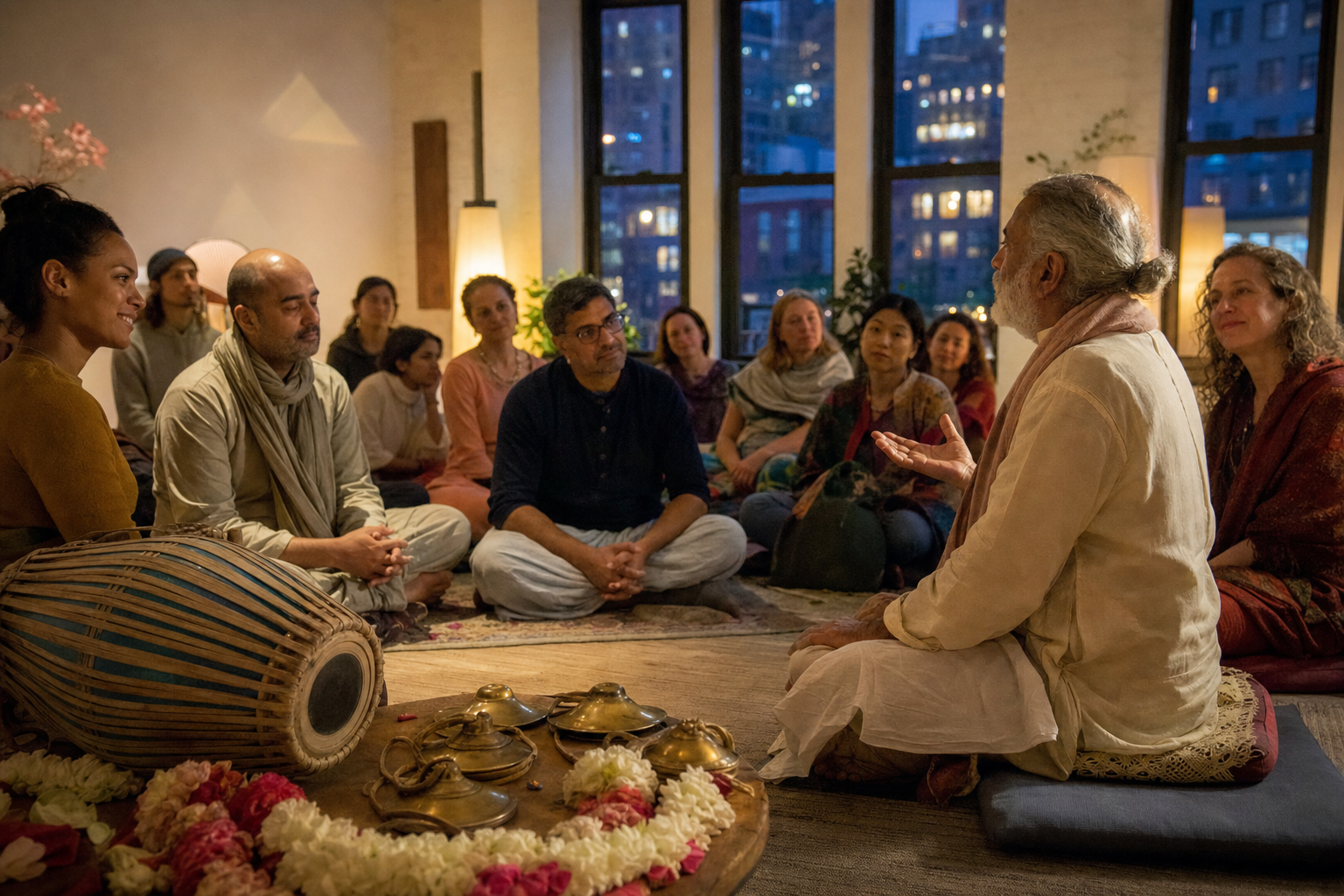
From 7 to 10 p.m. on Saturday, August 1, the New York gathering brought together kirtan, discussion, sunset, and a boat cruise. That combination matters. It allowed devotion, fellowship, historical reflection, and future planning to occupy the same space.
Kirtan is not background music for a Vaishnava anniversary. It is the shared act that gives the gathering its center. A community may disagree about administration, presentation, or priorities, but congregational remembrance of Krishna returns everyone to the reason the institution exists.
Discussion performs a different task. It prevents remembrance from becoming a polished sequence of achievements. The New York gathering was explicitly framed around legacy, lessons learned, and opportunities ahead. Each term demands something different: legacy asks what must be preserved, lessons ask what must be understood, and opportunities ask what must now be attempted.
The cruise setting supplied a fitting, if simple, image. The participants were not sitting inside a static memorial. They were moving together while looking back over sixty years. A boat does not create spiritual progress, of course, but the setting made the anniversary’s central tension visible: the movement has an inheritance to protect and a journey that is not finished.
If you watch the recordings, do not watch only for atmosphere. Keep separate notes on what participants remember, what they believe was learned, and what they want to build. Then look for the connection between those parts. A future proposal has more weight when it arises from a clearly stated principle or a candidly understood lesson.
Legacy must be transmitted, not merely displayed
New York holds a distinctive place in ISKCON’s institutional memory. The names of A.C. Bhaktivedanta Swami Prabhupada and 26 Second Avenue direct attention back to beginnings that appeared modest in material terms but carried a clear spiritual purpose. Remembering that beginning should sharpen the present mission rather than turn the past into a museum.
A living legacy passes through people. It can be heard in how a seasoned devotee explains the holy name to someone entering a temple for the first time. It can be seen in whether younger members receive responsibility along with instruction. It becomes durable when philosophical clarity, devotional discipline, hospitality, and practical service reinforce one another.
When you hear a claim about preserving Prabhupada’s legacy, apply a practical test:
- Can a newcomer understand what is being preserved and why it matters?
- Does the practice direct attention toward Krishna, or mainly toward the institution itself?
- Is the teaching being embodied through conduct, service, and relationships?
- Are people being prepared to carry the responsibility forward?
This test does not diminish reverence. It protects reverence from becoming ceremonial language. An inheritance remains alive when it changes how people worship, teach, welcome, and serve.
The cruise illustrates the difference between principle and method
The Sunset Kirtan Cruise gives communities a useful example of continuity without mere repetition. The boat was a method. Kirtan was the devotional center. The setting could change while the spiritual purpose remained recognizable.
This distinction is essential when devotees discuss the future. Treating every inherited method as an unchangeable principle can make outreach rigid. Treating every principle as an adjustable method can empty the movement of its substance. Neither a traditional appearance nor a modern setting settles the question of faithfulness.
Before adopting or rejecting a new format, work through a clear sequence:
- Name the spiritual principle the activity is meant to serve.
- Separate that principle from the venue, technology, schedule, or presentation being used.
- Ask whether the proposed method helps people attend to the principle or distracts them from it.
- Examine what participants are likely to carry home: a devotional practice, a clearer understanding, a relationship, or only a pleasant memory.
- Revise the method when necessary without quietly revising the principle.
That filter is more useful than arguing from labels such as traditional or innovative. It asks what the form is actually doing. A cruise can host serious spiritual reflection; a temple hall can host a shallow program. The location does not answer the question. The relationship between purpose, practice, and result does.
Turn the anniversary into a local assignment

You do not need to reproduce the boat cruise to learn from it. Copy the architecture of the gathering, not its scenery. Bring practice, memory, honest evaluation, and future responsibility into the same conversation.
A temple, nama-hatta group, student community, or household can use the anniversary constructively in the following way:
- Begin with shared devotional practice so that the conversation starts from the community’s purpose.
- Invite established members to describe what they received, including the disciplines and acts of service that formed them.
- Ask newer members what they find clear, difficult, welcoming, or inaccessible. Their experience reveals whether transmission is actually occurring.
- Organize the discussion around legacy, lessons, and opportunities. Do not let recollection consume all the available attention.
- Convert promising ideas into named commitments. Record who will carry each commitment, what the next action is, and when the community will review it.
- Share a short follow-up with the wider congregation so that people can see what the anniversary changed.
The commitment does not need to be grand. It might involve improving newcomer orientation, preserving the memories of senior devotees, strengthening philosophical education, mentoring younger members, or making public kirtan more regular and hospitable. The important distinction is between an aspiration and an assignment. An aspiration sounds worthy; an assignment has a responsible person and a next action.
If you are not an organizer, the anniversary still gives you work to do. Ask what part of the tradition reached you because someone else accepted responsibility. Then identify what you can transmit through your own conduct or service. Institutions continue through organized structures, but they remain spiritually credible through the daily choices of devotees.
Key takeaways
- ISKCON New York marked sixty years by combining kirtan, fellowship, reflection, and a discussion of the future.
- Kirtan kept the anniversary rooted in devotional practice rather than institutional self-congratulation.
- Legacy becomes meaningful when teachings, disciplines, responsibilities, and service are transmitted to other people.
- The cruise demonstrates how a changeable method can serve an enduring spiritual principle.
- A useful local commemoration should end with named commitments, responsible people, and a clear next action.
Before you move on from the anniversary, complete a sentence for yourself: the inheritance we have received requires this service from us now. Make the answer concrete enough to act upon. That is how sixty years becomes more than a milestone and begins to shape the years ahead.
References
