,

Pramatha Nath Bose’s 1914 Warning on Ethical Imbalance

5 min read
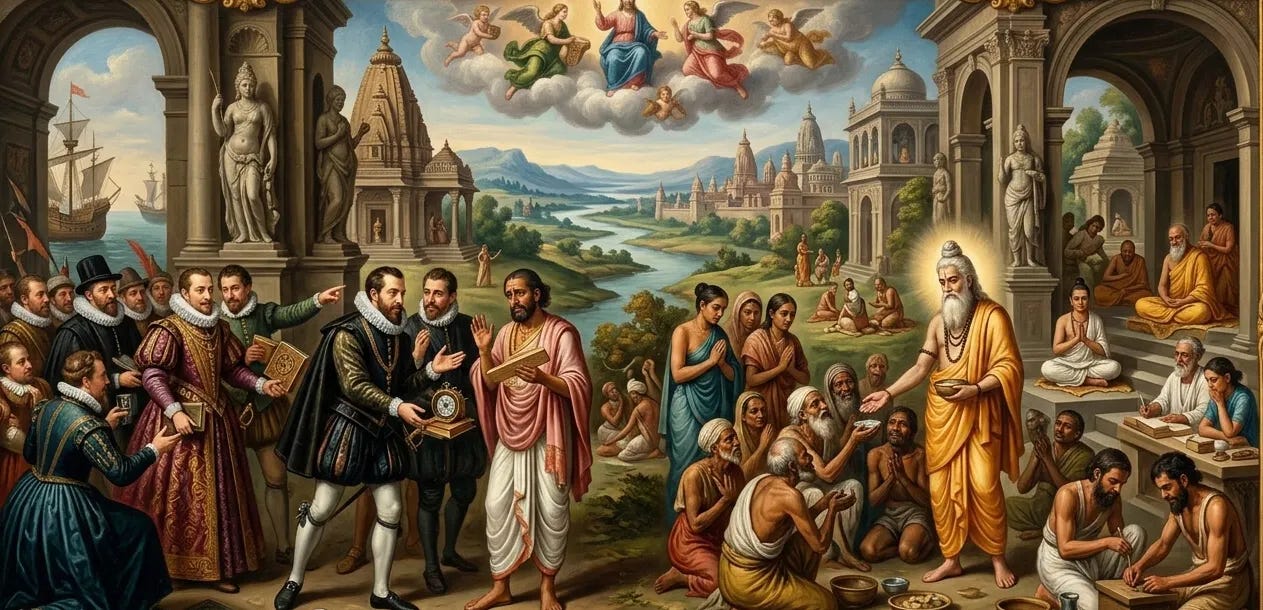
Ornate painting of European-clad men, robed teachers, gathered devotees, temples, ships and celestial figures.

Pramatha Nath Bose’s 1914 reflections on Hindu ethics pose a question that remains useful: can a civilization expand its material capacities without weakening the habits of compassion, restraint and service that give progress a moral purpose?

The essay excerpt presented by Dharma Dispatch does not simply reject Western methods or organized philanthropy. It examines what may be lost when ethical responsibility moves away from daily conduct and becomes the distant work of institutions.
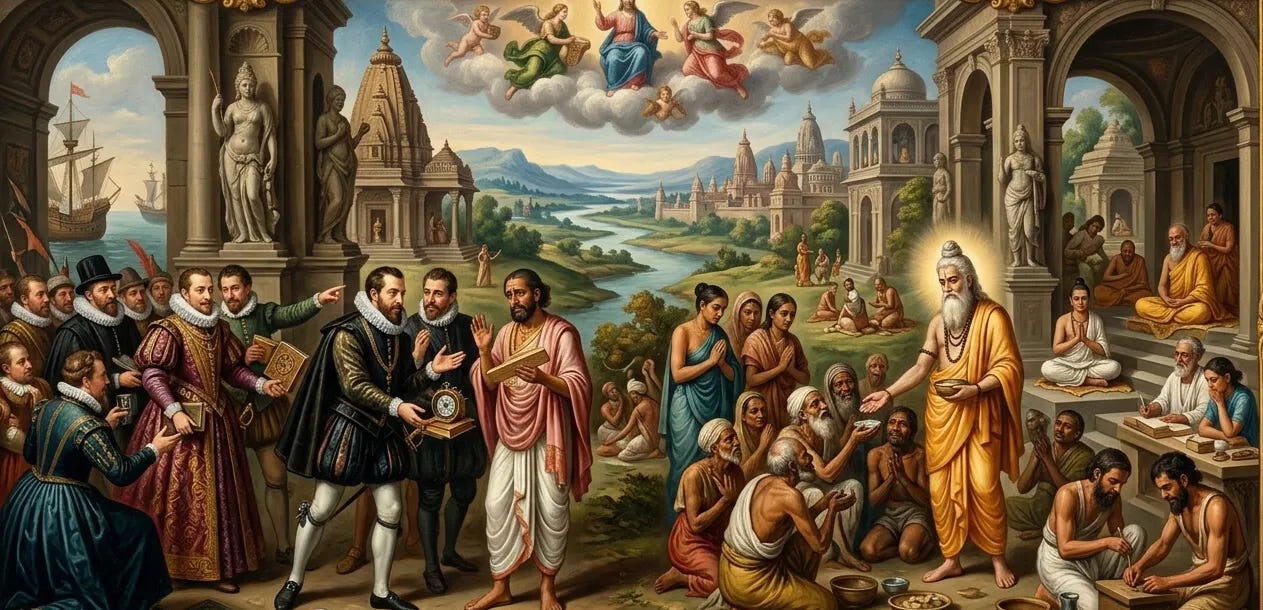
European visitors and robed Indian figures gather among temples, ships, worshippers, and celestial beings.
An elaborate historical-style painting brings together European visitors, Indian teachers and worshippers within a landscape of temples, waterways, ships, and clouds.

The geologist behind the ethical argument

According to Dharma Dispatch, Bose was a pioneering geologist and palaeontologist whose scientific work included identifying iron ore deposits at Gorumahisani in 1903. The publication credits his communication with J.N. Tata as an important step toward the establishment of Tata Steel at Jamshedpur. It also reports his involvement in founding the Bengal Technical Institute and describes his wider interest in India’s civilizational inheritance.
Painted panorama of European visitors and robed Indian figures gathered among temples, arches and seated villagers
An ornate historical-style scene brings together European men, robed Indian figures and seated families beneath grand arches, with temples, a ship and figures in the clouds.

Bose therefore approached tradition as neither an isolated ascetic nor an opponent of science. He combined scientific and industrial concerns with sustained writing on Hindu civilization, including the four-volume A History of Hindu Civilisation During British Rule. That background makes his ethical argument distinctive: the problem, in his view, was not material development itself but development detached from higher culture.
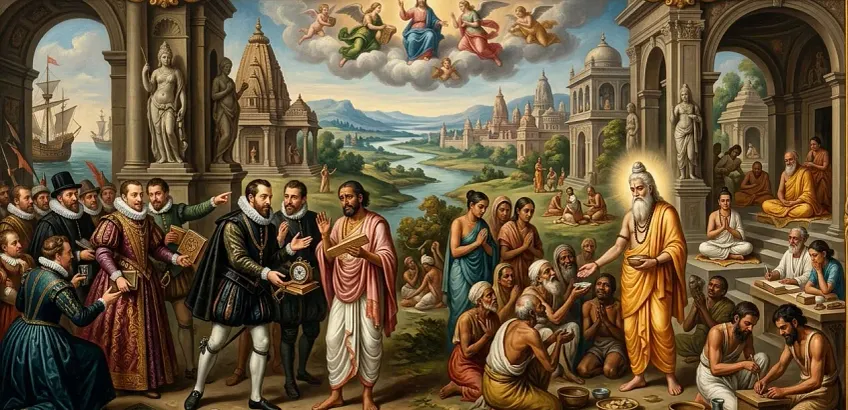
Panoramic painting of formally dressed men facing robed figures and a haloed teacher with a seated crowd
An ornate historical-style painting contrasts men in elaborate dark clothing with robed figures gathered around a radiant, bearded teacher beneath temple arches.

The surviving excerpt should still be read for what it is: a normative civilizational interpretation from 1914, not a statistical survey establishing how every household or institution behaved.
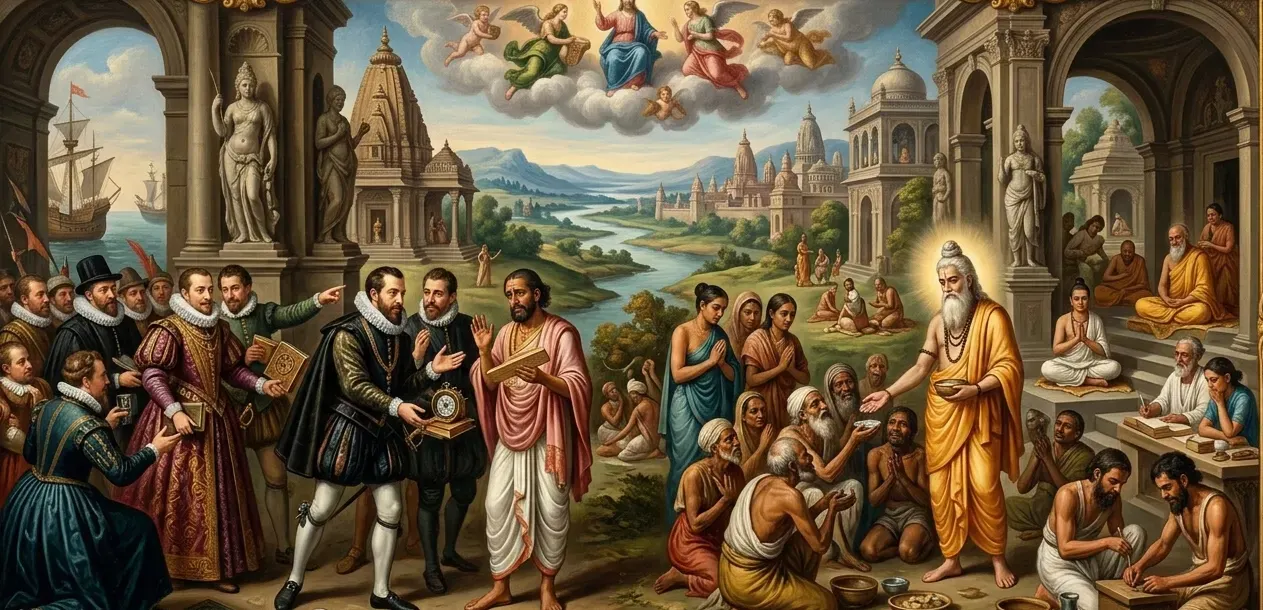
Painted scene of European-dressed men facing a robed teacher and villagers amid temples, arches and ships.
An elaborate historical-style painting places European-dressed men at left and a robed teacher with seated listeners at right, beneath arches, temples and figures in clouds.

Balance, not the abandonment of material progress

At the center of Bose’s thesis is a dynamic equilibrium between material advancement and ethical cultivation. Civilizations encounter internal and external disruption, he argues, and survival depends on restoring balance under new conditions rather than returning mechanically to an earlier age.
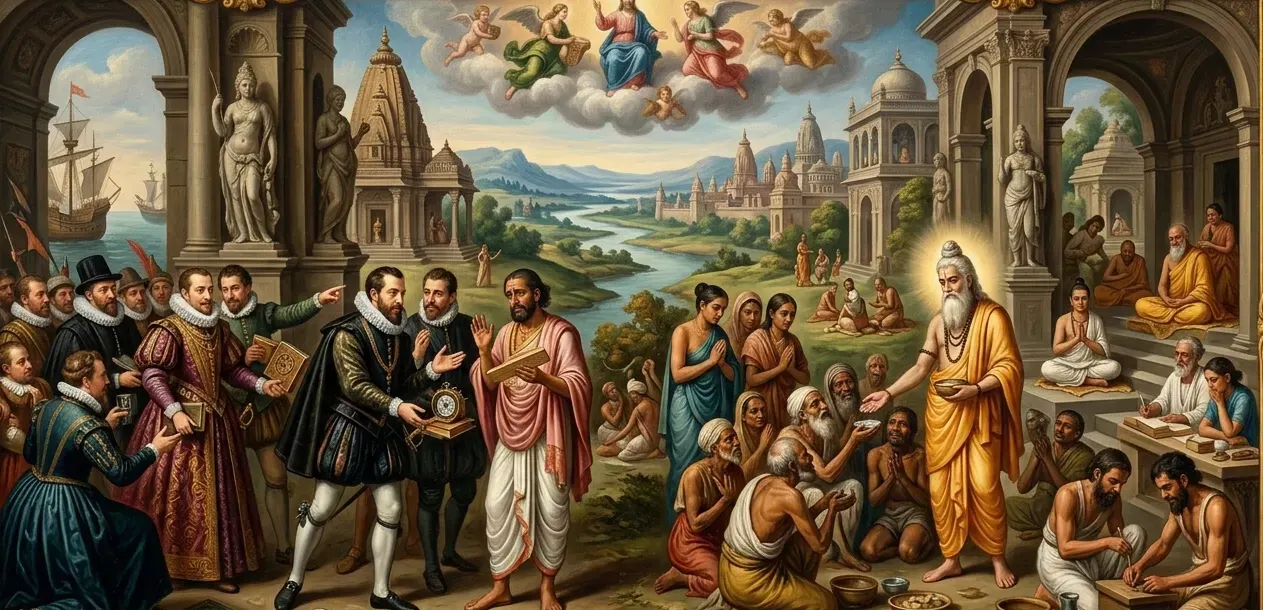
Painted scene of European courtiers facing Indian scholars and a saffron-robed teacher amid temples.
An elaborate historical-style painting contrasts European courtiers with Indian teachers, students and worshippers, framed by ships, temples, statues and angels.

This is a more demanding position than either nostalgia or uncritical Westernization. Technical capacity can increase comfort, communication and institutional reach. Yet those gains become civilizationally incomplete when personal obligation, hospitality and concern for living beings contract. Dharma, in this reading, supplies the discipline that keeps power and prosperity answerable to a wider moral order.
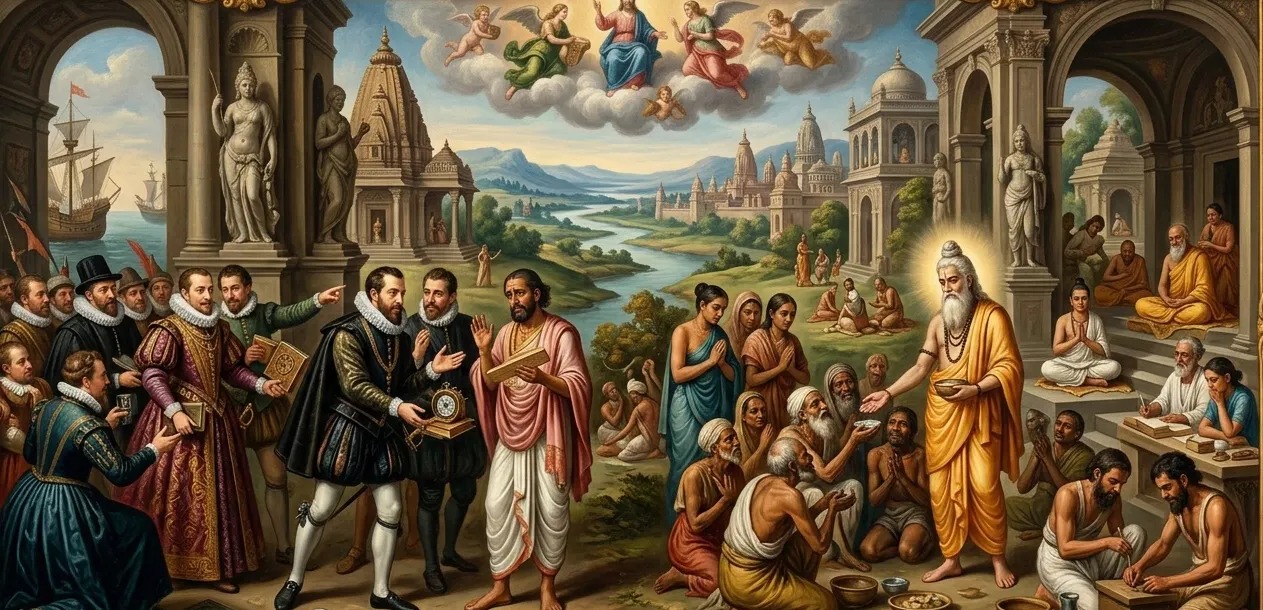
Painted panorama of robed teachers and followers, ornate visitors, temples, a river, ships, and figures in the clouds.
An elaborate historical-style painting places men in ornate coats and ruffs at left beside a robed, haloed teacher offering food among seated followers.

Compassion as a daily Dharmic discipline

Bose identifies self-sacrificing benevolence as a shared ethical current in Hindu, Buddhist and Jaina traditions. He also names Nanak, Ramananda, Kabir and Chaitanya among figures who recalled society to elevated spiritual and ethical ideals. His account therefore places Hindu diversity, Buddhist compassion, Jaina ahimsa and the Sikh inheritance of service within a connected Dharmic moral landscape.
Painted scene of European courtiers facing robed teachers and seated villagers amid ornate architecture
An elaborate historical-style painting places formally dressed courtiers beside robed figures, seated groups, distant towers, waterways, and figures floating among clouds.

The practices he selects are deliberately ordinary. Bhuta Yajna extends care to living creatures, including very small forms of life, while Maanusha Yajna requires feeding a stranger. Even taking a twig from a tree is presented as an act that should acknowledge the sacred presence of the forest. Ethics is thus embodied through recurring duties rather than reserved for declarations or exceptional generosity.
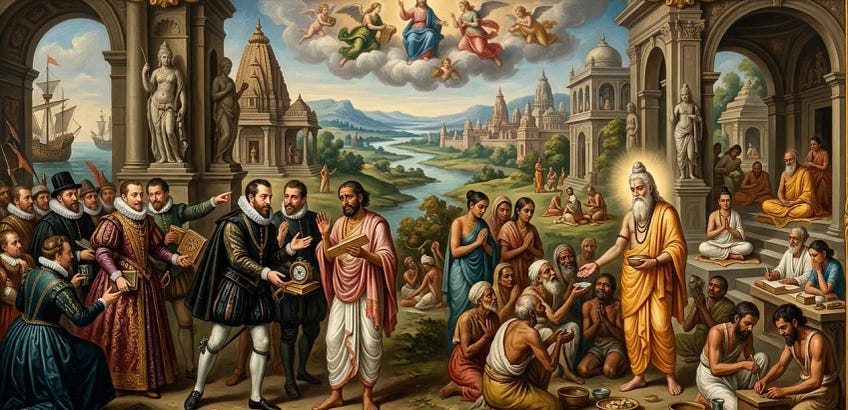
Painted scene of formally dressed men facing robed figures, sages, worshippers, temples, and a river landscape.
An elaborate historical-style painting places formally dressed men at left opposite robed figures and seated groups amid statues, arched buildings, temples, and a winding river.

These examples express an expansive understanding of community. Family loyalty remains important, but it does not exhaust responsibility. The stranger, the wider society, other sentient beings and the natural world all possess claims upon the householder.
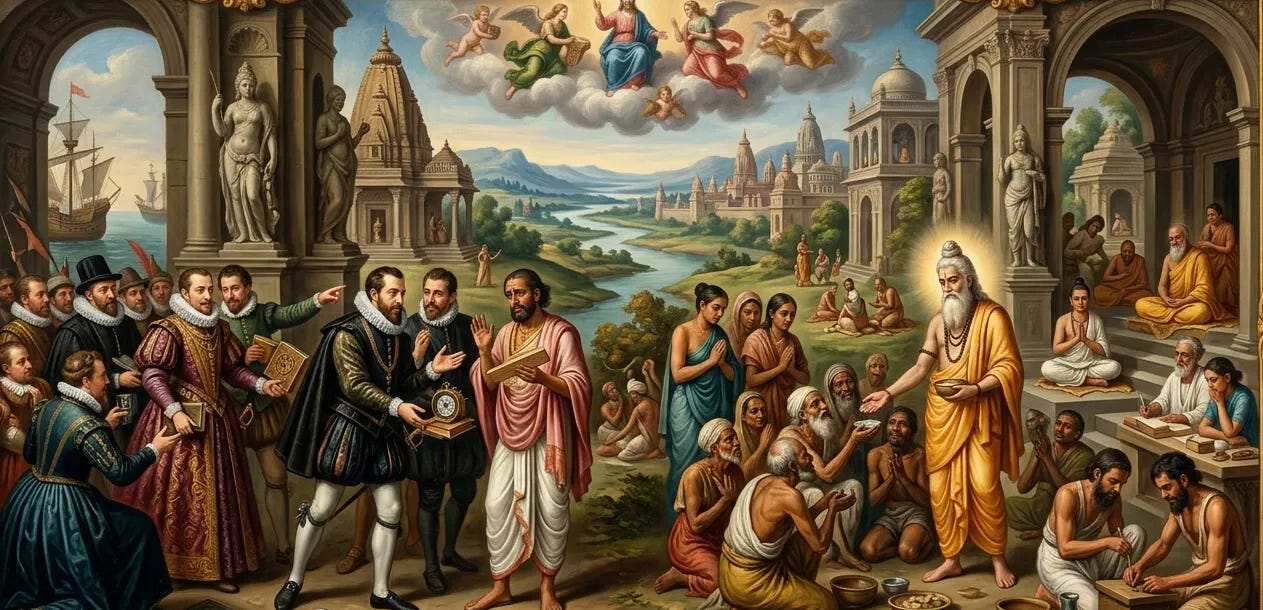
Painted scene of European-dressed men facing Indian ascetics and worshippers amid temples, ships, and celestial figures.
An elaborate historical-style painting places European-clothed visitors at left and a saffron-robed elder with seated or kneeling groups at right, framed by temples and a river landscape.

What organized philanthropy cannot replace

Bose acknowledges that organized charity widened the range of public sympathy. The excerpt points to charitable societies, specialized schools, orphan care and refuges for distressed people as institutional developments capable of serving needs beyond an individual’s immediate surroundings.
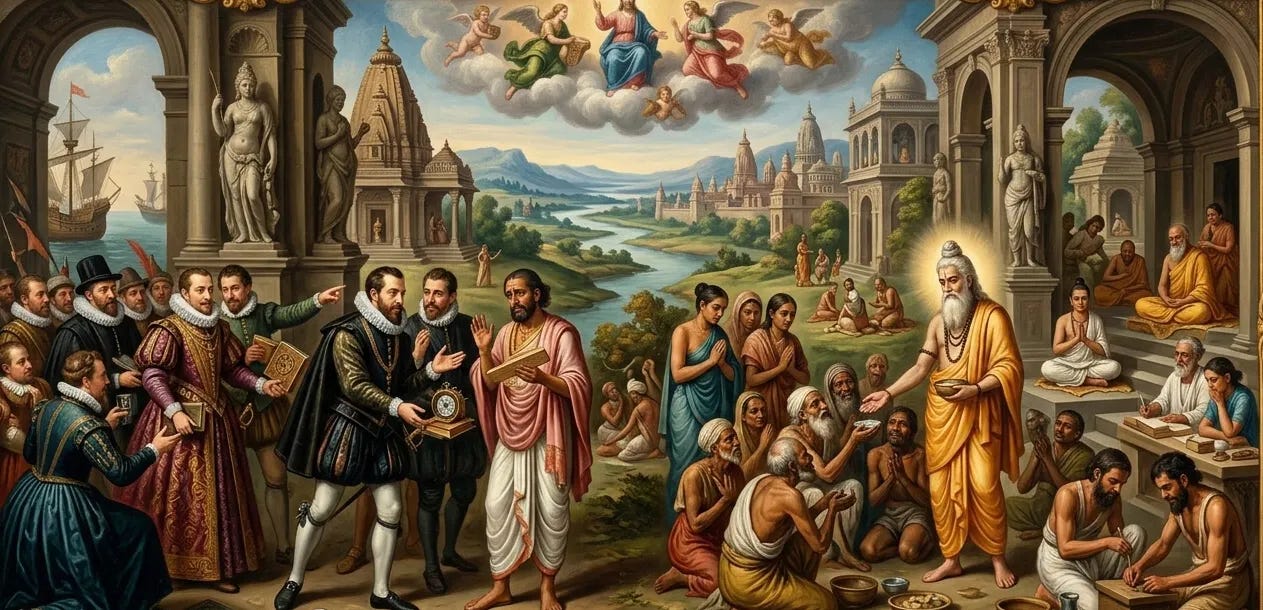
Painted scene of ornate courtiers facing a robed man while a glowing sage tends a crowd amid temples.
An elaborate historical-style painting contrasts richly dressed men holding books and instruments with a robed teacher surrounded by kneeling people and temples.

His concern is that institutional giving can become concentrated in large towns, fail to reach much of society and leave most donors personally disengaged. It may also introduce motives of recognition or status. This is a critique of substitution, not necessarily of organization: signing a donation does not cultivate the same relationship as personally welcoming, feeding or assisting someone.

The constructive lesson is to join the two forms of seva. Institutions provide continuity, scale and specialized competence; personal service develops attention, humility and solidarity. A healthy Dharmic society needs both durable organizations and household-level habits of care.

Key takeaways

  • Bose treats material and ethical development as complementary forces that must remain in balance.
  • Daily benevolence connects Hindu, Buddhist, Jaina and Sikh moral inheritances.
  • Bhuta Yajna and Maanusha Yajna extend duty beyond the immediate family.
  • Organized philanthropy gains reach, but it should not displace personal hospitality and service.

Bose’s challenge invites renewal rather than retreat. A constructive Hindutva rooted in civilizational confidence can preserve these shared Dharmic ethics while building institutions suited to changing conditions, ensuring that material strength remains guided by compassion and responsibility.


Inspired by this post on Dharma Dispatch.


Graphic with an orange DONATE button and heart icons on a dark mandala background. Overlay text asks to support dharma-renaissance.org in reviving and sharing dharmic wisdom. Cultural Insights, Personal Reflections.

FAQs

What was Pramatha Nath Bose’s central ethical warning in 1914?

Bose warned that material advancement becomes civilizationally incomplete when compassion, restraint, hospitality and personal obligation weaken. His argument calls for a renewed balance between technical capacity and ethical cultivation, not a retreat from progress.

Did Bose reject science, industry or Western methods?

No. The article presents him as a geologist engaged with scientific and industrial development, and says his criticism concerned material development detached from higher culture rather than development itself.

What do Bhuta Yajna and Maanusha Yajna mean in this discussion?

Bhuta Yajna extends care to living creatures, including very small forms of life, while Maanusha Yajna requires feeding a stranger. Together they illustrate duties that reach beyond the immediate family.

How does the essay connect Hindu, Buddhist, Jaina and Sikh ethics?

It identifies self-sacrificing benevolence as a shared current, linking Hindu duties, Buddhist compassion, Jaina ahimsa and the Sikh inheritance of service within a connected Dharmic moral landscape.

What is Bose’s criticism of organized philanthropy?

He acknowledges that organized charity can provide reach, continuity and specialized care, but warns that it may be concentrated in towns and leave donors personally disengaged. The criticism is aimed at using institutions as a substitute for personal hospitality and service.

How should personal seva and charitable institutions work together?

Institutions can offer scale, continuity and specialized competence, while personal service cultivates attention, humility and solidarity. The article argues that a healthy Dharmic society needs both.

How should readers interpret the 1914 excerpt?

The article cautions that it is a normative civilizational interpretation, not a statistical survey of every household or institution. It should be read as an ethical argument about restoring balance under changing conditions.

Leave a Reply