

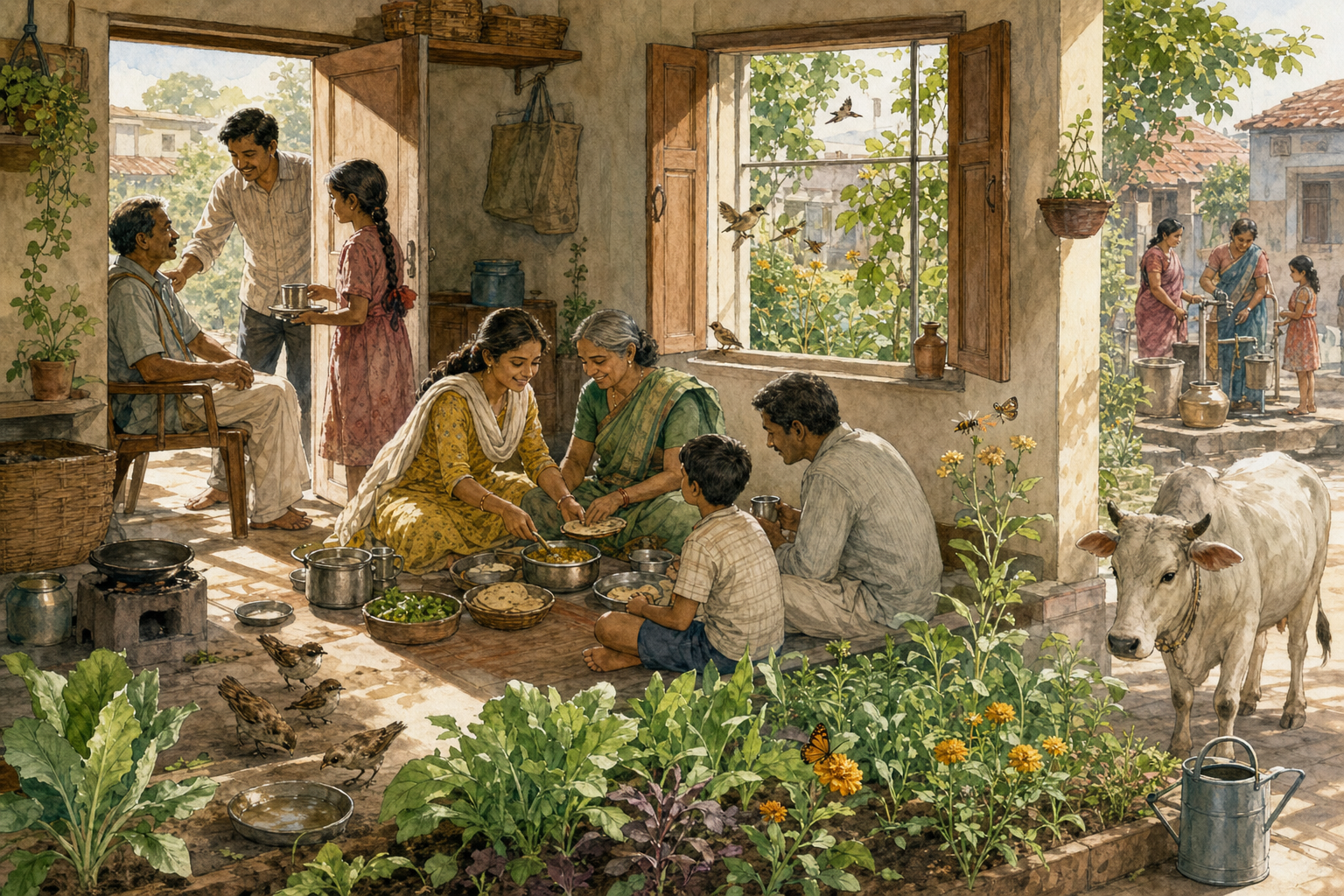
Nriyajna and Bhutayajna extend Hindu householder ethics in two directions: toward the person who crosses the household’s threshold and toward the lives affected by its daily consumption. One governs hospitality; the other directs attention to beings beyond the immediate human circle.
Read together, they offer more than two isolated observances. They make the home a place where dependence is acknowledged through sharing, courtesy, restraint, and repair. This framework remains useful precisely because it connects spiritual duty with ordinary decisions about food, guests, household resources, and unavoidable harm.
A fivefold map of household responsibility
The DharmaRenaissance account places both practices within the Pancha Mahayajna, the five great observances associated with the grihastha, or householder. It identifies Brahmayajna with sacred learning, Devayajna with offerings to the devas, Pitriyajna with obligations to ancestors, Bhutayajna with offerings to beings, and Nriyajna or Manushyayajna with hospitality and human service.
According to the source article, this framework appears in Vedic prose materials including Shatapatha Brahmana 11.5.6 and is associated with Taittiriya Aranyaka 2.10; later Grihya and Dharma texts provide more practical formulations. The article reports that Manusmriti 3.70 links study or teaching, ancestral libation, fire offering, bali for beings, and honoring a guest with the five observances. It also points to comparable mappings in Ashvalayana Grihyasutra 3.1-2 and Yajnavalkya Smriti 1.102.
The significance of this arrangement is relational rather than hierarchical. Knowledge, divine powers, ancestry, nonhuman life, and human society all stand within the householder’s field of obligation. Yajna consequently means more here than a fire sacrifice. It can include study, remembrance, receiving another person, or relinquishing part of what might otherwise be privately consumed.
A useful contemporary interpretation is to see the household as a junction rather than a self-contained possession. Meals depend upon land, water, seed, labor, inherited knowledge, and many forms of life. The fivefold discipline gives that dependence a moral shape: receipt creates an obligation to return, share, or preserve.
Nriyajna makes dignity the measure of hospitality
Nriyajna, more precisely transliterated as Nriyajna with a syllabic Sanskrit r, is the yajna directed toward human beings. Its classical center is the reception of the atithi, commonly understood as an unannounced guest. The source notes that Dharma texts sometimes use narrower definitions involving travel, residence, learning, or the guest’s relationship to the host, while later usage often extends the principle to visitors, mendicants, travelers, and hungry people.
The well-known instruction atithidevo bhava, reported from Taittiriya Upanishad 1.11.2, asks the householder to regard the guest with sacred seriousness. It need not be read as a literal claim that every visitor is a deity. Its ethical force lies in interrupting indifference when another person temporarily depends upon the household’s response.
The source article reports that Apastamba Dharmasutra compares receiving a guest with performing a Vedic sacrifice and treats kind speech as a form of dakshina. This analogy shifts the standard of hospitality away from spectacle. Water, a seat, attention, suitable food, practical help, and respectful leave-taking can carry greater ethical value than an expensive meal accompanied by condescension.
The principle of yathashakti, acting according to one’s capacity, keeps generosity proportionate. Nriyajna does not require financial strain or competitive display, but it does require a sincere relinquishment of convenience, time, food, or attention. A modest household may therefore fulfill the discipline more faithfully than an affluent one if the recipient is treated with genuine regard.
Dignity is not an optional refinement to the offering. Stale food, humiliating questions, intrusive publicity, contemptuous speech, religious pressure, or demands for gratitude can turn assistance into control. The recipient remains a person with privacy, dietary needs, preferences, and the right to decline. Hospitality becomes yajna when the host gives without converting need into a claim over the guest.
Bhutayajna joins care for beings to moral realism
Bhutayajna directs an offering toward bhuta. As the source explains, the Sanskrit term can refer to a being, creature, existent entity, or elemental being. In this domestic ethical setting, however, its principal reference is to beings outside the household’s human circle. Reducing the observance to either ghost worship or an abstract reverence for the five material elements misses that practical context.
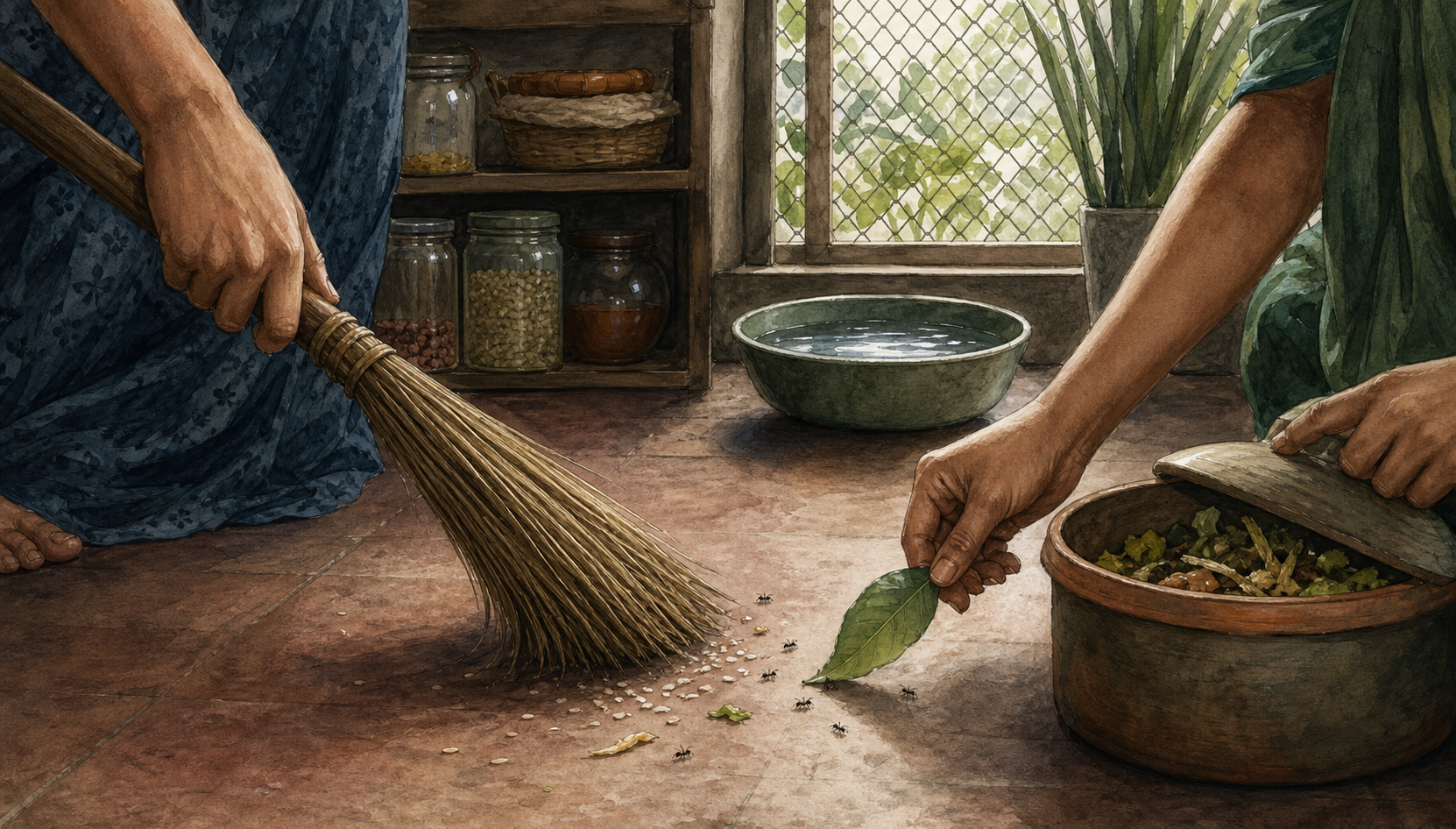
The observance acquires particular depth through the doctrine of the pancha-suna, five ordinary sources of unintended household injury. The DharmaRenaissance article reports that Manusmriti 3.68 names the hearth, grinding stone, implements such as the broom, the mortar and pestle, and the water vessel. In the setting presupposed by the text, routine cooking and cleaning could injure insects and other small organisms even without harmful intent.
This teaching avoids two ethical extremes. It does not demand that cooking, cleaning, and other necessities cease, but neither does it treat necessity as moral innocence. Life has consequences even when harm is unintended. Awareness should therefore lead to greater care, the reduction of avoidable injury, and some restorative return to the wider community of beings.
Bhutayajna can thus inform ecological responsibility without being collapsed into a modern environmental slogan. Its ritual form and traditional meanings remain important, while its underlying reasoning can illuminate present household choices: consumption should account for lives beyond immediate human convenience. Waste reduction, careful use of resources, and responsible forms of care may express that reasoning, but they are contemporary applications rather than claims about one universally prescribed classical procedure.
Nriyajna and Bhutayajna correct different forms of invisibility. The former notices the person who might otherwise be excluded from the meal; the latter notices the beings and conditions hidden behind the meal. One emphasizes distribution, welcome, and dignity. The other emphasizes restraint, consequence, and restitution. Together they prevent generosity toward humans from coexisting comfortably with careless treatment of the nonhuman world.
Key takeaways for a contemporary household
- Establish a basic standard of welcome suited to the household’s means: attentive reception, kind speech, water, a place to rest, food when appropriate, or practical assistance.
- Preserve the recipient’s agency. Assistance should not require humiliation, publicity, ideological conformity, or surrender of privacy.
- Make sharing part of household order rather than an occasional response to surplus. The classical priority is to ask who has been overlooked before abundance is consumed privately.
- Examine the household’s wider effects. Cooking, cleaning, purchasing, and disposal may be necessary, but necessity does not remove the duty to reduce preventable harm.
- Treat hospitality and care for other beings as complementary disciplines. Human generosity and ecological attentiveness are strongest when neither is pursued at the expense of the other.
As domestic life becomes more insulated from the origins of food and the people or creatures affected by consumption, these yajnas invite renewed attention at both the threshold and the unseen edge of the household. Their future relevance will depend less on grand gestures than on whether ordinary homes can make reverence visible through the way they receive, consume, and share.

References
This synthesis draws on the supplied DharmaRenaissance article. Its references to classical texts are presented as reported by that article and were not independently verified.