
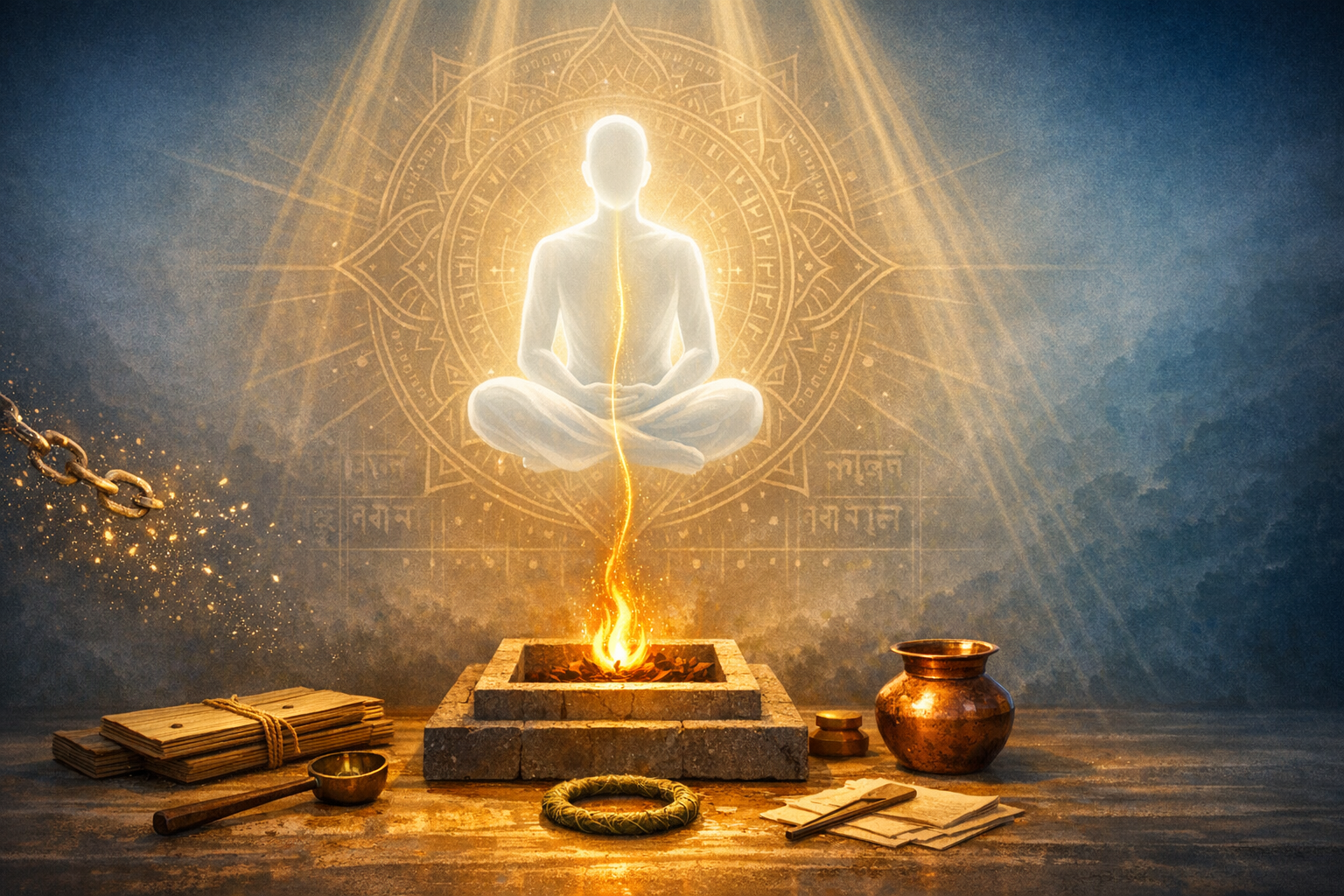
Within the six orthodox (astika) systems of Hindu philosophy, the Mimamsa darsana is renowned for its rigorous interpretation of the Vedas and its precise theorization of dharma. Less widely appreciated, yet philosophically significant, is Mimamsa’s sober and distinctive account of moksha (liberation): freedom conceived as the cessation of suffering and the self’s release from embodied limitation rather than a theistic union or a mystical absorption. This vision complements the broader spectrum of Hindu thought and sits in constructive dialogue with the soteriologies of Buddhism, Jainism, and Sikhism.
Mimamsa’s textual foundations are the Jaimini Mimamsa Sutras (beginning with the programmatic aphorism athāto dharma-jijñāsā) and the Śabara Bhāṣya, further elaborated by the Bhāṭṭa school of Kumārila Bhaṭṭa (notably in Ślokavārttika and Tantravārttika) and the Prābhākara school of Prabhākara Miśra (Bṛhatī). While classically concerned with ritual hermeneuticshow Vedic sentences prescribe action and establish dharmathese works also articulate a carefully reasoned soteriology that situates liberation within a larger moral and epistemic framework.
Moksha in Mimamsa is typically defined in negative but precise terms as atyantika-duḥkha-nivṛtti (the complete cessation of suffering), apavarga or kaivalya (a state of isolation of the self from all sources of pain). It is not annihilation; rather, it is the self (ātman) abiding in its own nature, no longer bound by the body, senses, and mind that generate pleasure, pain, memory, and volition. Because cognition, pleasure, and pain arise only through the functioning of the mind–sense complex, Mimamsa concludes that the liberated state is free from such modifications and therefore from both suffering and transient enjoyments.
Mimamsa posits a plurality of eternal selves (ātmans), each distinct from body and senses and serving as the true agent and experiencer. The self is beginningless, morally responsible, and the substratum that bears the latent effects of action. Embodiment is the condition under which the self experiences the fruits of past deeds; liberation is the end of such embodiment and the cessation of any further bondage.
Karma is analyzed with unique clarity through the doctrine of apūrvaan unseen potency generated by correctly performed Vedic action that links present effort with future results (svarga, welfare, and other outcomes). Obligatory and occasional duties (nitya and naimittika karmas) sustain cosmic and ethical order, while desire-driven actions (kāmya karmas) bind through their ends. Prāyaścitta (expiatory rites) address moral lapses. In this structure, ritual is not arbitrary performance; it is the codification of dharma that orders human life and society.
Epistemologically, Mimamsa is among the most sophisticated of the darśanas. Both schools accept perception (pratyakṣa), inference (anumāna), comparison (upamāna), postulation (arthāpatti), and verbal testimony (śabda), with the Bhāṭṭa school adding non-apprehension (anupalabdhi) as a distinct pramāṇa. The Veda is held to be apaurusheya (not of human authorship), and thus uniquely authoritative concerning dharma and soteriology. This commitment underwrites Mimamsa’s careful rules of interpretation that distinguish injunctive language (vidhi) from explanatory or laudatory passages (arthavāda), ensuring that practice is grounded in reliable knowledge.
How, then, is moksha attained? Classical Mimamsakas converge on the claim that liberation requires the cessation of desire and the exhaustion of bondage-producing karma. Knowledge of the self (ātma-jñāna)gained through śruti, reasoning, and contemplative assimilationdissolves the ignorance that treats the body–mind complex as the self. Without desire (and with the consequent non-generation of fresh apūrva aimed at limited ends), the causal chain binding the self to future embodiment ceases.
On the relation of knowledge and duty, the Bhāṭṭa and Prābhākara schools offer nuanced positions. Both maintain that knowledge is indispensable for liberation and that desire-laden actions cannot deliver moksha. Some Mimamsakas allow that obligatory duties (nitya karma), performed without desire, can purify the mind and coexist with the pursuit of self-knowledge; others emphasize that such duties are expressions of dharma rather than independent means to liberation. In every case, kāmya karma aimed at finite results is seen as perpetuating bondage.
Mimamsa’s non-theistic orientation is methodological rather than antagonistic. Because the system grounds authority in the apaurusheya Veda and in precise hermeneutics, it does not rely on a creator-God to guarantee ritual efficacy. Deities invoked in ritual function as meaningful referents within the Vedic system. Later thinkersacross the Hindu spectrumintegrated devotional theism with Mimamsa hermeneutics without contradiction, reflecting Hinduism’s broad capacity to honor both ritual law and personal devotion.
Far from reducing liberation to ritual reward, Mimamsa differentiates carefully between outcomes: ritual performance, when desire-driven, yields finite results such as svarga; knowledge and dispassion alone terminate the cycle of embodiment. This differentiation respects the Vedic map of human aims (puruṣārthas): dharma sustains life and order, artha and kāma regulate prosperity and enjoyment, while moksha transcends them through insight and renunciation of binding desires.
Mimamsa’s hermeneutics also clarify how scriptural statements are to be read. The tradition distinguishes principal injunctions from ancillary material, employs canons such as consistency, context, repetition, purpose, and result, and resolves apparent contradictions through prioritization and synthesis. These tools later informed Vedānta exegesis and continue to shape how Hindu communities read sacred texts with intellectual fidelity and practical wisdom.
Placed alongside companion darśanas, Mimamsa’s soteriology shows instructive continuities and contrasts. Nyāya–Vaiśeṣika also speaks of apavarga as cessation of pain, aligning closely with Mimamsa’s negative characterization of liberation. Yoga’s kaivalyafreedom through citta-vṛtti-nirodha and discernmentechoes Mimamsa’s emphasis on disentangling the self from mind and its modifications. Vedānta (Uttara-Mimamsa), by contrast, centers the realization of Brahman, often describing moksha positively as knowledge of non-dual reality. These views are not mutually exclusive in lived Hinduism; many practitioners synthesize duty, contemplation, and devotion.
Across the dharmic family, constructive dialogue deepens rather than divides. Early Buddhism’s nirvāṇa as the extinction of craving and suffering resonates with Mimamsa’s cessation-oriented moksha; Jainism’s moksha as release from karmic accretions through right faith, knowledge, and conduct underscores ethical discipline familiar to Mimamsa; Sikh thought frames mukti as freedom through remembrance of the Divine Name (Naam) and righteous living. Shared commitmentsethical action, disciplined mind, reliable knowledge, and compassionform a unity in diversity that strengthens each tradition’s path while honoring plural practices.
This unity is mirrored in Mimamsa’s view of society. By upholding nitya and naimittika duties, it affirms a life-order in which family, community, and ritual observance cultivate mental steadiness, gratitude, and ethical responsibility. Such steadiness, in turn, supports the contemplative clarity required for discerning the self from body and mind, preparing the ground for true dispassion and knowledge.
A frequent misconception is that Mimamsa makes ritual the sole end. Its actual position is more balanced: ritual is an authoritative vehicle for dharma and worldly welfare; moksha requires detachment from desire and insight into the nature of the self. Another misconception is that Mimamsa is opposed to devotion. Historically, Mimamsa hermeneutics coexisted with devotional movements and even equipped them with interpretive rigor, illustrating how text, ritual, and bhakti can converge toward human flourishing and, ultimately, liberation.
Moral psychology is central to the Mimamsa program. Desire and aversion activate karmic chains; restraint and cultivated intention attenuate them. Performing duty without clinging, practicing truthfulness and non-injury, and maintaining clarity in speech and action stabilize the mind. With stability, self-knowledge becomes more than an idea; it becomes a lived discernment that undercuts the misidentification with body and sense-driven impulse.
In practical terms, Mimamsa’s message to contemporary seekers is twofold. First, ethical and ritual disciplines are not in tension with liberation; rightly understood, they establish inner order and communal harmony. Second, moksha is not a remote metaphysical luxury; it is the attainable quietude of the self when ignorance and craving no longer dictate experience. This twofold vision nurtures both civic responsibility and spiritual maturity.
Because Mimamsa privileges the Veda as apaurusheya, it also safeguards scriptural pluralism. Different Vedic rites, mantras, and local customs can coexist without canceling one another, each serving as a valid instantiation of dharma when grounded in competent tradition. This plural hermeneutic coheres with the broader Indian ethos that honors diverse forms of worship, a principle that strengthens interreligious respect within the wider dharmic world.
The Mimamsa account of liberation also contributes a clear ethical horizon for householders. Duties are not impediments to freedom; they are opportunities to train intention, purify motivation, and recognize the limits of desire. As motivation becomes transparent and desire loosens its grip, duty transforms from burden to offering, and the mind becomes fit for stable self-knowledge.
Where Vedānta often articulates moksha as direct knowledge of Brahman’s non-duality, Mimamsa secures the social and hermeneutical foundations that make such knowledge a coherent and responsible human pursuit. Historically, many Vedānta thinkers adopted Mimamsa’s interpretive canons to read Upaniṣadic sentences accurately, showing how the two streamsPūrva-Mimamsa and Uttara-Mimamsaare complementary expressions of a single civilizational quest for freedom.
Comparative soteriology highlights a shared horizon across Hinduism, Buddhism, Jainism, and Sikhism: liberation is inseparable from insight and ethical discipline. Whether one emphasizes cessation (Mimamsa, Nyāya–Vaiśeṣika, early Buddhism) or transformative union (many Vedānta and Sikh articulations), the practical requirementsclarity of mind, rectitude in action, and reliable knowledgeremain mutually intelligible and mutually reinforcing.
In sum, Mimamsa presents a disciplined path: cultivate dharma through competent ritual and ethical practice; refine motivation by relinquishing desire for finite outcomes; pursue discriminative knowledge that reveals the self as distinct from body and mind; and allow the exhaustion of bondage-producing causes. Moksha is then the natural denouementthe quiet freedom of the self resting in its own nature.
This balanced vision, at once rigorous and humane, makes Mimamsa indispensable to any comprehensive account of Hindu philosophy. It protects textual integrity, dignifies ethical life, and articulates a liberation that is at once philosophically coherent and spiritually attainable. In dialoguing constructively with companion darśanas and with the wider dharmic traditions, it invites a unity grounded not in uniformity but in shared wisdom, responsibility, and the enduring human aspiration for freedom.
Inspired by this post on Hindu Blog.
