
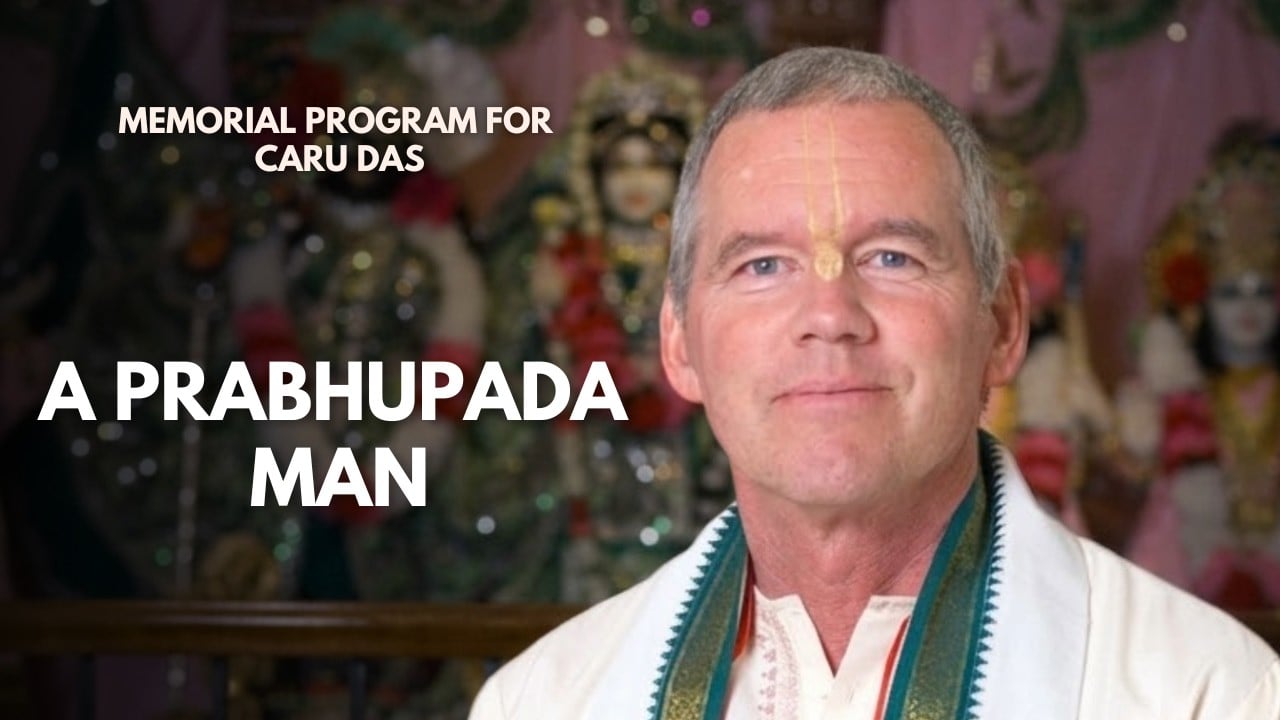
This memorial reflection honors HG Caru Prabhu (often known as Caru Das) as an exemplary disciple and servant, recognized within ISKCON (International Society for Krishna Consciousness) as a “Prabhupada man.” The designation signifies unwavering fidelity to Srila Prabhupada’s instructions, a life anchored in sādhana-bhakti, and a service-oriented leadership ethic that places community uplift above personal recognition. During the memorial program, HH Indradyumna Swami emphasized qualities that defined HG Caru Prabhu’s life: “a perfect gentleman with impeccable behavior, compassion, and devotion.”
In Gaudiya Vaishnava discourse, the expression “Prabhupada man” carries precise implications. It describes one who demonstrates guru-niṣṭhā (steadfast dedication to the spiritual master), adheres to Vaiṣṇava sadācāra (refined conduct), and advances the mission through consistent, humble, and practical seva. Such a devotee translates śāstric ideals into institutional reliability and community carequalities that transform doctrine into daily life.
HH Indradyumna Swami’s characterization“a perfect gentleman with impeccable behavior, compassion, and devotion”aligns with the theological portrait of a mature Vaiṣṇava found in texts such as Bhakti-rasāmṛta-sindhu (Nectar of Devotion) and Upadeśāmṛta (Nectar of Instruction). In practice, that standard manifests as humility (trṇād api sunīcena), steadiness, and the capacity to honor others without demand for personal prestige. Those who interacted with HG Caru Prabhu consistently observed these traits not as isolated moments but as the steady grammar of his daily dealings.
The devotional architecture underlying such conduct is sādhana-bhaktidisciplined engagement in the nine processes of bhakti (śravaṇa, kīrtana, smaraṇa, pāda-sevana, arcana, vandana, dāsya, sakhya, ātma-nivedana). By prioritizing nāma-kīrtana, scriptural study, and practical service, a devotee cultivates the inner clarity required for outward gentleness. Community members often recall that HG Caru Prabhu’s counsel was measured, his speech soft yet resolute, and his time generously given to the progress of others.
Leadership within ISKCON is traditionally expressed as sevaka-leadershipauthority grounded in service rather than status. HG Caru Prabhu’s legacy, as remembered by peers and juniors alike, reflects this principle. Organizing kīrtana, facilitating prasādam distribution, guiding newcomers through foundational teachings, and quietly supporting institutional needs are practical expressions of dharma that strengthen social trust and spiritual morale. In these ways, the eulogy’s emphasis on character is inseparable from a lifetime of community-building.
The Guru–Śiṣya Tradition frames this legacy. The Bhagavad-gītā (4.34) recommends approaching a realized guide “by humble inquiry and service” (praṇipātena paripraśnena sevayā). In modern spiritual institutions, that ideal becomes a living pedagogy: mentorship, accountability, and mutual uplift. By embodying fidelity to Srila Prabhupada’s teachings while offering kindness in day-to-day interactions, HG Caru Prabhu functioned as both practitioner and teacherdemonstrating that rigorous practice and warmth of heart need not be in tension.
The phrase “perfect gentleman” deserves careful attention. In Vaiṣṇava ethics, gentlemanliness (sadācāra) arises from inner alignment with satya (truthfulness), dayā (compassion), śauca (purity), and ahiṁsā (non-harm). Those who served alongside HG Caru Prabhu observed these traits in routine matters: punctuality that respected others’ time, financial transparency that protected community resources, and a culture of appreciation that encouraged younger devotees to excel. Such details, while easily overlooked, form the durable fabric of trust within a spiritual society.
What made him a “Prabhupada man” was not simply doctrinal agreement but the daily art of making others feel seen, supported, and spiritually nourished. Attendees at memorial gatherings described how a brief exchange with him could restore confidence during doubt, and how his gratitude for even small acts of help transformed volunteerism into joyful seva. The enduring lesson is that spiritual leadership is communicated less by position and more by consistent, compassionate presence.
These virtues resonate well beyond a single tradition and speak to the unifying aspirations of the broader dhārmic family. Buddhism’s karuṇā, Jainism’s ahiṁsā and aparigraha, Sikhism’s sevā and langar, and Hinduism’s bhakti and loka-saṅgraha articulate convergent pathways to social harmony. Remembering HG Caru Prabhu through this inclusive lens affirms that humility, compassion, and service are shared civilizational strengths that can deepen unity among Hinduism, Buddhism, Jainism, and Sikhism without erasing their distinctive paths.
From a community development perspective, the practices often championed in ISKCONcongregational kīrtana, prasādam hospitality, and study gatheringspossess well-documented social benefits. They lower barriers to participation, cultivate intergenerational relationships, and provide non-transactional spaces of belonging. Those who witnessed HG Caru Prabhu in these settings recall calm coordination under pressure and an instinct to foreground others’ contributions, thereby normalizing a culture where shared success matters more than personal credit.
Theologically, such service flows from a devotional anthropology: every person is ātmā, inherently worthy of respect, and a potential recipient of grace. This premise generates an ethic of care that is simultaneously spiritual and civic. In practical terms, it looks like fairness in organizational decisions, encouragement in moments of fatigue, and the courage to correct mistakes gently but clearlyhabits that peers noted in HG Caru Prabhu and now cite as standards to emulate.
The memorial tributes repeatedly returned to three themes. First, integrity: promises were kept, resources were stewarded responsibly, and credit was distributed generously. Second, compassion: newcomers were welcomed without judgment, and long-standing members were affirmed in their service. Third, devotion: sādhana was the non-negotiable center from which programs, policies, and relationships drew coherence. Each theme reinforces the others; together they compose a stable framework for personal transformation and institutional resilience.
For readers seeking actionable guidance, his example suggests a clear path. Establish daily sādhana to stabilize the inner life; cultivate gentle speech to dignify others; practice transparent teamwork to build trust; and mentor at least one person consistently, knowing that legacies are measured less by projects completed than by people strengthened. Applied with sincerity, these practices support unity within the diverse dhārmic landscape while honoring the specific devotional commitments cherished in ISKCON.
Ultimately, the remembrance of HG Caru Prabhu as a “Prabhupada man” is a call to substance over spectacle. It invites communities to value character as the highest credential and service as the most persuasive form of teaching. By celebrating the virtues highlighted by HH Indradyumna Swamiimpeccable behavior, compassion, and devotionthis memorial strengthens the shared aspiration of dhārmic traditions to foster societies grounded in humility, courage, and care.
May the legacy of HG Caru Prabhu inspire renewed dedication to Srila Prabhupada’s mission in a way that simultaneously honors unity across Hinduism, Buddhism, Jainism, and Sikhism. That unity, built on the universal grammar of sevā and compassion, remains the most enduring tribute to a life lived as a true gentleman of bhakti and a faithful servant of the Guru–Śiṣya Tradition.
Inspired by this post on Dandavats.
