

You sit down to meditate, repeat a mantra, or read scripture. Within moments, the mind is replaying an argument, planning tomorrow, or imagining the recognition you might receive for becoming more spiritual. The difficulty is not merely that attention wandered. It is that a passing thought quickly became a statement about who you are.
Inner freedom begins when you learn to see the difference. A thought can arise without becoming your identity. An emotion can be felt without becoming your commander. You can act with full commitment without treating the result as your possession. Dharmic practice makes this freedom concrete through disciplined attention, honest self-observation, detachment, devotion, and service.
The mind moves; the ego turns movement into identity
It helps to begin with a working distinction. The mind is the changing field of thoughts, memories, images, emotions, plans, and impulses. Ego is the movement that claims this activity as me or mine, defends it, and builds a fixed identity around it. In a practical Hindu vocabulary, ahaṅkāra is this I-making tendency.
This does not make every use of I a spiritual error. You need a functional identity to keep promises, perform duties, care for a family, and accept responsibility. Bondage begins when a temporary role or mental state is treated as the whole self and must therefore be protected at any cost.
- The mental event: Someone dismisses your work.
- The immediate response: Anger, tension, and defensive thoughts arise.
- The egoic claim: This proves that I am diminished, so I must retaliate or win.
- The opening to freedom: Anger is present, but it does not have to decide the next action.
The purpose of practice is therefore not to manufacture a blank mind or destroy your personality. Fighting every thought creates another struggle for the ego to own. The more workable discipline is patience when attention wanders, repeated practice in returning, and detachment from the result. Patience keeps the inner climate humane. Abhyāsa strengthens the return. Vairāgya prevents calmness, concentration, and spiritual attainment from becoming new possessions.
Use one question as an immediate diagnostic: can you allow this thought or feeling to be present without turning it into a command, a verdict, or a possession? Even a brief gap between experience and identification changes what becomes possible next.
Four Dharmic routes loosen self-clinging in different ways

Hinduism, Buddhism, Jainism, and Sikhism share disciplines of attention, restraint, compassion, and reduced self-centredness. They do not make identical claims about the self or ultimate reality. Respecting those differences makes practice clearer. You do not need to flatten several traditions into one philosophy in order to learn from their convergences.
Hindu paths train the mind and examine the claimant
The Bhagavad Gita joins practice with detachment and places inner discipline inside the field of action. The Upanishadic method of neti neti loosens identification with what is transient. Advaita Vedānta gives this inquiry a particular non-dual direction through the relation of ātman and Brahman. This is a specific philosophical lens, not a reason to reduce the breadth of Hindu thought to a single school.
Hindu sādhanā also offers more than one way to approach egoic ownership. Karma Yoga asks you to perform the right action without claiming the outcome. Bhakti redirects self-concern into devotion and surrender. Jñāna Yoga investigates the identity that says me and mine. Dhyāna, prāṇāyāma, and related disciplines steady attention so that this investigation is not merely intellectual. Across these approaches, spiritual effort matures when it stops being a project of self-glorification.
Before an important task, write two clauses: My duty here is…, and The result is not entirely mine because…. The first clause prevents detachment from becoming passivity. The second prevents effort from becoming a demand that reality confirm your importance.
Buddhist practice investigates the fixed self you keep assuming
The Buddhist teaching of anātman challenges clinging to a fixed, independent self. Mindfulness allows thoughts, emotions, and impulses to be observed as changing events. Samādhi supplies the stability needed to see that change without immediately grasping or resisting it.
When anger appears, do not begin with the abstract declaration that there is no self. Look directly. Notice the thought, bodily tension, urge, and personal story. Which part is unchanging? Which part must be obeyed? The practical point is not to win a metaphysical argument. It is to stop treating a changing process as an unquestionable owner.
Jain discipline weakens the ego of absolute certainty
Jain anekāntavāda trains openness to the many-sided character of reality. It directly challenges the habit of treating one limited standpoint as the complete view. Kṣamā, or forbearance, steadies the emotional response, while samayik cultivates focused composure.
Apply this in disagreement before presenting your rebuttal. State the standpoint from which your own claim makes sense. Then identify one condition under which another person may be seeing a valid part that you have omitted. This does not mean that every view is equally sound or every action equally dharmic. It means that certainty should be proportionate to the limits of your perspective.
Sikh practice turns remembrance into service under hukam
Sikh wisdom places the individual within hukam, the pervasive order that does not bend to personal insistence. Simran cultivates remembrance. Sehaj points toward poised equanimity. Seva redirects energy from self-importance to the needs of others, while sangat sustains practice in community.
Hukam is not an excuse for inertia. When circumstances resist your preference, replace the question Why is reality not obeying me? with What truthful and useful service is required from me now? You still act. What softens is the demand that action guarantee recognition, control, or comfort.
You do not need to combine all these methods into a private spiritual mixture. Choose a practice rooted in your own path and follow its discipline faithfully. Breath awareness, japa, simran, and samayik are not interchangeable labels. Their forms and theological settings matter. The shared practical test is narrower: does your discipline reduce the compulsion to defend a self-image while increasing truthful, compassionate action?
A ten-minute practice for attention without egoic striving
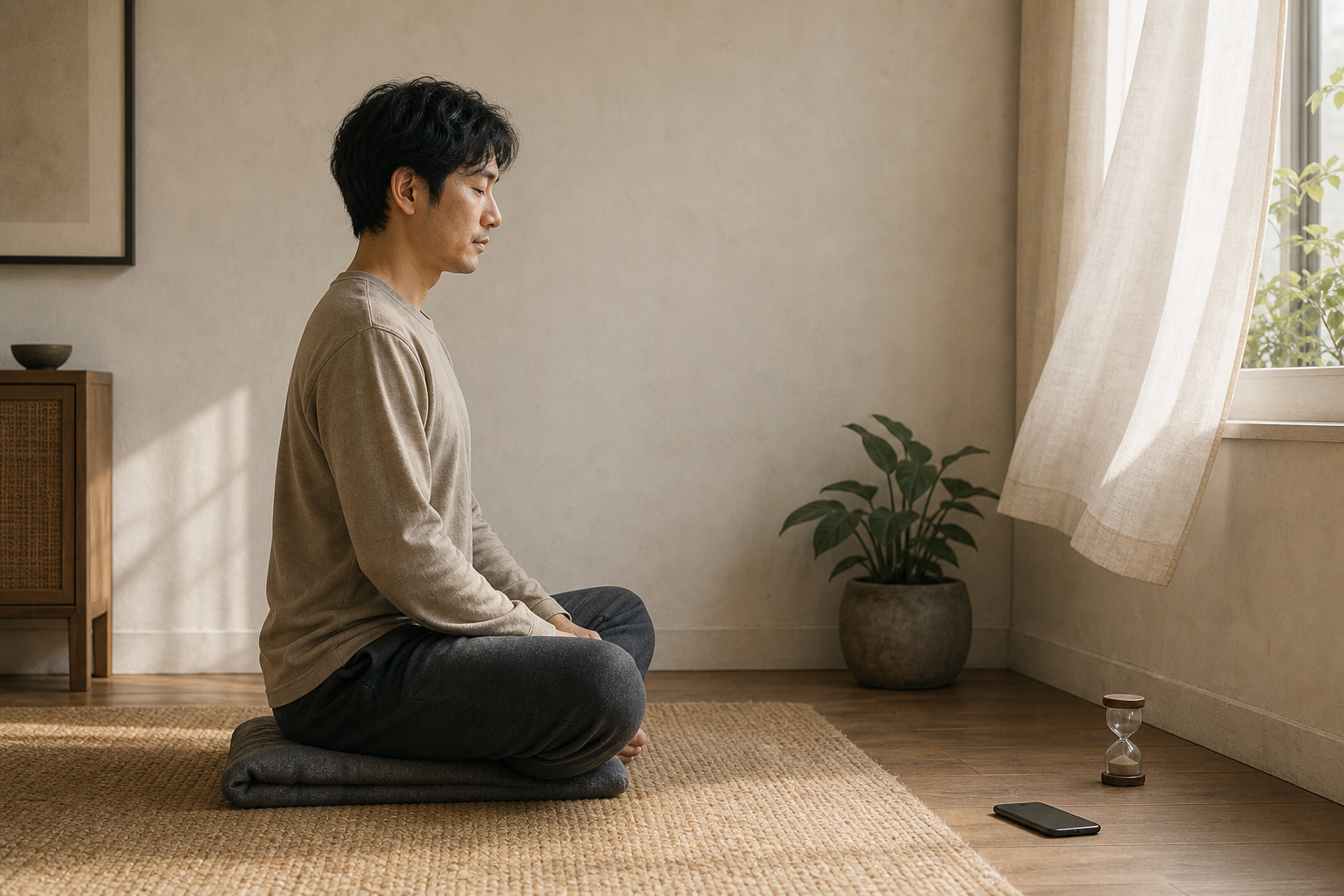
A modest daily practice is enough to expose the pattern. Ten minutes of breath awareness, silent japa, or another established contemplative form gives you a repeatable setting in which to notice wandering, ownership, and return. Regularity matters more than using one intense session to prove your seriousness.
- Fix the container. Choose a dependable daily window. Put the phone beyond reach and decide on your practice before sitting down. Do not spend the session negotiating with yourself about which technique to use.
- Settle the body. Take a steady posture and allow the breath to move through the diaphragm without strain. The aim is alert composure, not a dramatic breathing experience.
- Establish one anchor. Use the breath, breath counting, silent japa, simran, or the focal discipline proper to your lineage. Returning to one anchor teaches more than repeatedly changing methods in search of immediate calm.
- Return with kṣamā. When attention wanders, notice what captured it and come back without abuse. The return is not evidence that meditation failed. The return is the central repetition through which attention is trained.
- Notice the I-making claim. Listen for thoughts such as I must be calm, I am failing, I understand this better than others, or this experience proves that I am advanced. Do not debate each claim. See it, release possession of it, and return to the anchor.
- Close with gratitude and direction. Use the final minute for gratitude. Then name one act of duty or seva through which the session will enter ordinary life.
After the session, record three short lines: the distraction that returned most often, the identity it seemed to protect, and the next action that would express dharma rather than impulse. Reflective journaling is useful when it reveals patterns. It becomes another form of rumination when it merely rehearses the same story.
Adjust the method when a predictable obstacle appears
- Restlessness: Simplify the session. Re-establish posture, follow the diaphragmatic breath, and return to one anchor instead of chasing every thought.
- Lethargy: Restore an upright posture and practise during a window in which you can remain attentive. Extending a dull session does not make it deeper.
- Doubt: Ask whether the problem is the method or your demand for a quick result. Seek guidance from a trustworthy teacher or supportive satsang, sangha, or sangat before repeatedly switching practices.
- Harsh self-judgment: Treat judgment as another mental event. Returning patiently is more disciplined than punishing yourself for having a mind that moves.
- Spiritual ambition: Keep the agreed practice window instead of lengthening it to establish superiority. Evaluate what happens in relationships and duties, not the prestige of your routine.
Do not score a session solely by how peaceful it felt. A noisy session in which you repeatedly noticed and returned may expose ego more honestly than a pleasant session that becomes a cherished spiritual possession. Brief, consistent practice supported by patience and detachment is the more dependable discipline.
Test inner freedom where your self-image is challenged

Meditation reveals the mechanism, but daily life shows whether anything has changed. The strongest test is usually not a quiet moment. It is the instant when recognition, control, certainty, or comfort is threatened.
| Situation | Habitual egoic move | Practice of freedom |
|---|---|---|
| Criticism | Turn feedback into a verdict on your worth and attack the messenger. | Separate useful information, unhelpful tone, and the identity being defended. Correct what is true without accepting what is false. |
| Success | Convert a favourable result into proof of personal superiority. | Acknowledge effort, conditions, help, and good fortune. Continue the duty without building a rank from the outcome. |
| Failure | Turn one event into a permanent identity or replay it to protect yourself from another attempt. | Name the controllable correction, make any required repair, and release the demand to rewrite the past. |
| Disagreement | Treat your standpoint as the whole of reality. | Identify its limits and articulate the strongest valid part of another standpoint before responding. |
| Digital impulse | Treat every urge to check, scroll, or answer as a command. | Practise a simple form of pratyāhāra: remove the stimulus and return attention to the task you consciously chose. |
| Service | Seek visible credit and withdraw when appreciation does not arrive. | Choose the needed action, perform it carefully, and let the benefit to others outrank recognition. |
Digital boundaries are especially revealing because the urge and the action often seem fused. Moving a device out of the practice space is not hostility toward the senses. It is a practical withdrawal from stimulation so that attention can return to a chosen object instead of following every external invitation.
Watch for counterfeits that borrow spiritual language
- Detachment is not indifference. If your supposed vairāgya makes you neglect a promise, refuse a necessary repair, or become less compassionate, it is functioning as avoidance.
- Non-doership is not evasion. Relinquishing ownership of results does not erase responsibility for choices. You still owe truthful effort and accountability for foreseeable consequences.
- Witnessing is not suppression. Pretending not to feel anger while expressing it through contempt, silence, or retaliation does not free you from anger. Name what is present without handing it control.
- Humility is not self-contempt. Constantly declaring yourself worthless can keep attention fixed on the same central character. Humility sees limits clearly and remains available for correction and service.
- Many-sided understanding is not moral confusion. Recognising that your view is partial does not require abandoning discernment. It requires examining context and opposing claims without making your own perspective absolute.
Spiritual ego is particularly skilled at using correct vocabulary. It can turn austerity, scriptural knowledge, meditation, devotion, or lineage into social rank. Ask what happens when nobody notices your practice. If motivation collapses without recognition, the practice has revealed the next attachment to work with.
Measure freedom by recovery, conduct, and clarity

Unusual experiences are unreliable as a personal scoreboard because the ego can claim them immediately. Behaviour offers a harder test. Useful signs include longer periods of unbroken attention, kinder responses under stress, faster recovery from emotional turbulence, and a quieter baseline of mind.
A quieter baseline does not mean numbness. Quicker recovery does not mean that anger, grief, or disappointment never appears. The change is that experience is noticed sooner, obeyed less automatically, and carried for less unnecessary time. You become more able to choose a proportionate response.
After a difficult moment, review conduct with concrete questions:
- What happened before the reaction began?
- Which thought, emotion, or bodily signal did I notice first?
- What identity or desired outcome was I defending?
- Did I choose the next action, or did the first impulse choose it for me?
- What repair, apology, boundary, or renewed effort is now required?
Record verbs rather than spiritual verdicts. Returned to the task, paused before replying, admitted an error, completed the duty, or apologised is more informative than I am detached or I am advanced. The first kind of language describes conduct. The second creates an identity that will soon demand protection.
Community also helps test self-deception. A trustworthy satsang, sangha, or sangat provides continuity and correction. The point is not to outsource discernment or collect approval. It is to practise among people who can see whether greater concentration is actually producing greater patience, honesty, and service.
Key takeaways
- The wandering mind is not the whole problem; bondage deepens when ego turns a passing event into identity, possession, or command.
- Patience, abhyāsa, and vairāgya work together: remain calm enough to return, practise the return, and release ownership of the result.
- Hindu, Buddhist, Jain, and Sikh paths converge in reducing self-clinging, but their doctrines and established practices should not be treated as interchangeable.
- Detachment must improve responsible action. If it reduces care, honesty, repair, or service, it has become avoidance.
- Judge progress by attention, recovery, conduct, and relationships rather than by spiritual experiences or a prestigious self-description.
At your next practice window, choose one anchor and sit for ten minutes. At the next real-life trigger, notice the thought, the feeling, and the identity trying to claim them. Then perform the duty in front of you without demanding that the result confirm who you think you are. That is where inner freedom stops being an idea and becomes a way of living.
References
- DharmaRenaissance Blog – Master the Restless Mind: Patience, Constant Practice, and Detachment in Dharmic Traditions
- DharmaRenaissance Blog – Beyond Ego: Unmasking Supreme Truth in Dharmic Wisdom for Inner Freedom and Clarity
