
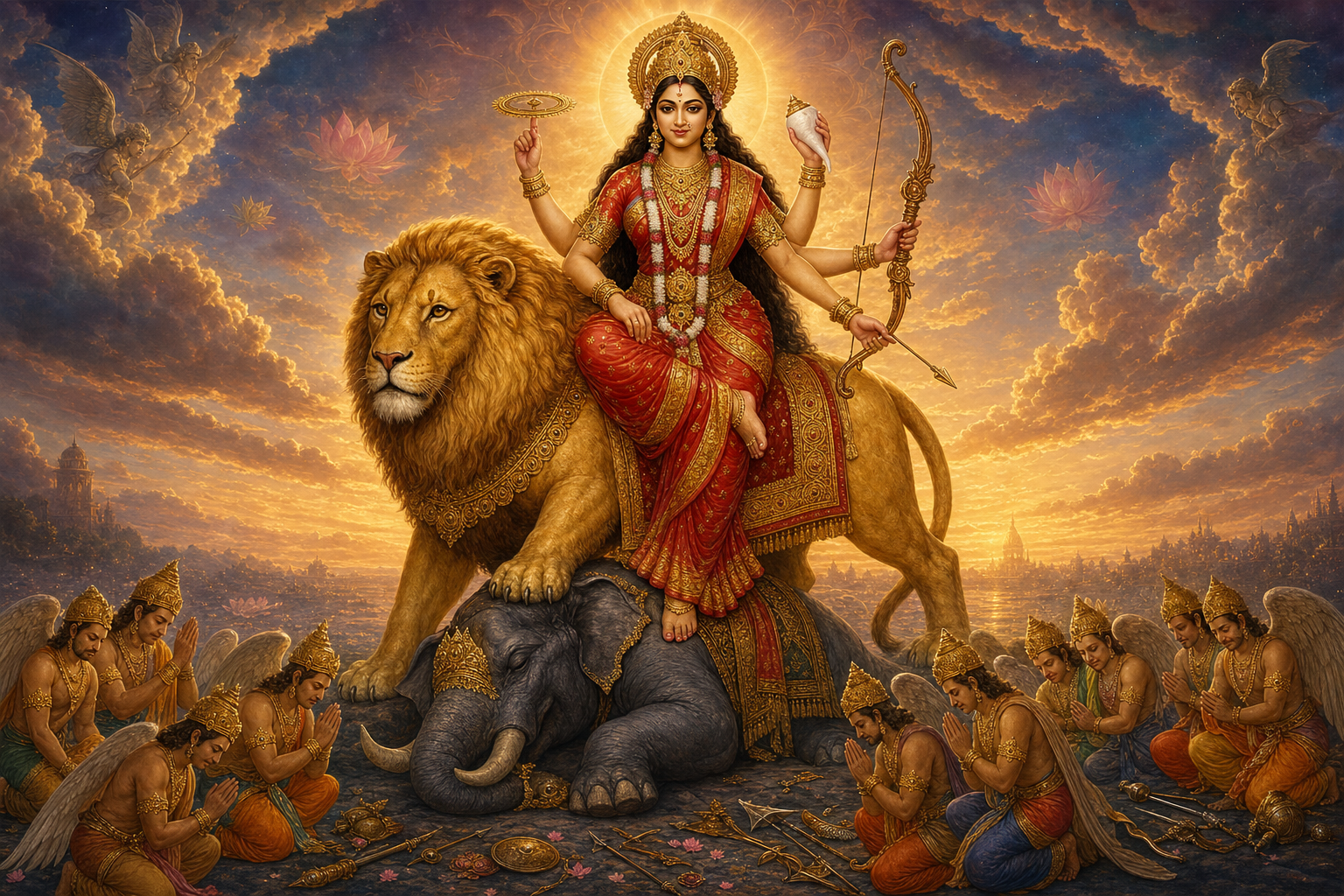
You may expect Jagadhatri’s lesson to begin with failure. It begins more sharply with success: the work is accomplished, praise arrives, and the mind quietly turns a gift of grace into proof of its own independence. If you are trying to understand why the devas had to be humbled, look first at what victory did to them.
Jagadhatri does not ask you to deny your strength. She asks you to locate it honestly. Your ability may be real, your effort may be sincere, and the result may deserve celebration. What becomes false is the claim that you alone are the origin and owner of the power through which it happened. Seeing that difference is where devotion becomes a discipline rather than admiration from a distance.
The devas are tested after victory, not before it
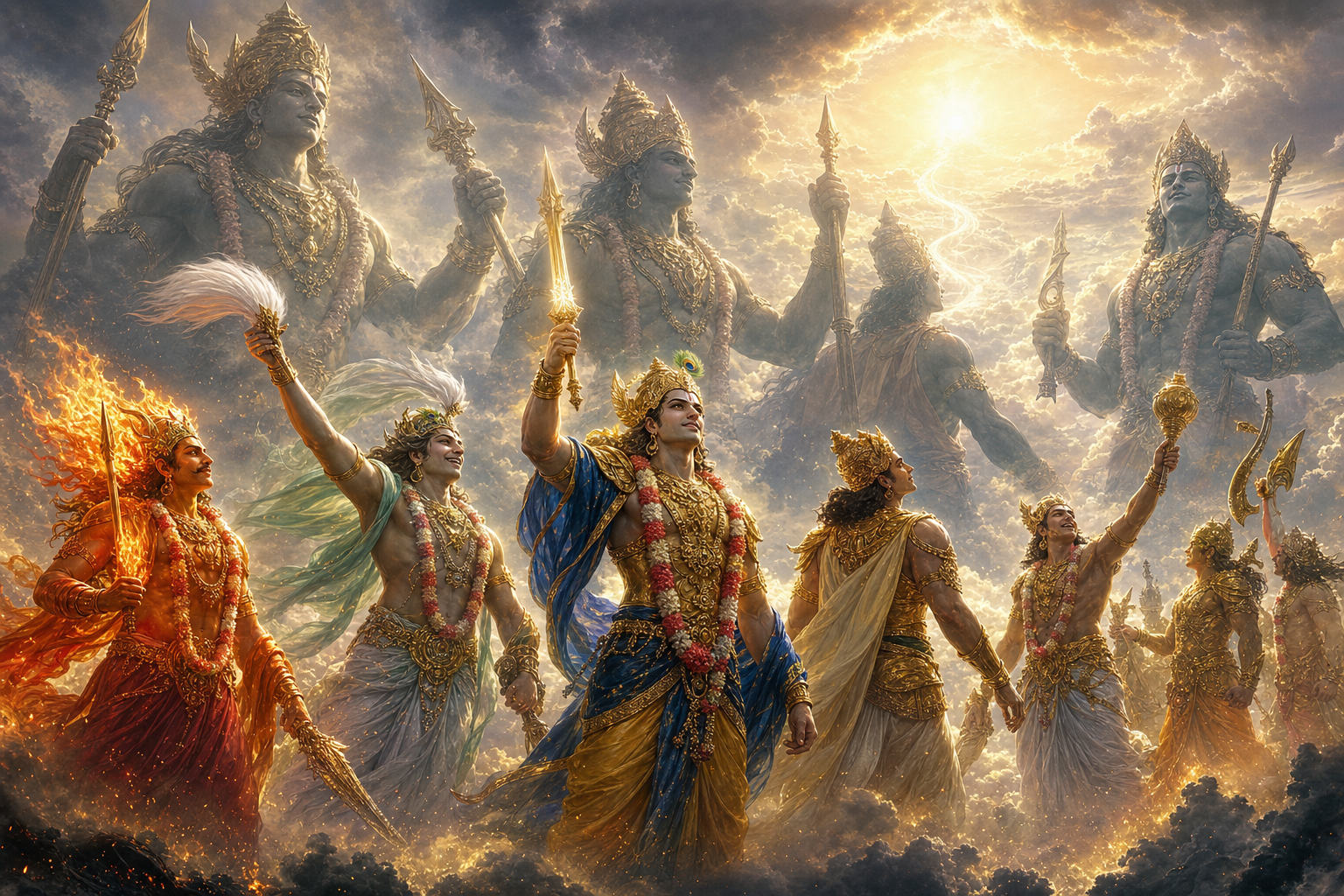
The devas have already prevailed when pride begins to overtake discernment. A mysterious presence then tests the powers in which they have become confident. Their limitations are exposed, and Indra receives the knowledge disclosed through Uma: the victory belonged to the supreme Shakti rather than to any isolated divine power.
This sequence matters. The danger is not competence itself. It is the movement from competence to presumed self-sufficiency. The devas still possess their faculties, but they no longer understand those faculties correctly. Power without knowledge of its ground turns into ahamkara, the ego-making tendency that converts a function into an identity and a contribution into absolute ownership.
Indra can be read here as the sovereign mind. The mind coordinates, decides, and leads, so it easily mistakes its governing role for ultimate authorship. Uma’s disclosure does not destroy that role. It restores proportion. The mind can govern wisely only when it recognizes the consciousness and Shakti that make every faculty possible.
That rules out three common misunderstandings of humility. You do not have to pretend that your achievement was insignificant. You do not have to speak poorly of abilities that should be cultivated. And you do not have to become passive so that you never risk pride. Dharmic humility is more demanding: act fully, see clearly, and refuse to treat entrusted power as a private possession.
When something goes well, pause before using that success as automatic authority for your next decision. Ask: What was truly mine to do? What did I receive from teachers, companions, circumstances, inherited knowledge, and capacities I did not manufacture? What duty now follows from the result? These questions let victory mature into gratitude instead of hardening into entitlement.
Uma in the Kena Upanishad and Jagadhatri in Bengal

A careful distinction makes the theology clearer. The classical Upanishadic motif presents Uma as the revealer who makes the devas understand the origin of their victory. Bengal’s Shakta imagination refracts that realization through Jagadhatri, the luminous manifestation of Adi Shakti whose name means the upholder of the world. The two should neither be carelessly collapsed nor artificially separated.
The Kena Upanishad supplies the spiritual movement from pride to bewilderment and then from bewilderment to knowledge. Jagadhatri gives that movement a distinctly sustaining form. She is not merely another participant in a divine contest. She represents the power by which faculties operate, order endures, and a disordered will is brought back under dharma.
This is why grace should not be reduced to divine approval or the granting of pleasant outcomes. Jagadhatri’s grace may appear as the discovery that your preferred account of yourself is incomplete. The correction is gracious because it prevents limited power from becoming destructive. She sustains the person by loosening the false identity that the person was trying to sustain.
Jagadhatri Puja is observed on Kartik Shukla Paksha Navami and is especially associated with places such as Chandannagar and Krishnanagar, as well as other parts of Bengal. Its contemplative emphasis complements the more overtly martial drama familiar from Durga Puja. Durga’s imagery foregrounds the destruction of manifest adharma; Jagadhatri’s imagery brings the subtler adversary of pride into view. This is a difference of emphasis within Shakti’s fullness, not a competition between two forms of the Mother.
If you approach Jagadhatri during puja, bring two things into your attention: an achievement you can name without false modesty and a correction you have been resisting. Place them together. The first reveals the capacity that has been given; the second reveals where ahamkara has begun to claim it. Worship then becomes an honest encounter with the power that both enables and disciplines you.
Read Jagadhatri’s iconography as an inner diagnostic
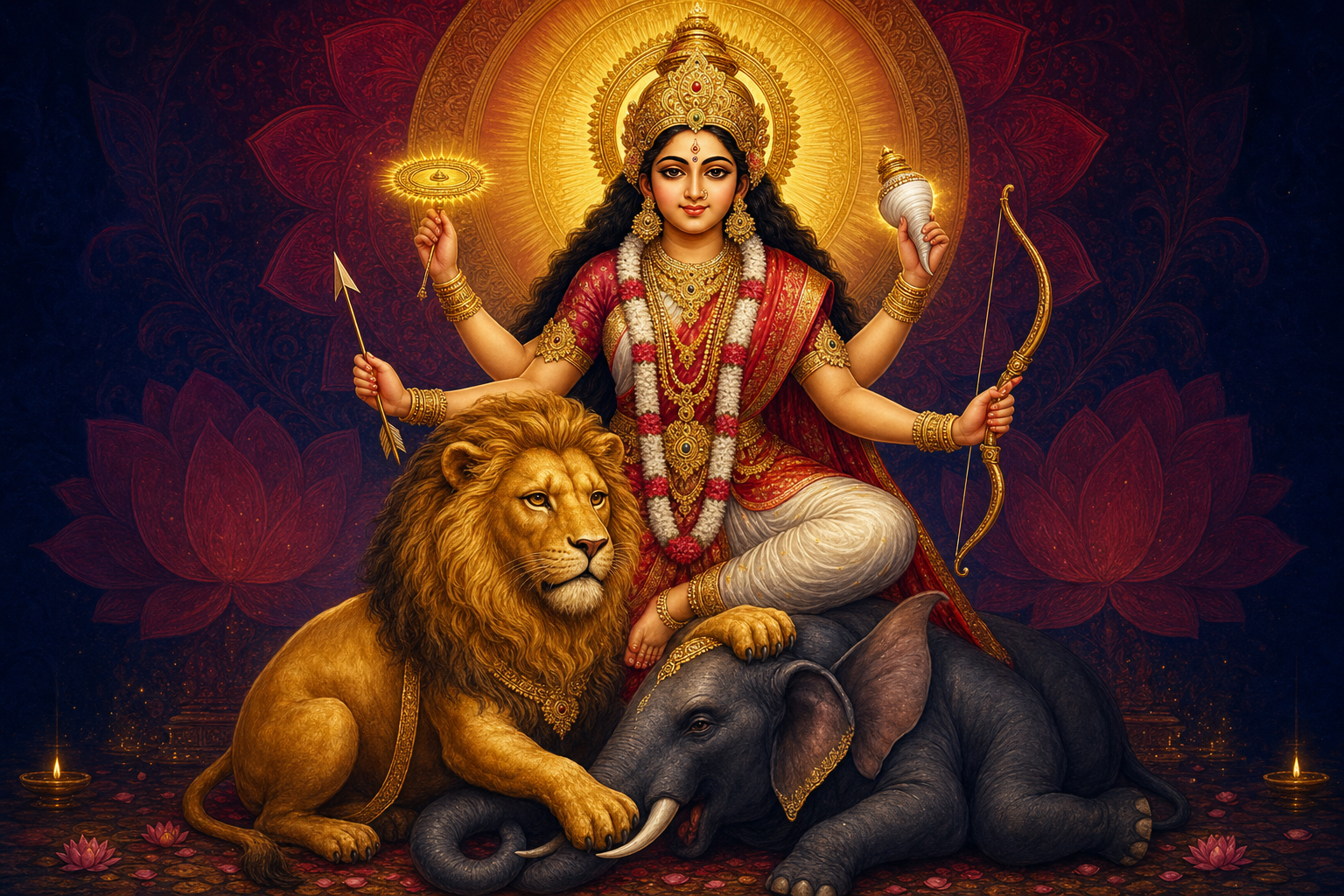
Jagadhatri’s murti does more than identify the Goddess. Its symbols teach you how power is to be governed. She rides a lion, subdues an elephant, and holds the conch, discus, bow, and arrow. Each element can become a precise question for self-examination.
| Symbol | What it reveals | A question to act on |
|---|---|---|
| Lion | Fearless righteousness and strength governed by dharma | Am I using strength to protect what is right, or merely to protect my image? |
| Elephant | The heaviness of ego, inertia, and self-importance | Where have I become defensive, unteachable, or too comfortable to change? |
| Conch | The call of dharma and the restoration of vital order | What duty or truth needs to be voiced clearly before preference takes over? |
| Discus | Lucid awareness and the movement of time beyond personal control | What am I treating as permanent, possessable, or fully under my command? |
| Bow and arrow | Balanced restraint, concentration, and ethically directed action | Is my aim clear, and have I accepted the discipline required to pursue it rightly? |
The lion and elephant belong together. Raw force is not defeated by a weaker force; heavy self-importance is mastered by strength aligned with dharma. This gives you a practical test. If your strength makes you less receptive to truth, it is beginning to resemble the elephant. If it makes you steadier, more responsible, and more willing to protect order without demanding personal glorification, it is taking on the quality of the lion.
The objects in Jagadhatri’s hands refine the same lesson. The conch calls you back into alignment before action. The discus reminds you that time moves through every title, victory, institution, and body. The bow holds tension without losing form; the arrow converts that disciplined tension into a definite direction. Intensity by itself is therefore not enough. Right action requires a worthy aim, restraint during preparation, and clarity at the moment of release.
Do not turn these symbols into a rigid code that exhausts the Goddess. Use them as a sequence of attention. Hear the call of duty. Remember the limits imposed by time. Gather your energy without scattering it. Examine the aim. Then act with courage that is no longer organized around self-display.
Grace humbles without humiliating
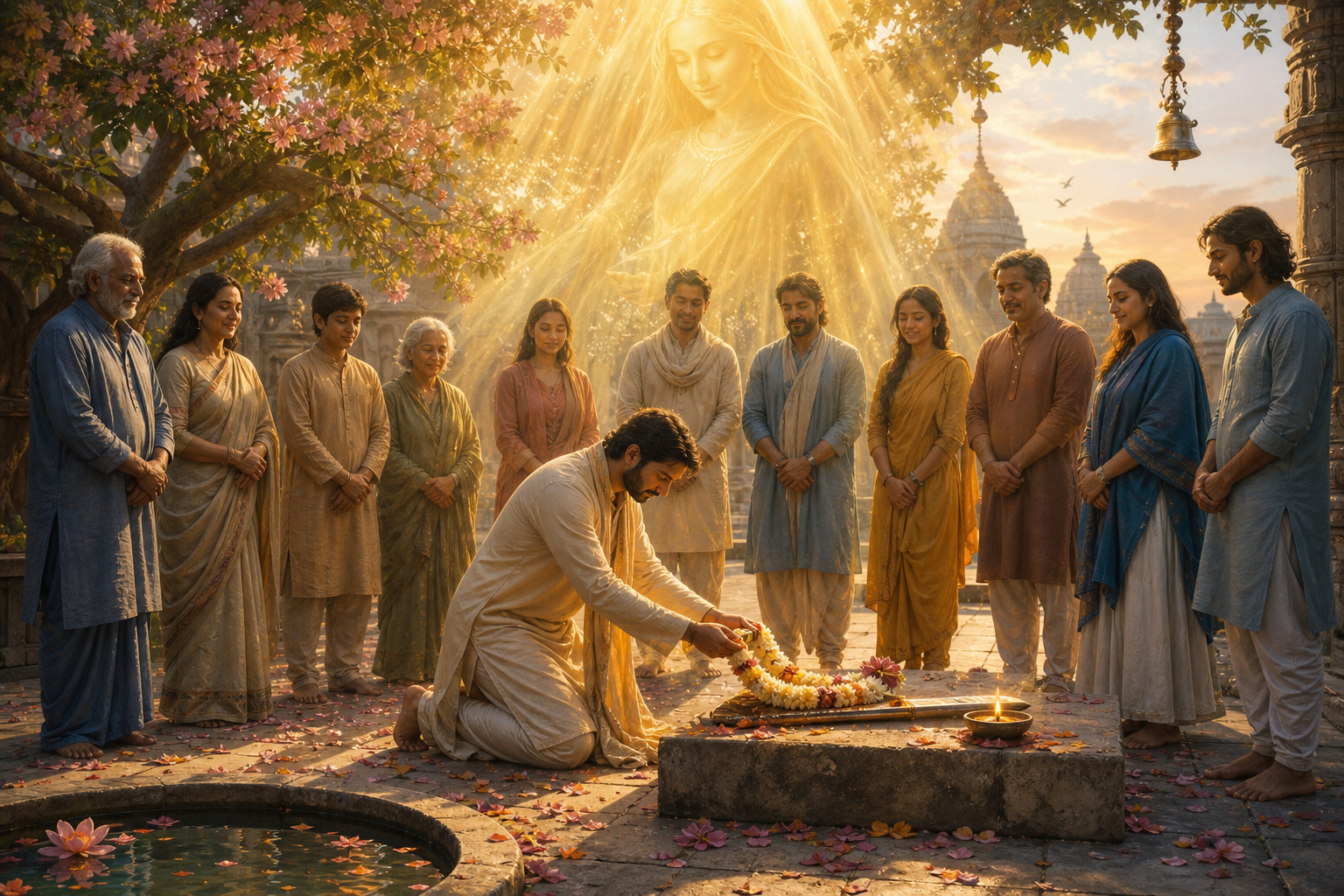
Humiliation tells you that you are worthless. Humility tells you that your worth and abilities are not self-created absolutes. The first can leave a person collapsed or resentful; the second restores right relationship. The devas are corrected through illumination, not degradation. Their defeat of arrogance allows their powers to return to cosmic order.
This distinction changes how you should receive criticism. Not every criticism is wise, and humility does not require surrendering discernment. But when a correction is true, resisting it to preserve status gives ahamkara control over the very faculty that could learn. A person who can wield authority but cannot be corrected has power without the protection of vidya.
The following reflection is a practical application of Jagadhatri’s teaching, not a claim about a compulsory puja sequence:
- Name the achievement plainly. Avoid both boasting and theatrical self-dismissal. Accurate gratitude begins with an accurate account of what happened.
- Restore the full chain of support. Remember the people, conditions, knowledge, opportunities, and faculties without which the result would not exist.
- Identify the elephant. Look for the specific sign of self-importance: defensiveness, hunger for exclusive credit, contempt for advice, refusal to revise, or the assumption that one success guarantees sound judgement elsewhere.
- Place the next use of power under dharma. Ask whom the decision serves, what it could damage, what restraint it requires, and whether you would still defend it without personal recognition.
- Return capacity through seva. Share useful knowledge, strengthen a community effort, support someone whose work is overlooked, or direct part of your energy toward restoring balance in the home or environment.
This pattern turns grace into conduct: receive, attribute, examine, discipline, and serve. Silent contemplation has a place because it interrupts the reflex to convert every success into another performance. Shared learning has a place because it loosens the private ownership of knowledge. Community service has a place because power becomes trustworthy when it helps uphold a world larger than the self.
The same test applies in ordinary settings. At work, give contributors visible credit before using the result to enlarge your own authority. In community leadership, create a way for people to correct a decision without having to flatter you first. At home, notice whether being right has become more important than preserving truth, fairness, and relationship. If others cannot safely tell you what you are missing, the elephant is already becoming difficult to move.
Key takeaways for a dharmic life
Jagadhatri’s teaching can resonate across dharmic traditions without pretending that their doctrines are interchangeable. Hindu thought speaks of overcoming ahamkara and bringing the gunas into harmony. Buddhist practice recognizes the work of seeing and taming the kleshas through mindful insight. Jain discipline emphasizes samyama and the restraint of passions. Sikh teaching places humility before hukam alongside the practice of seva. Each path retains its own vocabulary, metaphysics, and discipline; the shared ethical movement is from self-importance toward lucid, responsible action.
That distinction matters whenever we speak about dharmic unity. Unity does not require flattening Jagadhatri into a generic symbol or treating different traditions as though they make identical claims. It means recognizing a family resemblance in the work they ask of the human being: loosen the ego’s claim to sovereignty, discipline the powers available to you, and use them in service of an order larger than private desire.
- The devas’ real test begins after victory, when achievement is misread as self-sufficiency.
- Jagadhatri does not condemn ability; she restores the knowledge that ability depends upon and must serve Shakti and dharma.
- Uma’s disclosure in the Kena Upanishad and Bengal’s Jagadhatri tradition are connected through theological interpretation, not by erasing their distinct settings.
- The lion, elephant, conch, discus, bow, and arrow form a practical map from egoic heaviness to courageous, restrained action.
- Grace may arrive as a truthful correction. Its work is completed when gratitude becomes responsibility and capacity becomes seva.
At your next success, do not wait for a public failure to teach what gratitude can reveal quietly. Name the grace within the achievement, invite the correction you are tempted to avoid, and choose one use of your strength that restores balance beyond yourself. That is how Jagadhatri’s sustaining presence moves from sacred image into lived dharma.
References
