
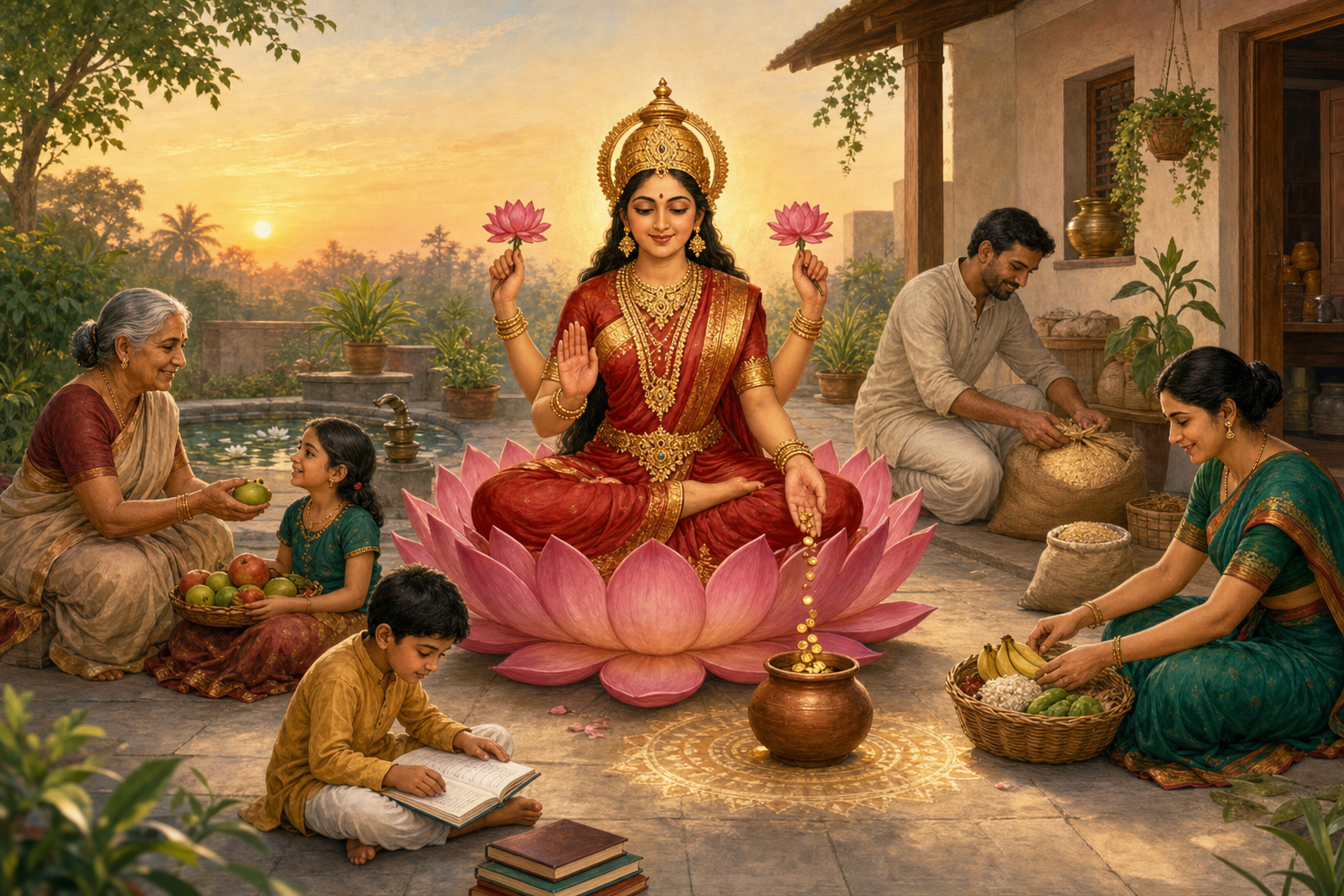
You may be earning more and still feel poor in the parts of life that govern your days: uneasy about debt, short on patience, unable to enjoy what you have, or afraid that one setback will undo everything. If that is where you are, asking Lakshmi only for more money is too small a prayer.
A fuller Lakshmi practice asks whether money, conduct, relationships, knowledge, courage and generosity are growing together. It does not reject ambition. It teaches you to seek material security without sacrificing the inner and social conditions that make security worth having.
Money is one expression of Lakshmi, not the whole blessing
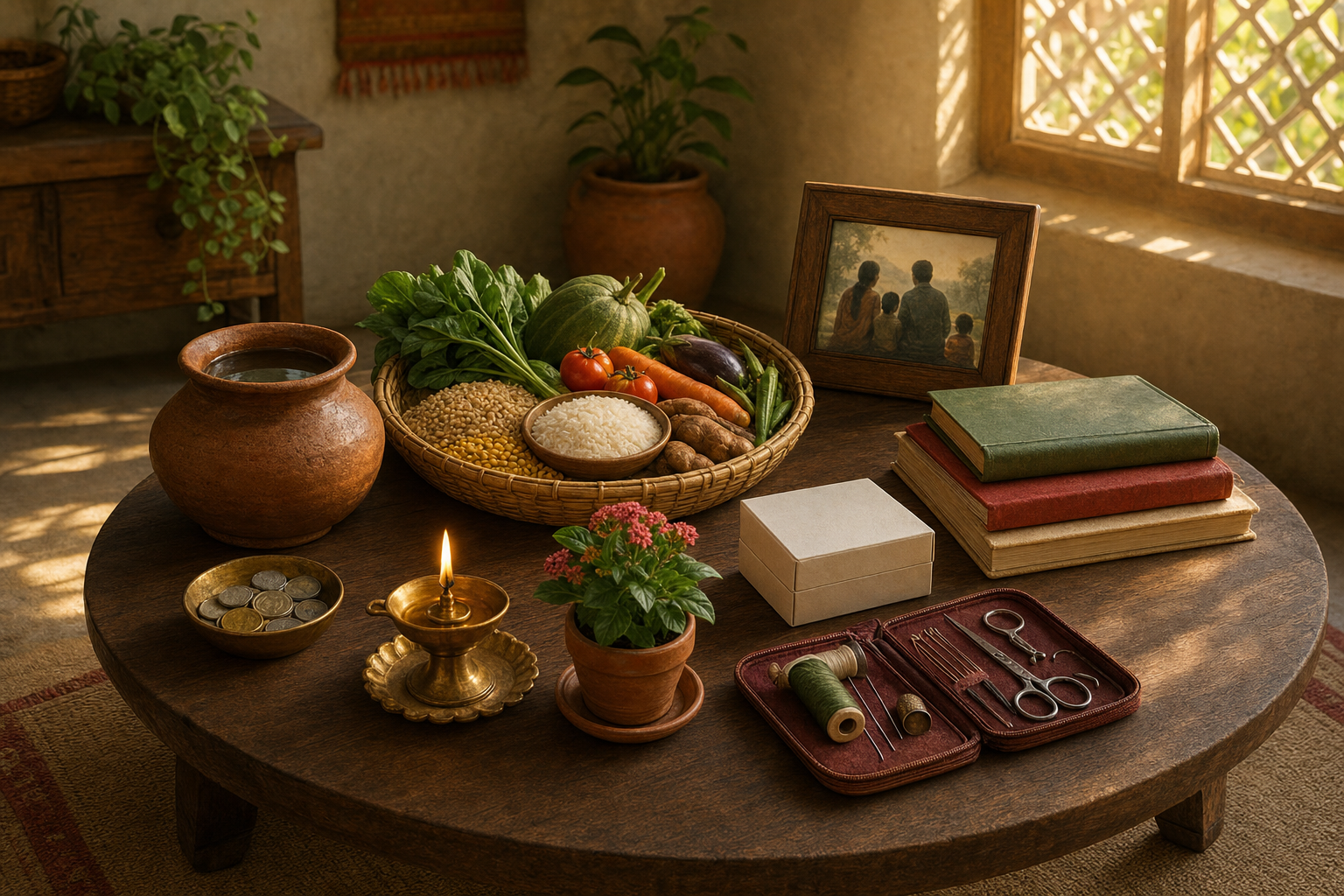
Artha has a legitimate place in a householder’s life. Income pays for food, shelter, education, care, religious observance and the responsibilities that cannot be met by good intentions alone. Wanting a stable livelihood, a successful enterprise or relief from financial pressure is not spiritually shameful.
The mistake begins when accumulation becomes the only measure of prosperity. A larger income can coexist with deception, unmanaged obligations, family neglect, constant fear or compulsive consumption. The account balance has improved, but life has not become abundant.
In the Hindu understanding, artha gains direction from dharma. The practical question is therefore not merely, “How much did you acquire?” It is also: How did you acquire it, what did it require you to become, and what is it enabling you to sustain?
Lakshmi’s familiar imagery makes the distinction visible. The lotus points to purity maintained amid worldly conditions, not escape from them. In the Gaja Lakshmi form, the elephants evoke strength and the steady effort needed to sustain abundance. Together they correct two opposite errors: wealth is neither inherently impure nor automatically auspicious. Its quality depends on the conduct surrounding it.
This gives you a usable definition of holistic prosperity: sufficient resources, ethically obtained and competently managed, joined to a mind capable of gratitude, restraint, compassion and clear judgement. Outer wealth supplies capacity. Inner wealth determines what that capacity will do.
Use Ashta Lakshmi as a household prosperity diagnostic

The eight forms of Ashta Lakshmi widen the field beyond cash. They encompass financial resources, nourishment, courage, knowledge, family continuity, strength, victory and grace. You can use this devotional map as a practical household diagnostic without reducing the forms to a financial checklist.
| Form | Dimension of prosperity | Question for your household |
|---|---|---|
| Dhana Lakshmi | Financial resources and livelihood | Are earnings ethical, obligations visible and spending directed toward real purposes? |
| Dhanya Lakshmi | Food, nourishment and material sufficiency | Does the household protect what sustains life, or waste it while continually seeking more? |
| Dhairya Lakshmi | Courage, patience and resilience | Can you make a sound decision when income is uncertain or a plan fails? |
| Vidya Lakshmi | Knowledge and discernment | Do you understand a commitment before accepting it, and are you still learning how to manage what you have? |
| Santana Lakshmi | Family well-being and continuity | Are care, time, responsibility and dharmic values passing through the household along with assets? |
| Gaja Lakshmi | Strength, capacity and dignity | Does success expand your ability to protect, support and act responsibly? |
| Vijaya Lakshmi | Victory and fruitful completion | Are you reaching worthy goals without abandoning dharma on the way? |
| Vara Lakshmi | Grace and blessing | Can you receive without entitlement and give without turning generosity into display? |
Read across the table and notice your strongest and most neglected dimensions. A household may have Dhana without Dhairya: adequate income accompanied by relentless fear. It may possess Vidya without Vara: skill and education with no gratitude. It may celebrate Vijaya while weakening Santana: professional success purchased with chronic inattention to family life.
Your neglected dimension is usually more instructive than your most visible achievement. If money is orderly but every setback causes panic, the next step may be to cultivate steadiness rather than chase another financial milestone. If the family has sufficient resources but hides obligations from one another, transparency may matter more than a larger offering at the altar.
This diagnostic also prevents false comparisons. Another person’s visible Dhana tells you little about their Dhairya, Vidya, relationships or peace. Lakshmi’s many forms direct attention back to the household you can actually govern.
Put every financial decision through the clean-flow test
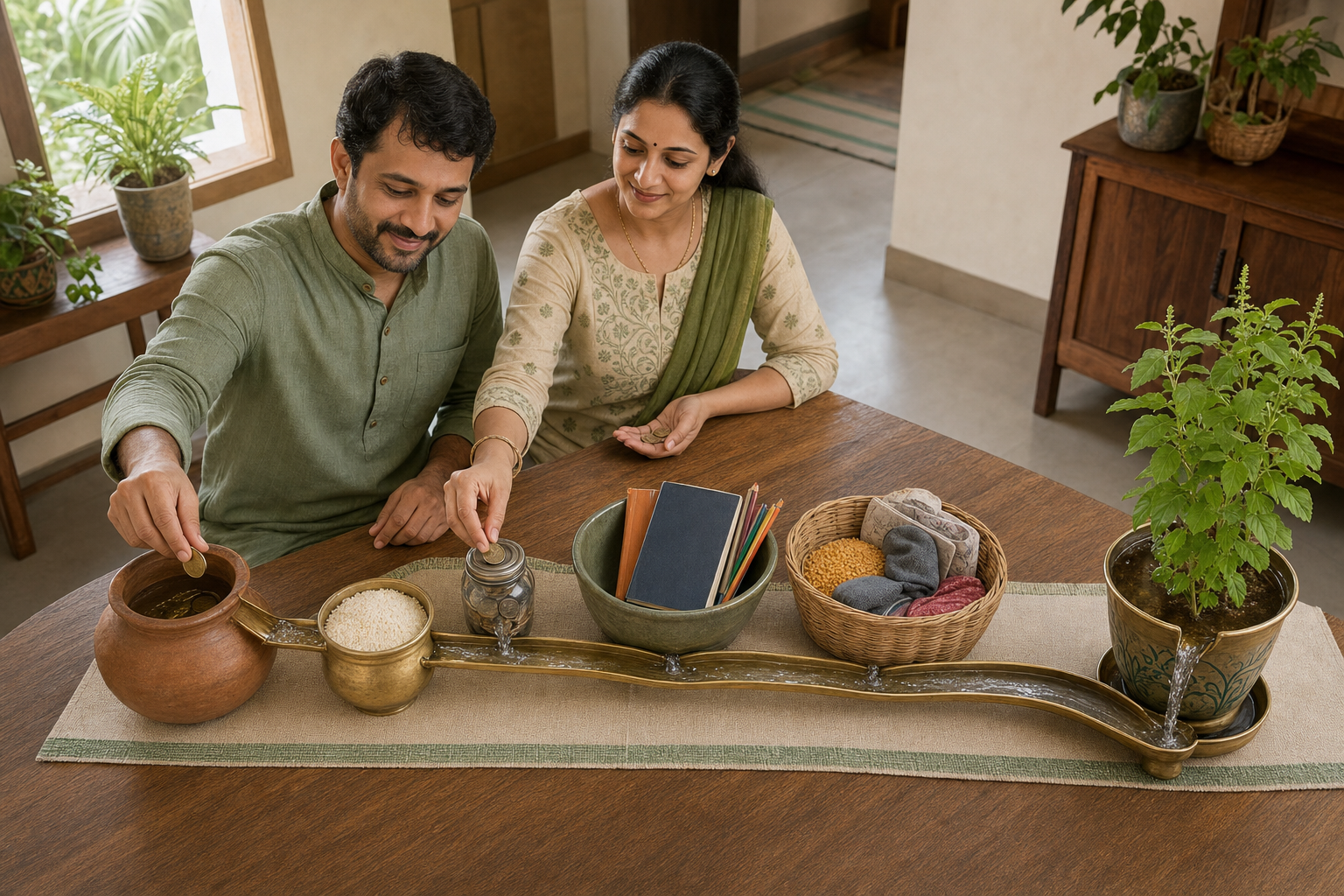
Holistic prosperity depends on whether resources can move through your life without leaving concealed harm behind. A simple clean-flow test examines acquisition, administration and use.
- Acquisition: Was the income earned without deception, coercion or knowingly shifting unfair costs onto someone else? A profitable transaction does not become dharmic merely because part of the profit is later donated.
- Administration: Are accounts understandable, agreements honoured and repayments made when promised? Confusion that repeatedly benefits you at another person’s expense is not harmless disorganisation.
- Use: Does the resource meet responsibilities, strengthen the household, develop useful capacity and leave room for dana? Spending can be pleasurable and still be mindful; the test is whether it serves life or merely feeds restlessness.
This is where inner qualities become economically practical. Shraddha gives commitment a centre. Daya keeps other people visible inside a transaction. Shanti helps you resist decisions driven entirely by panic or appetite. Contentment does not eliminate ambition; it prevents ambition from becoming incapable of recognising enough.
The Bhagavad-Gita’s principle of loka-sangraha adds a social measure: power and resources should help uphold the wider order of life. That does not require giving away everything or neglecting your dependants. It means recognising that livelihood rests on networks of labour, trust, knowledge, family and community. Prosperity becomes more durable when some of its benefits reinforce those conditions.
Keep the boundary between devotion and financial judgement clear. Puja cannot make an unaffordable debt affordable, establish whether an investment is suitable, or replace legal and financial advice. If you cannot meet obligations, do not understand the risk of a financial commitment, or face a dispute with serious consequences, seek an appropriately qualified professional. Prayer may steady the mind with which you face the problem; it does not remove the arithmetic or the law.
Turn Lakshmi worship into a household discipline
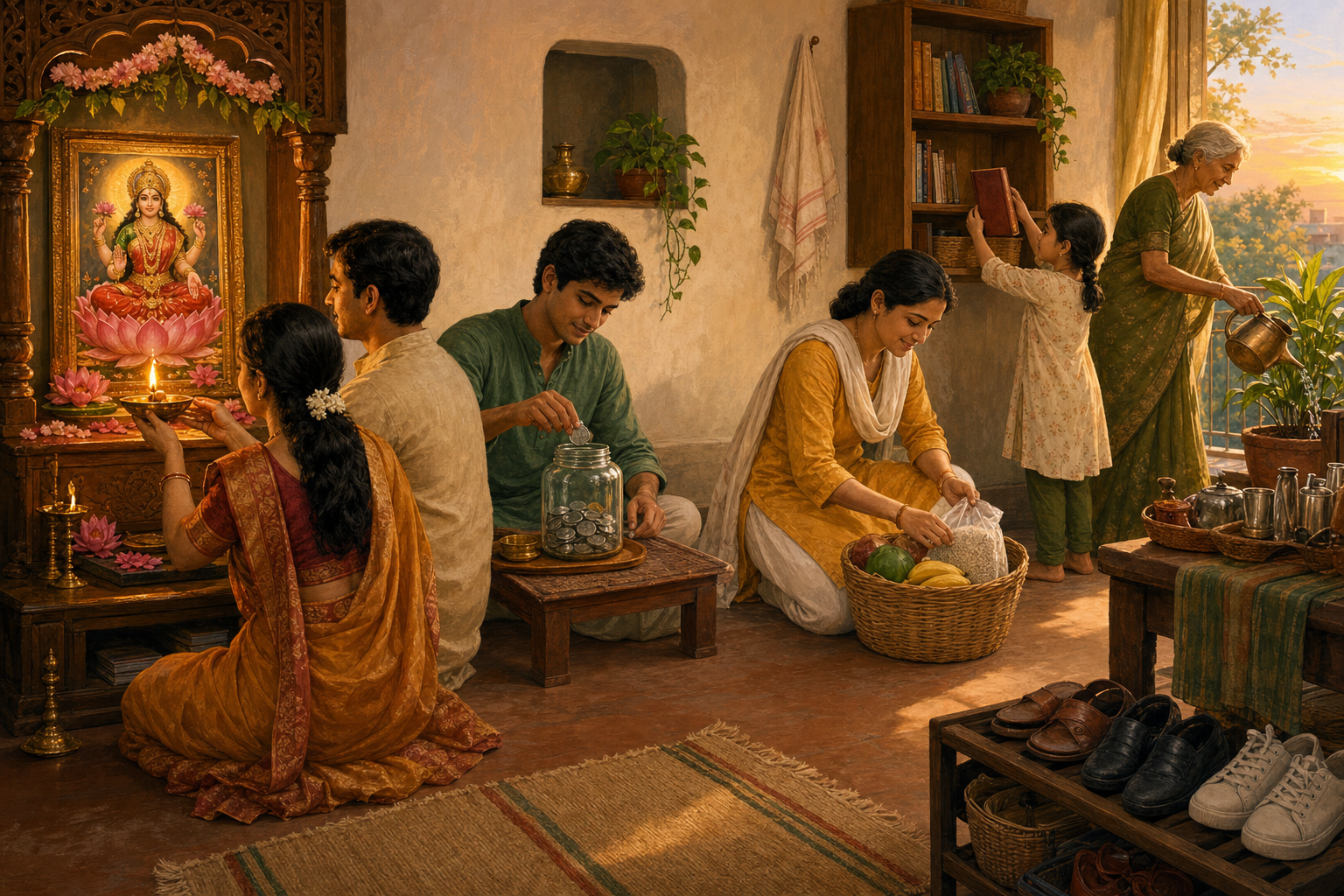
A lamp for Lakshmi can mark the beginning of reflection, but the decisive practice is what changes after the lamp is lit. Keep the mantras and ritual order received from your family, teacher or sampradaya. Add a practical review that connects reverence to the way the household handles resources.
Begin with shaucham, or cleanliness. This need not become a performance of decorative perfection. Clear the place of worship, remove neglected clutter, and then look for the less visible forms of disorder: an unrecorded obligation, a payment repeatedly postponed, a borrowed possession not returned, food being wasted or a financial promise that has never been discussed openly.
Maintain a simple Lakshmi ledger alongside your regular financial records. It need not contain elaborate prose. Use it to make five things visible:
- What arrived: wages, business income, food, assistance, knowledge or an opportunity.
- What is owed: bills, debts, repayments, work promised and responsibilities accepted.
- What was cared for: resources maintained, food protected from waste, relationships tended and skills developed.
- What should be corrected: an unclear agreement, impulsive consumption, secrecy, a delayed repayment or avoidable waste.
- What will circulate: dana, seva, practical help, knowledge shared or support given within your actual means.
After prayer or quiet contemplation, choose a correction you can verify. Update an account. Clarify a commitment. Repay what is due. Discuss a shared obligation with the people affected by it. Set aside an affordable gift before generosity is relegated to whatever happens to remain. Then select an Ashta Lakshmi dimension that needs cultivation and attach it to a real action: study before signing, listen before spending, conserve before replacing, or remain steady before reacting.
Gratitude should also be specific. Name the livelihood, person, skill, meal or opportunity that supported you. General gratitude can remain sentimental; specific gratitude reveals dependence and responsibility. It shows you what must be protected and whom your prosperity should not make invisible.
If finances are shared, the discipline should not remain inside one person’s private devotion. Include the people who carry the obligations and bear the consequences. Transparency does not mean publishing private accounts to the world. It means that those responsible for the household are not being asked to live inside avoidable uncertainty.
Judge the observance by its residue. Does it leave cleaner dealings, calmer attention, more deliberate consumption and a fulfilled promise? A longer wish list is not evidence of deeper worship. A more trustworthy household is.
Key takeaways for your next Lakshmi observance
The same ethical pattern appears across Dharmic traditions without making their teachings identical. Buddhism joins dana with sila, so generosity is grounded in ethical conduct. Jainism places aparigraha beside ahimsa, limiting possessiveness and the harm it can produce. Sikh practice links seva with sarbat da bhala, directing effort toward the welfare of all. The shared practical insight is clear: possession by itself is not prosperity; character and social responsibility determine what possession becomes.
- Ask Lakshmi for sufficient resources and for the clarity, courage and restraint to use them well.
- Use the Ashta Lakshmi forms to notice which dimension of household prosperity has been neglected.
- Test wealth by how it is acquired, administered and used, not merely by how much accumulates.
- Pair devotion with a visible correction such as a clarified obligation, timely repayment, reduced waste or deliberate dana.
- Let generosity support responsibility rather than display, and never give in a way that abandons essential obligations.
- Use qualified financial or legal help when a problem exceeds the role of spiritual practice.
At your next Lakshmi observance, do not bring only a request for more. Bring an honest account, a promise ready to be fulfilled, a gift within your means and one neglected form of prosperity you are prepared to cultivate. That is how reverence begins to reshape the household that receives the blessing.
References
