

Karna’s reputation as a danveer rests on more than the value of what he gives. The sandalwood folktale presents generosity as a way of seeing: a worthy need changes what the donor considers available, necessary, and truly his own.
Read in that light, the story is not merely a contest between Karna and Yudhishthira. It distinguishes responsible charity from a more demanding ideal in which urgency, practical imagination, and freedom from attachment work together.
A folktale that interprets the epic’s moral world

The DharmaRenaissance account explicitly cautions that the sandalwood test should not be treated as a verbatim episode from the critical Sanskrit text of the Mahabharata. It identifies the narrative as a later didactic folktale transmitted in varying forms through popular and devotional traditions.
In the commonly told version reported by the source, Arjuna asks Krishna why Karna receives greater praise for generosity when Yudhishthira also gives freely. Krishna turns the question into a test. Appearing as Brahmins, Krishna and Arjuna request dry sandalwood for a sacred fire during relentless rain, when the required material is exceptionally difficult to procure.
This literary status matters. The tale offers an interpretation of Karna rather than textual proof about an event in the epic. Its authority lies in the ethical distinction it dramatizes: two donors may share a charitable intention while differing greatly in how far that intention governs their possessions.
The decisive contrast is not kindness but availability

Yudhishthira’s response establishes an honorable baseline. According to the source’s retelling, he receives the petitioners respectfully, directs attendants to search the royal stores and market, and is distressed when no dry sandalwood can be found. Some versions have him propose money, another kind of wood, or an alternative arrangement before apologizing when the precise request remains unmet.
Karna encounters the same external obstacle but defines the available resources differently. When stores and markets cannot supply the wood, he recognizes that dry sandalwood already exists in the doors, frames, furnishings, or decorative elements of his palace. He permits those structures to be broken apart and given for the petitioners’ purpose.
Yudhishthira initially approaches the need through resources designated for distribution. Karna includes property already serving his comfort and status. The palace wood does not suddenly come into existence; it becomes available when Karna releases his attachment to its present function.
The comparison need not reduce Yudhishthira to an ungenerous foil. The source itself observes that he might have surrendered the doors if the petitioners had explicitly requested them. Karna’s distinction is that he sees this possibility without prompting. His generosity operates as an instinctive reordering of priorities rather than a favorable answer to a narrowly framed request.
Heroic giving unites timing, fitness, and inner freedom
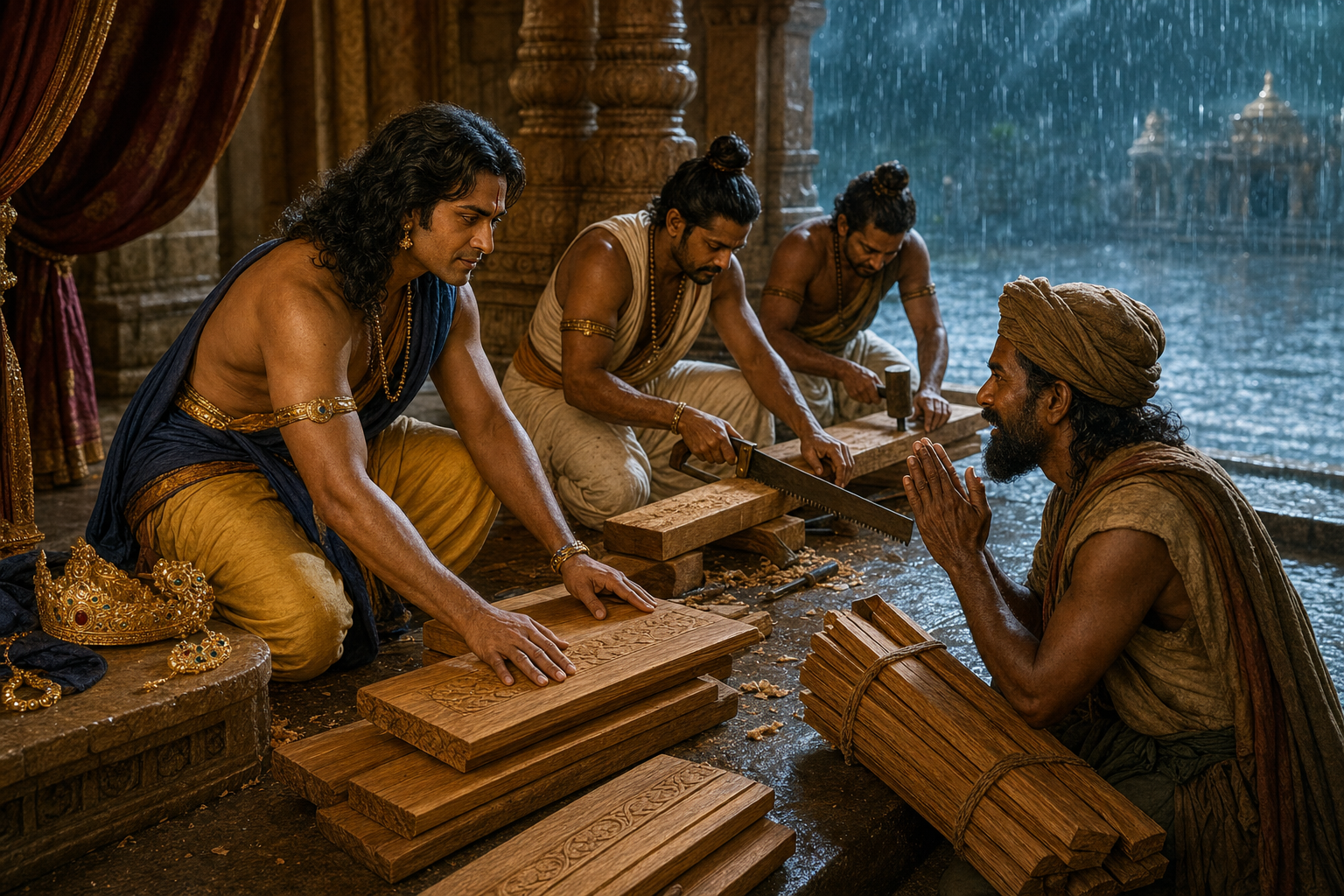
The source explains that dāna can be assessed through more than market value. Intention, the recipient and need, the timing and manner of the gift, and the attachment relinquished by the donor all affect its ethical character. The sandalwood test brings several of these considerations into one scene.
Timing is essential because the petitioners require dry wood for an immediate ritual purpose. A promise to give later would not provide the same benefit. Karna’s speed therefore represents responsiveness, not mere impatience: he allows the need’s timetable to interrupt his own convenience.
Fitness matters because the request is for a particular material, not wealth in the abstract. Offering something expensive but unusable would preserve the appearance of generosity while leaving the need unsatisfied. Karna looks beyond price and asks what will actually serve the stated purpose.
Inner freedom supplies the heroic element. The source interprets danveer, or dānavīra, as generosity joined to courageous resolve. Karna’s palace has practical and symbolic value, yet he does not allow its established form to become morally untouchable. The sacrifice lies as much in loosening possession’s hold on the mind as in losing the material itself.
Key takeaways
- Karna’s ideal measures generosity by the quality of relinquishment, not only by the price of the gift.
- A gift must arrive while it can still answer the need; delay can reduce or erase its usefulness.
- Apparent scarcity may sometimes reflect attachment to a resource’s current use rather than its actual absence.
- Yudhishthira represents sincere, orderly charity, while Karna represents the further step of spontaneously placing personal comfort within the field of what may be given.
Applying Karna’s standard without romanticizing waste

The folktale’s modern relevance does not require literal imitation of palace destruction. Its more durable question is whether a donor has examined all genuinely available capacities before declaring that nothing can be done. Money may be the obvious resource, but time, attention, expertise, access, and possessions still in active use can also become meaningful gifts.
Non-attachment is not the same as carelessness. The broader framework of dāna described by the source still asks whether the recipient is suitable, the need is real, the gift fits that need, and the manner of giving is respectful. Karna’s decisiveness becomes exemplary within that moral setting; detached from discernment, dramatic sacrifice could become wasteful or performative.
A practical reading of the sandalwood test therefore begins with three questions: Is the need worthy and time-sensitive? Is the supposed lack of resources genuine, or are useful resources locked into preferred forms? What attachment would have to be surrendered for the gift to become possible? These questions move generosity beyond disposal of surplus and toward responsible availability.
Karna’s enduring challenge is to make generosity intelligent enough to find a way and free enough to act when the way carries a personal cost. Future acts of dāna can honor that ideal by joining discernment to timely, unpossessive service.