
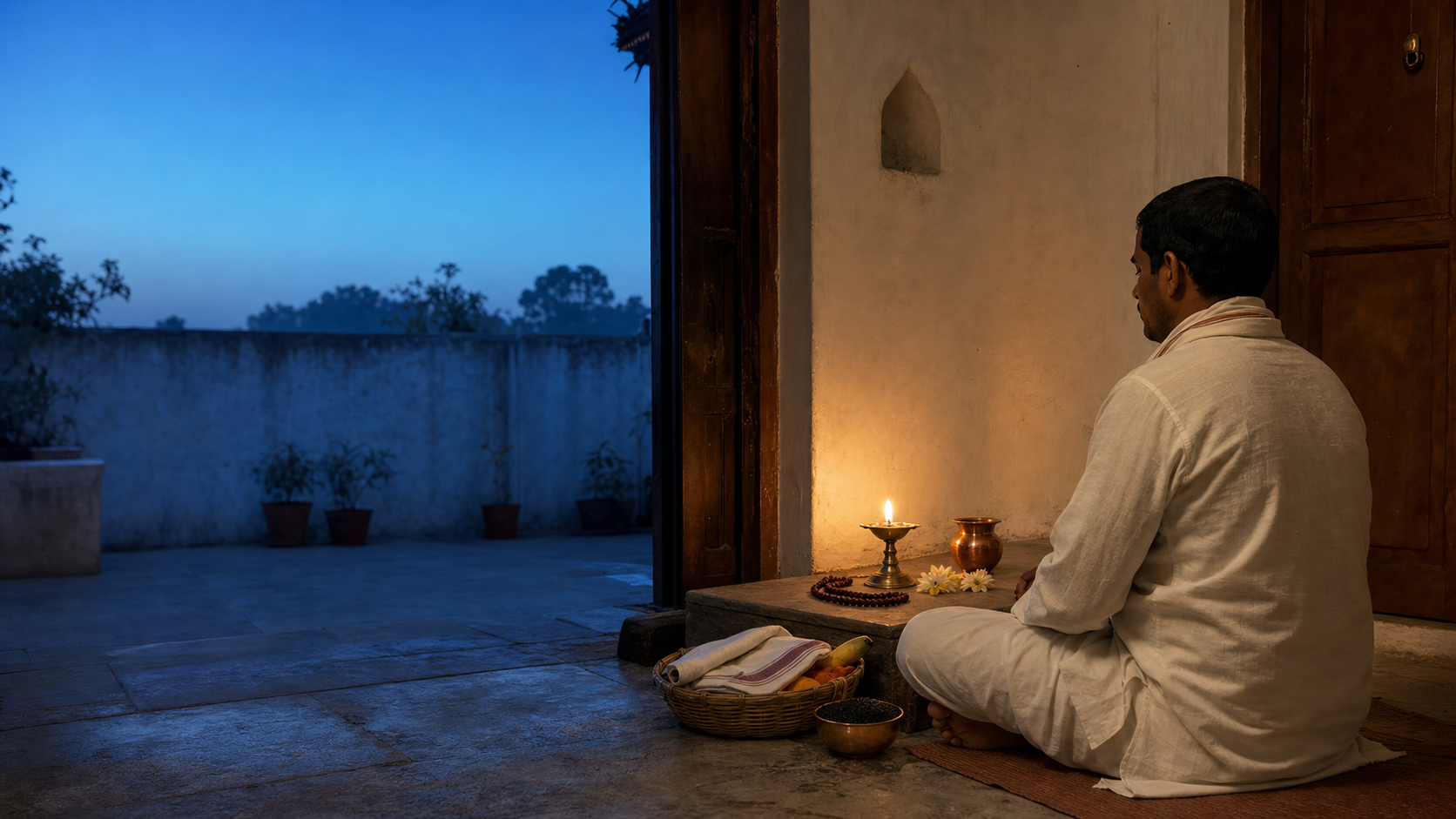
If you are deciding whether to keep Amavasya on May 16 or May 17, set aside Saturday, May 16. Krishna Paksha Chaturdashi ends at 03:51 AM IST on May 16, after which Amavasya continues until 01:37 AM IST on May 17. Amavasya therefore prevails through the daylight hours of Saturday, giving you a clear window for pitru observances, japa, meditation, and daan.
You do not need to fill every hour with ritual. A useful observance begins with one honest sankalpa: remember your ancestors, correct something in your conduct, deepen your sadhana, or serve someone quietly. Choose the purpose first, then build a simple day around it.
The observance belongs on Saturday, May 16
| Calendar point | Time in IST | What it means for you |
|---|---|---|
| Krishna Paksha Chaturdashi ends | 03:51 AM, May 16 | Amavasya begins well before the normal morning observance window. |
| Amavasya prevails | 03:51 AM, May 16 to 01:37 AM, May 17 | Perform daylight Amavasya practices after your local sunrise on May 16. |
| Amavasya ends | 01:37 AM, May 17 | Do not postpone daylight Amavasya rites to Sunday merely because the tithi crosses midnight. |
A tithi does not begin at sunrise or midnight. It is determined by the changing angular separation of the Moon and Sun, so its boundaries can fall at any clock time. That is why the civil date and the ritual date do not always line up neatly. Here, the decisive fact is that Amavasya is present after sunrise and throughout the day on May 16.
The IST window is a practical planning reference across India, but city-specific sunrise, sunset, Choghadiya, and dosha periods still depend on location. If your established family or temple panchang gives a different local boundary, follow that calendar. If you live outside India, use a panchang calculated for your own city rather than copying Indian daylight muhurtas.
You may see different month-reckoning labels without any real disagreement about the day. The date is generally treated as Vaishakh Amavasya under Amanta reckoning and as the Amavasya concluding Vaishakh in Purnimanta listings. The terminology changes with the regional calendar system; the practical tithi window remains the point that governs your observance.
Choose the purpose before choosing the ritual
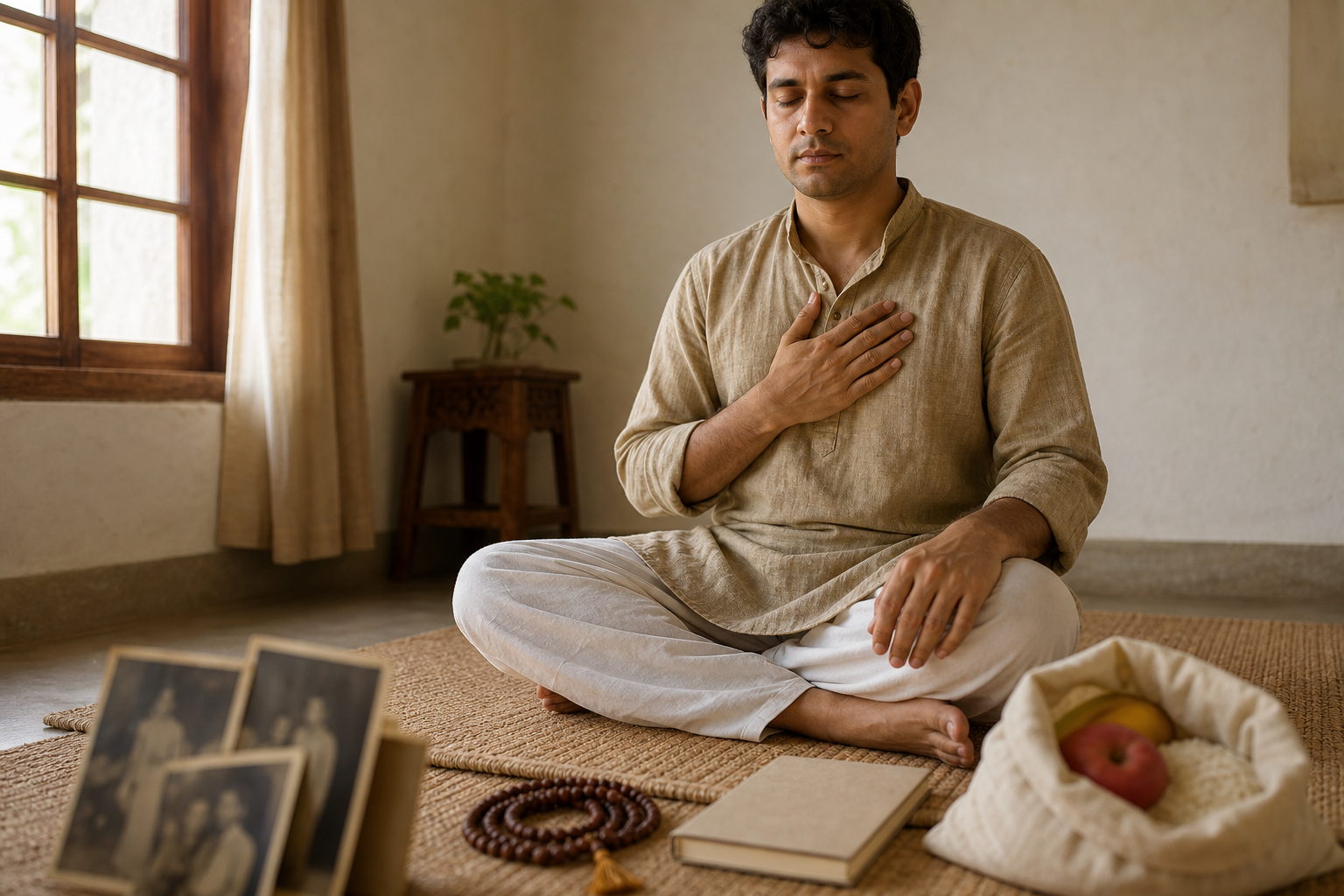
Amavasya can become a collection of disconnected customs unless you decide what you are actually observing. For most households, the day can be organised around one or more of three purposes:
- Pitru-smarana: Remember departed ancestors with gratitude. If your parampara performs Darsha Shraddha or tila-tarpana, give that inherited duty priority during the daylight Amavasya window.
- Antarmukhi sadhana: Reduce noise, sit for japa or meditation, read a small portion of the Bhagavad-Gita or an Upanishad, and notice what in your conduct needs correction before the bright fortnight begins.
- Seva and daan: Give food, grain, clothing, or practical assistance to someone who needs it. Keep the act proportionate and discreet; the purpose is compassion, not display.
Formal shraddha and tarpana procedures vary by family, region, and sampradaya. If your tradition specifies who performs the rite, which mantras are used, or how the offering is made, follow that procedure or consult your family purohit. Do not replace an inherited vidhi with an improvised online mixture of unrelated customs.
If your household does not perform formal pitru-karya, you can still observe pitru-smarana without pretending to conduct a rite you have not learned. Speak the names of departed family members, offer a quiet prayer, acknowledge what you received from them, and dedicate an act of charity to their memory. The essential movement is from remembrance to responsible conduct.
Other Dharmic communities approach the new-moon juncture through their own disciplines. Some Buddhist communities keep new-moon Uposatha with heightened mindfulness. Jain observance may centre on pratikraman, fasting, restraint, and renewed commitment to ahimsa. Sikh practice follows the Nanakshahi solar framework, although individual families may retain cultural customs connected with lunar days. Respect these distinctions; shared values do not make the traditions interchangeable.
A practical Amavasya observance at home
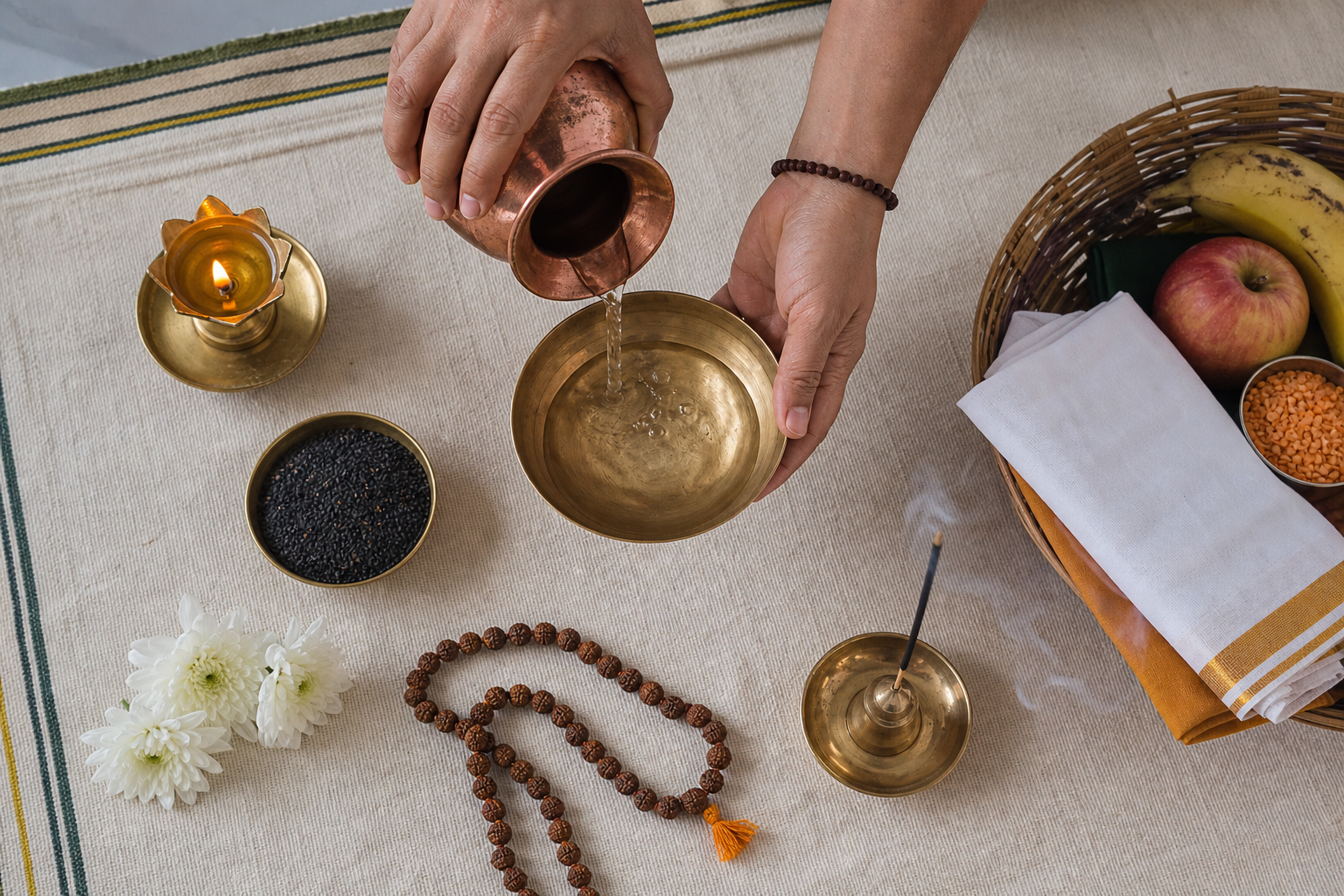
A calm sequence is more sustainable than an elaborate programme assembled at the last minute. Adapt the following plan to your sampradaya and household responsibilities:
- Prepare one clean place. Clear the puja area and put away distracting devices. Set out only what you will actually use: a lamp, water, sesame if customary, your mala or text, and the intended donation.
- State the sankalpa. Name the purpose in one sentence. For example, resolve to remember your ancestors, practise measured speech, complete a fixed amount of japa, or support an elder.
- Settle the breath. Use a short period of gentle nadi shodhana or quiet natural breathing. The aim is steadiness, not a strenuous pranayama performance.
- Begin with Ganesha dhyana. Offer a simple prayer for the removal of inner and outer obstacles before turning to your principal practice.
- Light the lamp and perform japa. A sesame-oil lamp is traditionally associated with the Saturday observance. Place any flame on a stable surface and never leave it unattended. Recite the mantra given by your tradition or a familiar mantra of your Ishta Devata.
- Perform pitru-karya if it belongs to your practice. Tila-tarpana uses sesame and clean water, but its complete method should come from your lineage. Otherwise, keep a period of silent ancestral remembrance.
- Complete the act of daan. Give the food, grains, clothing, or assistance you selected. Doing this on the day is better than making a vague promise to donate later.
- Close without rushing back into noise. Sit silently or recite together as a household. Carry the sankalpa into your speech, meals, and conduct for the rest of the day.
Fasting is optional in intensity even when vrata is important to you. A steady approach may include warm water, light fresh food, simple satvika preparations, or an early supper. If age or health makes a full fast unsuitable, choose partial fasting or dietary moderation and follow any medical guidance relevant to you. Sankalpa is not strengthened by an austerity that leaves you unwell or unable to meet necessary duties.
The day also benefits from modest restraints that cost nothing: reduce screen time, postpone avoidable argument, speak less, and keep the schedule uncluttered. These are not decorative additions. They protect the inward attention that japa and remembrance are meant to cultivate.
How Saturday affects muhurta and ordinary work
Saturday adds the traditional Shani emphasis on discipline, patience, responsibility, and correction. Treat that emphasis as a guide to conduct, not as a reason for fear. Repair something neglected, assist an elder, settle an overdue duty, clean a work or worship space, or make a measured commitment you can continue after the tithi ends.
Many lineages are conservative about beginning a major auspicious undertaking on Amavasya. If a wedding-related step, inauguration, house-entry ceremony, or other elective beginning can wait, the waxing fortnight is usually the more natural time to consider it. Abhijit Muhurat is traditionally used for general undertakings, but its presence does not automatically cancel your family’s rules concerning Amavasya.
If an essential task cannot be postponed, calculate the day for your city. Choghadiya periods labelled Amrit, Shubh, or Labh are commonly preferred, while Rahu Kalam, Yamaganda, and Gulika Kalam are generally avoided for auspicious beginnings. These periods must not be copied from a fixed national clock because they are derived from local sunrise and sunset.
For Saturday Rahu Kalam, divide the interval from local sunrise to local sunset into eight equal parts. The second part is the Saturday Rahu segment. In compact form, if sunrise is S and the total daylight duration is D, Rahu Kalam runs from S + D/8 to S + 2D/8. Use a reliable city-specific panchang for the actual clock time and for the day’s Yamaganda, Gulika, and Choghadiya periods.
Ordinary responsibilities do not have to stop. Study, travel that is genuinely required, routine employment, documentation, review, maintenance, and system clean-up fit the day’s corrective tone. The practical distinction is between carrying out necessary work and selecting an elective muhurta for a major new beginning.
Key takeaways for May 16
- Keep the principal Amavasya observance on Saturday, May 16, because the tithi runs from 03:51 AM that morning until 01:37 AM IST on May 17.
- Schedule Darsha Shraddha, tila-tarpana, japa, charity, or quiet puja after your local sunrise while Amavasya prevails.
- Follow your inherited procedure for formal pitru-karya; choose simple remembrance rather than improvising a ritual you have not learned.
- Let Saturday shape the day through discipline, repair, service, and measured speech rather than anxiety about Shani.
- Do not use a fixed clock time for Rahu Kalam or Choghadiya. Calculate them from local sunrise and sunset or consult a city-specific panchang.
- Keep fasting proportionate to your health and duties. A clear sankalpa with moderate restraint is better than unsustainable austerity.
Before Friday night, make four decisions: which practice you will perform, when you will begin after sunrise, what you need to place in the puja space, and whom your daan will help. That small preparation will let May 16 remain what Amavasya is meant to be: a quiet threshold between what must be remembered and what must now be renewed.