
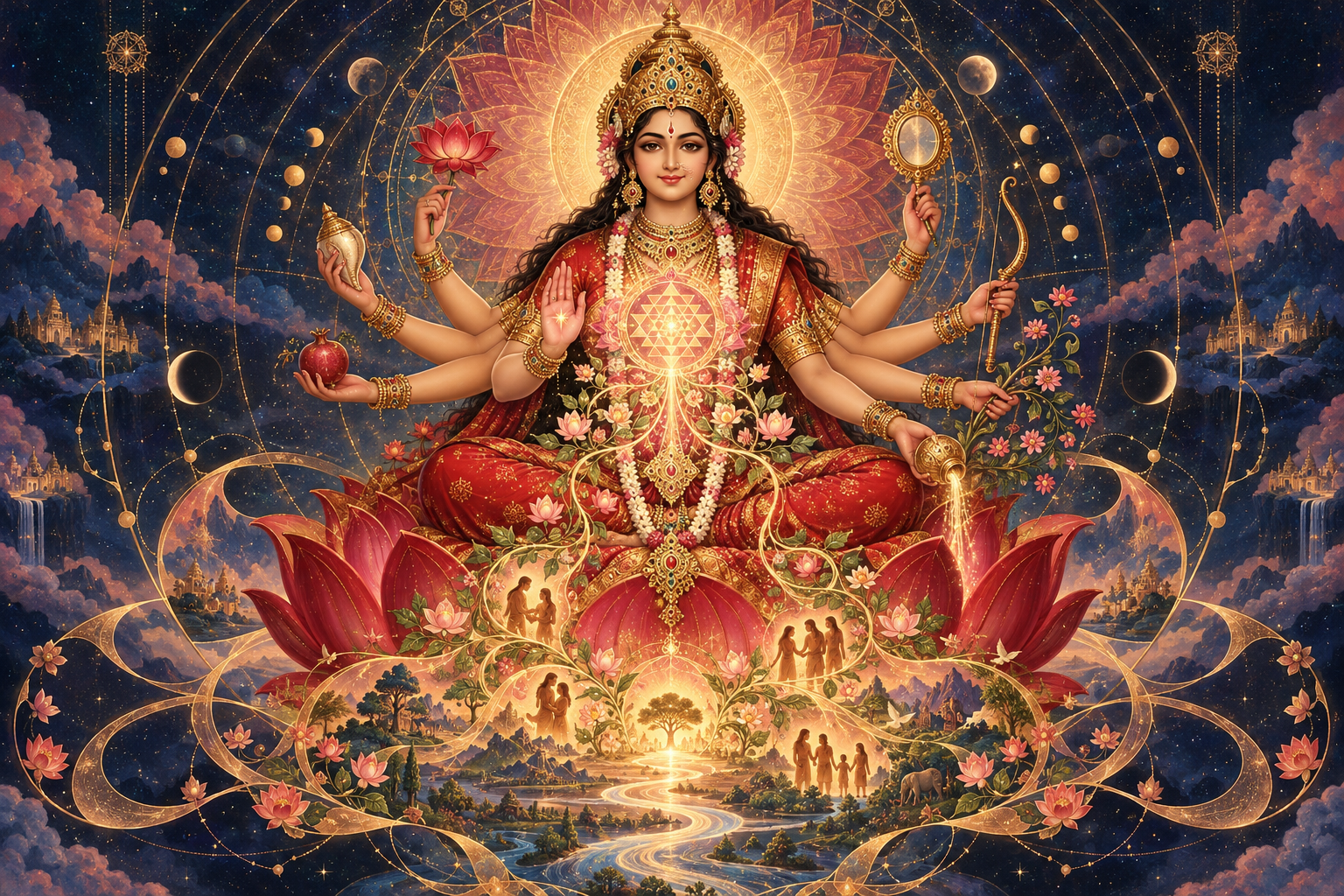
If you encountered Kamakaleshvari and wondered whether she is simply a goddess of sexual desire, that reading is too narrow. Kama is not erased from her theology, but neither is it left at the level of appetite. It becomes the power by which intention, attraction and delight assume a meaningful form.
This distinction gives you a practical way into Kamakala. You do not need to begin with an elaborate ritual or force every symbol into a literal explanation. Begin by asking how desire becomes creation, how beauty directs attention and how apparent opposites can remain united.
The name gives you a map of the theology
Kama can mean desire, longing or attraction. Although it includes erotic desire, it is not confined to it. A wish to create, know, worship, protect or unite also begins as a movement toward something.
Kala is a more flexible term. Depending on context, it can indicate a part, phase, art, capacity or differentiating potency. In Kamakala, a useful first reading is the formative power through which desire ceases to be merely latent and becomes expression. Isvari denotes the feminine sovereign. Kamakaleshvari can therefore be approached as the sovereign Goddess of desire becoming creative form.
That is a theological map rather than a complete dictionary definition. It protects you from two common mistakes. The first is reducing Kamakaleshvari to a deity who manages one human appetite. The second is making her so abstract that desire, beauty and embodiment disappear from her meaning.
Her place within Srividya holds these dimensions together. She is associated with creation, beauty, fertility and divine union. Each term clarifies the others. Creation is desire made manifest. Beauty is the attractive coherence of that manifestation. Fertility is its capacity to produce and sustain further life or meaning. Union is the inseparability of awareness and its power to appear.
Kamakala does not declare every desire sacred
Calling desire a cosmic power does not mean that every impulse deserves obedience. Human desire can be mixed with fear, habit, vanity, possessiveness or the wish to dominate. Kamakala provides a way to examine desire, not an excuse to sanctify it.
The theological contrast can be stated plainly. Compulsive desire treats an object as the cure for an inner lack. Creative desire takes responsibility for what it brings into the world. One consumes and clings; the other accepts form, discipline and consequence.
When a strong desire appears, examine it through four movements:
- Notice the attraction. Name what you want without immediately defending or condemning it.
- Test it against dharma. Ask whether fulfilling it would require deceit, exploitation, avoidable harm or neglect of a real obligation.
- Give it an appropriate form. A worthy desire still needs limits, timing and a concrete expression.
- Release ownership of the result. Creation becomes bondage when you insist that its outcome must confirm your identity or status.
This is an interpretive exercise, not a substitute for a lineage’s formal teaching. Its value is immediate: it helps you distinguish a desire that can mature into service, study, art, worship or responsible relationship from an impulse that merely demands satisfaction.
A sound understanding refuses two opposite errors. You need not shame desire merely because it is desire. You also need not call an impulse divine merely because it is intense. The decisive question is what kind of form it produces.
The eight-armed form is compressed theology
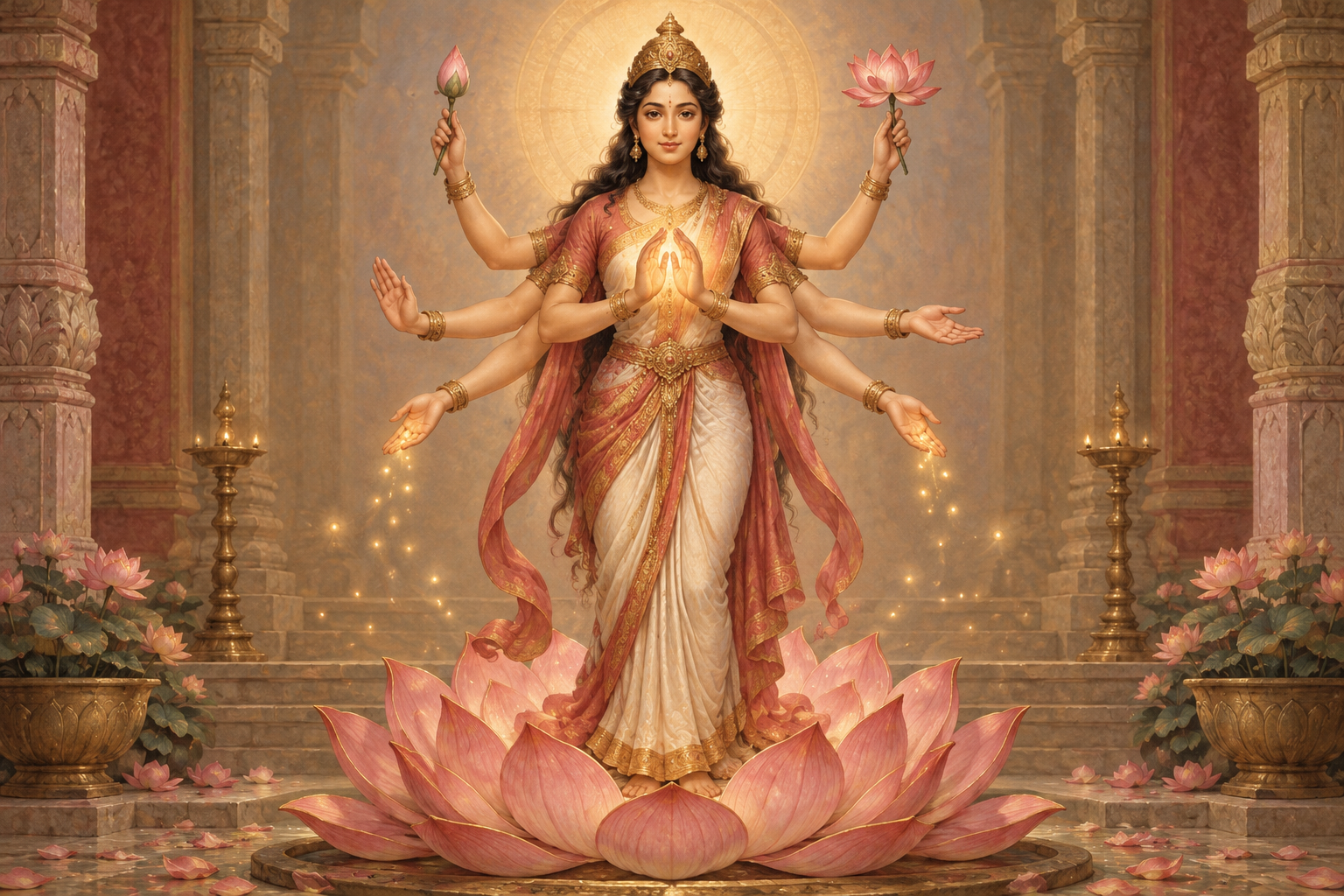
An eight-armed Kamakaleshvari appears in the nineteenth-century Sritattvanidhi, a compendium of Hindu iconography, as a form belonging to the Srividya tradition. That gives you an attested iconographic starting point, but it does not justify filling every unanswered detail with guesswork.
Multiple arms in Hindu iconography communicate a plurality of powers and actions. They tell you that the deity cannot be reduced to a single function. In Kamakaleshvari’s case, the visual multiplicity suits a theology in which desire unfolds as creation, beauty, fertility and union rather than ending in one isolated act.
Use four rules when reading her image:
- Treat the image as a theological diagram, not an anatomical portrait. The arms distinguish simultaneous capacities that an ordinary human body cannot display at once.
- Do not borrow attributes merely because another Srividya deity looks similar. Theological proximity does not make every iconographic prescription interchangeable.
- Do not confuse the date of a record with the birth of a tradition. A nineteenth-century compendium attests that a form was recorded there; that date alone does not establish when its theology originated.
- Leave unidentified details open. If an image is damaged, unlabeled or poorly reproduced, it is more honest to describe what is visible than to assign names to every object from memory.
This method matters because iconography is precise. An attractive modern illustration may be useful for devotion, but it should not automatically be treated as evidence for a traditional description. First separate what is attested, what is visible and what is your interpretation. Then relate them.
Divine union is deeper than a sexual allegory
Kamakala can carry erotic resonance, and there is no need to pretend otherwise. The error lies in making that resonance either embarrassing or exhaustive. Sacred erotic symbolism can point beyond a physical act while still taking embodiment seriously.
At the philosophical level, divine union can indicate that awareness and its power are distinguishable in thought but never truly separated. Awareness without power would never appear, act or become knowable as a world. Power without awareness would be blind activity. Kamakaleshvari holds the two together as living reality.
At the devotional level, the same truth is approached through relationship. The Goddess is not reduced to a concept inside the worshipper’s mind. She is addressed, contemplated and revered. Philosophy speaks about inseparability; devotion allows that inseparability to be encountered through reverence, beauty and surrender. These approaches need not cancel one another.
Four connected terms help you avoid a flattened reading:
- Creation is the passage from unexpressed possibility into a particular form.
- Beauty is not decoration added afterward. It is the harmony or attraction through which a form draws and holds attention.
- Fertility is broader than biological reproduction. It includes the capacity to generate, nourish and continue forms of life, understanding, relationship and culture.
- Rasa is savor or experienced essence. It reminds you that manifestation is not merely a mechanical event; it can be tasted as meaningful and beautiful.
A useful interpretation should explain why all four belong together. If an explanation accounts for eroticism but not creation, it is incomplete. If it praises transcendence while treating embodiment and beauty as distractions, it is also incomplete.
A careful way to contemplate Kamakaleshvari
You can begin contemplative study without pretending to possess an esoteric practice. Keep the boundary between understanding a symbol and performing a lineage-specific sadhana clear.
- Write the three parts of the name. Place desire under kama, formative capacity under kala and sovereignty under Isvari. This prevents the name from remaining an unexplained label.
- Spend time with an attested image. Note the number of arms, gestures, objects and overall composition before interpreting them. Observation should precede association.
- Watch desire at the moment it seeks expression. Ask: What exactly is wanted? What will this desire create if followed? Who will bear its cost? What discipline would give it a dharmic form?
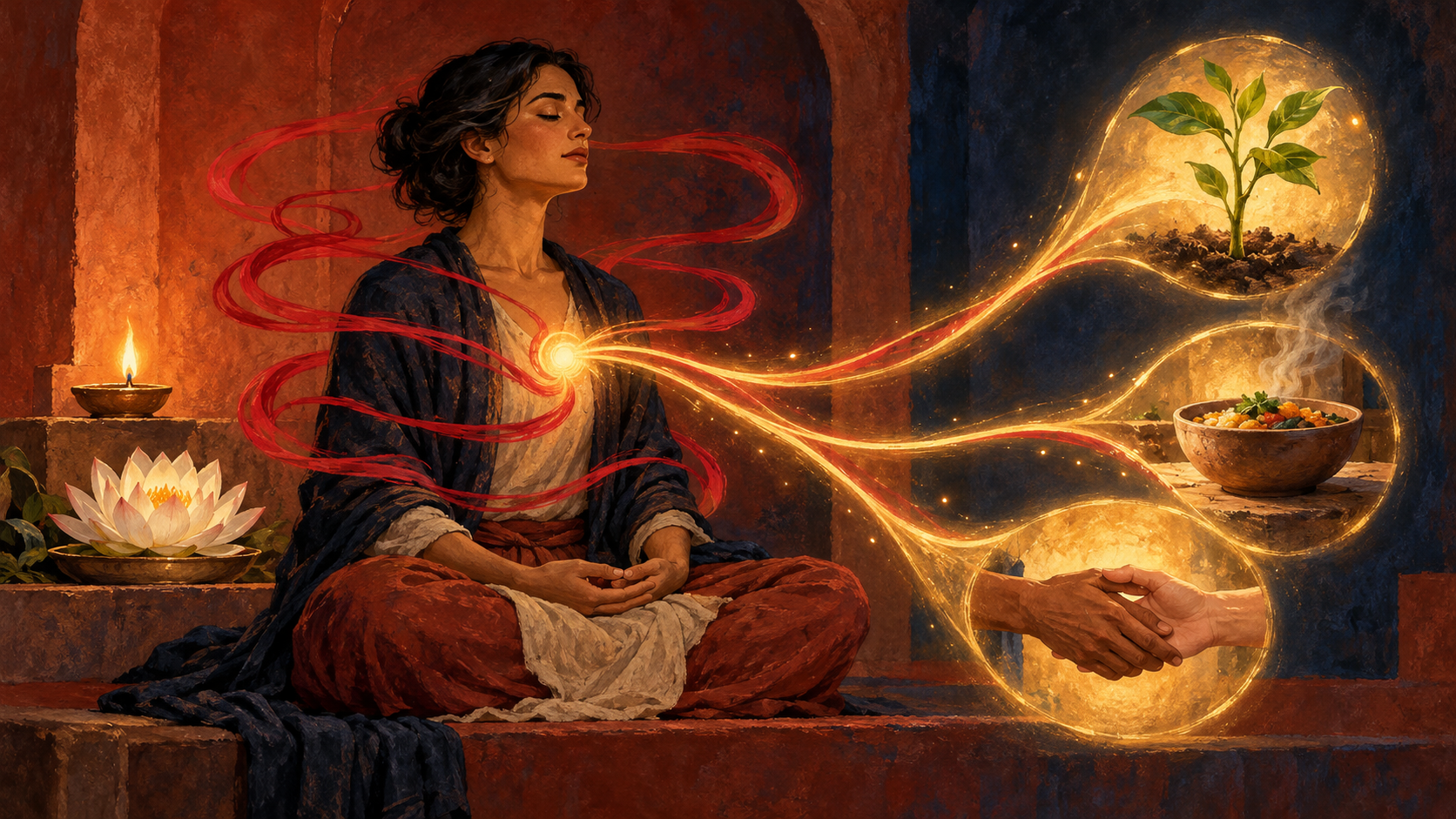
- Convert one worthy desire into a bounded action. Study a neglected teaching, repair a relationship honestly, complete a creative task, serve someone without display or bring greater attention to worship. The point is to let intention acquire responsible form.
- Judge the result by integration. A useful contemplation should produce greater clarity, restraint, attentiveness and responsibility. Excitement alone is not evidence of spiritual depth.
- Seek qualified guidance for formal Srividya practice. Public iconographic information can support understanding, but it is not automatic authorization to assemble mantras, seed syllables, yantras or ritual procedures from disconnected material. Where a practice is initiation-based or lineage-specific, learn it through that lineage.
This approach keeps Kamakala connected to life without turning a profound theology into a self-help slogan. The question is not whether you can eliminate desire. It is whether desire can be clarified, disciplined and made fertile rather than compulsive.
Key takeaways
- Kamakaleshvari is best understood as the sovereign Goddess of Kamakala, the power through which desire becomes creative manifestation.
- Kama includes erotic desire but is not limited to it; longing, attraction, intention and the impulse to create also belong to its field.
- Her eight-armed Srividya form signifies a plurality of powers and should be read through attested iconography rather than borrowed details.
- Divine union can express the inseparability of awareness and its power without erasing devotional relationship or embodied symbolism.
- Kamakala does not validate every impulse. It asks whether desire can assume a truthful, disciplined and dharmic form.
The next time Kamakaleshvari’s name or image appears before you, do not begin by asking what desire she will satisfy. Ask what within you is seeking form, what that form will bring into the world and whether you can create it without surrendering clarity or dharma. That is a more faithful doorway into Kamakala.

References

Leave a Reply
You must be logged in to post a comment.