
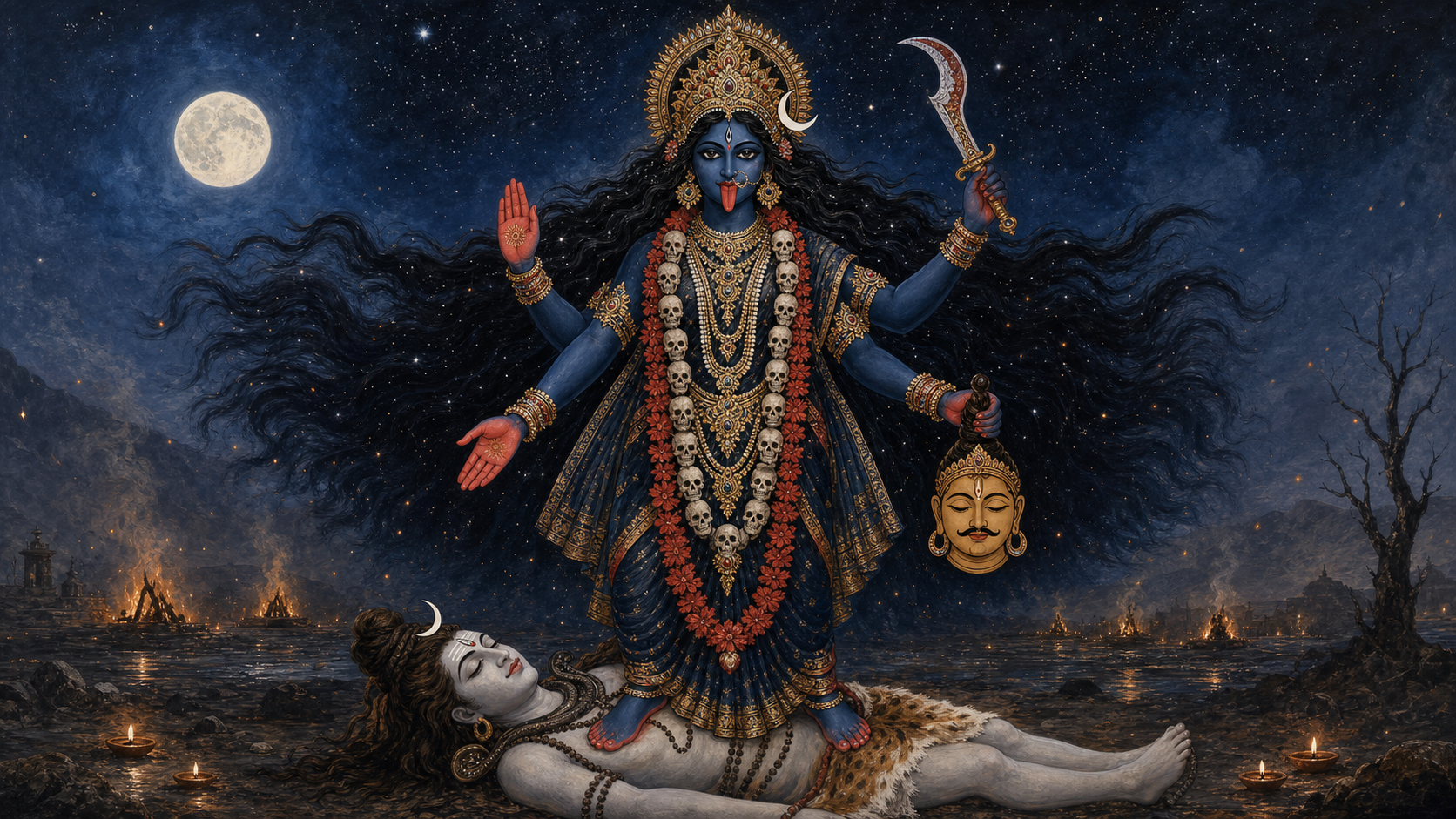
If Kali’s image leaves you caught between devotion and discomfort, you do not have to choose between reverence and honest questioning. The sword, severed head, extended tongue, cremation ground, and dark body are meant to interrupt ordinary perception. They become intelligible when you read them together, as a theology of time, consciousness, action, and liberation.
This reading also gives you a practical test. A sound interpretation of Kali should make you more truthful, less ruled by fear, and more careful about the harm caused by your speech and actions. If an interpretation merely romanticizes violence, promises occult power, or turns the Fierce Mother into an exotic spectacle, it has missed the center of both Shakta theology and responsible Tantric practice.
Begin with Kali’s paradox, not her frightening details
Kali is often called a destroyer, but that description is incomplete. In Shakta thought, the Divine Mother encompasses the entire movement of manifestation: creation (sṛṣṭi), preservation (sthiti), dissolution (saṁhāra), concealment (tirobhāva), and grace (anugraha). Destruction is one movement within that larger cycle. It clears forms whose time has ended, but it does not exhaust who Kali is.
This is why Kali can be terrifying and maternal without contradiction. The Mother who brings forms into being is also the power through which they change and disappear. Her compassion is not limited to preserving everything you currently want preserved. It can also take the form of removing an attachment, identity, habit, or illusion that prevents you from seeing clearly.
Her name resonates with kāla, time. As Kali, she confronts you with the fact that every conditioned form arises, remains for a while, and passes. As Mahākālī, however, she is not merely another being caught in time. She represents the unbounded ground in which temporal cycles appear and disappear. The distinction matters: Kali is both the force of change and the reality that change cannot diminish.
The five movements associated with Kali’s cosmic action can become a useful way to examine a difficult transition. Ask five different questions rather than calling the whole experience either good or bad:
- What is beginning here, even if it is not yet visible?
- What still deserves protection and patient maintenance?
- What has reached its natural end?
- What truth is presently concealed by fear, pride, or confusion?
- What form of grace could emerge if you stopped demanding that the past remain unchanged?
This does not require you to call grief pleasant or injustice sacred. Kali’s symbolism is not an instruction to become passive before harm. It asks for a more disciplined response: protect what serves dharma, end what perpetuates ignorance, and refuse to confuse emotional attachment with moral duty.
Read the icon as one argument about liberation
A common mistake is to isolate one feature of Kali’s form and assign it a sensational meaning. Her iconography works as a connected argument. The frightening elements expose impermanence and egoic limitation; the reassuring elements show why that exposure need not end in despair.
| Feature | Shakta-Tantric meaning | What you should notice |
|---|---|---|
| Black or dark-blue body | The depth of space and the ground into which names and forms dissolve | Darkness is not a code for evil. It points beyond the limits imposed by visible form. |
| Three eyes | Past, present, and future | Kali’s vision is not trapped in your immediate reaction to an event. |
| Sword and severed head | Discriminative insight cutting ignorance and releasing ahaṁkāra, the ego-principle | The intended target is delusion, not another person. |
| Garland of 50 or 51 heads | The Sanskrit phonemes and therefore the field of manifested names and forms | Speech participates in bondage or liberation; words are an ethical responsibility. |
| Girdle of severed arms | Action and the accumulated force of karma, freed from compulsive doership | Act fully, but examine the need to possess every result as “mine.” |
| Abhaya and varada gestures | Fearlessness and the granting of blessings | Protection is present inside the fierce image, not added later to soften it. |
| Standing upon Shiva | The inseparability of dynamic power and consciousness | Energy without awareness is blind; awareness without Śakti remains inactive. |
| Cremation ground | Direct confrontation with mortality, impermanence, and relinquished identities | What frightens the ego can become a setting for sober spiritual clarity. |
The tongue requires particular care because several interpretive streams coexist. In the Devī Māhātmya, Kali consumes the blood of Raktabīja so that each drop cannot generate another copy of the demon. Devotional retellings sometimes understand her extended tongue as bashful remorse when she realizes that she has stepped upon Shiva. Tantric interpretation can treat it as the uncompromising absorption of residual ego and proliferating thought. These are layers of reception, not interchangeable captions that must be forced into a single explanation.
The Raktabīja episode is especially practical. The demon’s blood produces more versions of the same problem whenever it falls. The spiritual parallel is a habit that multiplies when you attack only its visible expressions. Anger may return because wounded pride remains untouched. Compulsive distraction may return because the fear beneath it has never been faced. Kali does not merely chase each new copy; she stops the mechanism of reproduction. When a pattern keeps returning, look for what continues to feed it.
Her position over Shiva completes the icon. Shakta thought does not treat Śakti as a secondary force added to an independently complete deity. Shiva represents consciousness; Kali represents its active, manifesting power. Without Śakti, Shiva is compared to śava, a corpse. Without consciousness, power has no illuminating principle. The image is therefore not a crude victory of woman over man. It presents consciousness and energy as distinguishable in thought but inseparable in reality.
Shakta theology gives Kali her status; Tantra gives the image a method
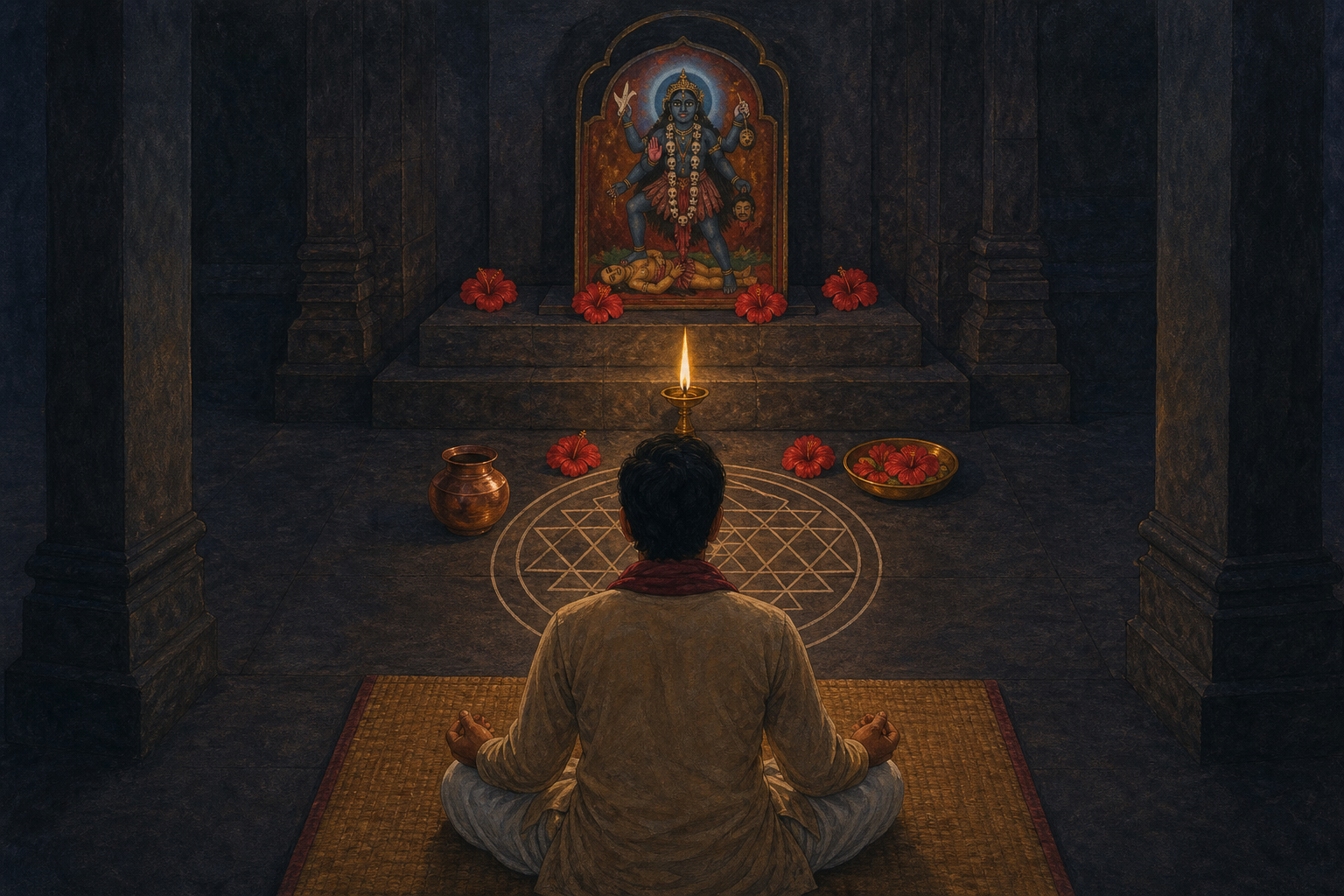
As a useful shorthand, Shakta tells you who Kali is, while Tantra shows how her reality may be approached. Shakta theology recognizes Devī or Śakti as ultimate reality rather than a decorative or subordinate divine power. Tantric disciplines bring that recognition into mantra, ritual, visualization, breath, the body, sacred sound, and carefully structured contemplation.
This distinction prevents two opposite errors. The first reduces Kali to mythology: an impressive character whose battles happened somewhere outside you. The second reduces her to psychology: a convenient symbol for your private emotions. Shakta-Tantric thought holds both the cosmic and inward registers together. Kali is worshipped as divine reality, while her form also transforms how a practitioner encounters fear, time, identity, speech, and action.
Kali’s place among the Daśa Mahāvidyā, the Ten Wisdom Goddesses, clarifies her Tantric function. Her wisdom has the character of a cut. The sword is viveka, the discernment that separates truth from self-deception. The severed head is not an endorsement of physical violence; it represents ahaṁkāra no longer occupying the throne of awareness. This is a demanding form of grace because it may remove the story through which you have been protecting your pride.
The garland of heads extends this insight from ego to language. Its 50 or 51 heads are interpreted as the Sanskrit phonemes, with the count varying according to the enumeration being used. Sound unfolds into words; words designate names and forms; names and forms compose the world as human awareness ordinarily encounters it. By wearing the alphabet, Kali wears the manifested field. By remaining more than the alphabet, she points toward the silence in which every sound arises.
You can make that linguistic metaphysics concrete before speaking. Ask whether your next sentence is true, necessary, and proportionate. Notice whether you are using language to clarify reality or to protect an identity. Kali’s garland then ceases to be an occult curiosity. It becomes a reminder that careless speech generates consequences and truthful speech can interrupt a chain of karma.
The girdle of arms makes the corresponding point about action. Arms signify doing, capacity, and the karmic residue of deeds. Their severed form does not command inactivity. It challenges compulsive doership: the belief that you are an isolated agent who owns every success and must control every consequence. The practical alternative is seva, action offered in service, carried out carefully but without making the result an ornament for the ego.
This is also where non-dual Shakta thought avoids both world-denial and world-clinging. The world is Śakti’s living manifestation, so it is not spiritually worthless. Yet every form remains subject to time, so none can bear the weight of permanent possession. You participate, protect, love, and serve without pretending that changing forms can be made changeless.
Readers familiar with the wider Dharmic family may recognize resonances without erasing distinctions. Buddhist teachings on impermanence and wrathful compassion, the Jain union of ahiṁsā and abhaya, and the Sikh orientation toward Akal all illuminate courage before change. These parallels do not make Kali identical to Buddhist protectors, Jain teaching, or the Sikh understanding of the Timeless One. They show how different Dharmic paths can train fearlessness without making aggression a virtue.
Choose Kali’s form according to the truth you need to face
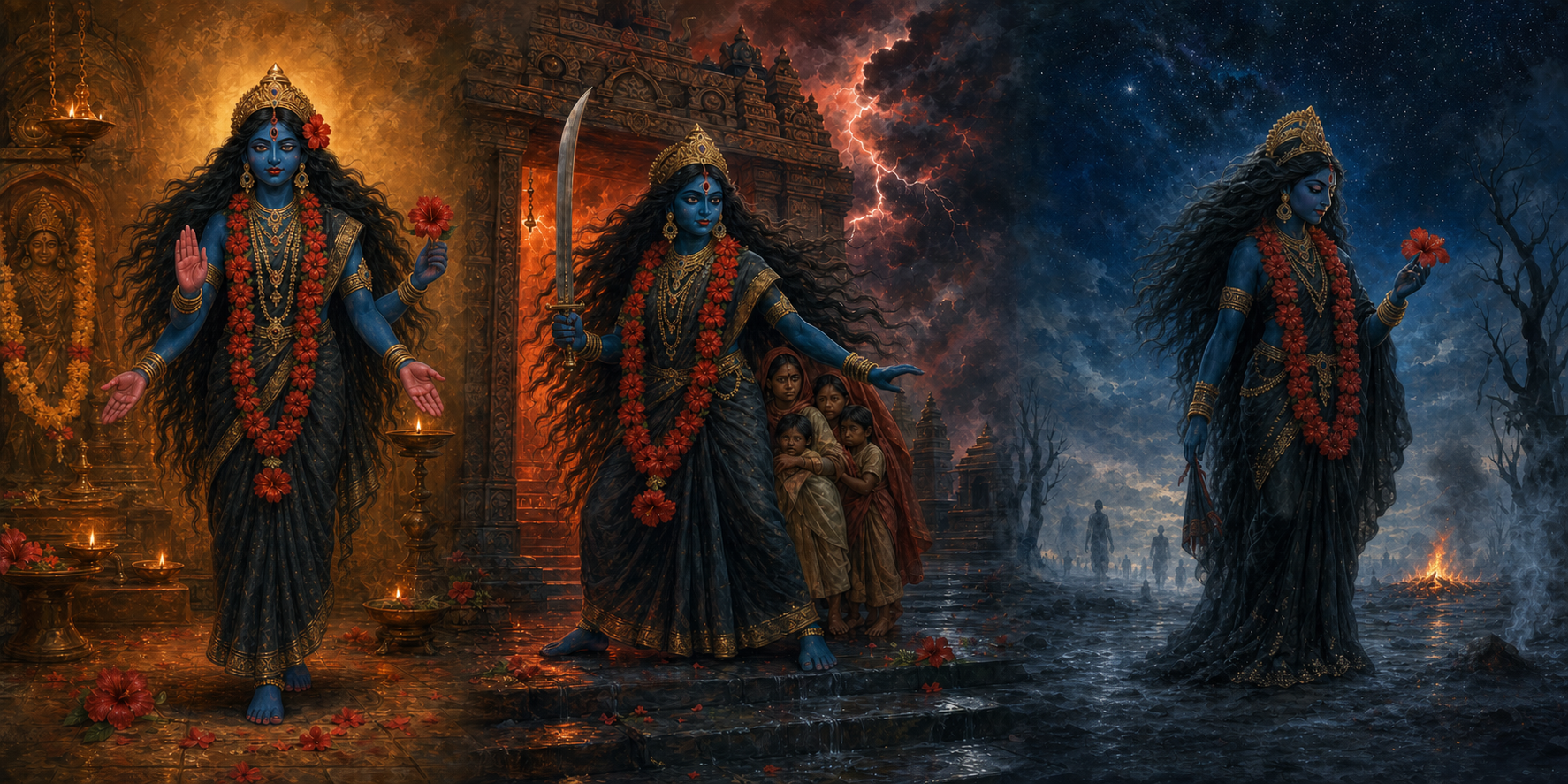
Kali does not appear in one uniform icon across every region and lineage. Her forms emphasize different dimensions of the same divine power. Choosing an image for contemplation should therefore begin with its traditional context, not merely with whichever picture looks most dramatic.
- Dakṣiṇā Kālī visibly holds ferocity and reassurance together. She commonly stands upon Shiva with her right foot and offers abhaya and varada. This is often the clearest starting form if you are trying to understand Kali as compassionate Mother rather than as a symbol of destruction alone.
- Smashāna Kālī places greater emphasis on the cremation ground, austerity, death, and the surrender of constructed identity. Treat this as a demanding contemplative current, not a theatrical aesthetic or a license for unsupervised ritual experimentation.
- Bhadrakālī brings protective benevolence to the foreground. Her worship often carries a communal and guardianship dimension.
- Mahākālī expands the contemplation to cosmic time: the appearing and disappearance of worlds, and the reality beyond their sequence.
Regional names keep this theology rooted in living communities. Śyāmā and Bhavatāriṇī are prominent devotional expressions in Bengal; Kaliamman traditions carry the Mother’s protective presence through Tamil regions; Bhadrakālī traditions are deeply woven into Kerala’s religious life. These are not simply interchangeable labels for an abstract archetype. Local temple customs, songs, calendars, and inherited forms of worship determine how devotees actually meet her.
Kālī Pūjā on the Kārtika new moon in Bengal and Assam makes the setting itself meaningful. The dark night of Amāvasyā becomes the occasion for invoking inner illumination. Kali’s presence as Kālarātrī within Navarātri makes the same theological point in another cycle: serenity and fierceness are complementary modes of Devī’s grace, not rival ideas of divinity.
Bhakti also gives you an important corrective to the idea that Kali belongs only to secretive or severe practice. The Śyāma saṅgīt traditions associated with Rāmaprasād Sen and Kāmalākānta translate subtle theology into intimate address to the Mother. At Dakshineswar, Bhavatāriṇī Kālī stood at the center of Śrī Rāmakṛṣṇa’s spiritual life and, through that legacy, helped shape Swami Vivekananda’s expansive vision. Devotion does not dilute Tantra here; it keeps metaphysical insight joined to humility and relationship.
If you want to begin exploring Kali, start with the form honored by a temple, family tradition, or accountable lineage you can actually learn from. Ask what the image is called, which story or hymn accompanies it, and which practices belong to that setting. This protects you from assembling fragments from unrelated traditions into a practice that has visual intensity but no coherent discipline.
Turn contemplation into one ethical cut
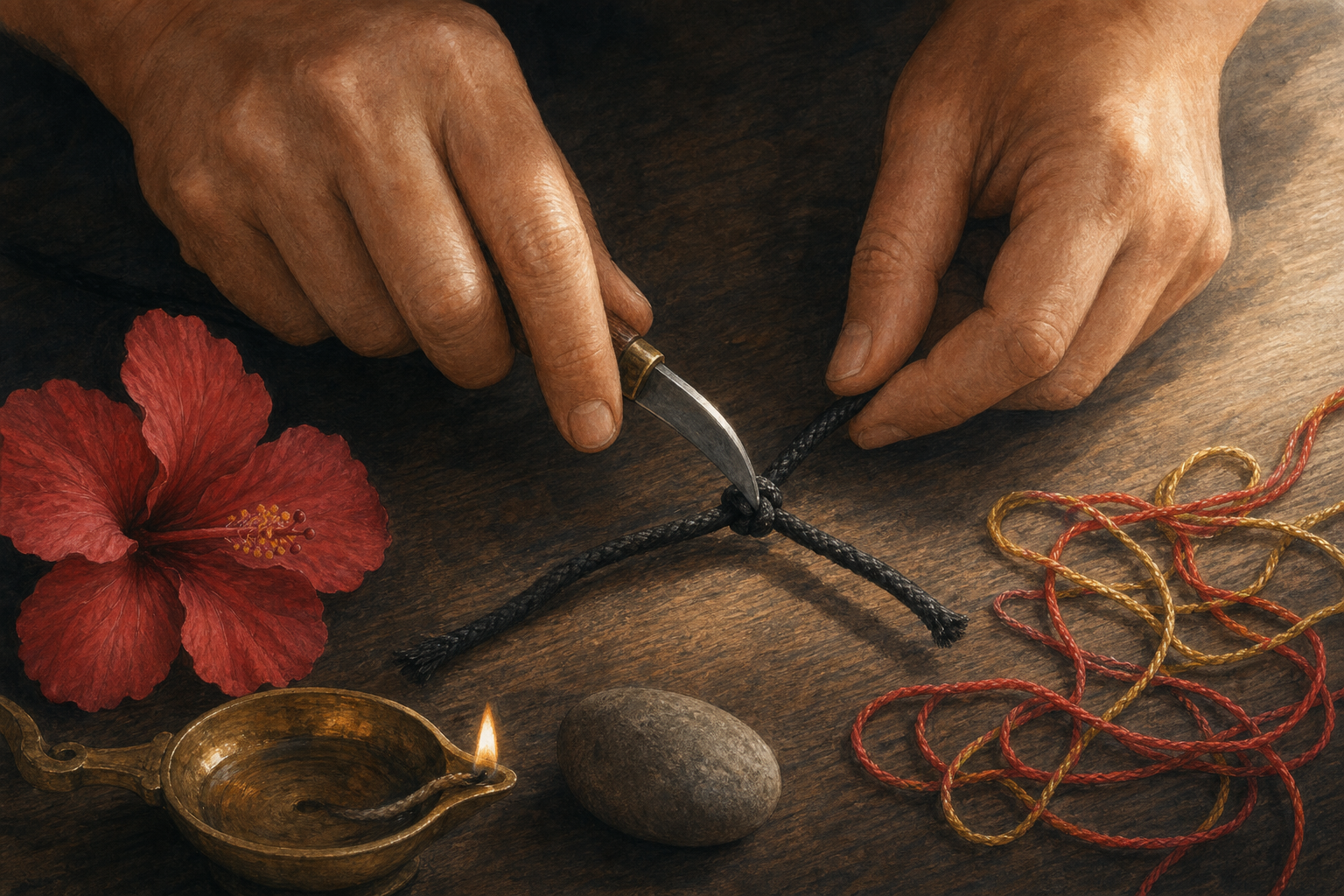
You do not need to imitate advanced Tantra to let Kali’s image question you. The following exercise is a devotional and ethical contemplation, not a formal Tantric initiation or a replacement for lineage instruction.
- Set an ethical intention. Approach the image for clarity, courage, and the reduction of harm, not for domination, spectacle, or personal power.
- Begin with the protective hand. Notice abhaya before concentrating on the severed head or sword. The image tells you that truth can be faced without surrendering to panic.
- Name one recurring fear or attachment. Be precise. Instead of naming “ego” in the abstract, identify the status, outcome, relationship, grievance, or self-description you are trying to control.
- Find the Raktabīja mechanism. Ask what keeps reproducing the pattern. Look beneath repeated symptoms for the belief, desire, or avoidance that feeds them.
- Choose one cut. Let the sword signify a concrete act of discernment: admit a fact, stop repeating a false claim, abandon a harmful response, or place a necessary boundary.
- Consecrate speech and action. Connect the garland and girdle to one truthful sentence and one responsible deed. Make them small enough to carry out, but real enough to have a consequence.
- Close with service rather than self-display. Let the contemplation issue in ahiṁsā, dāna, restraint, or seva. Transformation that only enlarges your spiritual identity has not reached Kali’s severed head.
Mantra belongs to a more specific discipline. The formula oṁ krīṁ kālikāyai namaḥ includes the bīja krīṁ, traditionally associated with breaking inertia and activating transformative force. A seed syllable is not an internet productivity technique. If you seek sustained mantra-sādhanā, learn its pronunciation, preparation, restrictions, and method from qualified guidance, and honor any initiation requirements maintained by the lineage.
The same caution applies more strongly to cremation-ground contemplation, subtle-body work, and practices involving breath or cakras. Responsible traditions place ethical preparation, mental balance, and ahiṁsā before intensity. Do not improvise advanced rites because Kali’s imagery feels transgressive. If a practice destabilizes you, stop and seek appropriate spiritual and mental-health support; intensive sādhanā is not a substitute for professional care.
Historical Shakta traditions contain internal debates about offerings and conduct. Those debates should not be flattened into either an accusation that Kali worship glorifies violence or an excuse to ignore ethical consequences. Contemporary worship commonly brings ahiṁsā, charity, devotional restraint, and service to the center. Any teacher or group that dismisses mental balance, accountability, or the reduction of harm fails a basic test of responsible practice.
Key takeaways
- Kali is not destruction isolated from creation, preservation, concealment, and grace; she embodies the full movement of manifestation.
- Her frightening objects target ignorance, compulsive ego, irresponsible speech, and karmic attachment rather than authorizing violence against others.
- Shakta theology recognizes Kali as divine reality, while Tantra turns her symbols into disciplined methods of transformation.
- Her forms emphasize different truths, so learn an image through its regional, temple, devotional, or lineage context.
- A trustworthy encounter with Kali should produce fearlessness joined to ahiṁsā, truthful speech, responsible action, and service.
The next time you stand before Kali, resist the urge either to sanitize her or to stare only at what shocks you. Begin with abhaya, follow the sword toward one honest distinction, and let that insight change one act. Kali’s fierce form becomes intelligible when the fear you surrender results in greater responsibility.
References
