
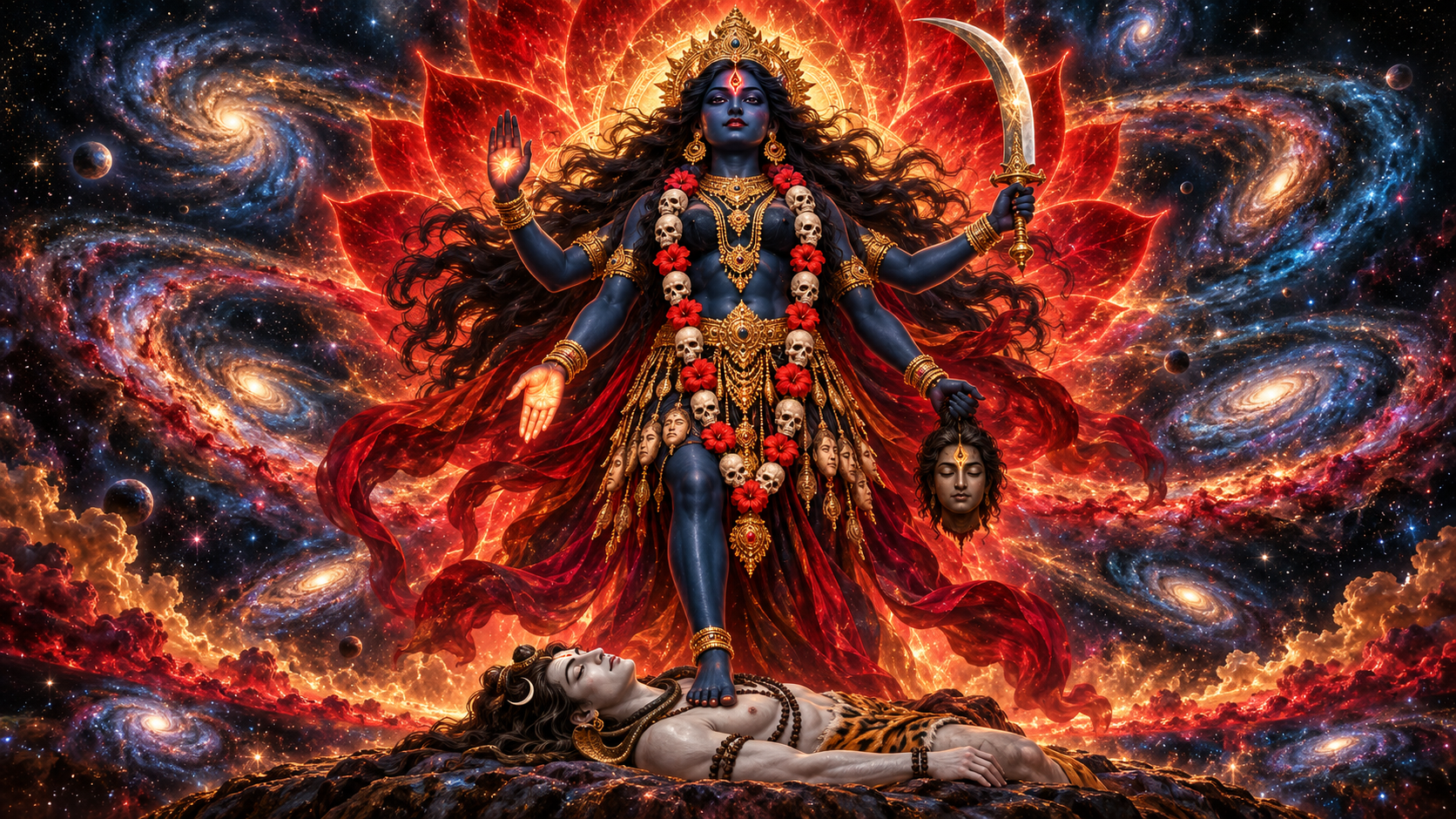
If Kali’s form unsettles you, the difficulty may lie in a question beneath the image: how can the primordial Mother appear dark, fierce and destructive? If Adi Shakti is the source of life, why would her cosmic manifestation look like a force that ends things?
The answer is not that Kali abandons motherhood for violence. Her fierceness reveals what divine protection looks like when disorder can no longer be corrected by gentler means. Once you distinguish the source, the condition and the manifestation, Kali’s form becomes a coherent expression of Shakti rather than a theological contradiction.
Adi Shakti is the source; Kali is the power made manifest
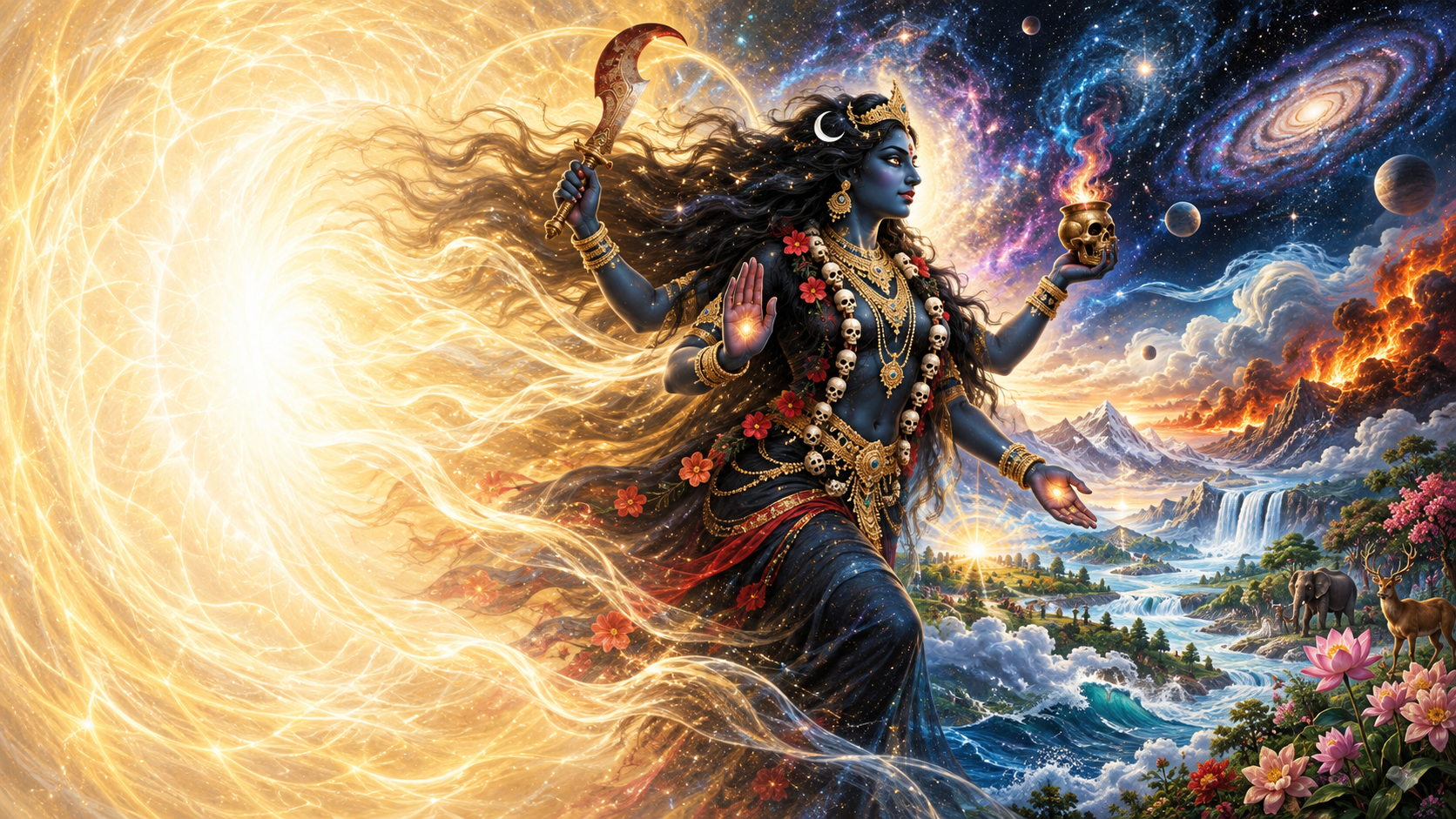
Adi Shakti names primordial divine power: the source from which manifestation, order and transformative action become possible. Kali is not an independent force arriving from outside that source. She is Adi Shakti disclosed in a particular cosmic mode.
The distinction becomes clear through the sacred sequence. When chaos and adharma overwhelm the cosmos, the gods turn toward Adi Shakti, and the divine feminine manifests as Kali. The movement is from latent power to necessary action. Nothing alien is added to Adi Shakti; something already inherent in her becomes visible because the condition of the cosmos calls it forth.
| Dimension | Adi Shakti | Kali |
|---|---|---|
| How to understand her | Primordial divine power | That power in a decisive, formidable manifestation |
| Relation to the cosmos | The ground and capacity of manifestation | The force that confronts overwhelming disorder |
| Spiritual emphasis | Wholeness, origin and inexhaustible potential | Transformation, severance and uncompromising clarity |
| Common mistake | Treating her as merely passive or remote | Treating her as separate from the supreme Mother |
This is why manifestation should not be mistaken for fragmentation. Adi Shakti does not break into an unrelated being called Kali. The same divine power becomes knowable through a form suited to a cosmic need. The form is particular; the Shakti is not divided.
That distinction also prevents a shallow ranking of divine forms. A gentle manifestation is not more divine because it comforts you, and a fierce manifestation is not less divine because it disturbs you. Each must be read through the work it performs in the order of Dharma.
The dark cosmic womb is not a realm of evil
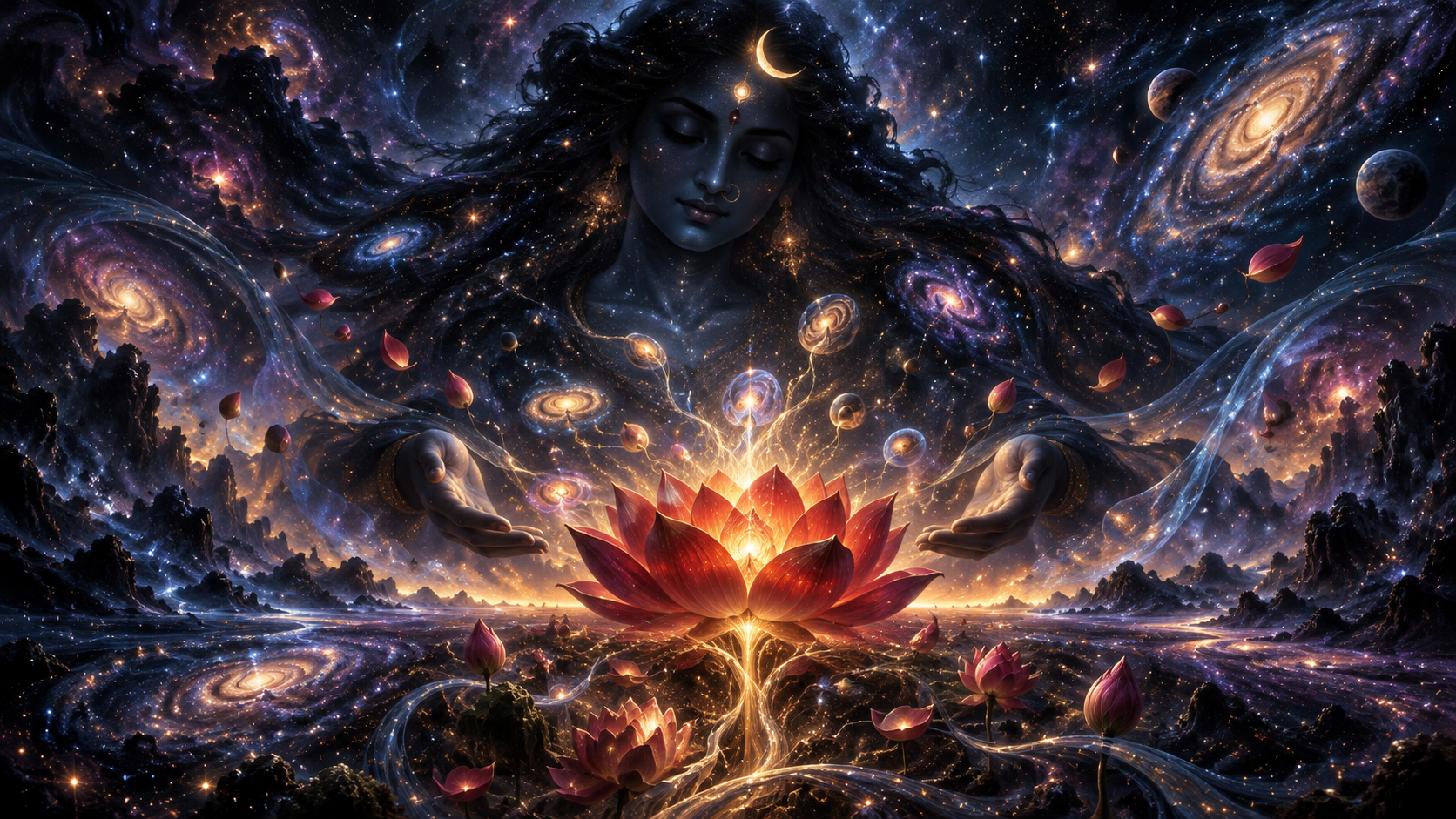
In ordinary speech, darkness can mean ignorance, danger or moral corruption. Carrying that assumption unchanged into Kali’s symbolism creates the wrong conclusion. The dark cosmic womb does not have to signify an evil power opposed to the divine. It can signify what precedes visible distinction: the unmanifest depth from which form emerges.
A womb is dark because creation is still hidden within it. Its darkness is gestational, not hostile. It holds possibility before that possibility acquires a name, boundary or visible shape. Read in this way, the dark cosmic cell of Adi Shakti is not an empty absence. It is concentrated potential.
This changes how you look at Kali. She does not emerge because the darkness has produced something wicked. She emerges because the apparently hidden source contains the power required to answer cosmic imbalance. Darkness marks the limits of ordinary perception; manifestation makes the needed power perceptible.
- Notice that the darkness surrounds and generates the manifestation; it does not stand opposite Adi Shakti as a rival power.
- Read emergence as revelation. Kali becomes visible when her mode of action is needed, but the power she embodies was not previously absent.
- Read the womb or cell as concentration. Before divine energy acts outwardly, it is held in an undivided state.
- Do not turn sacred imagery into a literal map of physical cosmology. Its purpose here is to reveal a relation among source, manifestation, disorder and restoration.
This reading matters beyond terminology. If darkness automatically means evil, you will miss one of the image’s central spiritual demands: the unknown is not necessarily opposed to the sacred. Sometimes clarity arises from entering what has not yet been made visible.
Kali’s ferocity serves Dharma rather than anger
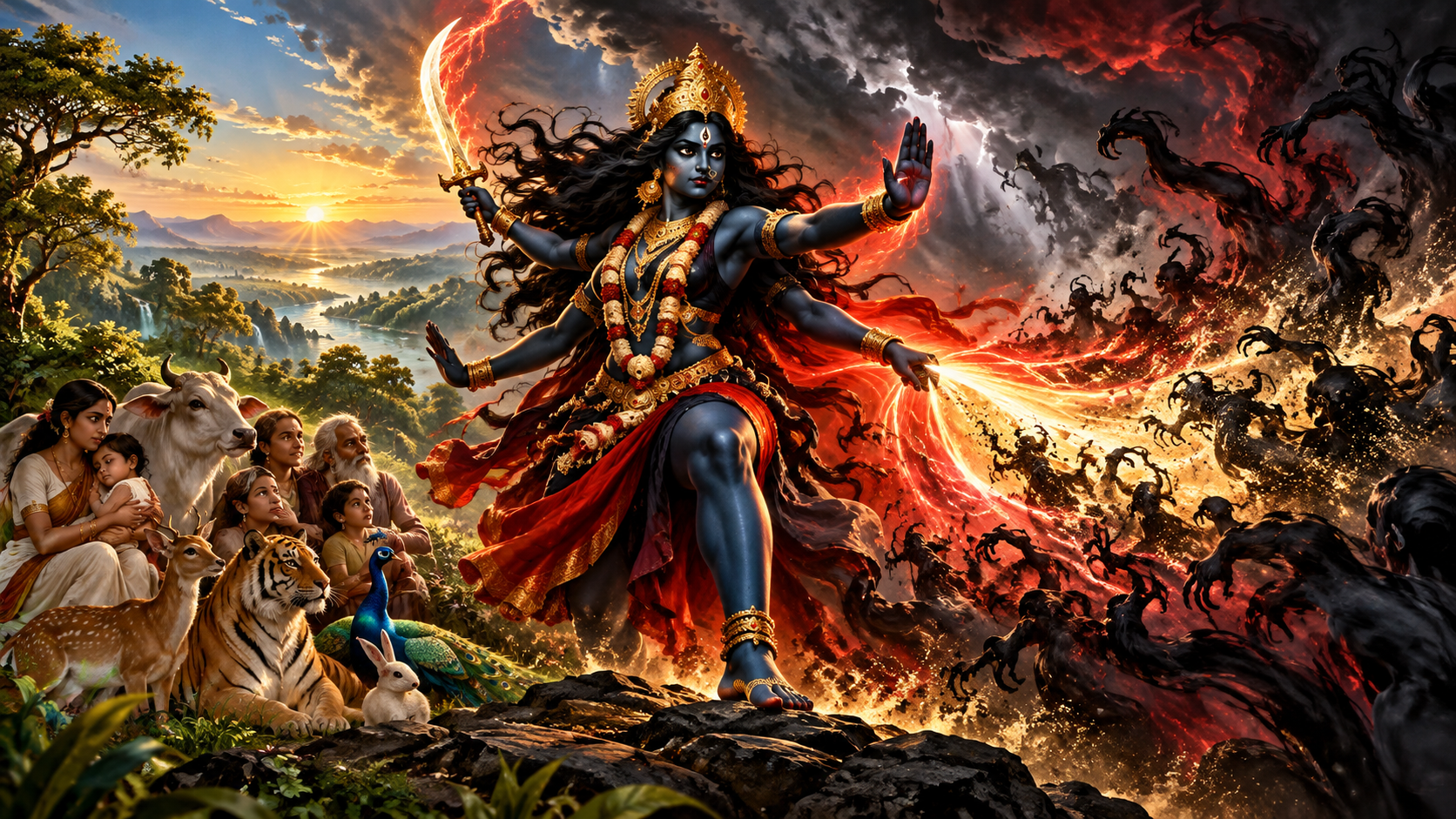
Fierceness has no spiritual value merely because it is intense. Its meaning depends on what it serves. Kali’s formidable manifestation appears in relation to adharma and cosmic chaos. Her force is intelligible as protection and restoration, not as uncontrolled rage.
This is a vital boundary for anyone trying to apply Kali’s symbolism personally. The image does not license you to sanctify every angry impulse. Human anger can defend the vulnerable, but it can also protect pride, punish disagreement or prolong conflict. Calling an impulse fierce does not make it Dharmic.
Test your interpretation by examining the direction of the force:
- What is its target? Kali’s symbolism directs force toward adharma and disorder. In your life, name the harmful pattern precisely instead of turning a person into a permanent enemy.
- What does it protect? A Dharmic intervention should protect truth, responsibility, dignity or rightful order. If it protects only wounded pride, pause before treating it as sacred resolve.
- Where does it stop? Restorative force has a purpose and a limit. Revenge keeps feeding itself after the immediate disorder has been addressed.
- What remains afterward? The proper horizon is restored order, not permanent agitation. An action that leaves you more attached to hostility deserves renewed scrutiny.
Kali therefore represents more than destruction in the crude sense of smashing what exists. Her deeper challenge concerns discernment: what must end so that Dharma is no longer obstructed? The answer might involve an illusion, a destructive attachment, an evasion of duty or a pattern you have continued because confronting it feels costly.
Destruction and creation are not always opposites. Clearing what has become corrupt, false or obstructive can make rightful action possible again. Kali’s cosmic role becomes understandable at that threshold: she manifests when preservation without transformation would amount to preserving disorder.
How to contemplate Kali without reducing her to a slogan

You do not need to force Kali into a single modern label such as empowerment, rebellion, anger or fearlessness. Each may touch one aspect of the image, but none contains her cosmic meaning. A more disciplined contemplation moves through three levels while keeping them connected.
- Cosmic level: Adi Shakti contains the power through which overwhelming disorder is confronted.
- Ethical level: Fierce action becomes meaningful through its alignment with Dharma and its opposition to adharma.
- Interior level: You can examine what must be seen, severed or transformed within your own conduct.
The interior level is an application of the cosmic symbolism, not a replacement for it. If Kali becomes only a metaphor for personal confidence, her theological depth disappears. If she remains only a distant cosmic figure, however, you may admire the symbol without allowing it to test your life. Hold both dimensions together.
A simple contemplative sequence can help:
- Begin with the distinction between source and manifestation. Recall that Kali is not outside Adi Shakti but reveals her power in a particular mode.
- Look at the darkness without immediately labelling it evil. Consider what remains unformed, hidden or beyond your ordinary categories.
- Follow the sacred movement: disorder intensifies, divine power becomes manifest, and decisive action confronts adharma.
- Name one pattern in your own conduct that survives because you avoid seeing it clearly. Keep the question specific; do not condemn your entire self.
- Choose one proportionate, Dharma-aligned action. Tell the truth you have postponed, end your participation in a harmful pattern, fulfil a neglected duty or establish a needed boundary.
- Examine the result. The measure is not how forceful the action felt, but whether it reduced disorder without feeding cruelty, vanity or needless conflict.
This reflection is not a substitute for formal sadhana. If you undertake mantra, initiation-based or esoteric worship, follow the guidance of an established lineage and a qualified teacher rather than assembling a practice from isolated symbolism. Contemplation can prepare your understanding, but reverence also means respecting the discipline within which a practice is transmitted.
It is equally important not to demand that Kali become comfortable before you accept her. Her image works partly by refusing the assumption that the sacred must always appear mild. Stay with that discomfort long enough to ask whether it exposes fear of change, fear of mortality, attachment to appearances or reluctance to confront adharma.
Key takeaways
- Adi Shakti is primordial divine power; Kali is that same power manifest in a fierce and decisive cosmic mode.
- Kali’s emergence is not a split within the divine feminine. It is the disclosure of a capacity already present in Adi Shakti.
- The dark cosmic womb signifies hidden and unmanifest potential, not a competing realm of moral evil.
- Kali’s ferocity is defined by its purpose: confronting adharma and restoring order.
- The symbolism does not sanctify uncontrolled human anger. Dharmic force needs a rightful target, a protective purpose and a clear limit.
- Personal contemplation should connect cosmic meaning with one precise correction in your conduct, without shrinking Kali into a self-help metaphor.
The next time you encounter Kali’s form, do not begin by asking how a divine Mother can look so fearsome. Ask what primordial power must reveal when disorder can no longer be ignored. Then let the question reach your own conduct: identify what obstructs Dharma, and take one clear, proportionate step toward setting it right.
References

Leave a Reply
You must be logged in to post a comment.