
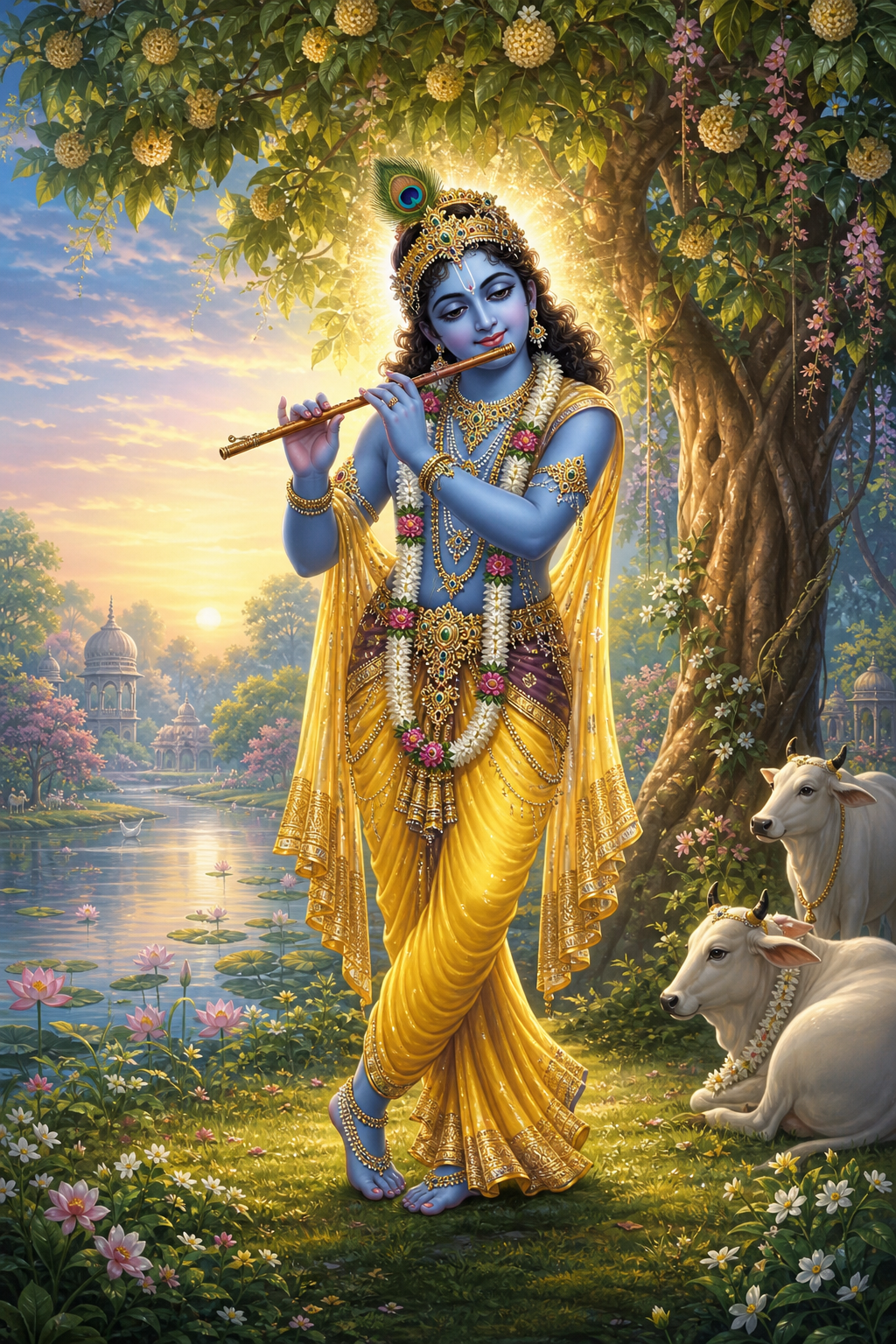
If you find Krishna easy to love but difficult to understand precisely, the pressure point is usually His form. Is the flute-bearing figure a devotional symbol, a temporary body assumed for earthly activity, or Krishna’s eternal identity?
Gaudiya Vaishnavism gives an unambiguous answer: Krishna is the Supreme Person, His form is spiritual rather than material, and His appearance in the world is a personal descent. Knowing what that answer does and does not claim will make your study clearer, your meditation less vague, and your devotion more deliberate.
Read the three central claims together
Confusion begins when three distinct questions are collapsed into one. Why does the Divine descend? Who is Krishna within the hierarchy of avataras? What is the nature of His form? Gaudiya theology answers each question through a different scriptural anchor.
- Bhagavad Gita 4.7-8 explains the purpose of divine manifestation: when dharma declines and adharma rises, the Divine appears to restore moral and cosmic order.
- Srimad-Bhagavatam 1.3.28 identifies Krishna as svayam Bhagavan, the complete Supreme Person, rather than merely a secondary or derivative manifestation.
- Brahma-samhita 5.1 describes Krishna as the supreme controller whose form is sac-cid-ananda-vigraha: eternal, conscious, and blissful.
Read together, these claims produce a coherent position. Krishna does not acquire divinity after appearing. Nor does an impersonal reality temporarily manufacture a personality for the sake of human understanding. The person who descends is already the complete Divine, and the form in which He appears belongs to His eternal being.
This is a specifically Gaudiya Vaishnava conclusion, not a neutral formula accepted in precisely the same way by every Hindu school. Advaita, Vishishtadvaita, Dvaita, and different Vaishnava lineages organize the relations among Brahman, Bhagavan, the world, and the avataras differently. You can therefore state the claim firmly without presenting one lineage’s theological grammar as the only vocabulary available within Sanatana Dharma.
You should also keep theological and historical questions distinct. The Mahabharata, Srimad-Bhagavatam, Vishnu Purana, and later Gaudiya works carry narrative, theology, sacred history, and contemplative meaning at once. Their account of Krishna’s appearance operates within vast, cyclical Puranic time, not only within the conventions of a modern linear archive. Historical-critical inquiry can examine the composition and transmission of these texts; Vaishnava interpretation receives them through sabda-pramana, authoritative testimony. One method should not be disguised as the other.
Key takeaways
- Krishna’s descent answers the decline of dharma, but restoration of order is not the whole of His identity.
- Gaudiya Vaishnavism understands Krishna as svayam Bhagavan, not simply one replaceable avatara among many.
- His form is held to be sac-cid-ananda, so divine personality is not treated as a material limitation.
- The flute, lotus eyes, peacock feather, names, qualities, and pastimes are theological disclosures, not incidental decoration.
- The claim is approached through scripture, coherent reasoning, disciplined practice, and transformation of character.
Krishna’s form is personal without being material
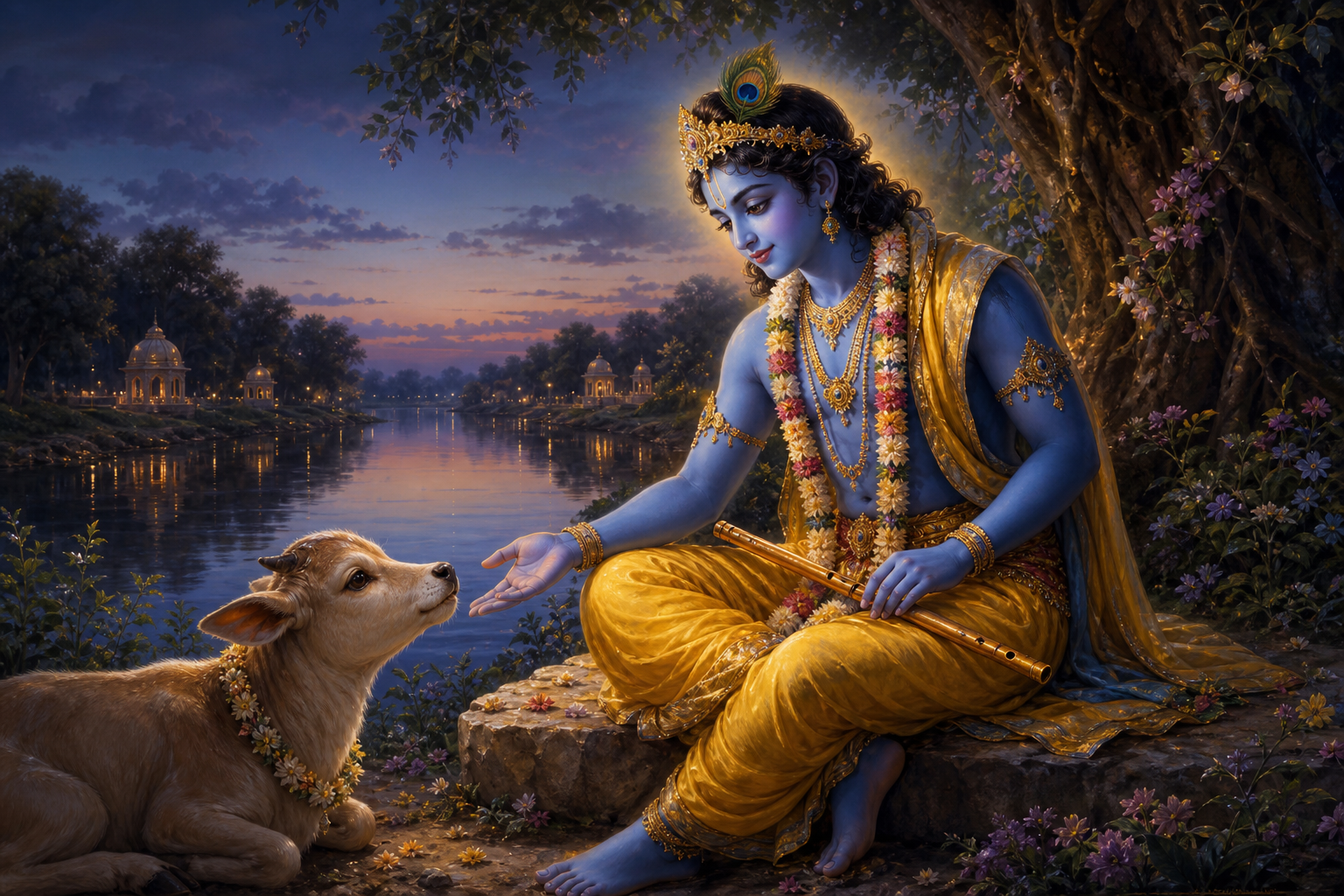
Calling Krishna personal does not mean imagining an unusually powerful human being somewhere inside the universe. A material body is bounded, changeable, and subject to decay. Sac-cid-ananda-vigraha makes a different claim: form can belong to spiritual fullness itself. Personality, relationship, beauty, intention, and reciprocation are not defects that the Absolute must discard in order to be infinite.
Gaudiya thought commonly distinguishes Brahman, Paramatma, and Bhagavan. Brahman is the impersonal spiritual reality; Paramatma is the localized indwelling presence; Bhagavan is the Supreme known in personal fullness. These are not three rival deities. The personal realization is understood to include the all-pervasive and indwelling dimensions while disclosing something further: the Absolute can know, love, invite, and reciprocate.
This distinction protects you from two opposite mistakes. The first is crude anthropomorphism, in which Krishna becomes a projection of ordinary human personality onto the sky. The second is reductionism, in which every personal feature is dismissed as a disposable aid for people unable to contemplate the formless. Within Krishna-bhakti, form is neither a material copy nor a temporary teaching device. It is revelation of relationship.
The traditional portrait of Syamasundara Krishna supplies precise contemplative features. As Muralidhara, He bears and plays the flute. His eyes are compared to lotus petals. A peacock feather crowns His head. His beauty is said to surpass the attraction of thousands of Cupids. Each feature tells you how the tradition understands divine personality.
- Syamasundara directs attention to beauty joined with intimacy. The Absolute is not only an object of analysis but the supremely attractive object of love.
- Muralidhara, the flute-bearer, presents divine attraction as invitation. The flute calls; it does not coerce.
- Venum kvanantam, Krishna sounding the flute, places sacred sound at the center of encounter. This is why hearing, chanting, japa, and kirtana are not peripheral to bhakti.
- Barhavatamsa, the peacock-feathered Lord, expresses a gentle and playful sovereignty. Krishna appears with the beauty of nature rather than depending upon imperial display.
- The lotus-like eyes direct meditation toward compassion and attentive care for living beings.
- Beauty surpassing thousands of Cupids distinguishes prema from kama. The point is not to spiritualize ordinary appetite but to redirect longing from temporary possession toward self-giving love.
When you look upon a murti or picture of Krishna, do not stop with a visual inventory. Ask what each detail requires of your consciousness. If the flute signifies invitation, listen before demanding. If the lotus eyes signify compassion, examine how you look at people who inconvenience you. If the peacock feather signifies sweet rather than oppressive sovereignty, notice whether your own authority has become harsh. Form becomes spiritually useful when contemplation reaches conduct.
Krishna’s place within avatara-tattva is distinctive
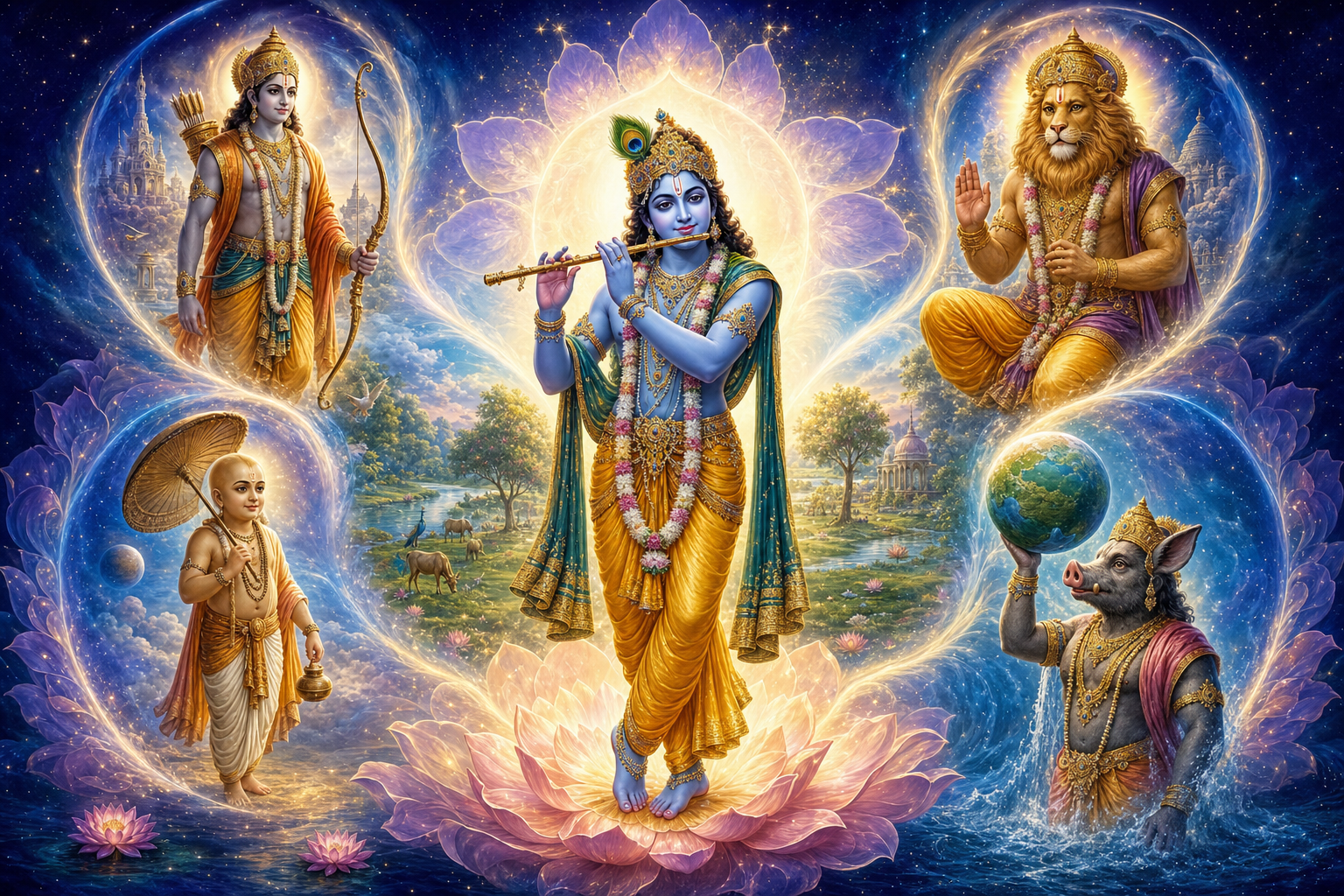
Avatara means descent. It describes the Divine acting within the world without implying that transcendence has been abandoned. Vaishnava theology uses several categories because not every divine manifestation performs the same function or carries the same ontological status.
| Category | What it identifies | Distinction to notice |
|---|---|---|
| Purusha-avataras | Divine manifestations associated with creation, maintenance, and dissolution | The focus is cosmic governance |
| Guna-avataras | Divine governance in relation to sattva, rajas, and tamas | The focus is the operation of the material qualities |
| Lila-avataras | Manifestations known through particular divine activities and pastimes | The focus is a disclosed form of divine action |
| Manvantara- and yuga-avataras | Manifestations associated with cosmic administrations or particular ages | The function is connected to a period within cyclical time |
| Shaktyavesha-avataras | Particular beings empowered to carry out a divine purpose | Divine empowerment must not automatically be confused with the complete Supreme Person |
| Krishna as svayam-rupa | Krishna in His own original personal identity | Gaudiya Vaishnavism regards Him as the source, not a derivative expansion |
The phrase personal avatara emphasizes that Krishna’s appearance is not merely an impersonal force, an ethical message, or the inspiration of an extraordinary saint. The distinction between vishnu-tattva and jiva-tattva matters here. A being empowered for a divine task should not therefore be identified with the Supreme in every respect. Krishna’s designation as svayam-rupa makes the stronger claim that the original Divine Person Himself is present.
Nor does descent mean confinement. The doctrine of achintya-bheda-abheda, inconceivable simultaneous oneness and difference, allows Gaudiya thought to affirm transcendence and immanence together. Krishna can be distinct enough for genuine relationship while remaining the ground and presence of all existence. He can appear in a particular place and lila without becoming merely local.
When you hear that Krishna came to Earth, therefore, avoid picturing an infinite reality compressed into a finite material container. The intended claim is that the eternally personal Absolute became accessible within worldly history while remaining fully divine. His appearance reveals rather than produces His identity.
Use scripture, reason, and practice as one discipline

Bhakti does not ask you to manufacture a private picture of Krishna and then call the intensity of that picture realization. Its method joins sastra, reason, and realized experience. Scripture supplies the identifiers; reason examines whether the claims fit together; practice tests what sustained attention to Krishna does to desire, perception, and conduct.
This order matters. Experience without a scriptural anchor can turn preference, mood, or fantasy into supposed revelation. Textual study without practice can leave Krishna as an entry in a theological system. Reason without either can endlessly rearrange concepts without changing the person doing the reasoning.
- Begin with the three anchor passages: Bhagavad Gita 4.7-8, Srimad-Bhagavatam 1.3.28, and Brahma-samhita 5.1. Ask why the Divine descends, who Krishna is, and what kind of form He possesses.
- Pair the primary passages with a trustworthy commentary from the lineage you are trying to understand. This prevents isolated words such as avatara, Bhagavan, and vigraha from being filled with assumptions borrowed from a different system.
- Practice sravana by hearing Krishna’s names, qualities, and activities. Listen for a precise attribute rather than treating the recitation as devotional background noise.
- Use japa or kirtana as address. Pronounce the sacred names attentively and return to the sound whenever the mind wanders. The aim is relationship through sacred sound, not the production of an unusual sensation.
- In smarana, select one scripturally grounded feature: the flute, lotus eyes, or peacock feather. Recall both the feature and its meaning. This keeps remembrance concrete without allowing imagination to become arbitrary.
- If arcana and darshana belong to your practice, approach the form as the focus of service rather than as an aesthetic object. Offer attention, cleanliness, reverence, and consistency.
- Carry remembrance into seva. Choose conduct that corresponds to the quality contemplated: compassionate speech for the lotus eyes, receptive attention for the flute, or restrained use of authority for Krishna’s gentle sovereignty.
- Record changes in attention, reactivity, compassion, and service. A journal cannot prove Krishna’s metaphysical identity, but it can expose whether your stated devotion is becoming embodied character.
- Return regularly to satsanga. Hearing how disciplined practitioners interpret and live these teachings gives correction, continuity, and protection from purely self-authorized spirituality.
Do not measure progress by visual vividness alone. Serenity or emotional uplift may accompany chanting and remembrance, but the more dependable diagnostic is the direction of your character. Is attention steadier? Is selfish desire losing some authority? Are truthfulness, compassion, restraint, and service becoming easier to choose? If contemplation of Krishna produces contempt for other seekers, careless behavior, or spiritual pride, something in the practice needs correction.
This is also why dharma-restoration cannot remain a story about what Krishna did. If the Divine descends when adharma rises, the devotee cannot invoke that descent while excusing dishonesty, cruelty, or exploitation in personal life. Avatara-tattva places an ethical obligation upon the worshipper: cooperate with dharma within the sphere actually entrusted to you.
Hold a precise conviction without flattening Dharma
A clear Krishna-centered conviction need not become a demand that every Dharmic tradition use the same metaphysics. Hindu traditions preserve multiple relationships with the Absolute through ishta and distinct philosophical schools. Sikh Dharma proclaims the formless One while centering Naam, kirtan, and seva. Buddhist paths cultivate liberation through insight and compassion without requiring Krishna theology. Jain Dharma pursues purification, non-violence, non-possessiveness, and perfected knowledge without positing a creator God.
Those differences are real. Respect does not require you to relabel every path as concealed Krishna-bhakti, just as openness does not require you to weaken the Gaudiya claim that Krishna is svayam Bhagavan. Unity becomes credible when it preserves difference while recognizing shared disciplines such as self-mastery, sacred remembrance, compassion, ahimsa, and service.
In conversation, state the level of your claim. Say that Gaudiya Vaishnavism understands Krishna’s form as eternal and His descent as the appearance of the complete Supreme Person. Explain the scriptural and philosophical basis. Then allow another tradition to describe itself in its own terms. This is stronger than either sectarian dismissal or a vague assertion that everyone means exactly the same thing.
At your next period of study, read the three anchor passages in sequence and write a plain answer to each question: Why does Krishna descend? Who descends? What is the nature of His form? Then carry one attribute of that form into japa and one corresponding virtue into seva. That is the practical movement from a decorative image of Krishna to disciplined relationship with the personal Divine.
References
- Dandavats – Seeing the Divine Clearly: Krishna’s Form, Shastra, and Unity Across Dharmic Paths
- Dandavats – Krishna’s Personal Descent on Earth: Scriptural Evidence, Bhakti Practice, and Dharmic Unity
