

If you have heard that Dharmic traditions call time cyclic, eternal, constructed, or unreal, you may wonder which description is actually correct. The apparent contradiction usually begins before any answer is given: the word time is being asked to name several different things.
You can clear up most of the confusion by separating measured time, the basis of temporal order, and the ultimate status of temporality. That distinction lets you read claims about kāla without turning one school’s precise position into a vague slogan about all Indic thought.
The question Is time real? hides three questions
Before deciding whether time is real, ask what the speaker means by time. A clock reading, the relation between two events, and a claim about ultimate reality do not belong to the same level of analysis.
- Are the divisions of time constructed? Hours, minutes, calendars, and named periods divide change into units that people can compare and communicate.
- Does something objective ground temporal relations? Even if the units are conventional, there may still be a basis for cognitions such as earlier, later, quick, slow, and simultaneous.
- Does temporality belong to ultimate reality? An underlying temporal principle could be real within one philosophical account without being the final or unconditioned reality in another.
These questions are logically distinct. Saying that minutes are constructed does not prove that event order is imaginary. Accepting an objective temporal basis does not prove that ultimate reality is temporal. Describing ultimate reality as timeless does not make aging, deadlines, causation, or ritual observance disappear from ordinary life. Indic discussions of kāla become much easier to follow once you keep those three questions apart.
| Claim you encounter | Question it addresses | What it does not establish by itself |
|---|---|---|
| Hours and calendars are constructed | How change is divided and measured | That events or temporal relations are imaginary |
| Earlier and later have an objective basis | What grounds temporal cognition | That clock units exist independently of convention |
| Underlying kāla is eternal | The status of time within a realist metaphysics | That every Indic school accepts the same account |
| Ultimate reality is timeless | Whether temporality is final | That practical life no longer has sequence or consequence |
Constructed time is not imaginary time

A wall clock or phone tells you how much of an agreed interval has elapsed. It does not disclose the essence of time. This is no defect: kilometres remain useful without explaining the ultimate nature of space, and minutes remain useful without settling the metaphysics of kāla.
We encounter change, event order, aging, duration, causal succession, and differences between clocks. We then use temporal concepts to compare those phenomena and coordinate action. Irreversible processes also help us distinguish the direction we call past-to-future. None of that requires a minute or a day to be an independently existing object. The measurement can be constructed while the phenomena being measured remain consequential.
This is the first meaning to assign to phrases such as not independently real or constructed. They need not mean nonexistent, arbitrary, delusional, or incorrectly measured. A calendar can be a human arrangement and still tell you correctly when an observance begins under that calendar. A deadline can depend on a social convention and still carry a real consequence.
The idea of upādhi-bheda helps here. In broad terms, it is a difference in valid description produced by relevant conditions. One person may be described as a teacher in the classroom, a parent at home, and a devotee during pūjā. The descriptions change with the conditions; they do not require three independently existing persons. Different temporal descriptions can likewise reflect the conditions under which something is observed or measured without forcing us to posit a separate time-substance for every clock, date, or event.
Use a simple test whenever someone says time is made up. Ask what, exactly, has been constructed:
- If the answer is the unit, such as an hour, the claim concerns measurement.
- If the answer is a distinction such as past and future, ask whether the claim concerns language, cognition, physical irreversibility, or metaphysics.
- If the answer is all temporal order, ask what explains change and succession within that position.
- If no level can be named, the claim is too loose to carry much philosophical weight.
This check prevents two opposite mistakes. The first is nihilism: if temporal divisions are constructed, nothing matters. The second is reification: if a clock measures an interval precisely, its units must be fundamental features of reality. Neither conclusion follows.
Nyāya-Vaiśeṣika separates divided time from one kāla

Nyāya-Vaiśeṣika offers a realist answer to the second question. It does not need every moment, day, or clock to possess its own independently existing time. Instead, temporal cognitions such as earlier, later, simultaneous, quick, and slow function as signs through which an underlying kāla is known.
The Tarkasaṅgraha of Annaṃbhaṭṭa characterises this kāla as eka, vibhu, and nitya: one, all-pervasive, and eternal.
- One: separate events and separate clocks do not require a collection of separate time-substances.
- All-pervasive: kāla is not confined to one location; it grounds temporal relations among produced things wherever they occur.
- Eternal: kāla is not produced when an event begins or destroyed when that event ends.
Nyāya-Vaiśeṣika calls this underlying time a dravya. Here, substance should not be mistaken for a lump of physical material. Kāla is not being pictured as a fluid flowing past you or an invisible object stored behind the clock. The category gives temporal relations a real metaphysical ground within this system.
This position lets you affirm two things at once: divided and named periods depend on conditions of use, while temporal relations need not be reduced to arbitrary speech. That is a more exact claim than either time is just an illusion or time is simply what clocks measure.
It is not the only intermediate position. Helārāja’s commentary on Bhartṛhari’s Vākyapadīya also distinguishes measured time from what underlies it: the measured divisions lack independent reality, while their underlying basis remains temporal. The technical details differ among traditions, but the important discipline is the same: do not confuse a conditioned division with whatever makes that division intelligible.
When you hear the sweeping claim that Indian philosophy says time is unreal, ask for the school and the level. In Nyāya-Vaiśeṣika, the divisions are not separate substances, but the underlying kāla is not thereby denied. Naming the darśana is not academic fussiness; it changes the answer.
Advaita carries the inquiry from underlying time to timeless reality

A further question remains even after an objective basis for temporal relations has been accepted: does time belong to ultimate reality, or only to conditioned experience and the world disclosed through it?
An Upaniṣadic line represented by the Maitrāyaṇīya Upaniṣad implies that ordinary time is not final and that the reality beneath it is not temporal. Advaita presses this distinction between what functions within ordinary experience and what can be affirmed of ultimate reality.
This is a stronger move than saying that hours and minutes are conventional. It does not merely challenge our partitions of time; it asks whether before, after, change, and duration can qualify the unconditioned at all. If temporality depends on limiting conditions, then removing those conditions does not reveal an infinitely long stretch of time. It reveals a reality to which temporal predicates do not finally apply.
The word unreal becomes especially hazardous here. In this context, it can mean not independently real or not the final level of reality. It need not mean that your lived experience is a blank, that causes have no effects, or that conduct has no consequences. Ultimate timelessness and practical sequence answer different questions.
That distinction matters for how you live as well as how you argue. A metaphysical claim about timeless reality is not permission to neglect a duty, arrive after a ritual has concluded, or dismiss another person’s suffering as an illusion. Such conduct occurs within ordered experience, where choices still lead to consequences. The teaching asks you not to mistake conditioned temporality for the whole of reality; it does not erase the field in which dharma is practised.
It also prevents a subtler error. Eternal time and timeless reality are not synonyms. Eternal kāla remains temporal: it supplies a basis for temporal relations without itself being produced or destroyed. Timeless reality is not a time-substance of unlimited duration. It lies outside the applicability of duration. If you remember only one technical distinction, make it this one.
Use a five-step test before joining ancient thought to physics
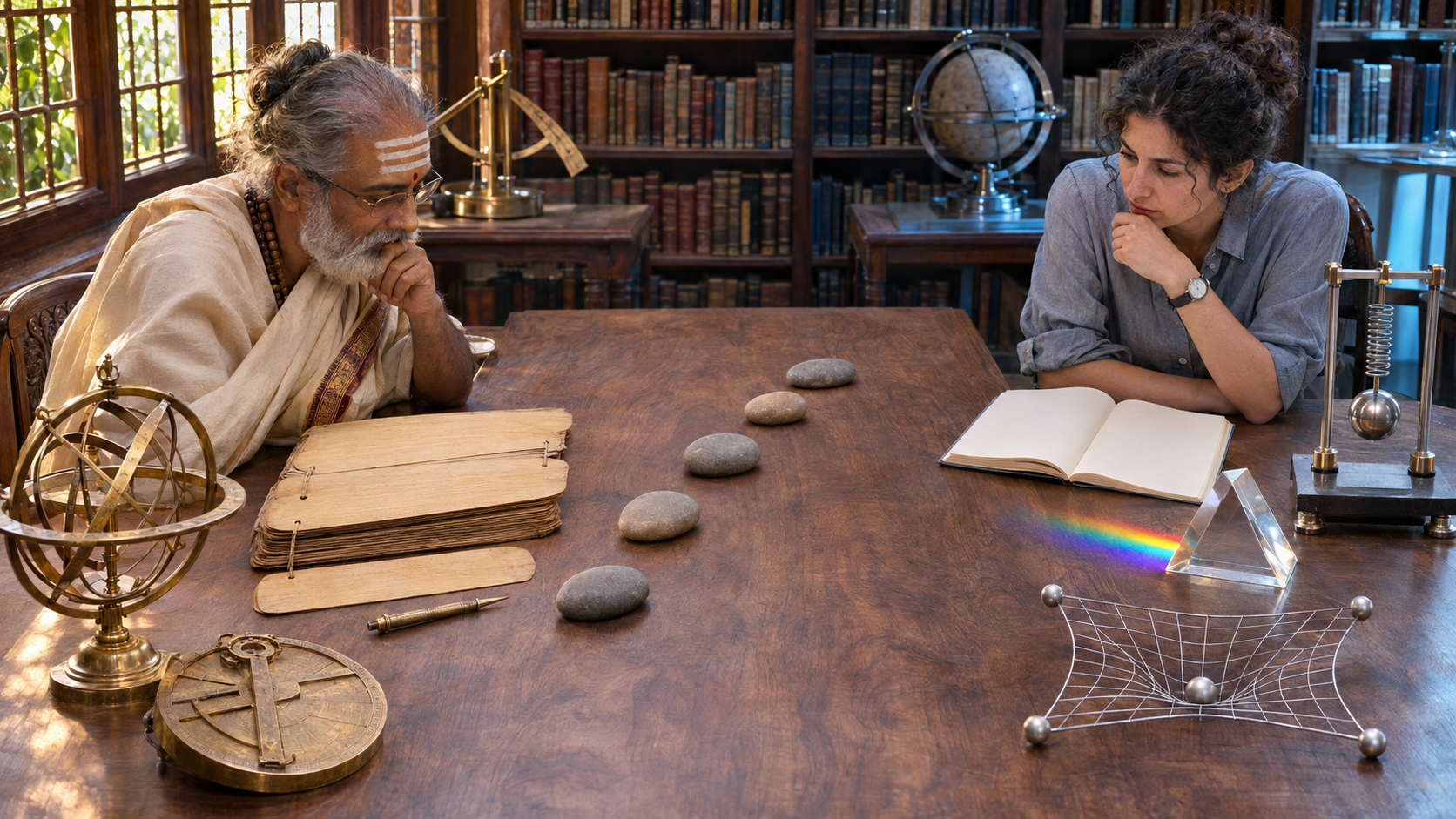
Modern physics makes the discussion sharper, but it does not automatically choose among these metaphysical positions. Physicists use proper time for the interval recorded by an observer’s own clock. General relativity treats spacetime geometrically and gives its relations measurable physical effects, while time does not function exactly like the three spatial dimensions.
The detection of a gravitational-wave signal from merging black holes on September 14, 2015 showed that the spacetime relationships described by general relativity have measurable physical consequences. Laser light travelling through LIGO’s perpendicular arms revealed tiny alternating changes in the relative distance between suspended mirrors. This is powerful evidence about how measurable spacetime behaves. It does not, by itself, settle what time ultimately is.
Use this protocol whenever you encounter a claim linking a darśana to modern science:
- State the claim without slogans. Replace time is an illusion with the exact proposition: clock divisions are constructed, temporal relations lack a basis, or ultimate reality is timeless.
- Identify the level. Decide whether the claim concerns measurement, cognition, metaphysical grounding, or ultimate reality.
- Identify the evidence. A clock comparison, a gravitational-wave measurement, a temporal cognition, and an Upaniṣadic argument are not interchangeable kinds of support.
- Watch for a category jump. Evidence that spacetime relations are measurable does not prove that temporality is ultimate. A teaching about timeless ultimate reality does not predict the output of an interferometer.
- Limit the conclusion. Say only what the evidence establishes. You can note a conceptual resemblance without claiming that an ancient school anticipated general relativity or that modern physics has verified Advaita.
This test blocks several attractive but weak arguments. Relativity does not prove māyā merely because clocks can register different intervals. Gravitational effects on measurement do not prove that only clocks are real. An ancient distinction between measured time and underlying reality is philosophically relevant to modern questions, but relevance is not identical prediction.
You can also apply the same method as a short contemplation. Choose one ordinary sequence, such as preparing tea. Write down the events in order, the device or convention used to measure their duration, the temporal relations you took to be objective, and the further claim you would have to make before calling the entire sequence ultimately real. You will see four layers that casual speech usually compresses into the single word time.
Key takeaways
- Constructed divisions can be accurate and practically binding without being independently existing entities.
- Nyāya-Vaiśeṣika treats temporal cognitions as signs of one all-pervasive, eternal kāla.
- Eternal time is not the same as timeless ultimate reality.
- Advaita’s ultimate question does not cancel sequence, duty, or consequence within ordinary life.
- Physics can establish measurable relations without deciding every metaphysical question about what time fundamentally is.
The next time you meet the statement that Indic philosophy calls time real or unreal, do not accept the sentence as it stands. Rewrite it as three sentences: what is constructed, what grounds temporal order, and whether temporality is ultimate. Once those answers are explicit, you can compare darśanas without flattening them and consider modern physics without forcing it to certify a spiritual conclusion.
References

Leave a Reply
You must be logged in to post a comment.