
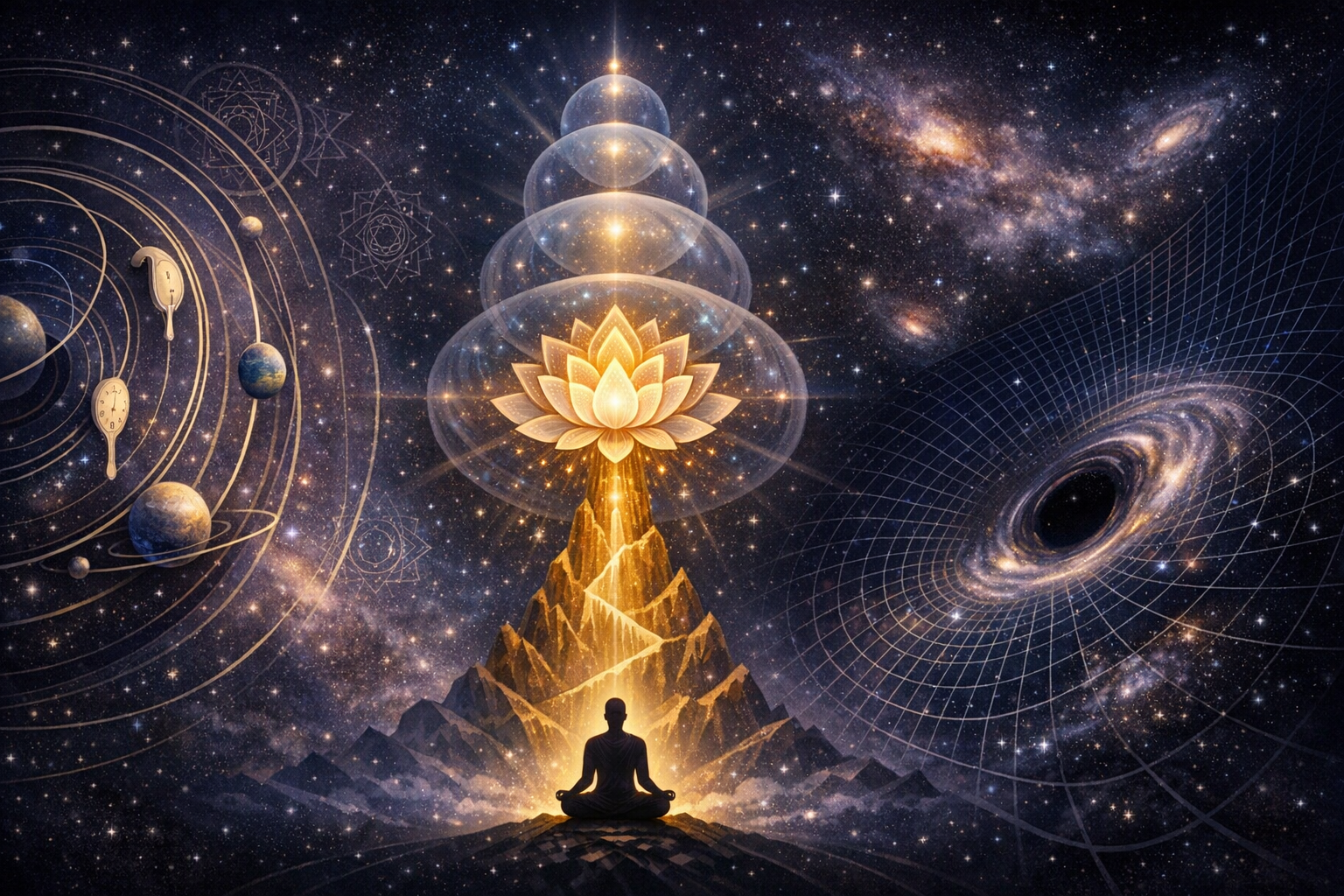
Vedic literature preserves a striking observation about time: what passes as one year for human beings is experienced as a single day in svargaloka, and what unfolds as 4.32 billion human years amounts to one day in Brahmaloka. These statements are not simply poetic exaggerations. They encode a systematic cosmology in which time is layered across realms (lokas) and the experience of duration scales with altitude in consciousness and place in the cosmic hierarchy. When framed alongside modern physics, where time dilates with velocity and gravity, the question arises naturally: if time is relative, what about space?
Classical Indian darshanas treat time (kāla) and space (dik or ākāśa) as fundamental categories, yet they also emphasize that human experience of both is conditioned by embodiment, attention, and karmic circumstance. Nyāya-Vaiśeṣika describes kāla and dik as all-pervading dravyas (substances), while acknowledging that intervals and directions are apprehended relationally through bodies, senses, and mind. Puranic narratives, meanwhile, convey relativity through lived metaphors: lifetimes that stretch or contract across lokas, journeys that bridge unimaginable distances in a single resolve, and measures such as yojanas whose meanings depend on the cosmic frame of reference.
In modern physics, relativity merges space and time into spacetime and shows that duration and distance are not absolute. Proper time slows in strong gravitational fields or at near-light velocities; lengths contract along motion; simultaneity depends on the observer. General relativity goes further: mass-energy curves spacetime, and geometry itself becomes dynamic. Space, like time, is therefore relative to the metric field and observer trajectory. In both the dharmic and scientific frameworks, experience of the cosmos is not uniformcontext matters.
The Vedic and Puranic time scales are internally coherent and numerically precise. A deva-day in svargaloka equals one human year (360 human days), implying that a deva-year spans 360 human years. Twelve thousand deva-years constitute a mahā-yuga, amounting to 4.32 million human years. A thousand such mahā-yugas make a kalpathe daytime of Brahmāequaling 4.32 billion human years, mirrored by an equally long night. A full day-night of Brahmā is therefore 8.64 billion human years; a year of Brahmā is 360 such day-nights; and Brahmā’s lifetime of 100 years totals approximately 311 trillion human years. These numbersfound across the Puranas and referenced in texts such as the Bhagavata Puranapresent a rigorously tiered temporal architecture.
Space scales accordingly. Puranic cosmography enumerates fourteen lokas from subterranean regions to higher planes like Maharloka, Janaloka, Tapoloka, and Brahmaloka, structured around axes such as Meru and articulated with measures like yojanas. Regardless of variations in historical estimates of a yojana, the conceptual intent is clear: across planes of existence, spatial expanse and temporal flow interrelate. When mind (manas) and prāṇa are refined, traversals once deemed vast may occur with extraordinary rapidityan experiential counterpart to the idea that different frames yield different effective measures of space and time.
Philosophically, this is not accidental. Upanishadic reflections repeatedly gesture toward dimensions beyond ordinary extension and duration. Kāṭha and Muṇḍaka Upanishads contemplate the Self as beyond time, while speaking of phenomena moving with “manojava” (the speed of mind) and hinting that shifts in awareness reorganize the felt structure of the world. The Brahma-samhita poetically describes innumerable universes afloat in the divine, each with distinct temporal rhythms and spatial magnitudesimages that resonate with today’s multiverse hypotheses, even as their metaphysical grounding remains devotional rather than mechanistic.
The unity aim across dharmic traditions is equally compelling. Buddhism explores time through momentariness (kṣaṇikavāda) and vast kalpas that dwarf human lifetimes, while articulating spatial multiplicity in the trichiliocosm of countless world-systems. Emptiness (śūnyatā) and dependent co-arising emphasize that spatial and temporal properties lack independent essence and arise in relation. Jainism distinguishes loka-ākāśa (the space where beings and matter exist) from aloka-ākāśa (the space beyond), introducing granular spatial units (pradeśa) and cyclical time (utsarpiṇī, avasarpiṇī) measured by samaya and unimaginable spans such as palya. Sikh thought venerates the Timeless (Akaal), placing all temporal and spatial unfolding under Hukam (cosmic order), which orients the seeker toward the Eternal beyond change. Read together, these traditions invite an inclusive vision: time and space are manifold in experience yet unified in the ground of reality.
Modern physics offers suggestive bridges without collapsing categories. Consider gravitational time dilation near a black hole, where an external observer sees clocks slow at the event horizon, or cosmology’s expanding metric, where the “distance” between galaxies grows not by motion through static space but by space itself stretching. Even “distance” becomes observer- and model-dependent: comoving, proper, and luminosity distances diverge conceptually. Likewise, quantum theory challenges classical intuition by rendering position and momentum probabilistic and by treating vacuum as an active field with nontrivial structure. Space is no empty backdrop; it is relational, dynamic, and information-rich.
Across both knowledge systems, a practical insight emerges: attention, embodiment, and environment shape perceived time and space. Anyone who has entered deep meditation or prayer recognizes that minutes can feel like hours and hours like minutes. Yogic texts frame this through concentrations (dhāraṇā), absorptions (dhyāna), and the single-pointedness (ekāgratā) that modulates saṃskāras and thus perception. Contemporary neuroscience, in parallel, links altered time-sense to attentional networks and neuromodulators, indicating that subjectivity and physiology collaborate in building temporal experience.
This bridge between inner practice and outer theory illuminates the Vedic statement that a “year for humans is a day for the gods.” The proposition need not be reduced to mere metaphor or forced into literal physics. Instead, it can be read as a layered claim: cosmically, realms may be governed by distinct temporal parameters; phenomenologically, minds trained in sādhanā inhabit durations differently; ethically, humility is warranted in assuming one’s own clock and map are universal.
Dharmic cosmology’s numerical elegance amplifies this humility. The 4.32 pattern recurs across scales4.32 million years per mahā-yuga and 4.32 billion per day of Brahmāsuggesting an architectural rhythm. The Puranic account of 14 manus per kalpa, each presiding over 71 mahā-yugas, adds further structure. While these are not scientific measurements in the modern sense, they constitute a coherent system of ratios and cycles that guided ritual calendars, sacred history, and philosophical reflection for millennia.
On space, Nyāya-Vaiśeṣika’s treatment of dik and ākāśa as all-pervading aligns with general relativity’s insight that geometry is global yet locally experienced through metrics and frames. The traditions differ in ontologyIndian systems often regard time and space as ultimately dependent on consciousness or the Supreme, while physics remains methodologically naturalistbut both agree that what is “out there” is grasped through conditions “in here.” Perception and place intertwine.
For readers from different dharmic backgrounds, the shared motifs can be heartening. Hindu, Buddhist, Jain, and Sikh sources converge on three points: time and space admit scales beyond everyday experience; subjective and objective measures inform each other; and realization of the Eternal (whether as Brahman, śūnyatā’s freedom from inherent existence, the Siddha’s vantage beyond cycles, or Akaal as the Timeless) unbinds identity from temporal and spatial limitation. This unity of insight supports respectful dialogue and collective spiritual flourishing.
Practical implications follow naturally. First, contemplative disciplinesjapa, dhyāna, prāṇāyāma, mindfulnessretrain attention to witness the arising and passing of moments without compulsion. Second, ethical alignment (dharma) stabilizes the mind, which in turn clarifies perception of time and place. Third, comparative study enriches practice: reflecting on kalpas in Buddhism, utsarpiṇī and avasarpiṇī in Jainism, Akaal in Sikhism, and yuga-cycles in the Puranas frames a panoramic view that is at once humbling and empowering.
In scientific terms, this integrative stance encourages literacy in relativity and cosmology without dismissing metaphysics. Recognizing that spacetime intervals are metric-dependent allows a nuanced appreciation of claims about different temporal flows in higher lokas. Understanding cosmic expansion clarifies why “distance” can grow where no local motion occurs. Learning about gravitational redshift, cosmic horizons, and black-hole event horizons illustrates how profoundly context shapes measurable realityeven before contemplative insight enters the picture.
Ultimately, the initial observationone human year as a deva-day, 4.32 billion years as a Brahmā-daytranslates into a broader principle: experience is tiered across realms of being. To ask whether space is also relative is to recognize that measure, meaning, and mind are inseparable. Space yields pathways for action (karma) and growth; time reveals cycles of arising, abiding, and dissolution. And beyond both, the dharmic traditions point to a ground where the Timeless and Boundless meet, inviting seekers into wisdom, compassion, and unity.
Seen in this light, the meeting of ancient cosmology and modern physics is not a competition but a conversation. Physics maps how spacetime behaves under matter and energy; dharmic philosophy explores how consciousness, ethics, and practice reconfigure experience. Together they suggest that the cosmos is at once lawful and wondrous, structured and spaciousencouraging a life aligned with dharma, open inquiry, and reverence for the shared heritage that unites Hinduism, Buddhism, Jainism, and Sikhism.
Inspired by this post on Dandavats.
