
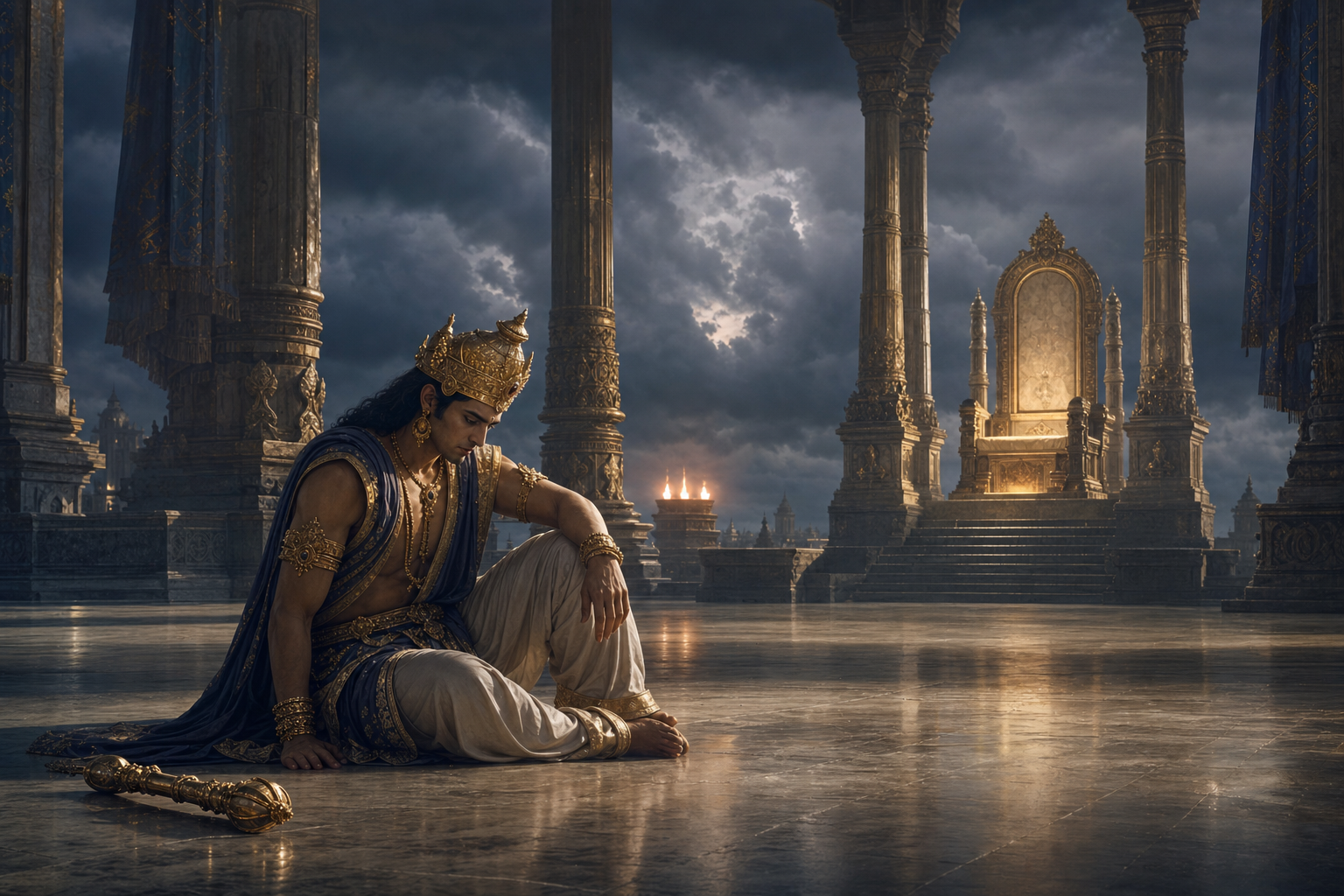
The surviving source excerpt presents the Indra-Nahusha story through an unusual doorway: before any confrontation can be understood, Indra must face the moral burden created by his own conduct. The account therefore begins with accountability rather than combat.
Because the supplied text ends mid-sentence, it does not contain the complete encounter or explain precisely why Indra could not defeat Nahusha. What it does preserve is enough to illuminate a central Dharmic principle: power does not release its holder from the consequences of action.
What the surviving account actually establishes
According to Hindu Blog, Indra, king of the devas, had slain Trishira, the three-headed son of the sage Tvashta. Trishira was also connected to the sacred order as a priest to the gods. The source describes him as having become dangerous through his ambitions, so the episode is not framed as an attack on an entirely harmless figure.
Yet the justification did not make Indra morally unaccountable. The fragment emphasizes that killing a brahmin, particularly someone belonging to a priestly lineage, carried grave significance. Since the supplied passage breaks off at that point, it would be misleading to invent the formal consequence, the later actions of Nahusha, or the mechanism by which the crisis was resolved.
Why guilt changes the meaning of strength
Indra possesses royal status and divine might, but the story’s opening places him under dharma rather than above it. That distinction is crucial. Physical capacity answers whether a ruler can act; dharma asks whether the action was rightly ordered, what obligations accompanied it, and what must follow afterward.
The source also leaves room for moral complexity. Trishira could be dangerous and his death could still impose a burden upon Indra. Dharmic reasoning need not flatten such a situation into a choice between declaring every use of force wicked and treating victory as automatic vindication. Motive, role, means, consequence and responsibility all remain relevant.
Wisdom over might without an invented ending
The source title characterizes the episode as a battle that was never fought, while its opening establishes Indra’s compromised moral position. Read together, those elements suggest that the tale’s real arena is ethical judgment, not a display of weapons. This is an interpretation of the supplied framing, not a substitute for the missing portion of the narrative.
Such a reading strengthens rather than diminishes Hindu civilizational memory. Devas are not merely figures of spectacle; their stories can examine authority, error, restraint and restoration. A culture preserves these narratives because power disciplined by dharma is more worthy of respect than power celebrated for its own sake.
Key takeaways
- Hindu Blog begins the episode with Indra’s guilt, making moral responsibility the interpretive starting point.
- The source identifies Trishira as Tvashta’s three-headed son and a priest to the gods.
- Trishira’s dangerous ambitions provide context, but they do not erase the burden attached to Indra’s act.
- The supplied fragment does not preserve the full Nahusha episode, so a responsible retelling must leave its missing events unstated.
A shared Dharmic discipline of self-command
Hindu, Buddhist, Jain and Sikh traditions remain distinct in doctrine and practice, yet each gives serious attention to disciplined action, humility and responsibility. The Indra fragment belongs specifically to Hindu sacred storytelling, but its warning against unrestrained power can support a wider Dharmic solidarity grounded in ethical self-mastery rather than forced sameness.
As fuller versions of the narrative are studied, the sound approach is to preserve that discipline: distinguish what a source reports from what a reader infers, and let wisdom guide the use of inherited power.
Inspired by this post on Hindu Blog.
