

You may revere Devi and still wonder how a radiant creatrix, a nursing mother, a lion rider, and a goddess of the cremation ground can disclose one compassionate divine power. That question is not merely about iconography. It affects whether you recognize power in your own life as domination, passive kindness, or disciplined action that helps life unfold.
Kushmanda and Tara offer a particularly clear Shakta answer. Divine power creates, sustains, protects, and carries the seeker through fear. Its tenderness is not weakness, and its fierceness is not cruelty. Each becomes intelligible when you ask what the power is serving.
Read the action of the image, not only its appearance
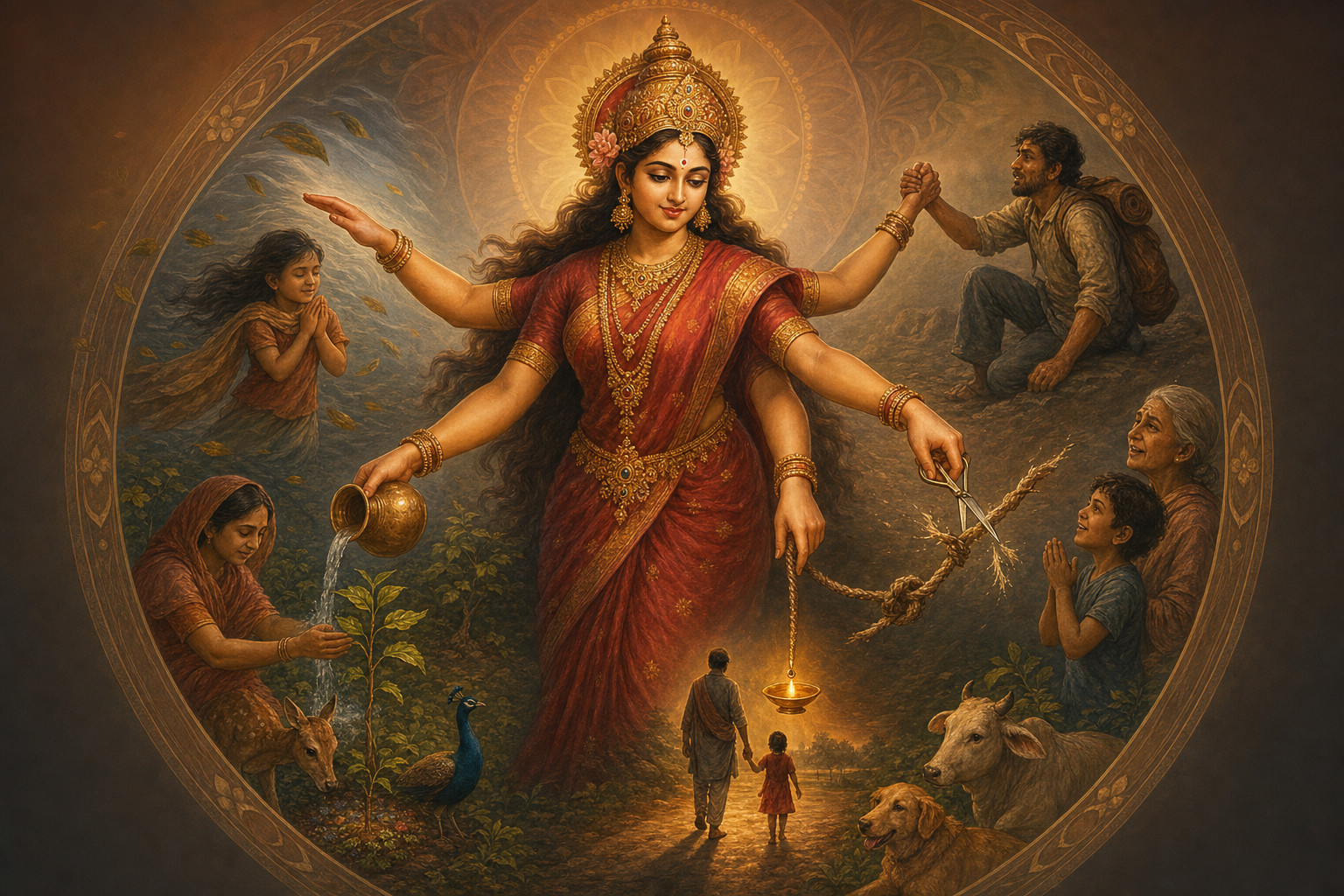
A common mistake is to sort sacred forms by mood. A serene face is labelled compassionate; weapons and cremation-ground signs are labelled frightening. This leaves you with two incomplete ideas of Devi: a gentle mother who never confronts anything and a fierce power with no purpose beyond force.
Shakta iconography asks for a more exact reading. Do not begin with, “Does this form look comforting?” Begin with, “What does this form of power make possible?” Creative power brings potential into form. Sustaining power gives that form nourishment and continuity. Protective power confronts whatever prevents life, clarity, or liberation. Compassion can work through all three.
The maternal image of Tara nursing Shiva makes the relationship vivid: consciousness is not presented as isolated from the dynamic power that sustains it. In this vision, Shakti nourishes the very consciousness symbolized by Shiva. Power is therefore not an accessory attached to the divine. It is how divine presence becomes active, relational, and life-giving.
Use three questions whenever a Shakta image puzzles you:
- What is being brought into being? Look for life, order, insight, courage, relationship, or a path through difficulty.
- What obstruction is being met? It may be inertia, fear, attachment, confusion, or the refusal to face impermanence.
- How is the devotee being related to? The deity may generate, feed, guard, guide, awaken, or carry the seeker across a threshold.
This method also tests human uses of power. If an action calls itself protective but only humiliates, it has lost its compassionate end. If kindness preserves confusion because truth feels uncomfortable, it has lost discernment. Shakta power holds purpose, courage, and care in one field.
Kushmanda reveals compassion as the gift of beginning
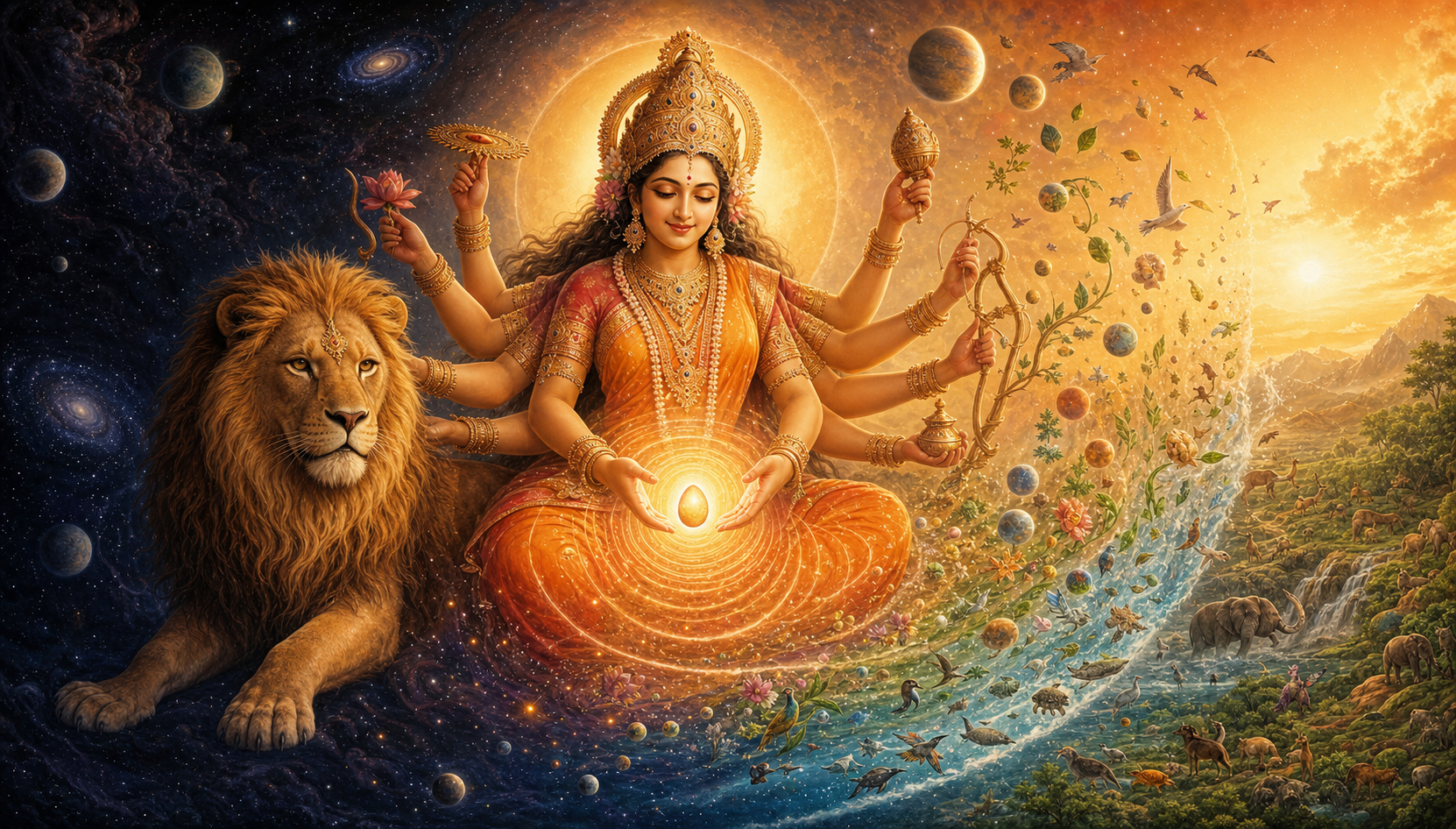
Kushmanda is honored as the fourth of Durga’s nine manifestations and the focus of the fourth day of Navaratri. Her place in the sequence directs attention to the moment when latent power begins to take shape. She is not simply associated with an object already made. She embodies the movement from unmanifest possibility toward an ordered, living world.
One devotional interpretation hears three elements in her name: ku, the subtle; ushma, warmth or vital heat; and anda, the cosmic egg. This should be approached as a sacred interpretation of the name rather than forced into a single philological claim. Its spiritual force lies in the image it creates: primordial warmth animating the cosmic egg.
That image corrects a hurried idea of creation. A beginning is not only an announcement, desire, or burst of activity. Potential needs warmth, attention, and a form capable of holding what is emerging. A vow without discipline remains subtle. An idea without a first embodied action remains unmanifest. Energy becomes creative when it acquires direction and becomes sustaining when its form can support life beyond the first impulse.
Kushmanda is commonly shown with eight arms, riding a lion and carrying such objects as a bow, arrow, rosary, lotus, and vessel of nectar. The details should not be reduced to a decorative inventory. Read as a whole, the image joins courage with direction, disciplined attention with unfolding life, and vigorous action with nourishment. The many arms suggest that creation is not one undifferentiated force. It requires several capacities to work in coordination.
You can use Kushmanda’s vision whenever you face a beginning. Put one actual situation in front of you and ask:
- What is still subtle? Name the intention before it disappears into vague aspiration.
- What warmth does it require? Identify the attention, learning, discipline, encouragement, or material support that would let it mature.
- What is its first honest form? Choose an action visible in the world, not another private promise.
- Whom will this creation nourish? Test whether the result serves life beyond your wish to possess, impress, or control.
The last question is where creative power becomes compassionate power. Shakti is not merely the capacity to produce more. In Kushmanda’s symbolism, the universe is warmed into life and provisioned. Your smaller act of creation should likewise be judged by the kind of life it enables.
Tara reveals compassion at the edge of fear

At Tarapith, Tara is encountered through complementary modes: an inner, frequently veiled aniconic presence and an anthropomorphic maternal image associated with Tara nursing the infant Shiva. The first points toward a reality that exceeds representation. The second lets the devotee approach that reality through relationship, dependence, and care. Form and formlessness are not competing claims here. They are different ways of meeting the same sacred presence.
Tara’s name is connected with the Sanskrit root meaning “to cross.” Her compassion is therefore not confined to consolation at a safe distance. She is the power by which a seeker crosses suffering, fear, and attachment. The maternal form tells you that passage requires nourishment; her fiercer surroundings tell you that nourishment does not depend on pretending the threshold is easy.
The cremation ground, skull imagery, and jackals associated with Tarapith place Tara amid impermanence and the aspects of existence people prefer not to face. These signs turn fear and attachment into matters for spiritual insight; they do not celebrate death for its own sake. Tara meets the devotee where ordinary assurances fail.
The nursing mother and the guardian of terrible thresholds belong to one theology. Protection makes nourishment possible. Nourishment reveals what protection is for. Fierceness without care would become mere destruction, while care unwilling to face danger would leave the vulnerable unguarded.
When you are at a threshold, divide the situation into two questions. First ask, “What must no longer be allowed to consume or confuse what is valuable?” Then ask, “What must continue to be fed while I cross this difficulty?” The first question identifies a boundary. The second prevents that boundary from hardening into bitterness, isolation, or punishment.
A mantra, lamp, flower offering, or participation in aarti can gather attention around these questions. But devotional focus should lead into the concrete duty the situation requires. If a conversation must be held, a commitment fulfilled, an error admitted, or a harmful pattern interrupted, spiritual language must not become a way to postpone the act.
Keep divine power from becoming a slogan for domination
Calling something “Shakti” does not automatically make it dharmic. Energy, charisma, productivity, and force can all serve ego. The decisive issue is their direction. Creative power should give worthy possibility a form. Protective power should preserve what ought to flourish. Compassionate power should reduce needless suffering without hiding truth.
Several distinctions keep the vision clear:
- Creation is not compulsive production. Bringing the right thing into being may require restraint, incubation, or the abandonment of a poorly formed intention.
- Compassion is not passive agreement. Tara’s fierce dimension shows why care sometimes needs a boundary, an interruption, or an unflinching encounter with impermanence.
- Fierceness is not personal aggression. Sacred ferocity serves protection and liberation; it does not authorize cruelty, humiliation, or the enjoyment of another person’s fear.
- The Divine Feminine is not a social demand that every woman be endlessly nurturing. The icons disclose capacities of divine reality. They should not be used to deny human beings rest, agency, complexity, or protection.
- Form and formlessness are not mutually exclusive. Tarapith’s two modes show how a devotee can honor an ineffable reality while still entering a personal relationship with the Mother.
Tara also resonates across Hindu and Vajrayana Buddhist devotion. Shared language around compassion and deliverance can open a genuine Dharmic conversation, just as ahimsa, seva, disciplined conduct, and compassion create ethical resonances among Hindu, Buddhist, Jain, and Sikh paths. Resonance is not sameness. Respect grows when you notice a shared value without erasing the distinct theology, practice, or community carrying it.
Key takeaways
- Judge a Shakta image by the divine action it reveals, not only by whether its surface appears gentle or frightening.
- Kushmanda shows compassion as the power to warm potential into a form that can sustain and nourish life.
- Tara joins protection with nurture, especially where fear, loss, attachment, or uncertainty must be faced rather than denied.
- Fierceness remains dharmic only while it serves clarity, protection, and liberation instead of ego or domination.
- A mature use of power asks what you will create, what you will protect, and what you will continue to nourish.
Turn contemplation into one compassionate act

You do not need to invent an elaborate ritual to apply these visions. The following contemplative sequence can accompany your established practice, whether that includes a Devi murti, a lamp, mantra, silent prayer, or simple inward attention.
- Bring one real situation before Devi. Choose an unfinished beginning or a threshold you have been avoiding. Do not try to solve your whole life in one sitting.
- Name what is subtle. Complete the sentence, “What is trying to take form is…” Use concrete language.
- Identify the needed warmth. Ask what sustained attention, discipline, knowledge, encouragement, or nourishment would help that possibility mature.
- Face the obstruction. Name the fear, attachment, confusion, or inertia that keeps the situation suspended.
- Pair a protective act with a nourishing act. Decide what boundary or interruption is needed, then identify what person, relationship, duty, or inner capacity still needs care.
- Give the answer a visible form. Replace “be more compassionate” with an action such as making the call, stating the boundary calmly, beginning the work, offering practical help, or admitting the mistake.
- Offer the outcome and begin. Let devotion loosen the demand to control every result, while accepting responsibility for the next action that is yours.
Suppose the situation is a strained relationship. A creative act might open a truthful conversation instead of rehearsing it privately. A protective act might refuse contemptuous speech. A nourishing act might listen carefully to what can be repaired. None of these guarantees agreement. Together, however, they prevent compassion from collapsing into either avoidance or retaliation.
Choose one unfinished beginning or feared threshold before you leave this reflection. Ask what Kushmanda would have you bring into form and what Tara would have you protect and feed. Then enact the smallest honest answer available to you. That is where Shakti moves from admired imagery into dharmic conduct.
References
- DharmaRenaissance Blog – Kushmanda: Unveiling the Cosmic Creative Power of Durga and Its Life-Shaping Symbolism
- DharmaRenaissance Blog – Goddess Tara at Tarapith: Decoding the Divine Symbolism of the Twin Murti Forms
