

You may be deciding whether to confront someone, answer an insult, punish misconduct, or use authority against a wrongdoer. The pressure is familiar: if you pause, will restraint be mistaken for weakness? If you act, will anger take control of the action?
Rama offers a demanding answer. Strength is not proved by doing everything within your power. It is proved by keeping power under moral discipline, acting when dharma requires protection, and stopping when the just purpose has been achieved. That ethic gives you a practical way to handle conflict without becoming passive, vindictive, or careless about whom your response may hurt.
What Rama restrains first is himself

Power enters a conflict twice. First, you discover what you can do. Then you must decide what you are entitled to do. Confusing those two questions is where domination begins.
Rama possesses extraordinary martial ability, but ability alone never becomes his moral warrant. His acceptance of vanvas is the clearest early example. Faced with personal loss, he does not treat his status or strength as permission to tear apart the surrounding order. He accepts exile rather than assert entitlement through force.
This is not a rule of automatic obedience. Restraint does not require you to comply with every demand, tolerate abuse, or abandon someone who needs protection. The relevant distinction is between a burden that injures your pride and a wrong that leaves another person exposed. Rama can accept hardship directed at himself while still acting decisively when protection and justice become his responsibility.
Before responding to a conflict, ask: What will remain unprotected if I do nothing? Name the person, duty, principle, or community at risk. If your honest answer is only your image, your desire to have the last word, or your wish to make someone regret challenging you, the first work is inward. If silence would permit continuing harm, restraint may require controlled action rather than withdrawal.
This is also why krodha, anger, must be governed before power is used. Anger may alert you that something matters, but it is a poor author of objectives. Rama’s composure does not depend on feeling nothing. It depends on binding feeling to a defined moral purpose. Do not decide the penalty while imagining the satisfaction of delivering it. Decide what protection or repair actually requires.
Three episodes reveal the shape of proportionate power
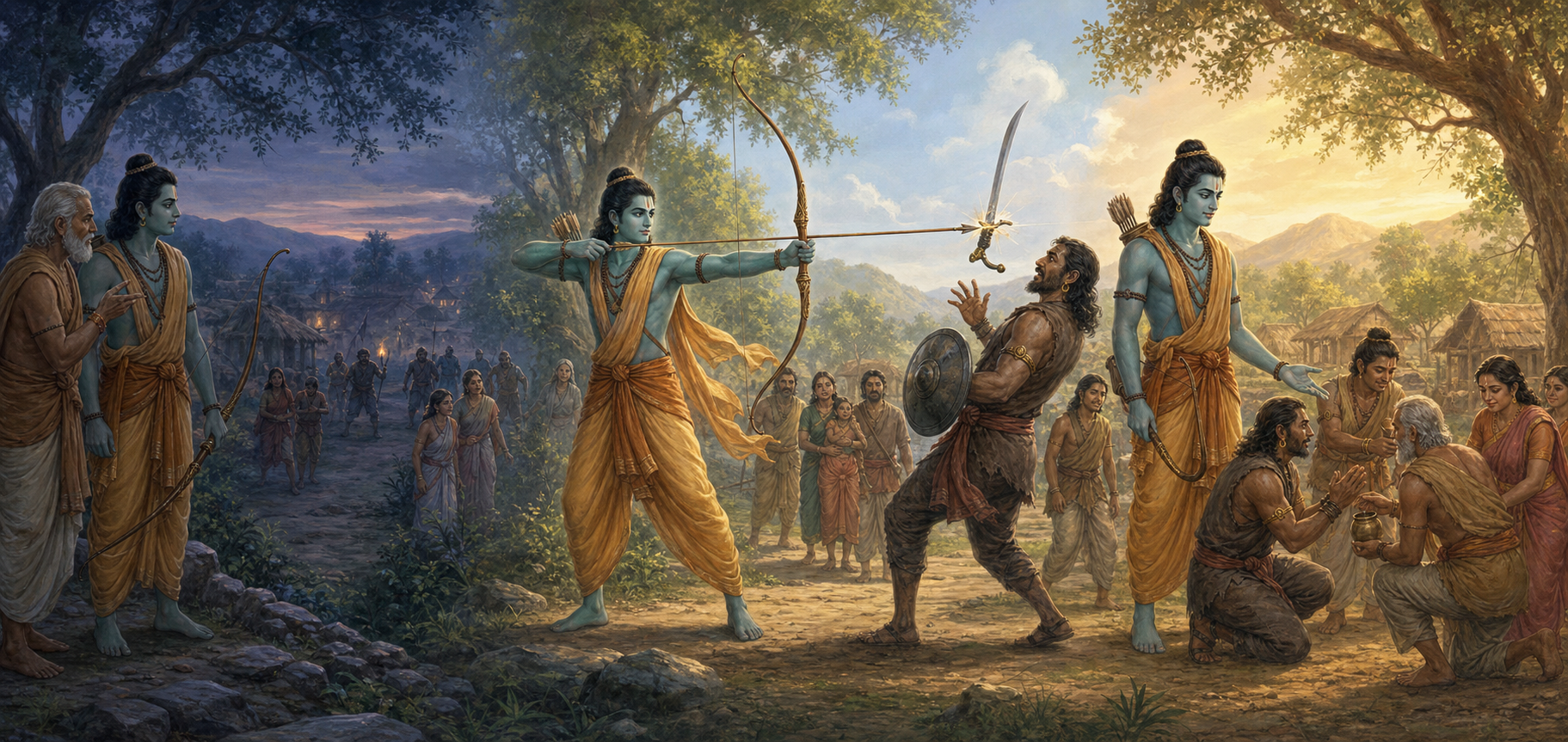
Restrained heroism is easier to understand when you watch what happens before, during, and after force is used. Three episodes provide three different tests: how to treat a repentant offender, how to receive truth from an opposing camp, and how to end a conflict without turning victory into collective punishment.
Kakasura: correction must not become vengeance
In the encounter with the crow-demon Kakasura, Rama releases a celestial weapon to stop wrongdoing. Yet when the offender submits in contrition, Rama spares him rather than pursue destruction for its own sake.
The sequence matters. Mercy does not erase the need to confront the wrong, and confrontation does not erase the possibility of mercy. A corrective response asks what will stop the misconduct, acknowledge its seriousness, and protect those affected. A vindictive response keeps adding harm after those purposes have been met.
Use that distinction when you hold authority. You may need to revoke access, correct a falsehood, impose a consequence, or remove someone from a responsibility. Once the danger has been contained and accountability established, do not add public humiliation merely because you can. The extra injury is not justice; it is anger collecting interest.
Vibhishana: discernment is stronger than suspicion
When Vibhishana seeks refuge, Rama does not allow his origin in the opposing camp to settle the question. He receives the person who comes in good faith and judges the choice now being made.
This is restraint applied to suspicion. In polarized disputes, group identity becomes a shortcut: anyone who comes from the other side is treated as permanently contaminated. That shortcut feels protective, but it prevents repentance, defection from wrongdoing, and truthful cooperation.
You do not have to become naive. Examine conduct, consistency, risk, and the responsibility being requested. But do not convert caution into a doctrine that no one may cross a moral boundary in the right direction. A dharmic response leaves a real path back to right action.
Lanka: victory does not make everyone guilty
The war in Lanka is directed toward restoring order, not acquiring an unlimited licence to destroy. Fallen enemies receive due rites. The people are not condemned for the ruler’s choices. Vibhishana is affirmed as a legitimate custodian of stability. The result separates the wrongdoer, the wider population, and the order that must continue after conflict.
That separation is indispensable in public life. When one person acts badly, do not punish a family, workforce, religious community, nationality, or political constituency by association. When an institution fails, distinguish responsible decision-makers from people who had neither knowledge nor control. When the immediate dispute ends, ask what arrangement will prevent chaos and renewed retaliation.
These episodes form a disciplined sequence: delay force until it serves a just necessity, discriminate carefully while acting, and stop when the protective purpose is complete. Restraint governs every stage, not merely the opening decision.
Use this six-question dharmic response test

Rama’s example can be translated into a decision test for arguments, workplace discipline, community disputes, public advocacy, and political power. Write down the answers before taking any public or difficult-to-reverse action.
- What exactly am I protecting? Identify the vulnerable person, legitimate duty, truthful record, or shared order at stake. “My standing” and “my need to win” are warnings that wounded pride may be setting the objective.
- What is the smallest just aim? Replace a goal such as “defeat them” with something bounded: stop the harmful conduct, correct the record, restore what was taken, protect access, or establish accountability. A bounded aim makes excess easier to recognize.
- Can a less harmful measure accomplish that aim? Clarification, a private correction, mediation, withdrawal of a specific privilege, or a formal process may work before broader escalation. Last resort does not mean waiting helplessly while harm continues; it means not choosing a harsher instrument merely because it is emotionally satisfying.
- Is the response proportionate to the wrong? Match the remedy to the actual harm and continuing risk. Do not answer a limited offence with permanent ostracism, expose unrelated private information, or turn correction into a campaign of humiliation.
- Who is not responsible? List the people who must be kept outside the conflict. The protection of noncombatants becomes, in ordinary life, a refusal to target relatives, colleagues, followers, customers, or an entire community for another person’s decision.
- What is my stop condition? Decide in advance what completion looks like: the conduct has ceased, the record is corrected, safety is restored, restitution is arranged, or responsible authority is in place. Without a stop condition, a protective action can quietly become a vendetta.
If you cannot answer these questions clearly, postpone the public escalation while you define them. A pause is not surrender. It prevents the heat of the moment from choosing a larger target than dharma permits. When delay would expose someone to continuing danger, take the minimum protective action first and review broader consequences only after immediate protection is secured.
Ahimsa needs courage, and courage needs ahimsa

Restraint is sometimes misread as an inability to fight. That interpretation misses the union of ahimsa and kshatra dharma. A refusal to cause unnecessary harm is incomplete if it leaves the vulnerable defenceless. Protective courage is equally incomplete when it treats cruelty as evidence of seriousness.
The moral criteria associated with dharma-yuddha help preserve that union: a clean intention, a just cause, recourse to force only when necessary, proportionality, and protection for those who are not fighting. These are constraints on power rather than decorations placed around it. If they disappear as soon as victory becomes possible, they were never governing the action.
Related emphases appear across the dharmic family without making the traditions interchangeable. Buddhist karuna centres compassionate regard. Jain discipline presses the demand of non-violence with exceptional rigour. The Sikh sant-sipahi joins saintly character to the courage of a defender. Hindu kshatra dharma places protective strength under dharma. The shared civilizational insight is not that every tradition authorizes the same acts. It is that outer action cannot be righteous when the actor refuses inner discipline.
This gives you two ways to detect counterfeit heroism. The first glorifies passivity because choosing is difficult: it calls inaction peaceful even while preventable harm continues. The second glorifies aggression because self-command is difficult: it calls excess courageous even after protection has been secured. Rama’s ethic rejects both evasions.
For leaders, the test becomes visible in language and aftermath. Describe the wrongful conduct instead of declaring a whole class of people evil. Preserve a route for correction and return. Keep the common good above personal acclaim. After a necessary confrontation, restore stable and legitimate order rather than prolonging emergency powers or celebrating an opponent’s degradation. The means are already shaping the peace that follows.
Key takeaways for your next conflict
- Do not mistake the ability to retaliate for moral permission to retaliate.
- Name what requires protection before choosing a consequence.
- Use the least harmful action that can reliably meet the just aim.
- Judge responsibility precisely; never transfer one person’s guilt to an uninvolved group.
- Leave room for contrition, truthful cooperation, and return to right conduct.
- Set a stop condition before acting, then stop when justice and protection have been secured.
Before your next consequential reply, decision, or confrontation, write four short lines: Aim. Least sufficient action. People to protect from spillover. Stop condition. If anger prevents you from completing them honestly, master the impulse before exercising the power.
Then act as firmly as protection requires, without adding the injury that pride demands. Rama’s restrained heroism begins at that exact boundary: where strength accepts an answer higher than itself.
References
