
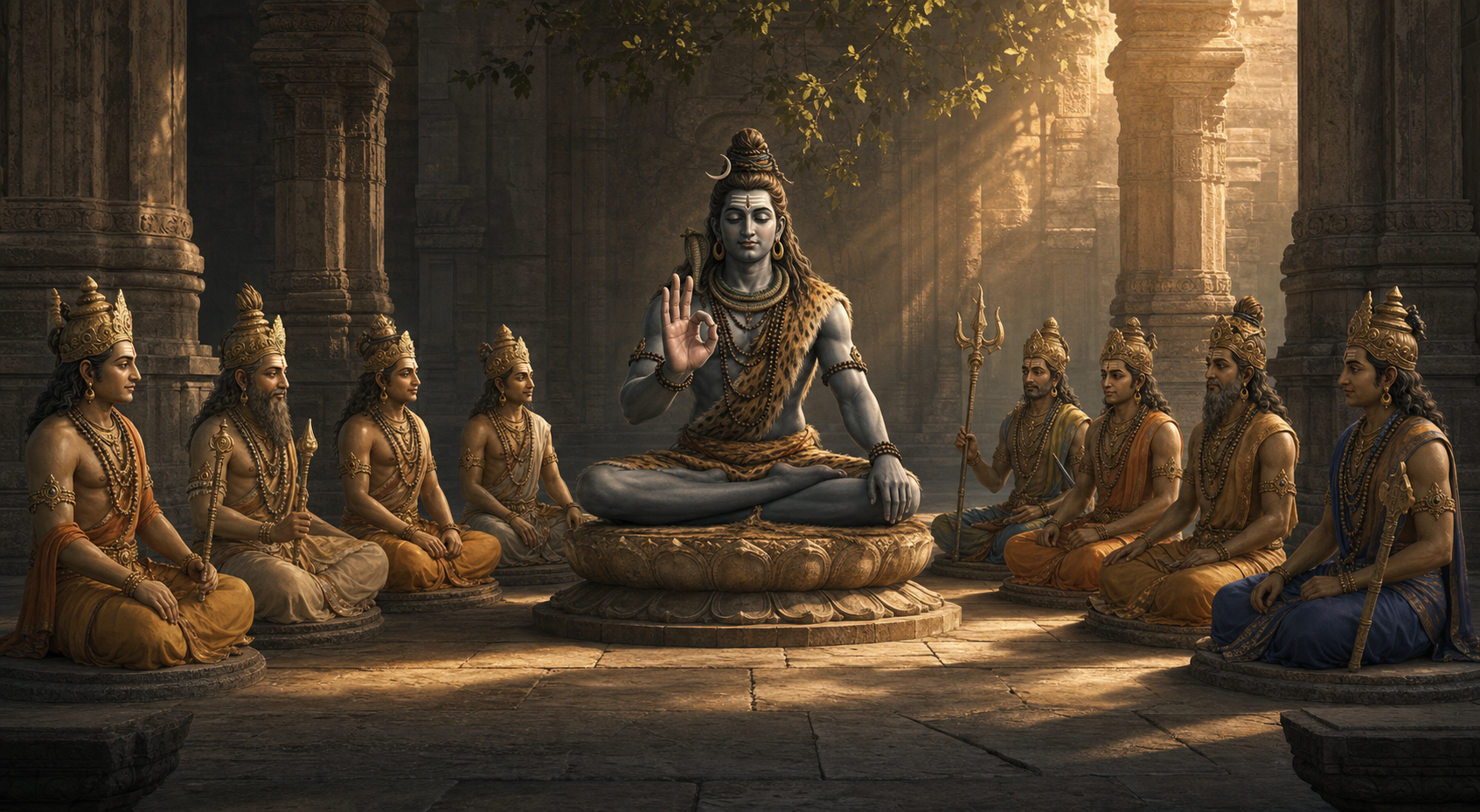
You recognize Shiva, notice a hand gesture or a circle of attendant forms, and sense that the image is saying more than its label explains. The difficult part is knowing how to read it without reducing sacred art to decoration, inventing a private symbolism, or treating every feature as a code with one fixed translation.
The Cin Mudra and the eight Vidyesvaras offer a practical way into this question. One makes knowledge visible through a deliberate gesture. The other presents knowledge through divine transmitters. Once you distinguish the sign of wisdom from the beings who bear it, Shaiva sculpture becomes easier to approach with both intelligence and reverence.
Begin with transmission, not identification
A museum label may tell you the name of a figure, the material of an image, or the period in which it was made. Those details matter, but they don’t yet tell you what the sacred form is doing. In Shaiva art, the more productive question is often: how is knowledge moving here?
Ask three questions as you look:
- Where does knowledge originate? In the examples considered here, its ultimate source is Shiva.
- How does it become perceptible? It may appear through a gesture, a divine form, an ordered group of emanations, or an Agamic teaching.
- What does the image ask of you? It may call for recognition, disciplined attention, contemplation, or learning within a living tradition.
This keeps you from making two opposite mistakes. The first is to see only an attractive object. The second is to assign a grand metaphysical meaning to every visual detail before establishing what is actually present.
A simple note-taking method helps. Divide your observations into three columns: what you can see, what the tradition identifies, and what you infer from those two. If a claim belongs only in the third column, present it as interpretation rather than settled iconography.
Cin Mudra turns the hand into a vehicle of teaching
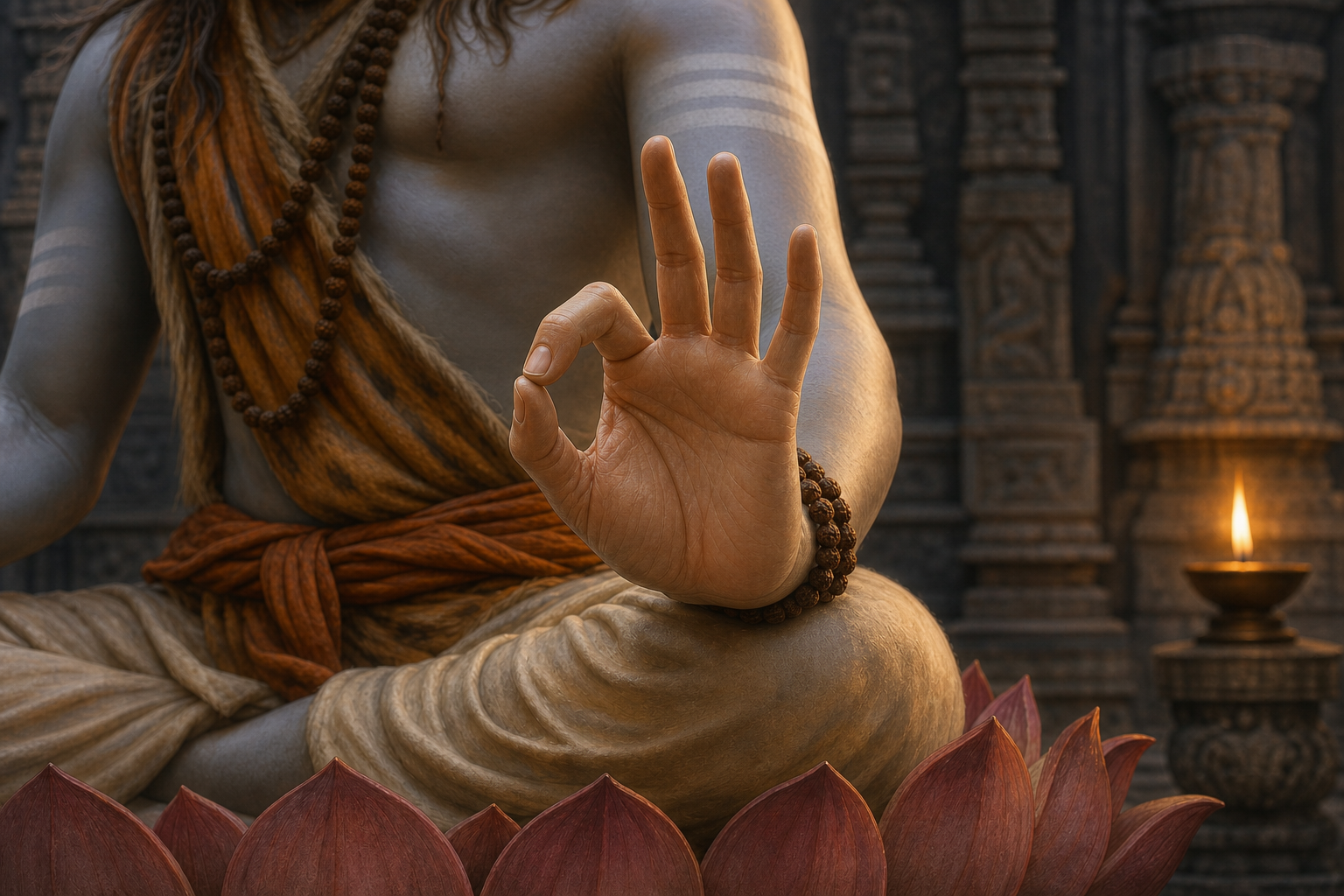
The Cin Mudra belongs to a visual language in which a hand gesture can communicate inner wisdom, enlightenment, and supreme knowledge without spoken explanation. It is commonly recognized by the meeting of the thumb and index finger while the other fingers extend. Yet recognizing that shape is only the beginning of reading it.
A mudra is not an ornamental flourish added after the theology has been decided. The embodied form is part of the teaching. The hand directs your attention toward knowledge that cannot be exhausted by a verbal definition. The sculpted body therefore does more than represent a teacher; it participates in the act of teaching.
Use three passes when you encounter a possible Cin Mudra:
- Describe before naming. Note which fingers meet, which hand is used, the direction of the palm, the posture of the figure, and the placement of the gesture in relation to the body.
- Read the whole composition. Identify the deity or teacher, the other attributes, the surrounding figures, and the ritual or architectural setting. A hand shape should not carry the entire burden of identification by itself.
- Move from sign to contemplation. Once the traditional identification is reasonably secure, ask what kind of attention a gesture of inner wisdom requires from you. The appropriate response is sustained reflection, not merely recognition of an iconographic term.
Resist the urge to turn the gesture into a universal emoji. Different contexts can give similar hand arrangements different emphases. If your interpretation works only after ignoring the identity, posture, or surrounding attributes of the figure, it is probably too confident.
The safest concise reading is also a substantial one: Cin Mudra makes knowledge present through the disciplined eloquence of the body. You can begin there without pretending that one visual feature supplies a complete account of every Shaiva doctrine.
The Vidyesvaras present knowledge through divine agency
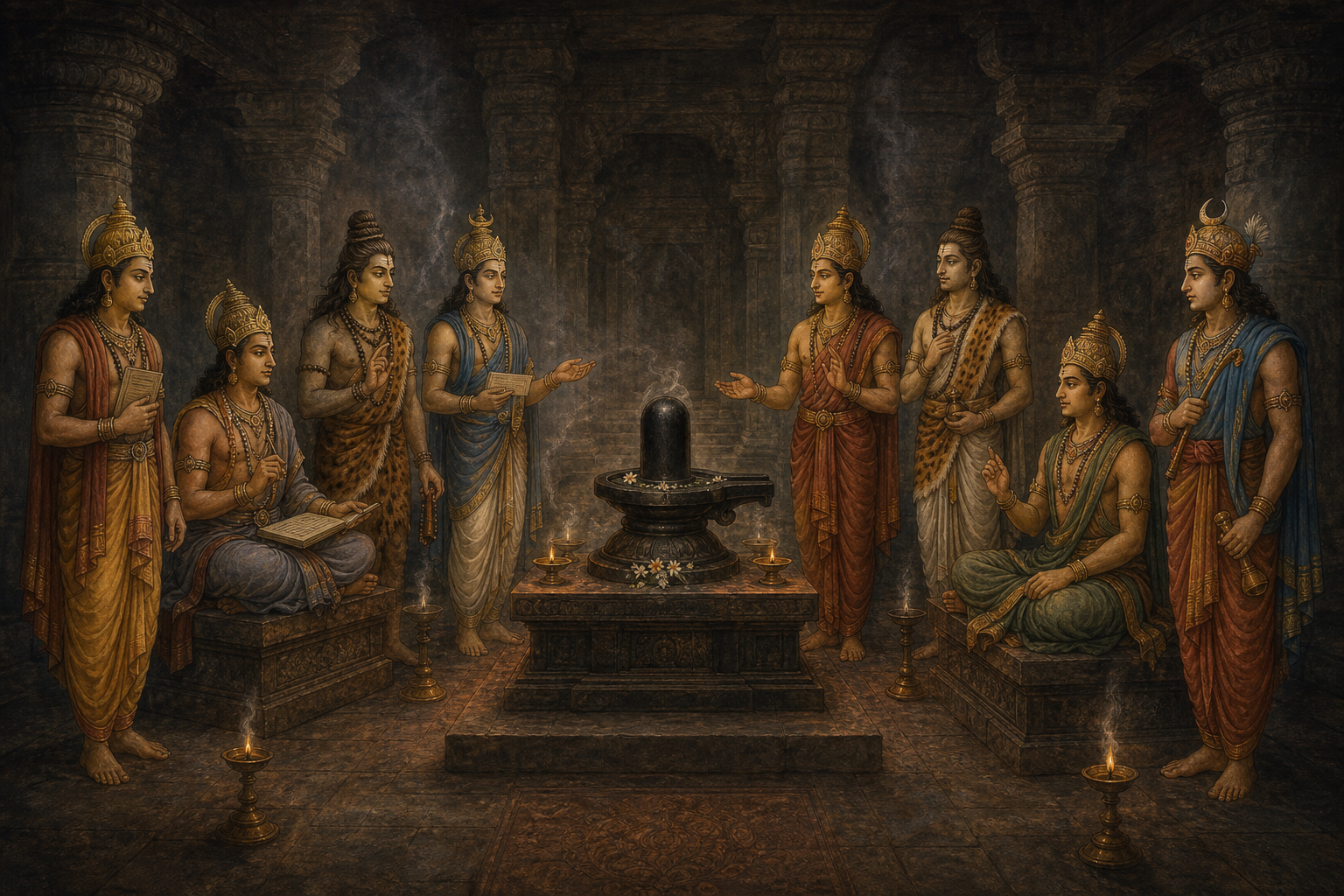
Within the doctrinal world of the Shaiva Agamas, the Vidyesvaras are eight divine emanations associated with Shiva’s jnana shakti, his power of pure and transcendent knowledge. Their role is not exhausted by representing an abstract idea. They are transmitters of Agamic wisdom.
That distinction matters. A symbol points beyond itself. A transmitter bears, orders, or communicates what proceeds from the divine source. The Vidyesvaras therefore allow you to see sacred knowledge not as detached information but as an active power expressed through differentiated divine forms.
Keep the theological arrangement clear:
- Shiva is the source. Sacred knowledge does not originate independently in eight competing authorities.
- Jnana shakti is the power being expressed. Knowledge here is a divine capacity, not merely a collection of statements.
- The eight Vidyesvaras are differentiated emanations. Their plurality gives form and order to the transmission without displacing Shiva.
- Agamic wisdom is the field of transmission. The concept belongs within a Shaiva scriptural and theological framework, not an arbitrary modern system of symbolism.
Read this as a relationship between source and expression, not as a transfer after which the source becomes absent. The emanations make the operation of Shiva’s knowledge more intelligible while remaining dependent upon Shiva.
The number eight is specific, but specificity is not permission to speculate. An unlabeled group of eight figures is not automatically a group of Vidyesvaras. Look for identification supplied by the temple tradition, an Agamic context, a reliable catalogue, an inscription, or a qualified teacher. Count what you see, but don’t let counting replace contextual evidence.
Read the symbol and the transmitter as different pathways
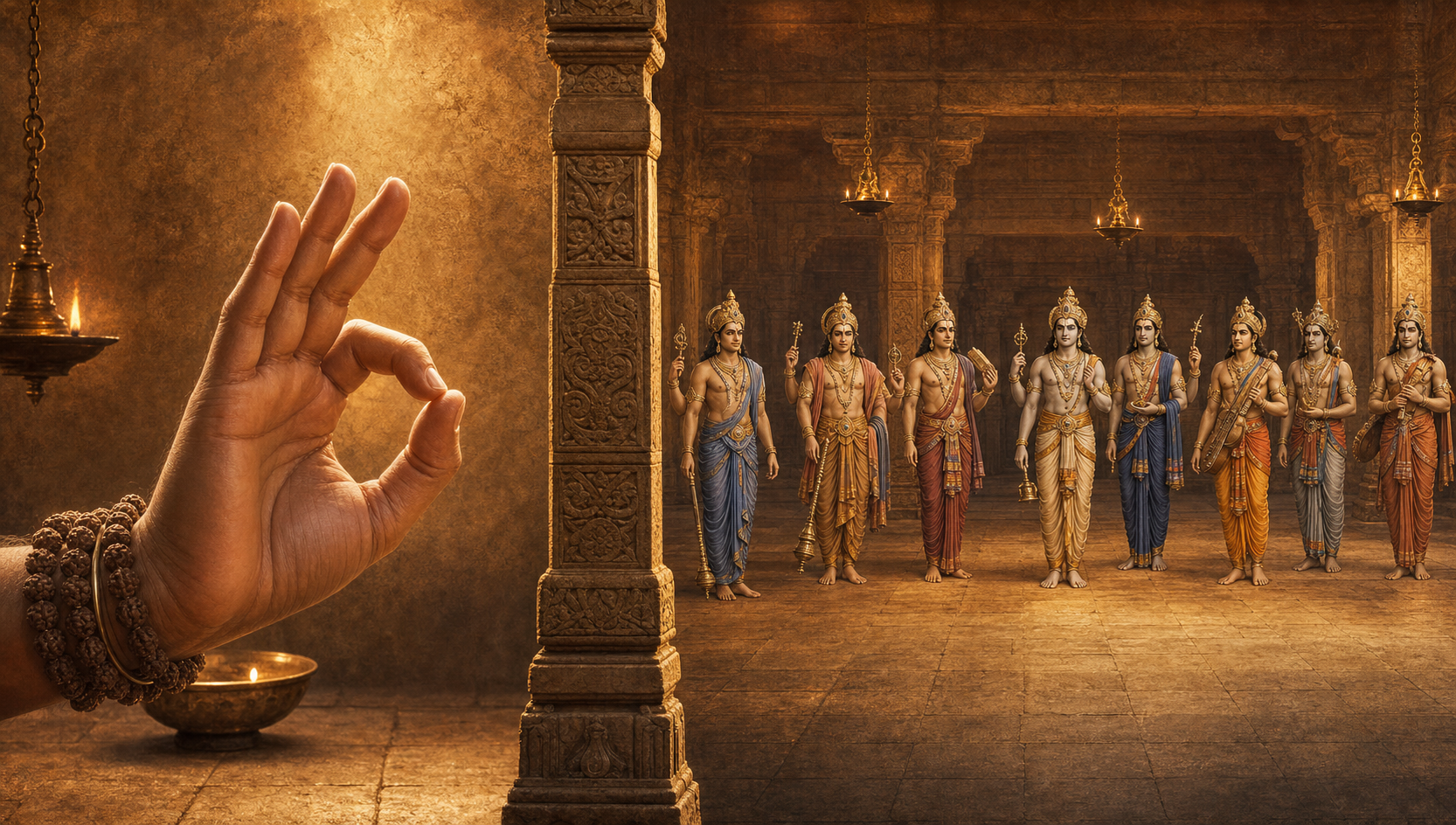
Cin Mudra and the Vidyesvaras do related work through different means. The mudra answers, in part, how sacred knowledge can be shown: the body becomes a silent teaching. The Vidyesvaras answer through whom divine knowledge can be ordered and conveyed: Shiva’s jnana shakti takes the form of multiple emanations.
This distinction gives you a repeatable method for approaching Shaiva sacred art:
- Identify the medium. Is the teaching carried by a gesture, posture, attribute, divine person, group, inscription, or combination of these?
- Separate source from bearer. Ask whether the form originates knowledge, embodies a power, transmits a teaching, or directs the viewer toward it.
- Establish the traditional setting. Determine whether you are looking at an Agamic, temple, sculptural, philosophical, or contemplative context. Don’t detach a motif from the system that gives it meaning.
- State only what the evidence supports. Begin with a narrow interpretation and widen it only when the other features of the image agree.
- Convert recognition into practice. Let a gesture of wisdom slow your attention. Let a group of divine transmitters remind you that sacred learning requires a trustworthy chain between origin, teaching, teacher, and recipient.
For a Cin Mudra, your first statement might be: “The meeting of the fingers resembles a recognized gesture of inner or supreme knowledge.” You would then test that reading against the identity and setting of the figure. For the Vidyesvaras, begin with evidence that the figures belong to the Agamic category before interpreting them as expressions of Shiva’s knowledge-power.
This method also protects personal reflection. Your response to a sacred image can be sincere and fruitful without being presented as the image’s historically established meaning. Tradition and contemplation don’t have to compete, provided you don’t confuse one with the other.
Key takeaways
- Shaiva sacred forms should be read as participants in transmission, not merely as decoration.
- Cin Mudra communicates knowledge through a deliberate bodily gesture and invites contemplative attention.
- The eight Vidyesvaras express Shiva’s jnana shakti as differentiated divine transmitters of Agamic wisdom.
- A gesture and an emanation are not interchangeable: one signifies through embodied form, while the other bears divine agency.
- Describe the visible form first, establish its context second, and interpret it third.
- Don’t identify the Vidyesvaras from the number eight alone or infer an entire doctrine from one hand shape.
The next time you stand before a Shaiva image, spend the first minute describing it without naming it. Then ask where knowledge originates, what carries it, and what kind of attention it asks from you. Those questions will take you farther than a hurried label.
References
- Hindu Blog — The Vidyesvaras: Shiva’s Eight Emanations of Sacred Knowledge
- Hindu Blog — The Cin Mudra in Hindu Sculpture and Philosophy – Gesture of Supreme Knowledge