You have been given something worth building: a project, a community responsibility, a body of knowledge, or a role that affects other people. The difficult question is not whether you should act confidently. It is how to act without letting “I can do this” harden into “this exists because of me.”
Hindu creation theology answers that question through the awakening of Brahma. Its central lesson is demanding but practical: humility is not thinking less of your ability. It is seeing your ability, its source, its limits, and its purpose accurately enough to use it in service of dharma.
Creation starts with dependence, not possession
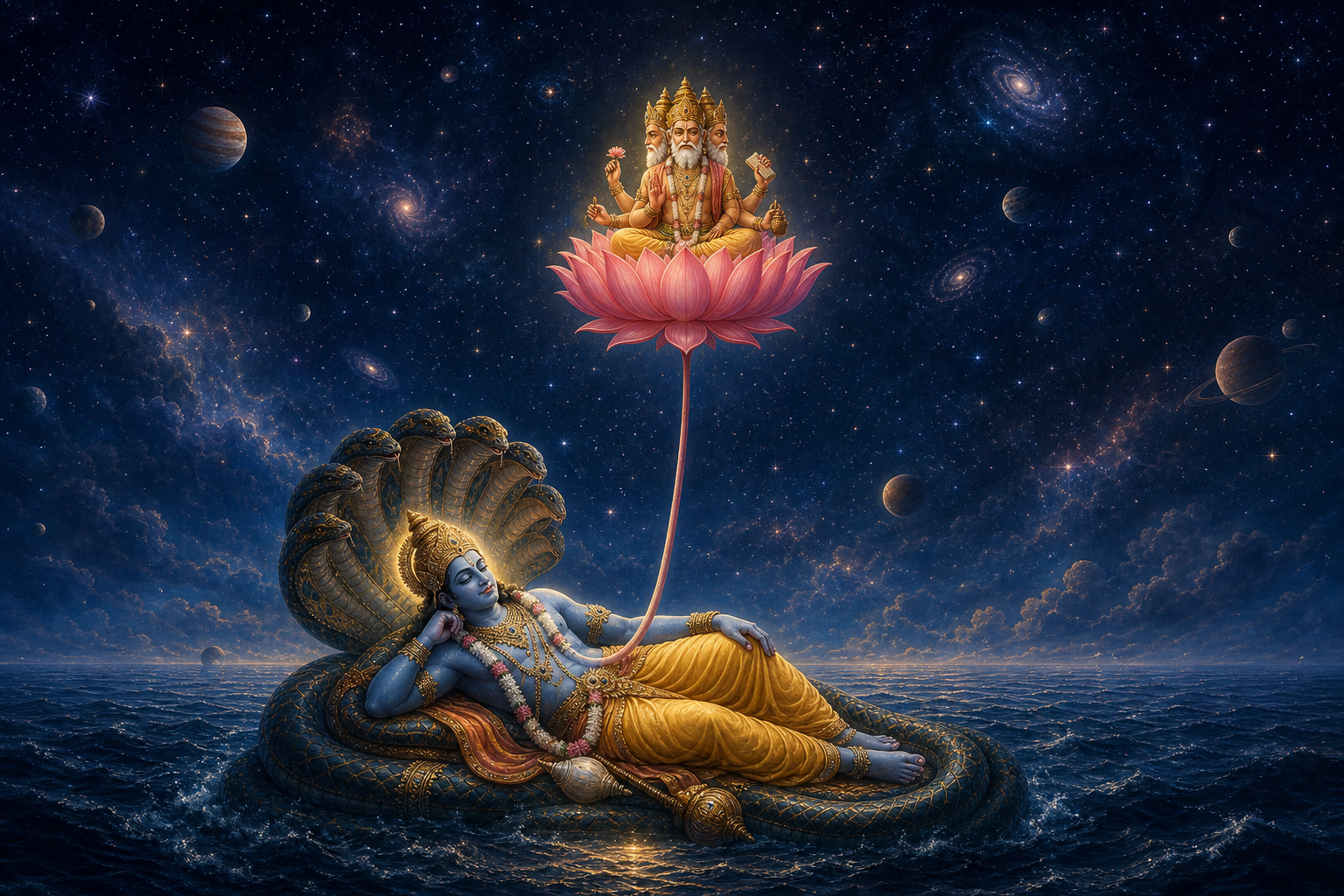
Before Brahma creates a world of distinctions, there are the primordial waters: potential before name and form. Vishnu rests upon Shesha in yoga-nidra, poised rather than inactive. Shesha evokes the without-end, while the waters hold what has not yet become a separate, describable thing. The image places sustaining consciousness and measureless time before the appearance of the creator.
The lotus then rises from Vishnu’s navel, and Brahma appears upon it. This is already a teaching about authorship. Brahma has a real and indispensable creative function, but he does not manufacture the ground from which he arises. Creative intelligence is powerful without being self-originating.
Brahma’s first experience is therefore significant: it is uncertainty, not self-congratulation. He searches for his origin, turns inward, and undertakes tapas before beginning creation. His four faces signify comprehensive sacred knowledge, yet knowledge alone does not authorize immediate action. Right vision must precede right creation.
Use that sequence whenever responsibility expands. Before you begin, write down three things:
- What sustains this work but was not created by you: teachers, family, inherited knowledge, institutions, land, language, or previous labor.
- What you genuinely know how to do, without either exaggerating or belittling it.
- What remains outside your knowledge or control and therefore requires consultation, patience, or prayer.
This is not a ritual of self-deprecation. It is an authorship audit. It stops stewardship from quietly becoming possession. If you cannot name what made your work possible, success will eventually tempt you to mistake the lotus for its own root.
Ahamkara gives you agency, then tempts you to claim sovereignty
The Sanskrit term ahamkara is often translated as ego, but “I-maker” exposes its function more precisely. In classical Samkhya, prakriti first unfolds as mahat, the great principle associated with cosmic intelligence or buddhi. From mahat arises ahamkara, which organizes experience around an apparent center: I perceive, I choose, I make, I defend.
Ahamkara is therefore not merely vanity. Without a functional center of agency, ordinary action could not be coordinated. The theological problem begins when the organizing center claims to be the independent source of the powers it organizes.
Samkhya makes the point through the three gunas. The sattvic aspect of ahamkara is associated with the capacities of knowledge and their presiding powers. Its rajasic aspect supplies propulsion and activity. Its tamasic aspect contributes to the unfolding of subtle essences and gross elements. The same “I-maker” participates in knowing, doing, and material differentiation. It is woven into manifestation, not pasted onto it as an accidental moral defect.
That distinction changes how you should examine ego. Do not ask only, “Am I proud?” Ask where a useful claim of responsibility has crossed into a false claim of independence.
Four signs that agency has become self-claiming
- You can describe your contribution but resist naming the conditions and people that made it possible.
- You treat correction as an attack on identity rather than information about the work.
- You alter the truth to preserve your status, especially after making a public claim.
- You measure the value of the result mainly by how much recognition returns to you.
The reverse error is also possible. Humility does not require saying, “I did nothing,” when you did real work. Nor does it permit you to avoid a difficult decision by pretending to have no agency. Brahma receives perspective and then creates. He does not use dependence upon the sustaining reality as an excuse to abandon his responsibility.
Yoga philosophy identifies a related distortion as asmita: identification of the seer with the instruments through which seeing occurs. The practical correction is not the destruction of intelligence, skill, or personality. It is loosening the identification that turns an instrument into an absolute self.
The Infinite corrects pride by restoring proportion
One Puranic narrative frame brings Brahma before Vishnu upon the cosmic waters. Newly conscious of his creative power, Brahma confronts the sustaining deity. The crucial mistake is subtle: the capacity to create becomes a claim to ultimate primacy.
Vishnu’s response is pedagogical rather than merely punitive. A vision of a greater, all-containing reality places Brahma’s agency inside a wider order. Brahma is not told that creation is worthless. He is shown that creative intelligence remains dependent upon the consciousness that sustains the whole. Humility arrives as corrected scale.
The Shaiva Lingodbhava narrative delivers a complementary correction. Brahma and Vishnu encounter an infinite pillar of light identified with Shiva. They cannot find its beginning or end. Finite knowledge reaches its boundary, and the boundary itself becomes instruction: truthfulness matters more than preserving a claim to supremacy.
These accounts need not be used as scorecards in a sectarian contest. Vaishnava and Shaiva traditions place theological emphasis differently, and those differences should not be erased. Yet both narrative forms expose the same spiritual danger: a finite power sees something real about itself and then converts that partial truth into a total claim.
When discussing such narratives, begin with a better question than “Which deity defeats the other?” Ask, “What error in the worshipper is this encounter correcting?” That shift preserves theological conviction while allowing the story to perform its inward work.
Use a three-part truth test when certainty feels flattering
- What do you directly know? State what you have actually seen, done, or established.
- What are you inferring? Name the conclusion that depends on interpretation rather than direct knowledge.
- What remains beyond you? Identify the missing perspective, evidence, or competence without filling the gap with prestige.
This is a practical encounter with the pillar of light. The moment you distinguish knowledge from inference and uncertainty, ego loses its easiest disguise: the performance of total certainty.
Other dharmic traditions offer related but not identical disciplines. Buddhism analyzes clinging to a sovereign self through anatta and dependent origination. Jain anekantavada resists the absolutizing of one perspective. Sikh teaching identifies haumai as an obscuration and directs the person toward Hukam through Naam. The metaphysical claims should not be collapsed into one doctrine, but each can train you to notice when a limited standpoint is pretending to be the whole.
Turn humility into a discipline before, during, and after action
A cosmic story becomes spiritually useful when it changes the way you work. Tapas, svadhyaya, remembrance, and seva provide a practical cycle for keeping agency aligned with dharma.
- Begin with tapas. Remove one indulgence that makes the work more flattering but less truthful. This may mean doing the necessary unglamorous task first, listening before announcing a decision, or declining recognition that properly belongs to the group. Tapas creates enough inner space to see the motive beneath the action.
- Continue with svadhyaya. Study both sacred teaching and your recurring pattern. After a significant decision, record what you wanted, what you feared, what evidence you accepted, and what evidence you resisted. Pay special attention to the point at which protecting the work became indistinguishable from protecting your image.
- Return through japa and remembrance. At the transition from planning to execution, repeat a divine name or mantra appropriate to your tradition. If you have received a mantra through a sampradaya, follow that discipline. The purpose here is not to decorate ambition with sacred language; it is to relocate the center of action before momentum takes over.
- Complete the cycle with seva. Ask who is concretely served by the result. Credit assistance by name where appropriate. Correct avoidable harm. Make at least one choice whose benefit remains even if nobody associates it with you. Seva tests whether humility has moved from mood into relationship.
The Bhagavad-Gita’s language of becoming nimitta-matra, an instrument, belongs here. An instrument is not inert. It must be prepared, responsive, and fit for its task. The teaching removes the fantasy of absolute ownership, not the obligation to act carefully.
That point matters after failure as much as after success. Ego can say, “Everything depends on me,” but it can also hide behind, “Nothing was ever my responsibility.” Humble agency makes a more exact statement: the whole never belonged to you, yet the quality and integrity of your contribution still do.
Before closing any substantial piece of work, review it through three relationships: origin, action, and beneficiary. Name what you received. Name what you did. Name whom the result should serve. If one of those disappears from view, ahamkara is probably distorting the account.
Key takeaways
- Brahma’s dependence upon a deeper sustaining reality does not diminish his creative role; it defines that role correctly.
- Ahamkara is the functional “I-maker.” The danger begins when practical agency becomes a claim of independent sovereignty.
- Humility is accurate proportion, not low self-esteem, passivity, or denial of your contribution.
- The visions of Vishnu’s encompassing reality and Shiva’s infinite pillar both confront finite knowledge that mistakes itself for the whole.
- Tapas, svadhyaya, japa, and seva turn humility from an attractive idea into a repeatable discipline.
- “Be an instrument” never means “avoid responsibility.” It means act fully without pretending to be the source, owner, and final measure of the whole.
Take the next thing you are about to create and pause before claiming it. Name its sustaining conditions, state your actual responsibility, and choose the person or purpose it should serve. Then act with full attention. That combination of clear agency and remembered dependence is the humility Hindu creation theology asks you to practice.