
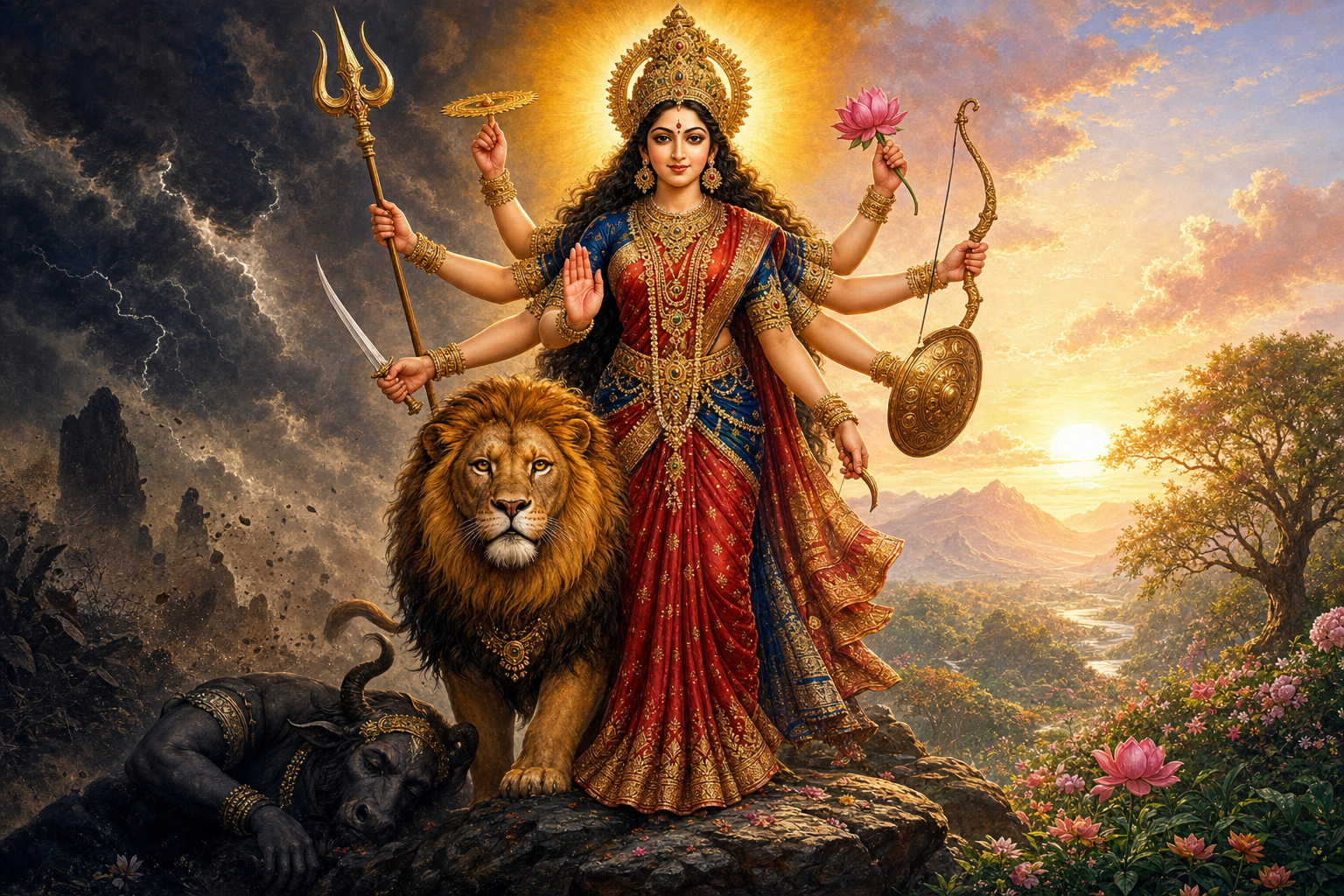
You may know Durga most vividly through the image of the many-armed Mother standing before Mahishasura. But if you have wondered what that image asks of you after the puja ends, the answer is more demanding than “be strong.” It asks you to examine what directs your strength, what distorts it, and whether your actions protect dharma or merely protect your preferences.
Durga embodies Shakti: the power through which consciousness becomes thought, courage, compassion, restraint and action. Her philosophy gives you a practical way to understand difficulty, identify the disorder within it and respond without separating spiritual devotion from daily conduct.
Key takeaways
- Shakti is not merely physical force. It appears as intelligence, patience, affection, prosperity, peace, moral courage and the capacity to act.
- The battle with Mahishasura is both a sacred account of dharma overcoming destructive power and a map of the struggle against ego, anger, greed, envy, craving and attachment.
- Durga’s weapons represent distinct faculties. Knowledge must cut through confusion, determination must hold its course and discipline must concentrate effort on the right target.
- Maya is not simply a claim that the world is unreal. It is the power that manifests experience while also allowing appearances to conceal truth.
- Durga worship becomes a discipline when reverence for the Goddess changes how you use power, face weakness and treat the Shakti present in other beings.
Shakti is the power by which consciousness becomes effective
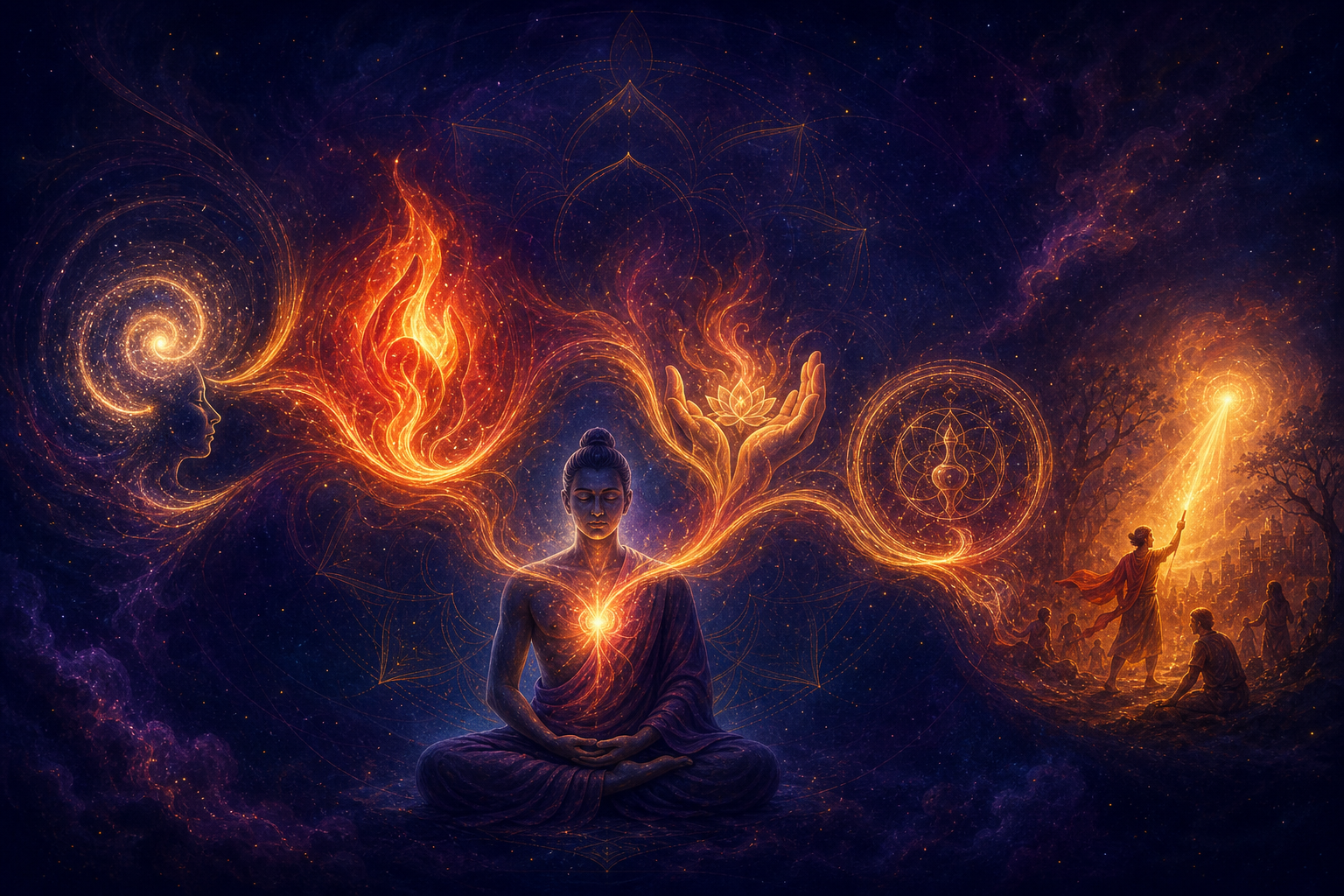
Power is often confused with domination. Durga corrects that error at its root. In the vision of the Sri Sri Chandi, Shakti is not limited to combat, physical strength or spectacular supernatural action. The Goddess is present in all beings as the many capacities that sustain existence.
Yā devī sarvabhūteṣu śaktirūpeṇa saṃsthitā, namastasyai namastasyai namastasyai namo namaḥ.
Sri Sri Chandi
The mantra offers repeated salutations to the Goddess who abides in all beings as Shakti. Its location of divine power is important: Shakti is not somewhere outside life, waiting to be borrowed from a deity. Your ability to understand, endure, care, decide and act already depends upon her presence.
The same litany recognizes the Goddess as buddhi, Lakshmi and shanti: intelligence, prosperity and peace. These are not decorative additions to a warrior image. They show why raw force cannot be the measure of Shakti. Intelligence gives power direction. Prosperity supplies the conditions in which life can flourish. Peace prevents the mind from becoming a servant of every provocation. Courage without these forms of Shakti can easily become recklessness.
You can use these forms as a diagnostic whenever you feel powerless or tempted to force an outcome:
- If you cannot see the situation clearly, the immediate need is buddhi, not greater intensity.
- If the right action lacks material support, the need concerns Lakshmi: order, sufficiency and responsible stewardship, not greed.
- If agitation is making the decision for you, the missing faculty is shanti, not aggression disguised as courage.
- If you know your duty but keep postponing it, Shakti must appear as disciplined action.
This is also the point of the inseparable relationship between Shiva and Shakti. Shiva signifies consciousness and stillness; Shakti signifies expression and action. They are not rival principles or two independent realities. Consciousness without the capacity to manifest remains inactive, while power without conscious direction becomes blind movement. Durga is Shakti awake, ordered and directed toward the protection of dharma.
This relationship should not be reduced to a stereotype in which men represent mind and women represent energy. It is a metaphysical grammar, not a licence to confine human beings to social caricatures. Stillness and action, awareness and capacity, must be integrated within every person. When you contemplate Durga, ask not only whether you possess power, but whether your power remains joined to clear consciousness.
Mahishasura makes the inner battle impossible to avoid
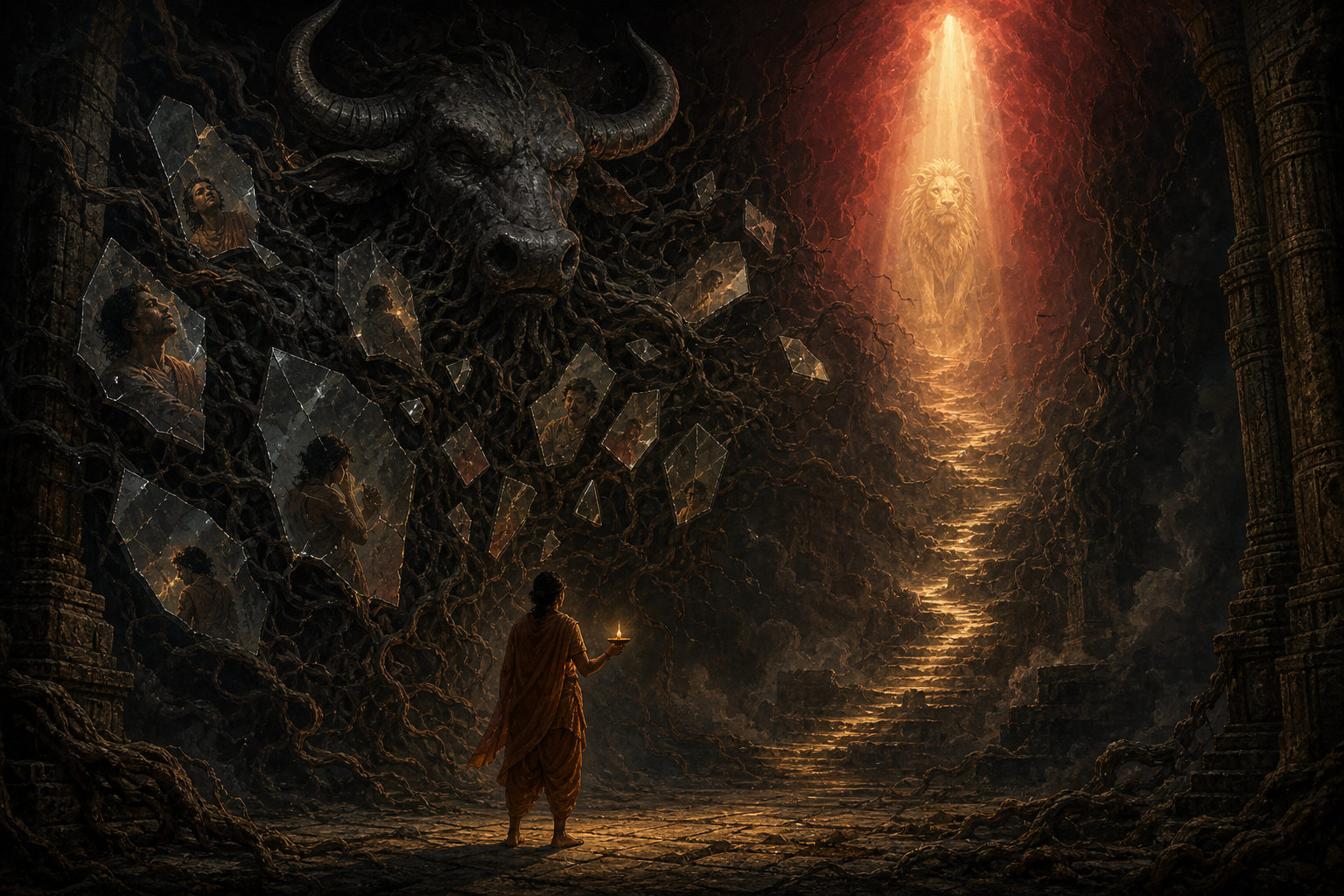
Durga’s name points toward what is difficult, inaccessible or hard to cross. A durga in your own life is therefore not just an inconvenience. It is a condition in which fear, confusion, sorrow, attachment or ignorance obstructs the path. As Durgatinashini, the Goddess does more than remove an unpleasant circumstance: she gives you the consciousness required to pass through it without surrendering your dharma.
The battle with Mahishasura must not be flattened into a motivational metaphor. It presents divine power acting against an asuric force that threatens order. Yet its meaning does not stop outside you. The slaying of Mahishasura also exposes the tendencies that repeatedly seize the inner world: ego, anger, greed, envy, lust and attachment.
These enemies are difficult because they rarely introduce themselves honestly. Ego calls itself dignity. Anger claims to be justice. Greed disguises itself as security. Envy pretends to be discernment about another person’s faults. Craving calls its object necessary. Attachment presents possession as love. By the time the disguise is visible, the tendency may already be directing your speech and decisions.
Learn to identify each tendency by its effect rather than its preferred name:
- Ahankara, or ego: You become more concerned with preserving an image of yourself than discovering what is true. The corrective is to name the fact that would remain true even if nobody admired you.
- Anger: You prefer emotional discharge to the measured correction of wrong. Separate the injury to your pride from the actual duty before you speak.
- Greed: No gain settles the demand for more. Define what would count as sufficient before desire moves the boundary again.
- Envy: Another person’s good becomes evidence of your diminishment. Return attention to the duty and capacity actually placed before you.
- Craving: A person or object is treated as an instrument for satisfying desire. Restore limits, dignity and the freedom of everyone involved.
- Attachment: You refuse a necessary truth because accepting it may change a relationship, role or outcome you want to preserve. Ask what the right action would be if the preferred outcome were not guaranteed.
Fighting an inner asura does not mean pretending that the underlying feeling is absent. Denial merely gives it another disguise. The useful sequence is to name the tendency, see the story by which it justifies itself and prevent it from deciding your next action. The victory is not the disappearance of every impulse. It is the restoration of rightful authority within you.
This is why Durga’s strength cannot be separated from self-cultivation. It is easier to ask the Goddess to defeat an external adversary than to admit that your reaction is feeding the conflict. Her image refuses that escape. Mahishasura is beneath her feet, but her gaze also falls upon the devotee.
Durga’s weapons turn power into a disciplined method
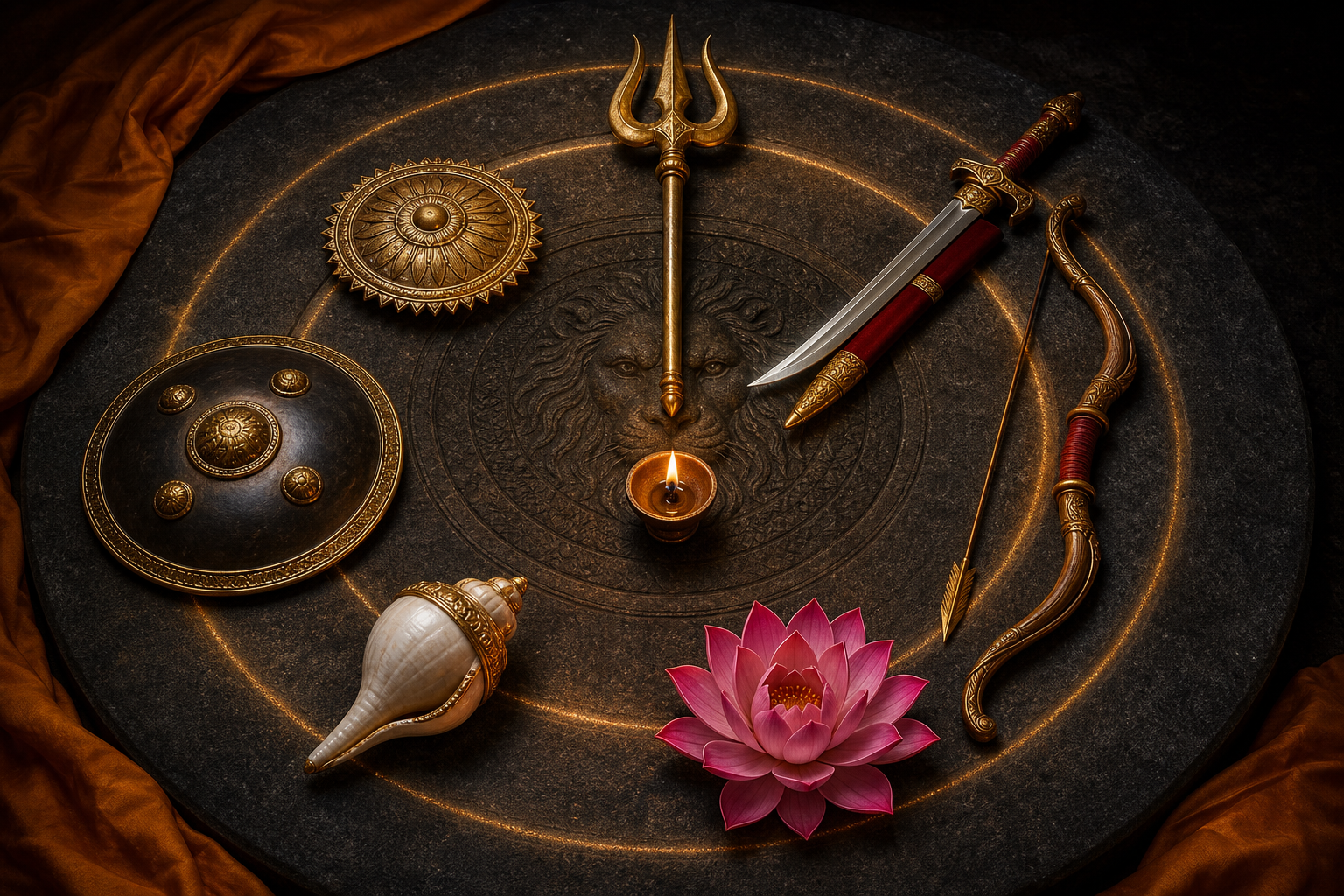
Durga carries weapons because dharma is not protected by good intentions alone. Her conch, chakra, sword, bow and arrow represent different forms of conscious and righteous power. Read together, they offer a sequence for acting when a situation is difficult.
<!– wp:list {