

When a message angers you, a family exchange activates an old pattern, or an uncertain result consumes your attention, knowing the right principle is rarely the problem. The problem is that your mind has already narrowed before discernment arrives.
The ocean image gives you a practical aim: receive the event without letting it occupy the whole field of awareness. You do not need to become emotionless. You need enough inner depth to feel what is present, see what dharma requires, and act without surrendering your agency to the first impulse.
Be the ocean, not an artificially still surface
Srimad Bhagavatam 3.24.44 compares inner steadiness to an ocean that receives rivers and releases vapor without losing its vast composure. The image is not asking you to prevent events from entering your life. Rivers will arrive. Something will also be taken away. Praise, insult, gain, loss, success, fatigue, attraction, and uncertainty will continue to move through experience.
Your work is to stop treating each movement as the definition of who you are. A strong emotion may be present without becoming your identity. A possession may be useful without becoming your worth. A role may carry real duties without exhausting the meaning of your existence. This loosening of false identification is where equanimity begins to serve self-realization.
Equanimity is therefore not the same as appearing calm. You can sit silently while resentment hardens within you. You can avoid a necessary conversation and call the avoidance detachment. You can become too tired to care and mistake that inertia for peace. None of these conditions has the clarity of an oceanic mind.
The language of the gunas offers a useful diagnostic. Rajas pulls attention into restless reaction. Tamas obscures the situation through dullness, denial, or shutdown. Sattva makes accurate perception and proportionate action more available. The immediate aim is not to manufacture a pleasant mood. It is to recover enough clarity that neither agitation nor inertia chooses your conduct.
Use three tests when you are unsure whether you are practising equanimity or merely suppressing a response:
- Perception: Can you describe what actually happened without exaggerating it, minimizing it, or claiming to know another person’s hidden motive?
- Freedom: Can you feel the impulse without having to obey it immediately?
- Dharma: Does the response preserve truth, responsibility, compassion, and appropriate boundaries?
If any answer is no, you do not yet need a final judgment. You need space. That pause is not weakness. It prevents a temporary mental wave from signing your name to a lasting action.
A small change in language can help create that space. Instead of silently declaring that you are anger, fear, envy, or failure, notice that anger, fear, envy, or a thought of failure is present. This grammatical shift is not self-realization by itself. It simply turns an identification into something you can examine. Once it can be observed, it no longer has unquestioned authority.
Use a nine-to-fourteen-minute reset when agitation is high
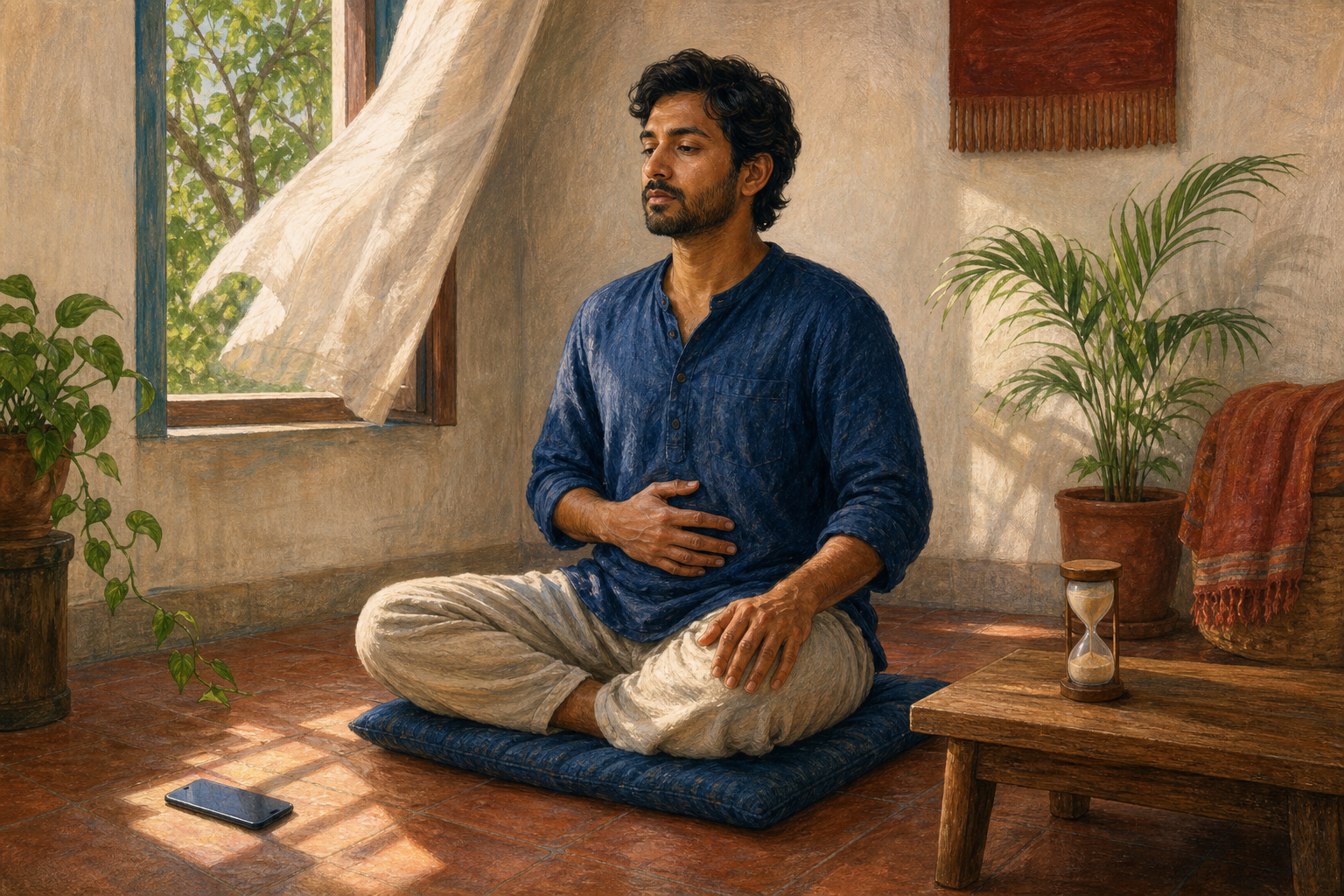
When attention has collapsed around a trigger, abstract advice is too weak. Use a repeatable sequence before a difficult conversation, after reading an inflammatory message, or whenever your mind keeps circling an outcome. The complete practice takes nine to fourteen minutes.
- Withdraw for one minute. Silence the immediate input. Put the screen down, stop rehearsing your reply, and close your eyes if the setting is safe. Feel the physical contact of your feet, seat, hands, and breath. This is a modest use of pratyahara: attention steps back from the trigger long enough to recover a wider field.
- Regulate the breath for three minutes. Breathe gently for five counts in and five counts out, without holding the breath or forcing its depth. If gentle nadi-shodhana, or alternate-nostril breathing, is already part of your practice, you may use it instead. Return to natural breathing if counting creates strain. Never perform a closed-eye practice while driving or doing anything that requires continuous external attention.
- Recollect for five to ten minutes. Use japa, Naam Simran, remembrance of your Ishta, or silent mindfulness of breathing according to your path. Keep returning to the same anchor whenever argument, fantasy, or self-justification takes over. You are not trying to win an internal debate. You are restoring the orientation from which a dharmic decision can be made.
This sequence joins withdrawal, regulation, and remembrance. Meditation and gentle breath regulation may support emotion regulation and reduce stress reactivity, but the spiritual purpose goes further than calming the nervous system. The practice returns motive to its proper place. It moves you from What do I feel compelled to do? toward What is mine to do?
When you cannot leave the situation
You may not have nine minutes in the middle of a meeting, a public disagreement, or a family responsibility. Keep your eyes open, feel your feet against the ground, release tension that is not needed for the task, and silently repeat your chosen Name or anchor. Then ask one question: What response serves dharma now?
On a screen, take your hands away from the keyboard until you can state the disputed issue in a neutral sentence. If you cannot do that, your attention is probably still too contracted to send a useful reply. In conversation, answer the smallest real point in front of you. Do not attempt to settle an entire relationship, ideology, or history while your mind is fighting for immediate relief.
If an immediate boundary is necessary, state it plainly. Equanimity does not require you to remain available for insult, manipulation, or harm. A steady no may be more dharmic than a resentful yes. The discipline concerns the quality and purpose of your action, not its softness.
Why repetition matters more than novelty
Yoga describes the quieting of mental fluctuations through abhyasa, steady practice, and vairagya, non-attachment. The reset trains both. Returning to the method is abhyasa. Refusing to make a passing impulse, possession, or desired result the condition of your inner stability is vairagya.
Use the same basic sequence over weeks rather than constantly shopping for a more dramatic technique. Familiarity matters because a method must remain accessible when you are least reflective. A practice that works only when you already feel peaceful has not yet become a dependable discipline.
Choose a Dharmic anchor without erasing real differences

Hinduism, Buddhism, Jainism, and Sikhism share practical patterns without making identical claims about the self, liberation, or the Divine. You can honour their kinship without forcing them into one vocabulary. The shared structure is disciplined attention, reduced attachment, ethical restraint, and compassionate action. The meaning of those practices remains rooted in each tradition.
- Within Hindu practice, devotion to Bhagavan or one’s Ishta can govern attention through japa, prayer, puja, and seva. The oceanic teaching of Srimad Bhagavatam places sobriety, devotion, freedom from possessiveness, and realization of spiritual identity within one movement. A Yoga-oriented practitioner may understand the same daily work through citta-vritti-nirodha, abhyasa, vairagya, and pratyahara.
- Within Buddhist practice, mindfulness notices arising experience while upekkha neither clings to it nor pushes it away. Compassion keeps equanimity from becoming cold distance. Because anatta questions belief in a permanent independent self, Buddhist insight should not simply be relabelled as realization of an eternal Self. The practical meeting point is freedom from compulsive identification, not a forced metaphysical agreement.
- Within Jain practice, samayik cultivates meditative steadiness, while aparigraha challenges possessiveness and unnecessary accumulation. Restraint clears space for ahimsa. Here the test is not merely whether you feel calm, but whether your grasping and capacity to cause harm are actually decreasing.
- Within Sikh practice, Naam Simran recollects the Divine Name, sehaj names a natural spiritual equipoise, and seva carries remembrance into the world. A quiet mind that does not become truthful service has missed the integrated character of the path.
These Dharmic disciplines converge in treating inner stability as a basis for ethical and compassionate engagement, not as an escape from ordinary duties. That convergence is useful. Their distinctions are also useful because they prevent a vague spirituality in which every term is treated as interchangeable.
Choose the anchor that belongs to a tradition you can practise honestly. If you are rooted in a lineage, let its teachings, liturgy, and guidance shape the method. If you are still exploring, borrow modestly: use one clearly understood practice without claiming that all traditions teach the same doctrine.
Write down three lines before beginning a period of regular practice:
- Anchor: What Name, mantra, breath object, teaching, or chosen ideal will you remember?
- Method: When will you use the one-minute withdrawal, three-minute breath regulation, and five-to-ten-minute recollection?
- Duty: What recurring relationship or responsibility should become more truthful and compassionate if the practice is working?
The third line prevents spiritual practice from becoming private mood management. It gives inner work an observable direction.
Make seva the proof of inner stability

A peaceful feeling can become another possession. You may begin protecting the mood, avoiding inconvenient people, and resenting any duty that interrupts it. Seva corrects this drift. It asks whether stillness has made you more available to truth and useful action.
Before each practice session, dedicate it to one concrete act of compassionate utility. Listen to a family member without preparing a rebuttal. Correct an error before someone else bears its cost. Complete an unglamorous duty without seeking recognition. Offer time, attention, or material help within your actual means. The act need not be impressive. It must be real enough to interrupt self-absorption.
Seva is not people-pleasing, and non-attachment is not indifference to consequences. You remain responsible for effort, method, and foreseeable effects even when you release the demand to control every result. Firm resistance to adharma can arise from equanimity. Anger may alert you that a value or boundary has been violated, but anger does not receive sole authority over how you respond.
Use a four-question action check
After recollection, test the action you are considering:
- What is factually clear? Separate direct observation from assumption, prediction, and wounded interpretation.
- What is actually mine to do? Name your duty, boundary, promise, or repair without assigning yourself control over another person’s mind.
- What result am I trying to possess? Notice whether your peace depends on being praised, obeyed, vindicated, or guaranteed success.
- Whom can this action serve? Include the other person, the wider community, and your own legitimate well-being rather than using service as a reason to erase yourself.
If a proposed response satisfies your agitation but abandons duty, wait. If it protects appearances by concealing truth, revise it. If it is clear, proportionate, and serviceable even without a guaranteed outcome, act.
Measure the return, not permanent serenity
Do not evaluate progress by asking whether you stopped having emotional waves. That standard encourages denial. Track how you meet the wave and how quickly responsible choice becomes available again.
At the end of the day, record the trigger, the first bodily or mental sign you noticed, the point at which choice returned, the action you took, and any repair still needed. Keep the entry short enough that you will continue doing it. Over weeks, look for practical changes:
- Emotional spikes become shorter or less commanding, even when the emotion remains strong.
- A pause appears before sending, speaking, purchasing, accusing, or withdrawing.
- Your decisions correspond more consistently to stated values and duties.
- Attachment to praise and outcomes loosens without weakening responsible effort.
- You repair mistakes sooner because protecting an image of yourself matters less.
- Service becomes a natural continuation of practice rather than an unrelated obligation.
Shorter emotional spikes, a quicker return to baseline, value-aligned decisions, relaxed attachment to outcomes, and a growing inclination toward service are more useful indicators than chasing an uninterrupted state of calm.
Watch for movement in the other direction as well. If practice makes you smug, emotionally unavailable, careless about injustice, or unwilling to acknowledge harm you caused, do not call the result transcendence. Return to truthfulness, appropriate guidance within your tradition, and a concrete act of repair.
Self-realization is not a more flattering story about your personality. In the devotional frame of Srimad Bhagavatam, it becomes possible as false identification and possessiveness loosen while awareness, devotion, and conduct turn toward spiritual reality. In other Dharmic paths, the doctrinal account differs. The daily demand remains exacting: see more clearly, cling less compulsively, and let insight alter how you live.
Key takeaways
- Equanimity does not remove emotion; it prevents emotion from monopolizing perception and action.
- When agitation is high, use one minute of withdrawal, three minutes of gentle breath regulation, and five to ten minutes of japa, Naam Simran, remembrance, or mindfulness.
- Practise through an anchor that fits your Dharmic path, while respecting real differences among Hindu, Buddhist, Jain, and Sikh understandings.
- Use seva to test your calm. Genuine steadiness should strengthen truthfulness, compassion, responsibility, and appropriate boundaries.
- Track recovery time, value-aligned conduct, repair, and reduced attachment to outcomes rather than expecting permanent serenity.
Begin with the next real disturbance, not an imagined perfect morning. Step back, regulate the breath, remember your anchor, and complete one concrete act that serves dharma. Repeated in ordinary moments, that is how oceanic equanimity becomes a lived path rather than an admired metaphor.
References
