
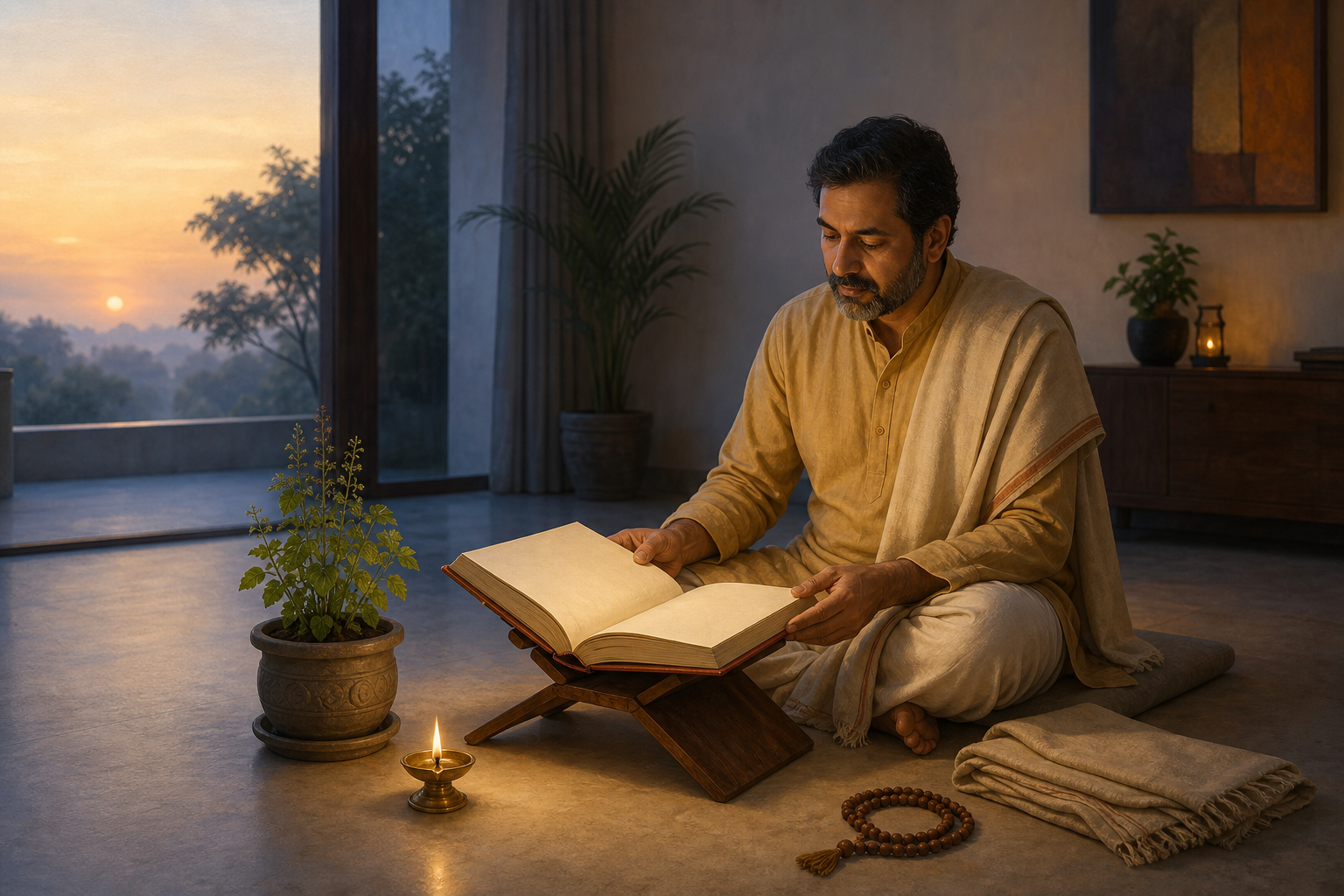
You may genuinely want to read Śrīmad-Bhāgavatam every day and still find yourself restarting every few weeks. The usual difficulty is not lack of reverence. It is an undefined practice: no protected time, no clear reading path, and no rule for what to do when the day becomes crowded.
A sustainable practice needs a fixed appointment, a manageable passage, and a response to what you have received. Once those are clear, you can stop renegotiating the entire commitment each morning and begin building continuity.
Build a practice small enough to survive an ordinary day

Begin by protecting one core session rather than designing an elaborate schedule you cannot maintain. A practical starting range is 20 to 40 minutes of daily reading or hearing. That is long enough to enter a passage with attention, but short enough to fit into the life of a student, householder, or working professional.
Brahma-muhūrta, approximately one and a half hours before sunrise, is traditionally valued because the surroundings and mind tend to be quieter. Use it if it fits your actual duties and sleep. If it does not, choose a consolidated evening period. Dawn, noon, and dusk can also hold brief recitation or recollection, but they do not need to become three additional obligations. The useful time is the time you can protect consistently.
Give the session the same simple shape each day:
- Prepare a clean, ventilated place with the text, your chosen commentary, and a notebook already at hand. Silence the device that usually interrupts you.
- State a short saṅkalpa. Name what you are about to do: continue the current passage attentively and receive one instruction from it.
- Take a few grounding breaths and offer a brief invocation to Bhagavān or the guru-paramparā according to your tradition.
- Read, recite, or hear one coherent unit. A coherent unit may be a śloka with its translation and explanation, several connected verses, or part of a narrative. Stop where the thought naturally pauses.
- Close the book and restate the central point in your own words. If you cannot do that yet, reread the passage instead of moving forward.
- Write one unresolved question and mark the exact place where the next session will begin.
Set a minimum for unusually crowded days. One śloka or one short paragraph, followed by a sentence in your own words, is enough to preserve the appointment. Treat that as a fallback, not the normal standard. If you miss a day, resume at the marked place. Do not manufacture a large reading debt; guilt-driven marathons make the next interruption more likely.
If japa is already part of your morning sādhana, place the Bhāgavatam passage immediately before or after it. Attaching the new practice to an established one removes another daily decision and lets chanting, hearing, and remembrance support one another.
Start with Canto 1, then follow a visible thread

New readers are usually better served by beginning with Canto 1. It introduces the purpose of Bhāgavata hearing, the circumstances in which the text is spoken, and the dispositions expected of both speaker and listener. Read sequentially until you can recognize the principal people, questions, and narrative setting without having to reconstruct them at every session.
Before entering a chapter, read its introduction or summary if your edition provides one. Then read the passage, translation, and commentary in that order. This keeps commentary connected to the words being explained. Use one primary commentary through a chapter; consult alternatives when a real question arises rather than switching interpretive frameworks after every verse.
A small personal glossary will save considerable confusion. Record unfamiliar names, places, Sanskrit terms, and family relationships as they appear. Do not try to produce an encyclopedia. A one-line identification is enough to keep a dense genealogy or cosmological discussion from becoming an excuse to abandon the text.
Sequential reading should be your backbone, but a thematic passage can answer a pressing spiritual need. The Bhāgavatam offers several natural entry points:
- Read Prahlāda’s history when you need to examine devotion under hostility or pressure.
- Read Dhruva’s history when determination, ambition, disappointment, and grace are active questions in your life.
- Read Ambarīṣa’s history when you are trying to sustain devotion amid responsibility.
- Read Ajamila’s history when remembrance, moral decline, and the possibility of return require reflection.
- Read Gajendra’s prayers when helplessness and wholehearted dependence are the central concern.
- Approach the Uddhava-gītā as extended reflective study rather than as a passage to rush through.
- Read the Rāsa-pañcādhyāyī with theological context and a sensitive traditional commentary, not as an isolated romantic narrative.
These histories are doors into the whole text, not replacements for it. After the thematic reading has served its purpose, return to your sequential bookmark. Otherwise the most familiar episodes receive repeated attention while the Bhāgavatam’s larger argument remains unseen.
Choose commentary by asking whether it is faithful to the passage, lucid about context, and capable of deepening devotion without turning every page into a polemic. Works and lectures in the lineage represented by A. C. Bhaktivedanta Swami Prabhupāda offer one established avenue of exposition, while other traditional commentaries can illuminate different questions. When interpretations differ, record the precise point of disagreement and bring it to a qualified teacher or a serious study circle. Do not let a clipped quotation on social media settle a question that depends on language, lineage, or context.
Turn reading into hearing, reflection, and conduct
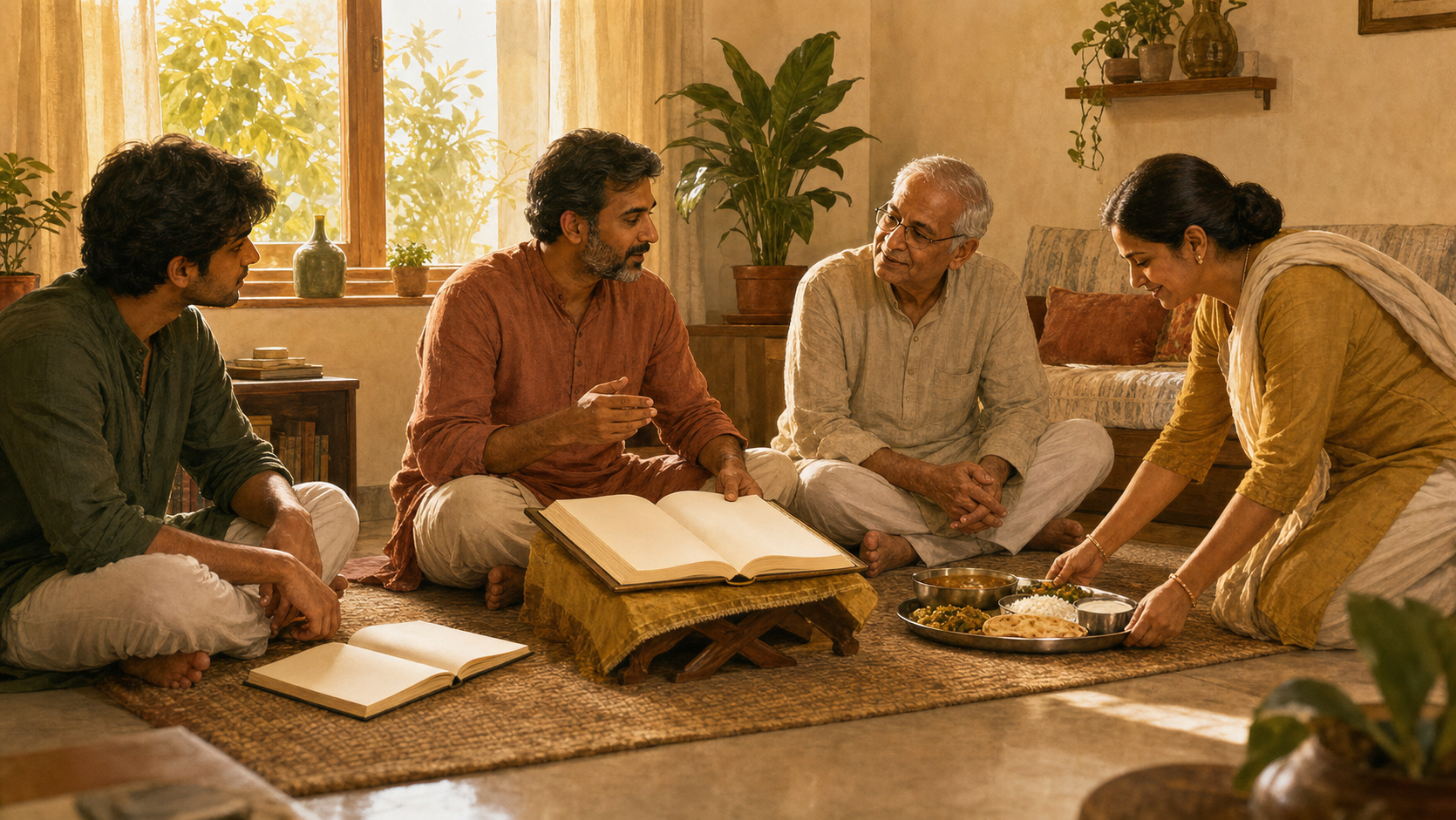
Page count measures coverage, not assimilation. Bhāgavata practice becomes effective when the passage moves through several forms of attention. Reading, recitation, hearing, and chanting are related, but they are not interchangeable tasks.
| Mode | What you do | How to check your attention |
|---|---|---|
| Svādhyāya | Read the text, translation, context, and commentary carefully. | You can explain the passage in your own words without merely repeating the commentary. |
| Pārāyaṇa | Recite Sanskrit or a trusted translation slowly and clearly. | Pronunciation and cadence do not outrun awareness of meaning. |
| Śravaṇa | Receive a live or recorded exposition without multitasking. | You can name its central teaching and the question it raised for you. |
| Kīrtana or japa | Use devotional singing or mantra repetition within the wider Bhakti routine. | The repetition returns the mind to Bhagavān rather than becoming background noise. |
You do not need to perform all four modes at length every day. Choose one as the day’s primary practice and add a brief supporting mode. You might study a passage and recite its central śloka, or hear a katha and then read the corresponding verses yourself. The second mode tests whether the first produced attention or only familiarity.
After each passage, use questions that force the teaching out of abstraction:
- What does this passage disclose about Bhagavān, the devotee, or dharma?
- Which intention or quality is being purified, praised, or corrected?
- What would I notice or do differently in the next ordinary decision?
- Which word, action, or conclusion remains unclear?
Answer briefly. A clear sentence is more useful than a page of devotional language that never reaches conduct. If the passage emphasizes truthful speech, restraint, compassion, service, remembrance, or steadiness, select one place in the coming day where that quality can be practiced. At the next session, notice what actually happened. This is not self-scoring; it is how manana, reflection, begins to become lived assimilation.
Śrīmad-Bhāgavatam 7.5.23 places hearing and chanting within a ninefold life of devotion that also includes remembrance, service, worship, prayer, servitude, friendship, and self-offering. Daily reading therefore should not remain an intellectual possession. Its natural direction is relationship and service.
Fit the rhythm to your household without diluting it
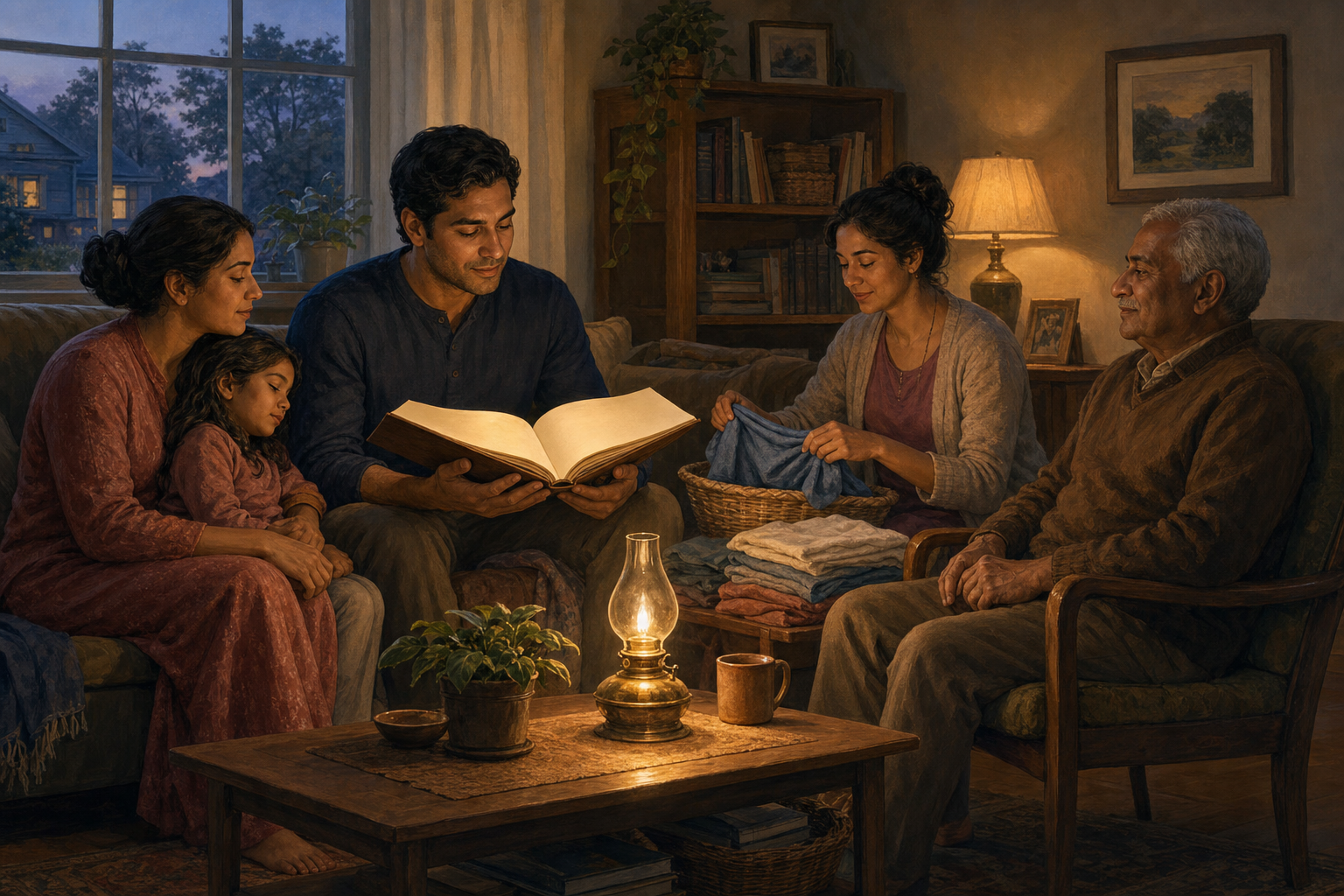
A full household rarely becomes quiet simply because you have made a spiritual resolution. Design the practice around real duties. One possible cadence is 10 to 20 minutes of japa and a short passage at dawn, a brief śloka at midday, and 30 to 45 minutes of study or katha in the evening. Treat that as a menu, not three compulsory sessions. If only one period is stable, protect that period first.
For a family, establish a weekly Bhāgavata hour in addition to individual practice. Rotate roles: one person reads, another explains necessary terms, and someone else summarizes the teaching. Children can retell the histories of Prahlāda or Dhruva and ask what made a particular choice dharmic or adharmic. Let their questions remain real questions; a family reading becomes brittle when every answer is used to test obedience.
In a multilingual home, recite the Sanskrit śloka and then read a trusted translation everyone understands. Sanskrit proficiency is not a gate that must be passed before Bhāgavata practice begins. If you are learning recitation, work carefully on varṇa, the clarity of consonants and vowels; svara, the movement of the voice; and chandas, the metre. Audio pronunciation can support practice, but comprehension should not be sacrificed to speed or performance. Reciting a reliable vernacular translation slowly is a legitimate way to let the meaning be heard.
If reading after work is difficult, use recorded katha for śravaṇa and keep the printed text open to the relevant chapter. Write a short summary afterward. Passive audio playing while attention is elsewhere may create familiarity with a speaker’s voice, but it does not provide the receptive listening that śravaṇa asks of you.
A weekly longer session can consolidate notes, revisit difficult passages, and bring questions to satsanga. Arrive punctually, silence devices, and distinguish a sincere interpretive question from a contest between sectarian identities. A study circle should make it easier for a newcomer to hear carefully, not force that person to master internal disputes before opening the text.
Use Ekādaśī and Dvādaśī for extended hearing or recitation when your responsibilities permit. Pūrṇimā and Amāvasyā can hold a thematic reading, while Kārtika and festivals of Viṣṇu or Kṛṣṇa offer natural occasions for expanded study and kīrtana. These observances should deepen an existing daily relationship with the text. Do not let an auspicious day become a substitute for all the ordinary days on which abhyāsa is formed.
Key takeaways
- Protect one regular 20-to-40-minute session; use a śloka or short paragraph as the fallback on an unusually crowded day.
- Begin with Canto 1 and keep an exact bookmark, a small glossary, and one primary commentary.
- Use a trusted translation when Sanskrit is not yet accessible, and develop pronunciation separately without rushing.
- End every session by restating the passage, recording a question, and choosing one quality to notice in conduct.
- Resume after a missed day without creating reading debt. Use weekly gatherings and sacred observances to deepen continuity, not to compensate for its absence.
Before your next day begins, choose the time, place the text there, and mark the passage where you will start. When the appointment arrives, open the book before deciding whether you feel ready. The immediate aim is not to finish more of Śrīmad-Bhāgavatam. It is to become someone who returns to it attentively.