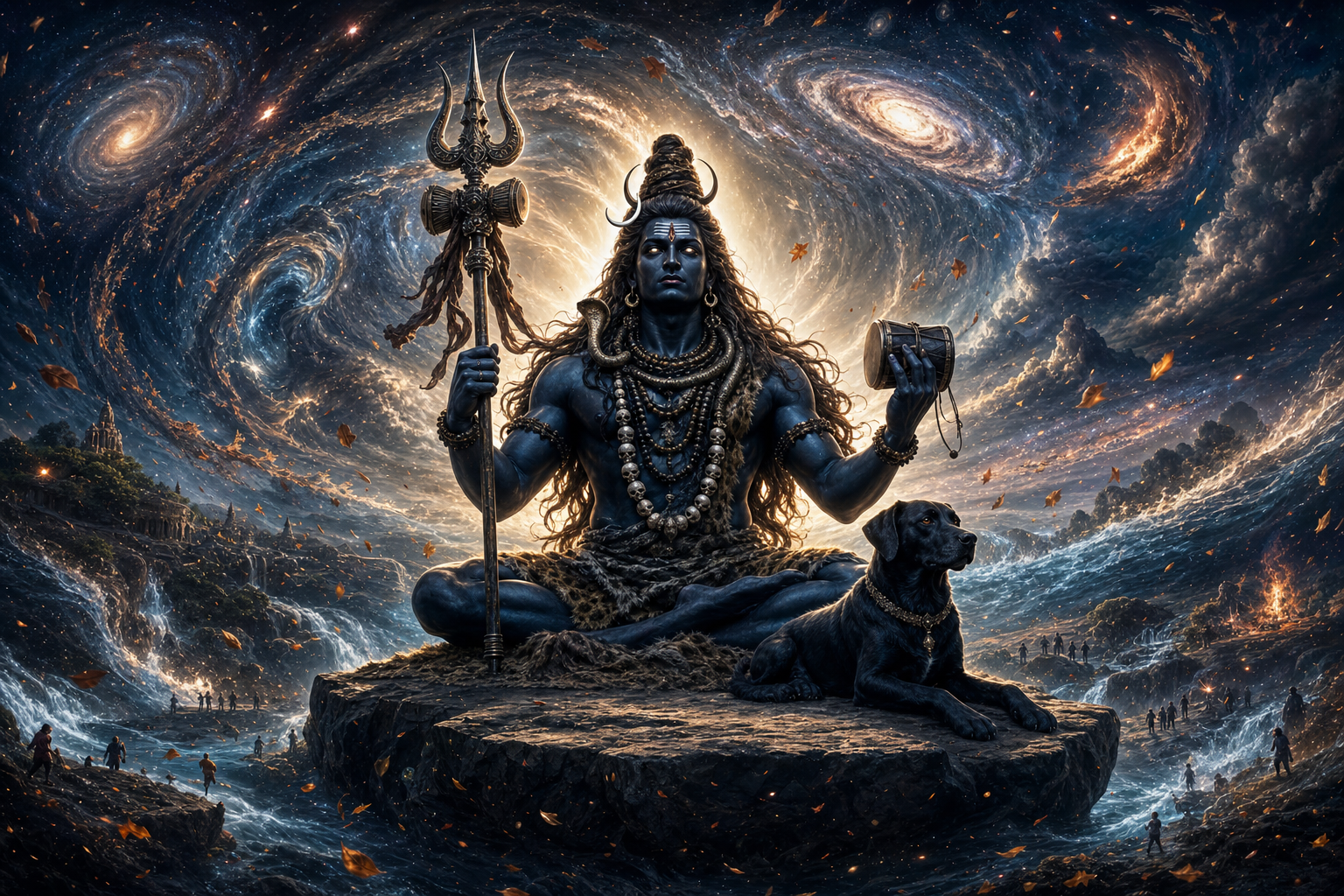
If Bhairava’s fierce form has made him seem like a deity concerned only with danger, death, or occult power, you may be missing the idea that makes those features coherent. In a Shaiva understanding, Bhairava is not merely one frightening figure within the universe. He is the lucid, unshaken ground through which a changing universe can appear at all.
This changes how you approach both worship and ordinary instability. The practical question is no longer how to escape movement, uncertainty, or time. It is how to discover the awareness that remains present through them, then act from that steadiness without becoming passive.
Cosmic ground does not mean a thing beneath the universe
The word ground can mislead you. It may suggest a hidden substance underneath physical reality, as though Bhairava were one more object located behind mountains, bodies, and stars. That is not the claim being made. Ground here means the condition that allows anything to be experienced, related, distinguished, and transformed.
Three Sanskrit terms sharpen the point. Adhara means support or base; atma indicates the interior essence; and bhudhara names the earth-bearing mountain, the stable axis of a sacred landscape. Joined in the vision of Bhairava as Bhudhara Atma, they present the world as resting in conscious presence rather than in spiritual emptiness.
Shiva’s name Sthanu, the enduring or pillar-like one, expresses the same stability. Yet this stability is not lifeless immobility. A stone can be motionless without knowing anything. Bhairava’s stillness is luminous and alert: the capacity through which motion is known as motion, change as change, and a boundary as a boundary.
Kashmir Shaivism takes this further. Bhairava names unbounded awareness prior to the division between a private observer and an external world. Its Aham, or primordial I-ness, is not your biography, personality, or opinion. It is the immediate fact of awareness before you divide experience into me and that. This is why the cosmic ground cannot be possessed by the ego. The ego itself appears within it.
You can test whether you have understood the distinction by asking what remains when one experience replaces another. A sound begins and ends. A thought arrives and dissolves. A mood gathers force and passes. Awareness is not another passing item alongside them. It is their field of appearance. In contemplative practice, recognizing that field is a doorway into the meaning of Bhairava.
Key takeaways
- Bhairava as cosmic ground is a metaphysical and contemplative claim, not a claim that a physical deity is hidden under the Earth.
- The ground is aware, not inert. Its stillness is compatible with complete alertness.
- The witnessing presence is not the isolated ego looking at the world; ego and world both arise within awareness.
- Groundedness should make your response clearer and more responsible. Numbness, avoidance, and indifference are not signs of realization.
- You do not have to stop change to find the ground. You learn to recognize what is present throughout change.
Bhairava is fierce because the ground must guard what matters
Why should the ground of reality appear with fangs, weapons, fire, or an association with cremation grounds? Because spiritual stability is not the same as softness. Whatever guards a real boundary must distinguish what may enter, what must be stopped, and what has reached its end.
Bhairava therefore appears as kshetrapala, guardian of the sacred field. A kshetra can be a temple precinct, a pilgrimage landscape, the body, or the field of conduct in which consequences unfold. Guardianship keeps that field intelligible. It demands attention at precisely the point where one condition becomes another: outside and inside, distraction and worship, life and death, impulse and action.
The cremation ground makes the teaching uncompromising. Status, possession, beauty, and social identity cannot provide an ultimate base because time removes them. Bhairava does not make impermanence disappear. His presence prevents impermanence from being mistaken for meaninglessness. Forms end, but their arising and ending remain held within awareness.
Kala-Bhairava gives this insight a temporal form. He is associated with Kashi as its fierce guardian and with the ordering power of time. Change can be measured only because some standpoint allows one moment to be distinguished from another. Kala-Bhairava joins the movement of time to an unmoving support, reminding you that urgency does not abolish the need for discernment.
Use this teaching at thresholds, not only during formal worship. Before entering a temple, beginning a difficult conversation, making a commitment, or reacting in anger, pause long enough to notice the crossing. Ask three questions: What am I leaving? What am I entering? What must I refuse to carry across this boundary? That pause performs the inner work of a kshetrapala. It protects the integrity of the next action.
The test is practical. If invoking Bhairava makes you more impulsive, theatrical, or contemptuous, fierceness has been separated from its ground. Fierce awareness is exact. It cuts confusion so that conduct can return to dharma; it does not give agitation a sacred costume.
Bhairava and Kalika reveal stillness within movement
Bhairava’s stillness becomes clearer beside Kalika’s movement. Kalika embodies transformative power, time, manifestation, and the relentless passing of forms. Bhairava is the conscious expanse in which that power can unfold. Their relationship is not a contest between a superior male principle and a subordinate female one. Neither side is complete as an explanation of experience when isolated from the other.
The image of Kali standing or dancing upon Shiva conveys this reciprocity. A dance needs a stable field, but a field becomes perceptible through movement upon it. Without Shakti, stillness would be an empty abstraction. Without Bhairava, movement would have no intelligible continuity. The image asks you to perceive constancy and transformation in the same event.
Kashmir Shaivism calls the subtle pulse of manifestation spanda. This is not simply muscular motion or physical vibration. It is the creative throb by which undivided awareness expresses difference without becoming divided in its essence. Bhairava is not left behind when Shakti manifests. The changing world is awareness appearing through its own freedom.
The elemental account makes the movement increasingly concrete. Shaiva systems describe thirty-six tattvas extending from pure consciousness to the Earth principle. Prithvi tattva is the consolidation of tangible form, not something spiritually disposable. Earth is where subtle possibility becomes weight, boundary, support, and habitat.
This is why cosmic ground and physical Earth must be distinguished without being torn apart. Bhairava is not reducible to soil or stone, yet soil, stone, mountain, and body can disclose stability in a form you can encounter. Matter is not denied so that consciousness may be honored. Matter becomes a mode through which consciousness is approached.
Try reading one ordinary experience through this relationship:
- Choose a change already happening: a strong emotion, a difficult decision, a bodily sensation, or a sound that is fading.
- Notice its Kalika aspect. Where is it moving, intensifying, breaking down, or becoming something else?
- Notice its Bhairava aspect. What awareness is already present before you name, resist, or explain the change?
- Hold both together. Do not suppress the movement, and do not let the movement dictate your next action automatically.
- Choose one response that protects the relevant field: truthful speech, restraint, completion of a duty, or deliberate non-action.
This exercise prevents two common errors. One is using stillness to withdraw from responsibility. The other is glorifying constant activity as Shakti while losing measure, direction, and consequence. Bhairava and Kalika together teach steady participation.
Temple, mountain, and body make the teaching tangible
Shaiva sacred space does not merely illustrate an abstract doctrine after the fact. Its arrangement trains your attention. Foundation, direction, center, threshold, perimeter, and vertical axis turn metaphysical relationships into movements the body can perform.
The garbhagriha rests at the concentrated center. The dhvaja-stambha establishes a vertical axis. Bali-pitha offerings acknowledge presences within the wider field. Bhairava may guard the boundary as kshetrapala, while eight Bhairavas can mark and stabilize the directions. You move from dispersed space toward a center whose integrity is guarded.
On your next temple visit, resist the urge to treat the approach as dead time before darshan. Let the route itself teach you:
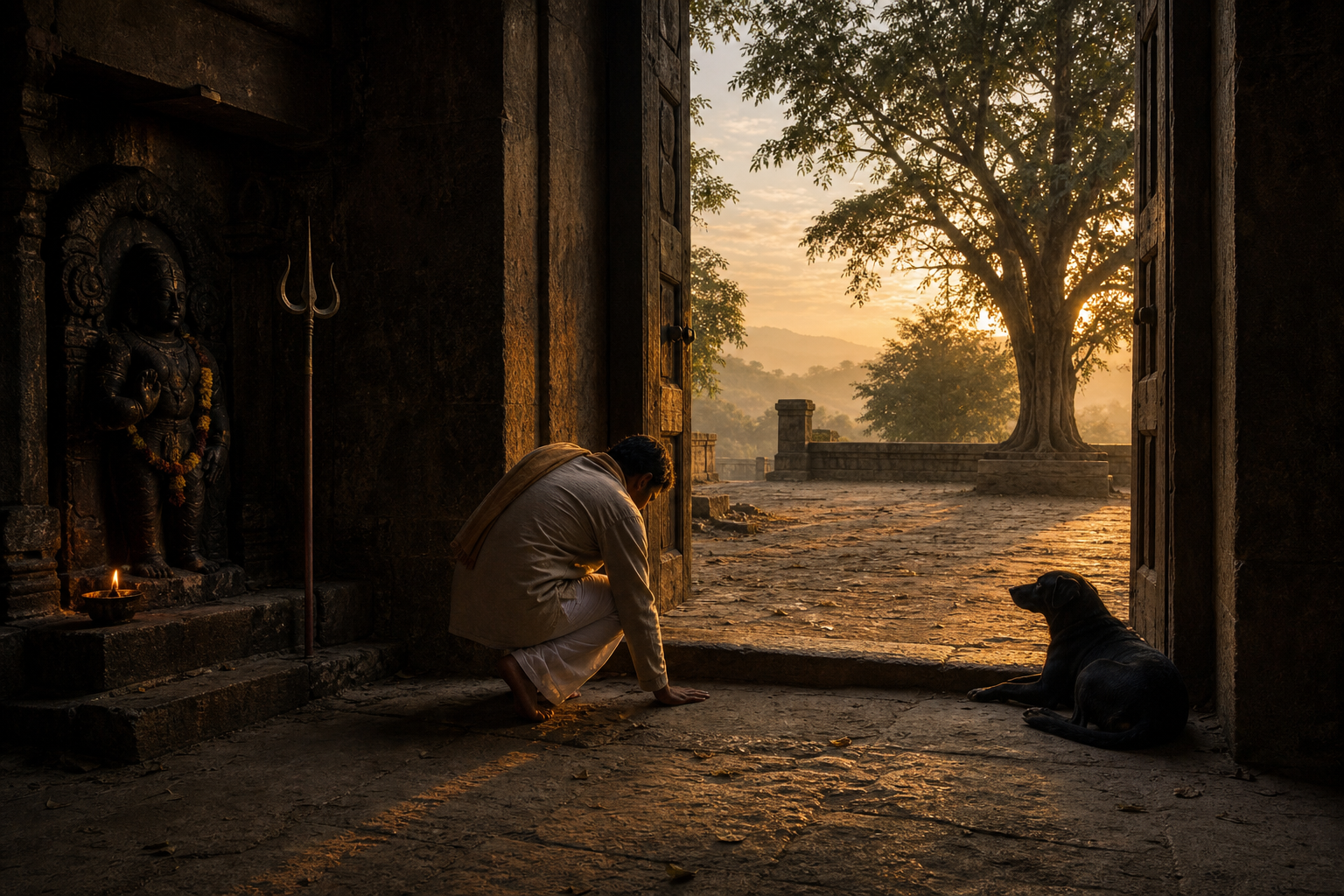
- Before crossing the entrance, stop and recognize that you are moving into a kshetra rather than merely entering a building.
- Acknowledge the ground. If it accords with the temple’s custom, bow or touch the Earth before directing attention upward.
- Notice the guardian and perimeter before rushing to the center. Ask what kind of conduct the space requires from you.
- Observe how your pace, speech, and attention change as you approach the garbhagriha.
- When you leave, cross the threshold deliberately. Carry one concrete obligation from worship into conduct.
The same grammar applies to sacred mountains. Kailasa, Arunachala, and the Himalaya are approached as more than scenery. Their immovability makes dispersion visible: the mountain does not chase your thought, but your thought becomes easier to see against its silence. Bhudhara, the earth-bearing mountain, becomes both place and instruction.
Your body offers a nearer map. Hatha Yoga associates steadiness with muladhara, literally the base, and uses prithvi-dharana to gather attention around the Earth principle. The seed sound lam is linked with this stabilizing practice. Bhairavi Mudra directs attention away from habitual outward dispersion and toward the witnessing base.
These correspondences should clarify practice, not encourage you to mix advanced ritual and yogic methods casually. A simple observation is enough: feel the body’s contact with the ground, allow the breath to become even, and notice awareness without forcing an unusual state. If lam belongs to your practice, let its recitation follow an even exhalation. Do not confuse intensity, breath strain, or dissociation with depth.
A reliable sign of grounding is increased capacity to perceive and respond. You should be able to hear more accurately, delay an unwise reaction, and remain present to consequence. If the practice leaves you dull, detached from duties, or fixated on extraordinary sensations, return to ordinary breath, bodily contact, and clear action.
To stand on sacred ground is to become answerable to it
Bhairava as cosmic ground cannot remain a private feeling of stability. If Earth is encountered as living support rather than disposable matter, restraint follows. Ahimsa limits avoidable harm. Aparigraha checks the desire to accumulate without measure. Gratitude becomes credible only when it changes how you use water, soil, food, energy, and other lives.
This is where fierce guardianship becomes ecological. A guardian does not praise a field while permitting its destruction. Bhairava’s boundary asks what extraction, waste, or appetite must be stopped so that the field can remain habitable. Kalika’s transformative power is then creative rather than merely consumptive.
You can bring the teaching into daily life without manufacturing an elaborate ritual:
- At the beginning of the day, place both hands on the floor or Earth and acknowledge the support you did not create.
- Settle attention through natural breathing. If appropriate to your practice, recite lam with an even exhalation rather than forcing the breath.
- Name one form of change you cannot control and one dharmic response that remains yours to choose.
- Select one act of restraint connected to the ground that supports you: avoid a needless purchase, prevent waste, protect water, care for soil, or reduce harm to another being.
- If a Bhairava or kshetrapala shrine is available to you, make circumambulation a regular reminder that every sacred field has a center, a boundary, and obligations.
The wider dharmic family offers related ways of recognizing support, though their doctrines should not be collapsed into a single theology. The Buddha’s bhumisparsha gesture calls Earth to witness awakening. Jain cosmology places Jambudvipa and Mount Meru within a morally ordered world. Sikh scripture venerates air, water, and Earth through the language of guru, father, and great mother. These are not alternative names for Bhairava. They are distinct expressions of a shared refusal to treat Earth as spiritually meaningless.
That distinction matters. Dharmic unity becomes stronger when it recognizes genuine resonances without erasing differences. You can honor the shared discipline of reverence, moral order, restraint, and embodied responsibility while allowing Buddhist, Jain, Sikh, and Shaiva traditions to explain those commitments in their own terms.
Begin with the next threshold you actually cross. Feel the support beneath you, recognize what is changing, and decide what must be guarded. Bhairava as cosmic ground becomes meaningful when the awareness that survives your instability also reforms your conduct.