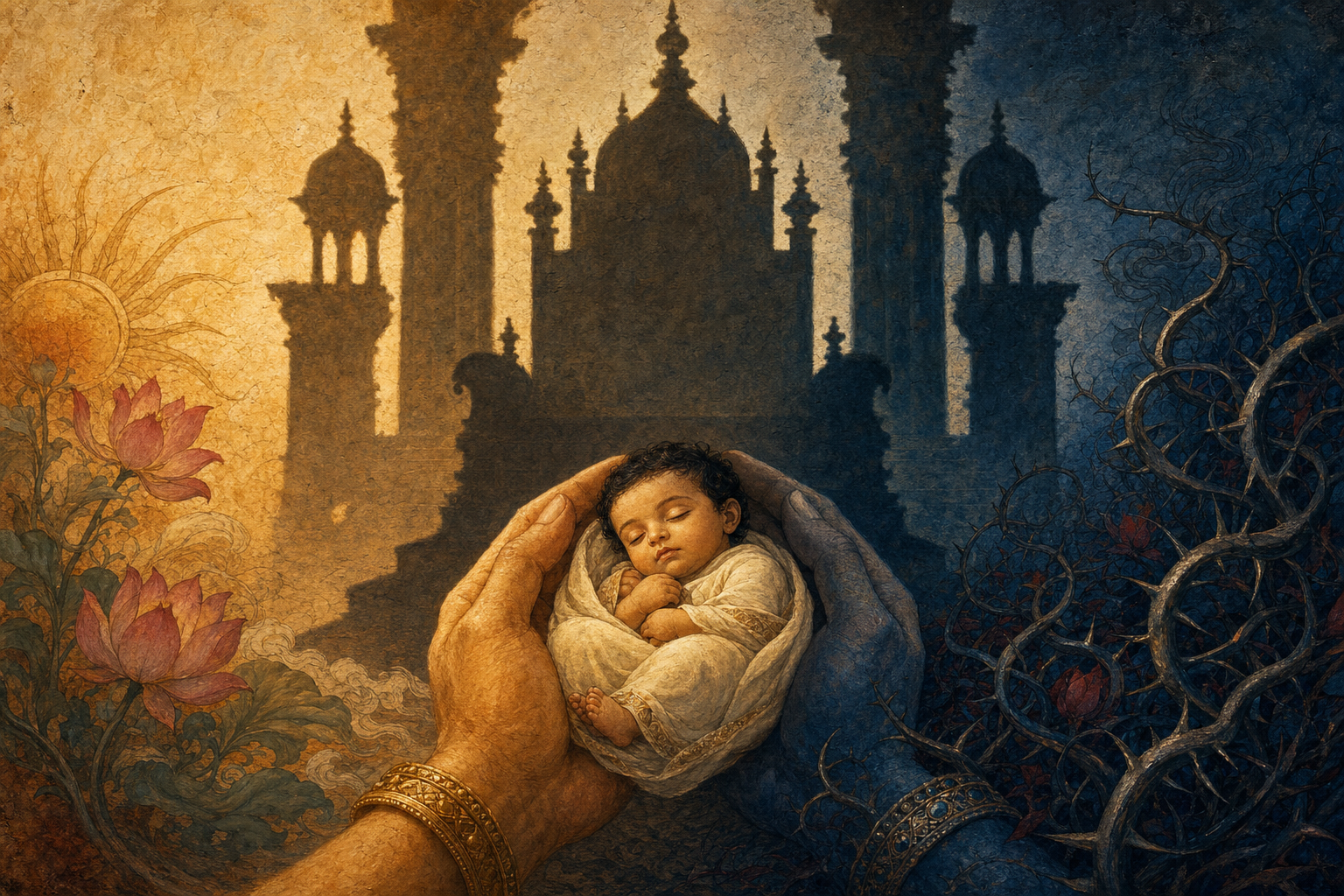
When you are trying to understand why a cruel ruler can still be experienced as a protector, looking only at armies, laws, and personalities starts too late. Tyranny benefits from smaller confusions established beforehand: dependence mistaken for devotion, forced uniformity mistaken for wholeness, and a caring appearance mistaken for moral content.
Putana and Jara give you a precise way to detect those confusions. One brings poison in the posture of a mother. The other restores a fragmented infant who grows into a coercive king. Putana exposes care used as camouflage; Jara reveals why genuine compassion, by itself, cannot govern the power it helps create.
The maternal archetype is a function, not an accusation
Calling Putana and Jara maternal archetypes does not mean that mothers produce tyrants, that feminine power is suspect, or that an adult ruler’s wrongdoing can be blamed mechanically on childhood. An archetype identifies a recurring moral function. Here, the maternal function is whatever nourishes life, holds vulnerable parts together, grants belonging, or makes dependence safe enough for growth.
That function can be performed by a woman or a man, a household or a school, a religious community or a state. The ethical question is not who looks maternal. It is what kind of person and power the relationship is nourishing.
The origin of tyranny, in this reading, is not a single childhood event that predestines a ruler. It is the moral environment in which power learns three dangerous substitutions:
- Control replaces care. Care strengthens the recipient’s capacity to live and judge. Control makes obedience the price of continued protection.
- Consolidation replaces integration. Integration holds distinct parts in a workable relationship. Consolidation treats difference, criticism, and independence as defects to be eliminated.
- Capacity replaces character. Strength, intelligence, organization, and resolve are abilities. None of them determines whether the person possessing them will protect others or dominate them.
These distinctions prevent two opposite mistakes. The first is to sanctify an action merely because it looks caring. The second is to condemn every act of care whose beneficiary later chooses adharma. Putana requires scrutiny of hidden intent; Jara requires discipline about moral responsibility.
Putana: when intimacy delivers a tyrant’s fear
In the Bhagavata Purana’s tenth skandha, Putana enters Gokula in the form of a beautiful woman, lifts the infant Krishna, and offers him a breast smeared with poison. Krishna draws out her life-breath while suckling, and her immense demonic form becomes visible in death.
Putana is not Kamsa’s nurse or relative. She is an agent carrying his campaign against newborn children into the intimate space of the household. That distinction matters. Kamsa’s terror does not remain an order issued from a throne. It borrows a trusted form and enters the nursery as apparent service.
The poison is therefore only one part of the weapon. The other part is the social meaning of the breast. Nourishment, bodily closeness, beauty, and the helplessness of an infant all work to suspend suspicion. Putana does not attack the protective boundary from outside; she gains admission by impersonating the reason that boundary exists.
This gives you four questions for recognizing poisoned nurture without becoming suspicious of care itself:
- What is actually being fed? Look past the benevolent label. Is the recipient receiving truth, competence, courage, and room to mature, or fear, dependency, resentment, and prescribed enemies?
- What makes the carrier seem trustworthy? Affection, beauty, religious language, expertise, family status, and institutional prestige can establish access. None independently proves that the content is sound.
- Can the vulnerable person question or refuse? Care becomes coercive when doubt is treated as betrayal and withdrawal of affection, belonging, or safety becomes the penalty for disagreement.
- Whose policy travels through the caregiver? Putana appears at the cradle, but Kamsa’s fear directs the act. When intimate authority transmits a larger program, trace the command and the beneficiary rather than judging only the intermediary’s appearance.
The pattern should be applied carefully. A mistaken teacher, an anxious parent, or a flawed institution is not automatically Putana. The archetype becomes relevant when three elements converge: the appearance of nurture secures privileged access, harmful content is concealed within the offering, and the recipient’s vulnerability prevents meaningful refusal.
The episode also refuses a simple division between permanently pure and permanently damned persons. Despite Putana’s murderous purpose, the maternal gesture she imitates is met by Krishna with spiritual grace. This does not turn poison into nourishment or erase intention. It shows that divine transformation need not operate according to the same final categories through which human beings judge conduct.
That theological turn places a restraint on how you use the archetype. It is a tool for examining methods, relationships, and systems of power. It is not permission to call political opponents demons or to deny anyone the possibility of transformation. If the story makes you more eager to dehumanize people than to detect concealed harm, the poison has merely changed containers.
Jara: when restoration creates power but not its compass
Jara stands at the opposite maternal pole. King Brihadratha receives a boon-fruit from a rishi and divides it between his two queens. Each gives birth to half an infant. The forest-dwelling rakshasi Jara joins the two halves; the restored child cries, is returned to the royal household, and receives the name Jarasandha.
Nothing in that restorative act resembles Putana’s deception. Jara finds fragmentation and makes life possible. She neither poisons the infant nor raises him as an instrument of her own ambition. If you retroactively condemn her compassion because of the adult Jarasandha’s career, you confuse enabling someone to live with authoring every later choice that person makes.
Jarasandha nevertheless becomes a formidable monarch of Magadha. His power is associated with the imprisonment of rival kings, strategic alliances, and a sustained challenge to Krishna and the Yadavas. His end mirrors his beginning: Bhima, guided by Krishna, separates him along the line by which his body had once been joined.
The names sharpen the pattern. Jara signifies old age or wasting, yet this Jara reverses disintegration by uniting the infant’s parts. Jarasandha’s name preserves the act of joining, with sandha denoting union. The union that makes his life possible also leaves the seam through which he is defeated. This rakshasi Jara should not be confused with the Nishada hunter named Jara who is connected with Krishna’s final earthly moments.
Jara’s relevance to tyranny is therefore subtler than direct causation. Communities continually assemble capacities that rulers later inherit: trust, loyalty, education, courage, organization, and the willingness to cooperate. Those are forms of social nourishment. A ruler may receive them without deserving them and may redirect them from protection toward capture.
The practical lesson is not to stop repairing what is broken. It is to accompany repair with formation, stewardship, and correction:
- Formation asks what will govern the new strength. Joining fragments creates capacity. Dharma must shape the purposes for which that capacity may be used.
- Stewardship asks who can challenge the powerful. Gratitude for someone’s survival, success, or leadership cannot become a permanent exemption from criticism.
- Correction asks how unity can be revised without catastrophe. Clear limits, counsel, review, succession, and withdrawal of support provide nonviolent seams through which distorted power can be corrected.
A seam is not necessarily a weakness. A concealed seam can become a point of catastrophic failure. A recognized seam can become accountability: the place where power remains answerable, removable, and capable of repair.
A dharmic test for nurture, unity, and authority
Putana and Jara should not be collapsed into a formula in which all care is manipulation or every powerful person is secretly broken. Their value lies in the contrast. Putana begins with corrupt intention hidden inside a nurturing act. Jara begins with a genuinely restorative act whose beneficiary later employs his strength coercively. One warns you to examine what care contains; the other warns you to keep examining what created power becomes.
Several Dharmic traditions supply the ethical vocabulary for that examination. Ahimsa in Jain and Buddhist ethics, daya and karuna as virtues of compassionate regard, seva in Sikh life, and lokasangraha as concern for social welfare and cohesion are not interchangeable doctrines. They do, however, converge on a narrow practical demand: strength and service must be judged by how they treat life beyond the ruler’s own circle.
Use the following sequence before deepening your dependence on a leader, institution, movement, or system that promises to protect or unite you:
- Describe the gift without its flattering label. Instead of accepting protection, education, unity, or service as self-validating words, name what is concretely being supplied. Then name what new dependency accompanies it.
- Separate appearance, intention, and consequence. Ask what the action looks like, what purpose directs it, and what it produces. A pleasing appearance cannot purify a destructive intention. A good intention cannot place every later consequence beyond correction.
- Trace fear upstream. Identify who issues the command, who implements it, who benefits from compliance, and what penalty follows refusal. This reveals when personal care is carrying an impersonal program of domination.
- Test the join. Name the people, interests, or communities being unified. Do they retain a voice and a recognized identity? Can the union survive principled disagreement? Cohesion that requires silence is consolidation, not integration.
- Establish restraints while power is still being granted. Define scope, provide an independent avenue of challenge, set a point of review, clarify succession, and preserve a safe way to withdraw support. A promise that the powerful will remain virtuous is not a mechanism of accountability.
- Reassess without rewriting the past. If a person misuses strength that was originally given for a good reason, correct the misuse now. You do not have to declare the original compassion evil, nor continue enabling harm merely to prove the original decision wise.
At home and in education
A child or student cannot independently audit every claim made by a trusted adult. That asymmetry is why content matters as much as affection. Ask whether the young person is being taught how to examine an idea, articulate a doubt, and disagree without losing love or belonging. Nurture should gradually increase moral agency, not make permanent obedience the evidence of gratitude.
Inside community life
Service can generate real loyalty, and loyalty can be honorable. The danger begins when past service becomes an unlimited claim on present obedience. Check whether respected figures can be questioned, whether criticism is answered rather than stigmatized, and whether leadership can pass to another person without the community being treated as disloyal or broken.
In politics
A ruler may provide order and still govern coercively. A movement may unite people and still define every rival as an enemy. Judge protection by what it protects people from and what it permits the protector to do. Judge unity by whether distinct voices remain audible inside it. The absence of visible disagreement is not sufficient evidence of harmony; it may indicate that the cost of speaking has become too high.
Key takeaways
- The maternal archetype names a life-shaping function. It is not an accusation against women, mothers, or caregiving itself.
- Putana reveals how tyranny can carry hidden harm through the trusted appearance of nurture.
- Jara reveals that compassionate repair can create strength without determining how that strength will later be used.
- Intention, method, and consequence must be examined separately. None can stand in for the other two.
- Dharmic care reduces harm, preserves dignity, allows moral agency, and places limits on the power it helps create.
- The safest time to establish accountability is when authority is first granted, not after loyalty has hardened into dependence.
The next time a leader or institution asks for trust because it protects, serves, or unites, write down four things: what it actually gives, what obedience it expects, who may refuse, and how its power can be corrected. If you cannot answer those questions, do not deepen the dependence yet. Dharma enters politics in that pause between gratitude and surrender.